to a low-carbon economy: the U.S. Experience Dr. Dale Eppler 5 th - - PowerPoint PPT Presentation

to a low carbon economy
SMART_READER_LITE
LIVE PREVIEW

to a low-carbon economy: the U.S. Experience Dr. Dale Eppler 5 th - - PowerPoint PPT Presentation

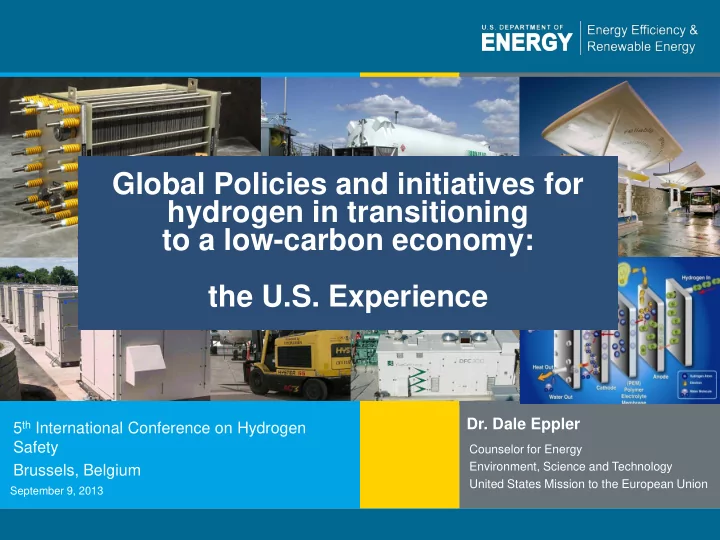
Global Policies and initiatives for hydrogen in transitioning to a low-carbon economy: the U.S. Experience Dr. Dale Eppler 5 th International Conference on Hydrogen Safety Counselor for Energy Environment, Science and Technology Brussels,


slide-1
SLIDE 1

1 | Fuel Cell Technologies Office eere.energy.gov

5th International Conference on Hydrogen Safety Brussels, Belgium

  • Dr. Dale Eppler

Counselor for Energy Environment, Science and Technology United States Mission to the European Union

September 9, 2013

Global Policies and initiatives for hydrogen in transitioning to a low-carbon economy: the U.S. Experience

slide-2
SLIDE 2

2 | Fuel Cell Technologies Office eere.energy.gov

Presidential Commitment

“We’ve got to invest in a serious, sustained, all-of-the- above energy strategy that develops every resource available for the 21st century.” – President Barack Obama

slide-3
SLIDE 3

3 | Fuel Cell Technologies Office eere.energy.gov

Transportation

  • Reduce oil imports by 1/3 by 2025

Renewable Energy and Energy Efficiency

  • By 2035, generate 80% of electricity from a diverse set of clean energy sources
  • Make non-residential buildings 20% more energy efficient by 2020

Environmental

  • Cut green house gas emissions to 17% below 2005 levels by 2020, and 83% by

2050

Federal Leadership

  • Reduce Federal Greenhouse Gas emissions by 28% by 2020

Administration’s Clean Energy Goals

slide-4
SLIDE 4

4 | Fuel Cell Technologies Office eere.energy.gov

Fuel Cells part of All-of-the-Above Energy Strategy

The President’s proposal will support research into a range of cost-effective technologies – like advanced vehicles that run on electricity, homegrown biofuels, fuel cells, and domestically produced natural gas.

slide-5
SLIDE 5

5 | Fuel Cell Technologies Office eere.energy.gov

slide-6
SLIDE 6

6 | Fuel Cell Technologies Office eere.energy.gov

EERE’s National Mission

The U.S. Department of Energy’s Office of Energy Efficiency & Renewable Energy (EERE) ‘s mission is to create American leadership in the global transition to a clean energy economy.

1) High-Impact Research, Development, and Demonstration to Make Clean

Energy as Affordable and Convenient as Traditional Forms of Energy 2) Breaking Down Barriers to Market Entry

Vehicle Technologies Office: Develops more energy efficiency and environmentally friendly highway transportation technologies that will enable America to use less petroleum. Bioenergy Technologies Office: Helps transform the nation’s renewable and abundant biomass resources into cost-competitive, high-performance biofuels, bioproducts, and biopower. Fuel Cell Technologies: Development and deployment of hydrogen and fuel cells with the ultimate goals of decreasing our dependence on oil, reducing carbon emissions, and enabling clean, reliable power generation.

slide-7
SLIDE 7

7 | Fuel Cell Technologies Office eere.energy.gov

Fuel Cells – An Emerging Global Industry

[1] http://cepgi.typepad.com/heslin_rothenberg_farley_/2013/03/clean-energy-patent-growth-index-2011-year-in-review.html

Top 10 companies for fuel cell patents: GM, Honda, Toyota, Samsung, UTC Power, Nissan, Ballard, Panasonic, Plug Power, Delphi Technologies

Source: Clean Energy Patent Growth Index

slide-8
SLIDE 8

8 | Fuel Cell Technologies Office eere.energy.gov

Fuel Cell Market Overview

Source: Navigant Research

Market Potential Independent analyses show global markets could mature over the next 10– 20 years, producing revenues of:

  • $14 – $31 billion/year for stationary

power

  • $11 billion/year for portable power
  • $18 – $97 billion/year for

transportation

For further details and sources see: DOE Hydrogen and Fuel Cells Program Plan, http://www.hydrogen.energy.gov/pdfs/program_plan2011.pdf; FuelCells 2000, Fuel Cell Today, Navigant Research

Market Growth Fuel cell markets continue to grow

  • 48% increase in global MWs

shipped

  • 62% increase in North American

systems shipped in the last year

  • 1,000

2,000 3,000 4,000 5,000 6,000 2008 2009 2010 2011 2012P

(Systems Shipped)

Fuel Cell Systems Shipped

by Application, Manufactured in North America: 2008-2012

Stationary Transportation Portable
slide-9
SLIDE 9

9 | Fuel Cell Technologies Office eere.energy.gov

DOE H2 and Fuel Cells Program Overview

The Program is an integrated effort, structured to address all the key challenges and obstacles facing widespread commercialization.

slide-10
SLIDE 10

10 | Fuel Cell Technologies Office eere.energy.gov

DOE DOE R&D R&D

  • Reduces cost and improves

performance

 Reduced cost of fuel cells 35% since 2008, 83% since 2002

Target: $30/kW

Status: $47/kW

(high vol)

DOE Program: RD&D to Deployments

DOE OE Demo emonstr nstrations tions & & Tec echn hnolog

  • logy

y Valida alidation tion

  • Validate advanced

technologies under real- world conditions

  • Feedback guides R&D

Examples—validated:

  • 59% efficiency
  • 254 mile range

(independently validated 430-mile range)

  • 75,000-mi durability

Tr Transport ansportat ation Fuel C ion Fuel Cell ell System C System Cost

  • st
  • projected to high-volume (500,000 units per year) -

Examples of progress:

Deplo Deployment yments

  • DOE Recovery Act and

Market Transformation Projects

  • Government Early

Adoption (DoD, FAA, California, etc.)

  • Tax Credits

> 1,300 fuel cells deployed

Recovery Act & Market Transformation Deployments

slide-11
SLIDE 11

11 | Fuel Cell Technologies Office eere.energy.gov

Safety, Codes and Standards

www.eere.energy.gov/hydrogenandfuelcells/codes/

slide-12
SLIDE 12

12 | Fuel Cell Technologies Office eere.energy.gov

Mission: To promote the commercial introduction and widespread adoption of FCEVs across America through creation of a public-private partnership to overcome the hurdle of establishing hydrogen infrastructure. Current partners include:

H2 USA

slide-13
SLIDE 13

13 | Fuel Cell Technologies Office eere.energy.gov

Inter Interna national tional Par artner tnership f ship for H

  • r Hydr

drogen

  • gen

and and Fuel Cells Fuel Cells in t in the Econ he Economy

  • my

International Energy Agency – Implementing Agreements

International Partnerships

  • Japan- Chair; U.S. and Germany-Vice Chairs
  • Representatives from 17 member countries & the European Commission
  • Facilitates international collaboration on RD&D and education
  • Provides a forum for advancing policies and common codes and standards
  • Guided by four priorities:
  • 1. Accelerating market penetration and early adoption of hydrogen and fuel cell technologies and their

supporting infrastructure

  • 2. Policy and regulatory actions to support widespread deployment
  • 3. Raising the profile with policy-makers and public
  • 4. Monitoring technology developments

Advanced Fuel Cells Implementing Agreement: 19 member countries currently implementing six annexes Hydrogen Implementing Agreement: 21 member countries, plus the European Commission currently implementing nine tasks

slide-14
SLIDE 14

14 | Fuel Cell Technologies Office eere.energy.gov

Continue to promote and strengthen R&D activities

– Hydrogen, fuel cells, safety, manufacturing, etc. – Cost, performance, durability need to be addressed

Conduct strategic, selective demonstrations of innovative technologies

– Industry cost share and potential to accelerate market transformation

Continue to conduct key analyses to guide RD&D and path forward

– Life cycle cost; economic & environmental analyses, etc.

Leverage activities to maximize impact

– U.S. and global partnerships – H2USA: Public-Private partnership to enable widespread commercialization

  • f hydrogen vehicles in the United States

Future Plans

slide-15
SLIDE 15

15 | Fuel Cell Technologies Office eere.energy.gov

Thank You

hydrogenandfuelcells.energy.gov