* * To review the AS AM guidelines on the treatment of opioid - - PDF document

to review the as am guidelines on the treatment of opioid
SMART_READER_LITE
LIVE PREVIEW

* * To review the AS AM guidelines on the treatment of opioid - - PDF document

APNA 30th Annual Conference Session 2035: October 20, 2016 * Jessica L. Estes, DNP , APRN-NP APNA 2016 Annual Conference * This provider has no conflicts of interest to disclose. * * To review the AS AM guidelines on the treatment of opioid


slide-1
SLIDE 1

APNA 30th Annual Conference Session 2035: October 20, 2016 Estes 1

Jessica L. Estes, DNP , APRN-NP APNA 2016 Annual Conference

*

*

*This provider has no conflicts of interest to

disclose.
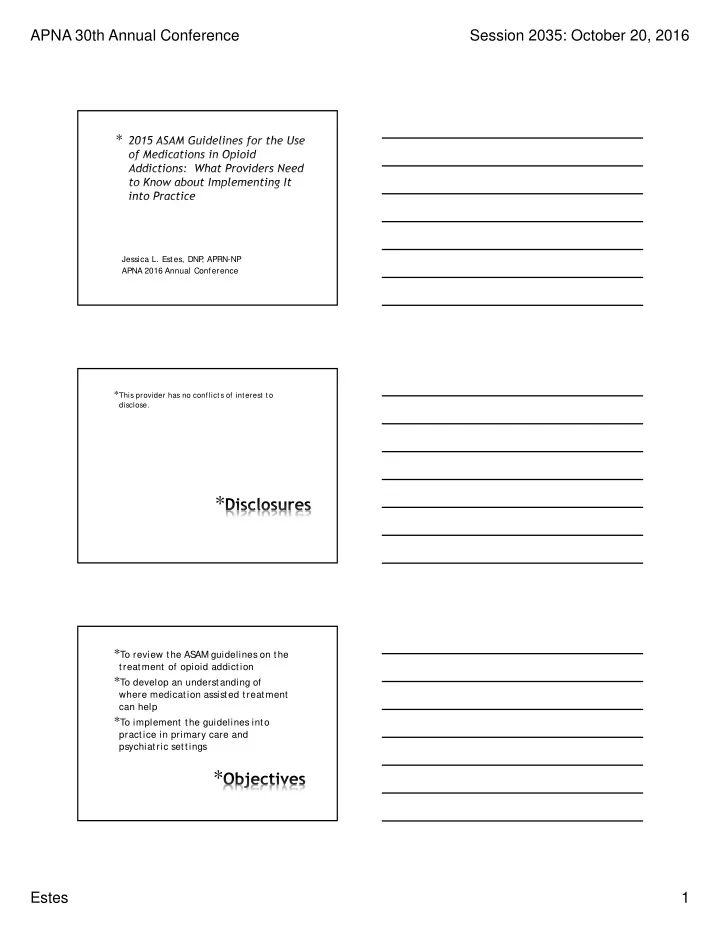
*

*To review the AS

AM guidelines on the treatment of opioid addiction

*To develop an understanding of

where medication assisted treatment can help

*To implement the guidelines into

practice in primary care and psychiatric settings

slide-2
SLIDE 2

APNA 30th Annual Conference Session 2035: October 20, 2016 Estes 2

*

*A clinical tool used to help

prescribers determine the appropriate medication treatment protocols for opioid addictions

*It’s the FIRS

T prescriber reference to include all medications used in the treatment of opioid addictions.

*

*2014 recorded the highest number of

  • verdose deaths on record

*6/ 10 of those deaths had opiates involved *78 Americans die daily from opiates *S

ince the late 1990s the number of opiate prescriptions had quadrupled

*

*Assessment of Addiction and Potential for abuse *Diagnosis of a substance use disorder meeting the

DSM V criteria

*Plan for Intervention with the patient and family *Interventions psychosocially and medication

assisted treatment

*Evaluate the effectiveness of treatment at regular

intervals

slide-3
SLIDE 3

APNA 30th Annual Conference Session 2035: October 20, 2016 Estes 3

*

*Clinical S

creening Tool

*Physical Assessment to rule out acute issue *UDT

*Point of Care vs. Confirmation

* 6, 10, or 13, panel vs. custom panels

*Psychosocial assessment *http:/ / asamcontinuum.org/

*

*WHO-DAS *Good global assessment of well-being *International standard *AUDIT *Focuses on Alcohol – but needed for

concurrent addictions

*DAS

T

*Focuses primarily on drug abuse *CAGE *Common primary screening tool that can

signal a need to look at other scales

*

*No longer substance abuse or addiction *Correct terms are

*Opioid Use Disorder *Opioid Intoxication *Opioid Withdrawal

slide-4
SLIDE 4

APNA 30th Annual Conference Session 2035: October 20, 2016 Estes 4

*

*At Least 2 of the following: *They are used in larger amounts and a longer period

than intended

*There’s a desire or persistent effort to cut down *Cravings for the substance *Recurrent use = role fulfillment failures *Continued use despite deterrents *Use that results in hazardous situations *Use despite knowledge of reliance or dependence *Withdrawal

*

*They are in remission *Early or S

ustained

*Maintenance or controlled environment *S

everity

*Mild 2-3 symptoms *Moderate 4-5 symptoms *S

evere 6+

*

*Intoxication *Recent use *Clinically significant symptoms *Withdrawal *Presence of (decrease or complete end of

long-term use) or

*Medication assisted antagonist *Three or more: changed mood, NVD, nasal

complaints, yawning, fever, insomnia

slide-5
SLIDE 5

APNA 30th Annual Conference Session 2035: October 20, 2016 Estes 5

*

*Determine treatment options: *Inpatient *Partial Hospitalization *Intensive Outpatient *Outpatient *Medication assisted therapies

*

*Clonidine *Buprenorphine *Buprenorphine and Naltrexone

*

*Naltrexone

*Oral Versus Inj ectable

*Buprenorphine *Methadone

slide-6
SLIDE 6

APNA 30th Annual Conference Session 2035: October 20, 2016 Estes 6

*

*Narcotics Anonymous *Individual Therapy

*CBT

, Trauma focused care

*Group Therapy *Legal Assistance

*

*Pregnancy *Age *Mental Health Co-morbidities *Availability of Treatment options *Detox, then partial, then intensive

  • utpatient, then outpatient, plus long-term

medications or short term

*Medicaid vs Private Insurances

*

*RANDOM *UDT or saliva *Making sure panel includes natural and

synthetic opiates

*Medication Counts *Collateral from family *Interdisciplinary Collaboration with mental

health, pain management, etc.

slide-7
SLIDE 7

APNA 30th Annual Conference Session 2035: October 20, 2016 Estes 7

*

*S

ection 303 of the Comprehensive Addiction and Recovery Act (CARA), signed into law by President Obama on July 22, 2016, made several changes to the law regarding office-based opioid addiction treatment with buprenorphine.

*One of these changes is that prescribing privileges have been

expanded to nurse practitioners (NPs) and physician assistants (P As) for five years (until October 1, 2021At the moment, there is no set date when NPs and P As will be able to apply to receive a waiver to prescribe buprenorphine. A separate application form will need to be approved by the federal government for NPs and P As to apply for a waiver to prescribe buprenorphine.

*Any NP or P

A who begins to prescribe buprenorphine before applying for and receiving a waiver will be in violation of federal law.

*For NPs and P

As to be eligible to apply for a buprenorphine waiver, they must complete 24 hours of training that covers the following topics: opioid maintenance and detoxification; clinical use of all FDA-approved drugs for medication-assisted treatment; patient assessment; treatment planning; psychosocial services; staff roles; and diversion control.

*

American Psychiatric Nurses Association. (2014). Psychiat ric Ment al Healt h Nursing: S cope and S t andards of Pract ice (2nd ed.). S ilver S pring, MD: American Nurses Association. Centers for Disease Control and Prevention. Increases in Drug and Opioid Overdose Deaths —United S tates, 2000– 2014. MMWR 2015; 64;1-5.

  • CDC. Wide-ranging online data for epidemiologic research

(WONDER). Atlanta, GA: CDC, National Center for Health S tatistics; 2016. Available at http:/ / wonder.cdc.gov. Chang H, Daubresse M, Kruszewski S , et al. Prevalence and treatment of pain in emergency departments in the United S tates, 2000 – 2010. Amer J of Emergency Med 2014; 32(5): 421-31. Daubresse M, Chang H, Yu Y , Viswanathan S , et al. Ambulatory diagnosis and treatment of nonmalignant pain in the United S tates, 2000 – 2010. Medical Care 2013; 51(10): 870-878.

*

Morrison, J. (2014). DS M-5 Made Easy: The Clinician's Guide t o Diagnosis. New Y

  • rk, NY

: The Guilford Press. Morrison, J. (2015). Diagnosis Made Easier: Principles and Techniques for Ment al Healt h Clinicians (2nd ed.). New Y

  • rk, NY

: The Guildford Press S adock, B. S . (2014). Kaplan & S adock's Pocket Handbook

  • f Psychiat ric Drug Treat ment (6th ed.). Phildelphia, P

A: Wolters Kluwer. http:/ / www.asam.org/ docs/ default-source/ practice- support/ quality-improvement/ http:/ / www.asam.org/ qualit y-practice/ guidelines-and- consensus-documents/ npg https:/ / www.guidelinecentral.com/ shop/ use-of- medications-in-the-treatment-of-addiction-involving-

  • pioid-use-guidelines-pocket-card/