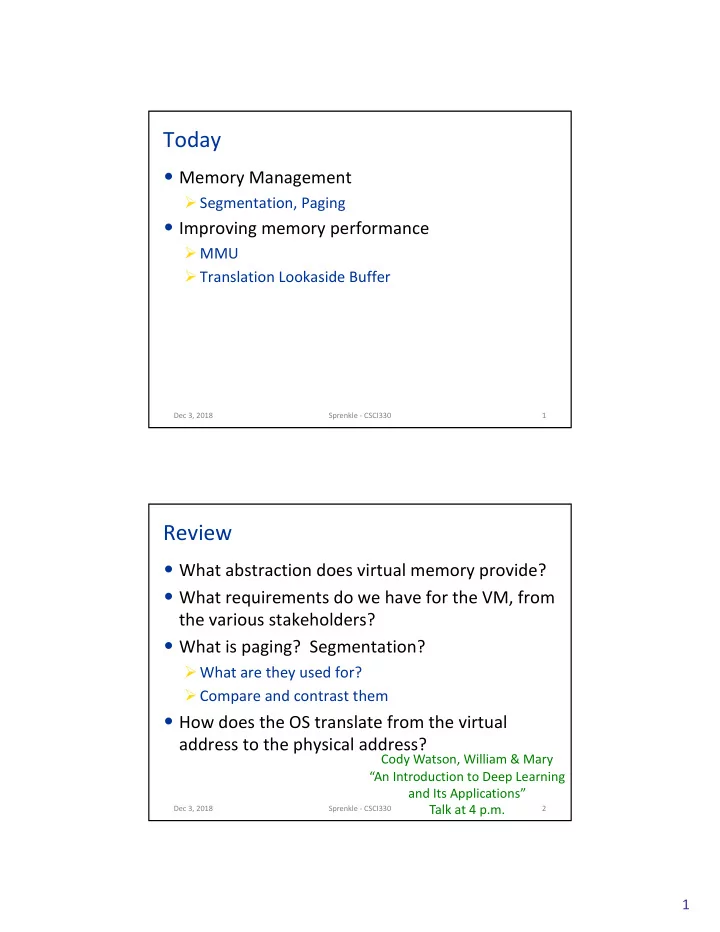
Today Memory Management Segmentation, Paging Improving memory - - PDF document

today
SMART_READER_LITE
LIVE PREVIEW

Today Memory Management Segmentation, Paging Improving memory - - PDF document

Today Memory Management Segmentation, Paging Improving memory performance MMU Translation Lookaside Buffer Dec 3, 2018 Sprenkle - CSCI330 1 Review What abstraction does virtual memory provide? What requirements do we


slide-1
SLIDE 1

1

Today

  • Memory Management

Ø Segmentation, Paging

  • Improving memory performance

Ø MMU Ø Translation Lookaside Buffer

Dec 3, 2018 Sprenkle - CSCI330 1

Review

  • What abstraction does virtual memory provide?
  • What requirements do we have for the VM, from

the various stakeholders?

  • What is paging? Segmentation?

Ø What are they used for? Ø Compare and contrast them

  • How does the OS translate from the virtual

address to the physical address?

Dec 3, 2018 Sprenkle - CSCI330 2

Cody Watson, William & Mary “An Introduction to Deep Learning and Its Applications” Talk at 4 p.m.

slide-2
SLIDE 2

2

The Big Picture: Virtual Memory

Dec 3, 2018 Sprenkle - CSCI330 3

How can the OS build the abstraction of a private, potentially large address space for multiple running processes (all sharing memory)

  • n top of a single, physical memory?

Review: Address Translation: Wish List

  • Map virtual addresses to

physical addresses

  • Allow multiple processes to

be in memory at once, but isolate them from each other

  • Determine which subset of

data to keep in memory/move to disk

  • Allow the same physical

memory to be mapped in multiple process VASes

  • Make it easier to perform

placement in a way that reduces fragmentation

Dec 3, 2018 Sprenkle - CSCI330 4

Process 1 Process 3 OS Process 2 Process 1 Text Data Stack OS Heap libc code

slide-3
SLIDE 3

3

Review: (Unrealistic) Translation Example

  • Process P2’s virtual addresses

don’t align with physical memory’s addresses

  • Consider: P2 wants to access

address 0x1000

  • Determine offset from

physical address 0 to start of P2

Ø store in base

P3 P1 P2 P2 P2max Phymax base +

Dec 3, 2018 Sprenkle - CSCI330 5

base

Review: Generalizing

  • Problem: process may not fit in
  • ne contiguous region
  • Solution: keep a table (one per

process)

Ø Keep details for each region in a row Ø Store additional metadata (ex. permissions)

  • Interesting questions:

Ø How many regions should there be (and what size)? Ø How to determine which table entry we should use?

Dec 3, 2018 Sprenkle - CSCI330 6

P2 P2max Phymax P2 P2 P2

… …

?

Perm Base R, X R R, W

slide-4
SLIDE 4

4

Review: Defining Regions

  • Segmentation:

Ø Partition address space and memory into logical segments Ø Segments have varying sizes

  • Paging:

Ø Partition address space and memory into pages Ø Pages are a constant, fixed size

Dec 3, 2018 Sprenkle - CSCI330 7

Review: Fragmentation

Internal

  • Process asks for memory,

doesn’t use it all

  • Possible reasons:

Ø Process was wrong about needs Ø OS gave it more than it asked for

  • internal: within an allocation

External

  • Over time, we end up

with small gaps that become more difficult to use

Ø eventually, wasted

  • external: unused

memory between allocations

OS Used Memory allocated to process Unused

Dec 3, 2018 Sprenkle - CSCI330 8

slide-5
SLIDE 5

5

Review: Segmentation vs. Paging

  • A segment is good logical unit of information

Ø Can be sized to fit any contents Ø Easy to share large regions (e.g., code, data) Ø Protection requirements correspond to logical data segment

  • A page is good physical unit of information

Ø Simple physical memory placement Ø No external fragmentation Ø Constant sizes make it easier for hardware to help

Dec 3, 2018 Sprenkle - CSCI330 9

Review: For Both Segmentation and Paging…

  • Each process has a table to track memory

address translations

  • When a process attempts to read/write to

memory:

Ø use high order bits of virtual address to determine which row to look at in the table Ø use low order bits of virtual address to determine an

  • ffset within the physical region

Dec 3, 2018 Sprenkle - CSCI330 10

slide-6
SLIDE 6

6

Review: Performance Implications

Virtual Address

Upper bits Lower bits

Physical Address Phy Loc Meta Perm … Physical Memory Table

Dec 3, 2018 Sprenkle - CSCI330 11

Which row? Offset into region Without VM: Go directly to address in memory With VM: Do a lookup in memory to determine which address to use

Concept: level of indirection

Defining Regions - Two Approaches

  • Segmentation:

Ø Partition address space and memory into logical segments Ø Segments have varying sizes

  • Paging:

Ø Partition address space and memory into pages Ø Pages are a constant, fixed size

Dec 3, 2018 Sprenkle - CSCI330 12

slide-7
SLIDE 7

7

Segment Table

  • One table per process
  • Where is the table located in

memory?

Ø Segment table base register (STBR) Ø Segment table size register (STSR)

  • Table entries: Segment metadata

Ø V: valid bit

  • does it contain a mapping?

Ø Base: segment location in physical memory Ø Bound: segment size in physical memory Ø Permissions

Bound Base V Perm …

STBR STSR

Dec 3, 2018 Sprenkle - CSCI330 13

Segment Address Translation

  • Physical address:

base of s + i

Virtual Address

Segment s … Offset i Physical Address

Dec 3, 2018 Sprenkle - CSCI330 14

slide-8
SLIDE 8

8

Check if Segment s is within Range

Dec 3, 2018 Sprenkle - CSCI330 15

Virtual Address

Segment s … Offset i Physical Address STBR STSR

s < STSR

Check if Segment Entry s is Valid

Dec 3, 2018 Sprenkle - CSCI330 16

Virtual Address

Segment s … Offset i Physical Address STBR STSR

V == 1

slide-9
SLIDE 9

9

Check if Offset i is within Bounds

Dec 3, 2018 Sprenkle - CSCI330 17

Virtual Address

Segment s … Offset i Physical Address STBR STSR

i < Bound

Check Permissions

Dec 3, 2018 Sprenkle - CSCI330 18

Virtual Address

Segment s … Offset i Physical Address STBR STSR

Perm?

slide-10
SLIDE 10

10

Translate Address

Dec 3, 2018 Sprenkle - CSCI330 19

Virtual Address

Segment s … Offset i Physical Address STBR STSR

+

Pros and Cons of Segmentation

Pros Cons

Dec 3, 2018 Sprenkle - CSCI330 20

slide-11
SLIDE 11

11

Pros and Cons of Segmentation

Pros

  • Each segment can be

Ø located independently Ø separately protected Ø grown/shrunk independently

  • Small segment table size

Ø ~256 Bytes à 1GB memory

Cons

  • Variable-size allocation

Ø Difficult to find holes in physical memory Ø External fragmentation

Dec 3, 2018 Sprenkle - CSCI330 21

Defining Regions - Two Approaches

  • Segmentation:

Ø Partition address space and memory into logical segments Ø Segments have varying sizes

  • Paging:

Ø Partition address space and memory into pages Ø Pages are a constant, fixed size

Dec 3, 2018 Sprenkle - CSCI330 22

slide-12
SLIDE 12

12

Paging Terminology

  • For each process, the virtual address space is

divided into fixed-size pages

  • For the system, the physical memory is divided

into fixed-size frames

  • The size of a page is equal to that of a frame

Ø Often 4 KB in practice Ø Some CPUs allow for small and large pages at the same time

Dec 3, 2018 Sprenkle - CSCI330 23

Page Table

  • One table per process
  • Table parameters in memory

Ø Page table base register Ø Page table size register

  • Table elements: Page metadata

Ø V: valid bit Ø R: referenced bit Ø D: dirty bit

  • If page has been modified

Ø Frame: location in physical memory Ø Perm: access permissions

Dec 3, 2018 Sprenkle - CSCI330 24

PTBR PTSR

V R D Frame Perm …

slide-13
SLIDE 13

13

Paging Address Translation

  • Physical address =

frame of p + offset i Virtual Address

Page p Offset i

Physical Address

Dec 3, 2018 Sprenkle - CSCI330 25

V R D Frame Perm …

Why do we just need the frame number, rather than the location?

Paging Address Translation

  • Physical address =

frame of p + offset i Virtual Address

Page p Offset i

Physical Address

Dec 3, 2018 Sprenkle - CSCI330 26

V R D Frame Perm …

Frames are all the same size Only need to store the frame number in the table, not exact address!

slide-14
SLIDE 14

14

Check if Page p is Within Range

Dec 3, 2018 Sprenkle - CSCI330 27

Virtual Address

Page p Offset i

Physical Address V R D Frame Perm … PTBR PTSR

p < PTSR

Check if Page Table Entry p is Valid

Dec 3, 2018 Sprenkle - CSCI330 28

Virtual Address

Page p Offset i

Physical Address V R D Frame Perm … PTBR PTSR

V == 1

slide-15
SLIDE 15

15

Check if Operation is Permitted

Dec 3, 2018 Sprenkle - CSCI330 29

Virtual Address

Page p Offset i

Physical Address V R D Frame Perm … PTBR PTSR

Perm?

Translate Address

Dec 3, 2018 Sprenkle - CSCI330 30

Virtual Address

Page p Offset i

Physical Address V R D Frame Perm … PTBR PTSR

concat

slide-16
SLIDE 16

16

Physical Address by Concatenation

Dec 3, 2018 Sprenkle - CSCI330 31

Virtual Address

Page p Offset i

Physical Address V R D Frame Perm … PTBR PTSR

concat

Physical Address by Concatenation

Dec 3, 2018 Sprenkle - CSCI330 32

Virtual Address

Page p Offset i

Physical Address V R D Frame Perm … PTBR PTSR

concat

Frame f Offset i

slide-17
SLIDE 17

17

Pros and Cons of Paging

Pros Cons

Dec 3, 2018 Sprenkle - CSCI330 33

Pros and Cons of Paging

Pros

  • Each page can be

Ø located independently Ø separately protected

  • Fixed-size pages and frames

Ø No external fragmentation Ø No difficult placement decisions

Cons

  • Large table size

Ø ~4MB for 1GB of memory

  • That’s for each process!
  • maybe internal

fragmentation

Dec 3, 2018 Sprenkle - CSCI330 34

slide-18
SLIDE 18

18

Hybrid Approach: Paged Segmentation – x86

  • Design:

Ø Multiple lookups: first in segment table, which points to a page table Ø Extra level of indirection

  • Reality:

Ø All segments are max physical memory size Ø Segments effectively unused, available for “legacy” reasons Ø (Mostly) disappeared in x86-64

VM PM

Page Tables Segment Table

Outstanding Problems

  • Mostly considering paging from here on

1.Page tables are way too big

Ø Most processes don’t need that many pages Ø Can’t justify a huge table

2.Adding indirection hurts performance

Ø Accessing memory to access memory…

Dec 3, 2018 Sprenkle - CSCI330 36

slide-19
SLIDE 19

19

Challenge: Large Page Tables

  • Most processes don’t need that many pages

Ø Can’t justify a huge table for every process

  • What can we do so that our page table scales

with the amount of memory we need?

Ø What problem does this sound like?

Dec 3, 2018 Sprenkle - CSCI330 37

Solution: MORE indirection!

V R D Frame …

Multi-Level Page Tables

Virtual Address

1st-level Page d Offset i 2nd-level Page p

Points to (base) frame containing 2nd-level page table

concat

Physical Address

Dec 3, 2018 Sprenkle - CSCI330 38

V R D Frame …

slide-20
SLIDE 20

20

V R D Frame …

Multi-Level Page Tables

Virtual Address

1st-level Page d Offset i 2nd-level Page p

Points to (base) frame containing 2nd-level page table

concat

Physical Address

Insight: VAS is typically sparsely populated Idea: every process gets a page directory

  • 1st-level table

Only allocate 2nd-level tables when the process is using that VAS region!

Dec 3, 2018 Sprenkle - CSCI330 39

V R D Frame …

Multi-Level Page Tables

Text Data Stack OS Heap

V R D Frame …

Virtual Address

1st-level Page d Offset i 2nd-level Page p

Points to (base) frame containing 2nd-level page table

concat

Physical Address

V R D Frame …

Dec 3, 2018 Sprenkle - CSCI330 40

slide-21
SLIDE 21

21

Multi-Level Page Tables

  • With only a single level, the page table must be

large enough for the largest processes

  • Multi-level table à extra level of indirection:

Ø WORSE performance – more memory accesses Ø Much better memory efficiency – process’s page table is proportional to how much of the VAS it’s using

  • Small process à low page table storage
  • Large process à high page table storage, needed

it anyway

Dec 3, 2018 Sprenkle - CSCI330 41

Challenge: Translation Cost

  • Each application [logical] memory access now

requires multiple memory accesses!

  • Suppose a memory access takes 100 ns

Ø one-level paging: 200 ns Ø two-level paging: 300 ns

  • Solution: Add hardware, take advantage of

locality…

Ø Most references are to a small number of pages Ø Keep translations of these in high-speed memory

Dec 3, 2018 Sprenkle - CSCI330 42

slide-22
SLIDE 22

22

Memory Management Unit (MMU)

  • When a process tries to

use memory, send the address to MMU

  • MMU will do as much

work as it can

Ø If it knows the answer, great!

  • If it doesn’t

Ø trigger exception (OS gets control) Ø consult software table

Dec 3, 2018 Sprenkle - CSCI330 43

Process 1 Process 3 OS Process 2 Process 1 Text Data Stack OS Heap libc code

Combination of hardware and OS, working together In hardware, MMU: Memory Management Unit

Translation Look-aside Buffer (TLB)

  • Fast memory mapping cache inside MMU keeps

most recent translations

Ø If key matches, get frame number quickly Ø Otherwise, wait for normal translation

  • Add to TLB

“key” Page p or [page d, page p] or [segment s, page p] Offset i

Match key

frame Frame f Offset i

Dec 3, 2018 Sprenkle - CSCI330 44

Higher order bits

Parallel check

slide-23
SLIDE 23

23

Recall: Context Switching Performance

  • Even though it’s fast, context switching is

expensive:

  • 1. time spent is 100% overhead
  • 2. must invalidate other processes’ resources (caches,

memory mappings)

  • 3. kernel must execute – it must be accessible in

memory

  • Also recall: Advantage of threads

Ø Threads all share one process VAS

Dec 3, 2018 Sprenkle - CSCI330 45

Text Data Stack OS Heap

Translation Cost with TLB

  • Cost is determined by

Ø Speed of memory: ~100 nsec Ø Speed of TLB: ~10 nsec Ø Hit ratio: fraction of memory references satisfied by TLB, ~95%

  • Speed to access memory with address

translation (2-level paging):

Ø TLB miss: 300 nsec (200% slowdown) Ø TLB hit: 110 nsec (10% slowdown) Ø Average: 110 x 0.95 + 300 x 0.05 = 119.5 nsec

Dec 3, 2018 Sprenkle - CSCI330 46

slide-24
SLIDE 24

24

TLB Design Issues

  • The larger the TLB…

Ø the higher the hit rate Ø the slower the response Ø the greater the expense Ø the larger the space (in MMU, on chip)

  • TLB has a major effect on performance!

Ø Must be flushed on context switches Ø Alternative: tagging entries with PIDs

Dec 3, 2018 Sprenkle - CSCI330 47

Virtual Addressing: Under the Hood

raise exception probe page table load TLB probe TLB access physical memory access valid? page fault?

kill

(lookup and/or) allocate frame page

  • n

disk? fetch from disk zero-fill load TLB

start here

MMU

OS

illegal reference legal reference

yes no (first reference) yes no miss hit

Dec 3, 2018 Sprenkle - CSCI330 48

NEXT!

slide-25
SLIDE 25

25

Summary

  • Many options for translation mechanism:

segmentation, paging, hybrid, multi-level paging

Ø All of them: level(s) of indirection

  • Simplicity of paging makes it most common

today

  • Multi-level page tables improve memory

efficiency

Ø page table bookkeeping scales with process VAS usage

  • TLB in hardware MMU exploits locality to

improve performance

Dec 3, 2018 Sprenkle - CSCI330 49

Looking Ahead

  • Project 5 due Friday

Dec 3, 2018 Sprenkle - CSCI330 50