Today 1. Add top-level function defines to the Book language not in - - PowerPoint PPT Presentation

today
SMART_READER_LITE
LIVE PREVIEW

Today 1. Add top-level function defines to the Book language not in - - PowerPoint PPT Presentation

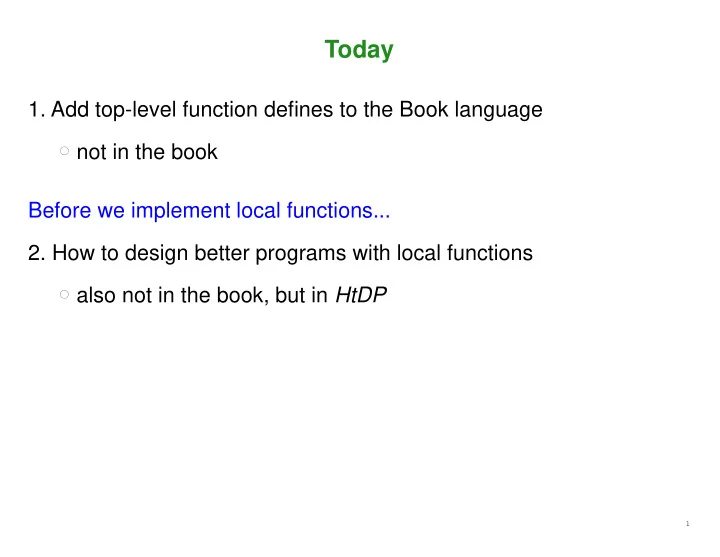
Today 1. Add top-level function defines to the Book language not in the book Before we implement local functions... 2. How to design better programs with local functions also not in the book, but in HtDP 1 Top-Level Procedure Definitions


slide-1
SLIDE 1

Today

  • 1. Add top-level function defines to the Book language

not in the book Before we implement local functions...

  • 2. How to design better programs with local functions

also not in the book, but in HtDP

1

slide-2
SLIDE 2

Top-Level Procedure Definitions

Concrete syntax: <prog> ::= { <id> <funcdef> } * in <expr> <funcdef> ::= (<id>*) = <expr> <expr> ::= (<id> <expr>*) identity(x) = x in (identity 7)

2-3

slide-3
SLIDE 3

Top-Level Procedure Definitions

Concrete syntax: <prog> ::= { <id> <funcdef> } * in <expr> <funcdef> ::= (<id>*) = <expr> <expr> ::= (<id> <expr>*) fact(n) = if n then *(n, (fact -(n, 1))) else 1 identity(x) = x in (identity (fact 10))

4

slide-4
SLIDE 4

Top-Level Procedure Definitions

Abstract syntax: <prog> ::= (a-program (list <id>*) (list <funcdef>*) <expr>) <funcdef> ::= (a-funcdef (list <id>*) <expr>) <expr> ::= (app-exp <id> (list <expr>*))

  • When evaluating a procedure application, we'll need a way to find a

defined procedure Use an environment (so we have two: local and top-level)

5-7

slide-5
SLIDE 5

Implementing Top-Level Procedure Definitions

(implement in DrScheme)

8

slide-6
SLIDE 6

How to Design Better Programs

Let's open an aquarium

  • At first, we only care about the weight of each fish
  • Represent a fish as a number
  • Represent the aquarium as a list of numbers
  • Functions include big, which takes an aquarium and returns only

the fish bigger than 5 pounds

9

slide-7
SLIDE 7

Aquarium Functions

Start with a template (generic): ;; lon-function : <list-of-num> → <????> (define (lon-function l) (cond [(null? l) ...] [(pair? l) ... (car l) ... (lon-function (cdr l)) ...]))

10

slide-8
SLIDE 8

Getting the Big Fish

;; big : <l-o-n> → <l-o-n> (define (big l) (cond [(null? l) '()] [(pair? l) (cond [(> (car l) 5) (cons (car l) (big (cdr l)))] [else (big (cdr l))])])) (big '(2 4 10)) → '(10)

11-12

slide-9
SLIDE 9

Getting the Small Fish

;; small : <l-o-n> → <l-o-n> (define (small l) (cond [(null? l) '()] [(pair? l) (cond [(< (car l) 5) (cons (car l) (small (cdr l)))] [else (small (cdr l))])]))

  • Tiny changes to big, so cut-and-paste old code?

13-14

slide-10
SLIDE 10

A Note on Cut and Paste

When you cut and paste code, you cut and paste bugs Avoid cut-and-paste whenever possible!

  • Alternative to cut and paste: abstraction

15-16

slide-11
SLIDE 11

Filtering Fish

;; filter-fish : (<num> <num> → <bool>) <l-o-n> → <l-o-n> (define (filter-fish OP l) (cond [(null? l) '()] [(pair? l) (cond [(OP (car l) 5) (cons (car l) (filter-fish OP (cdr l)))] [else (filter-fish OP (cdr l))])])) (define (big l) (filter-fish > l)) (define (small l) (filter-fish < l))

17-19

slide-12
SLIDE 12

More Filters

  • Medium fish?

No problem: (define (medium l) (filter-fish = l))

20-21

slide-13
SLIDE 13

More Filters

  • How about fish that are roughly medium, between 4 and 6 pounds?

close-to : <num> <num> → <bool> (define (close-to n m) (and (>= n (- m 1)) (<= n (+ m 1))) (define (roughly-medium l) (filter-fish close-to l)) Remember: function names are values! Note the contract for close-to

22-24

slide-14
SLIDE 14

More Filters

  • How about 2-pound fish?

Abstract filter-fish with respect to the number 5? ;; filter-fish : ... <num> <l-o-n> → <l-o-n> (define (filter-fish OP N l) (cond [(null? l) '()] [(pair? l) (cond [(OP (car l) N) (cons (car l) (filter-fish OP N (cdr l)))] [else (filter-fish OP N (cdr l))])]))

25-26

slide-15
SLIDE 15

More Filters

  • How about 2-pound fish?

Abstract filter-fish with respect to the number 5?

  • How about fish that are either 2 pounds or 4 pounds?

Actually, we can write either of those already: (define (size-2-or-4 n m) (or (= n 2) (= n 4)) ; ignores m (define (2-or-4-fish l) (filter-fish size-2-or-4 l)) This suggests a simplification of filter-fish

27-29

slide-16
SLIDE 16

Filter

;; filter : (<num> → <bool>) <l-o-n> → <l-o-n> (define (filter PRED l) (cond [(null? l) '()] [(pair? l) (cond [(PRED (car l)) (cons (car l) (filter PRED (cdr l)))] [else (filter PRED (cdr l))])])) (define (greater-than-5 n) (> n 5)) (define (big l) (filter greater-than-5 l))

30-31

slide-17
SLIDE 17

Local Helpers

Since only big needs to use greater-than-5, make it local: (define (big l) (let ([greater-than-5 (lambda (n) (> n 5))]) (filter greater-than-5 l))

  • Suppose we move to Texas, where "big" means more than 10

pounds (define (texas-big l) (let ([greater-than-10 (lambda (n) (> n 10))]) (filter greater-than-10 l)) More cut-and-paste?!

32-34

slide-18
SLIDE 18

Abstraction over Local Functions

(define (relatively-big l m) (let ([greater-than-m (lambda (n) (> n m))]) (filter greater-than-m l)) (define (big l) (relatively-big l 5)) (define (texas-big l) (relatively-big l 10)) (big '(2 4 8 11)) = '(8 11) (texas-big '(2 4 8 11)) = '(11) How does that work?

35-37

slide-19
SLIDE 19

Evaluation with Local Functions

(define (rel-big l m) (let ([gt-m (λ (n) (> n m))]) (filter gt-m l)) (define (big l) (rel-big l 5)) (big '(2 4 8)) → (define (rel-big l m) (let ([gt-m (λ (n) (> n m))]) (filter gt-m l)) (define (big l) (rel-big l 5)) (rel-big '(2 4 8) 5)

38

slide-20
SLIDE 20

Evaluation with Local Functions

(define (rel-big l m) (let ([gt-m (λ (n) (> n m))]) (filter gt-m l)) (define (big l) (rel-big l 5)) (rel-big '(2 4 8) 5) → (define (rel-big l m) (let ([gt-m (λ (n) (> n m))]) (filter gt-m l)) (define (big l) (rel-big l 5)) (let ([gt-m (λ (n) (> n 5))]) (filter gt-m '(2 4 8))

39

slide-21
SLIDE 21

Evaluation with Local Functions

(define (rel-big l m) (let ([gt-m (λ (n) (> n m))]) (filter gt-m l)) (define (big l) (rel-big l 5)) (let ([gt-m (λ (n) (> n 5))]) (filter gt-m '(2 4 8)) → (define (rel-big l m) (let ([gt-m (λ (n) (> n m))]) (filter gt-m l)) (define (big l) (rel-big l 5)) (define (gt-m98 n) (> n 5)))) (filter gt-m98 '(2 4 8)) Every time we call rel-big we get a brand-new gt-m

40-41

slide-22
SLIDE 22

Filter and Map

  • A function like filter is so useful that it's usually built in

But not in the EoPL langugae, unfortunately

  • Here's one that's even more useful (and is built in):

;; map : (<num> → <num>) <list-of-num> → <list-of-num> (define (map F l) (cond [(null? l) '()] [else (cons (F (car l)) (map F (cdr l)))])) (map add1 '(1 2 3)) = '(2 3 4)

42-43

slide-23
SLIDE 23

Map, More Generally

Actually, map is more general ;; map : (X → Y) list-of-X → list-of-Y (map even? '(1 2 3)) = '(#f #t #f) (map car '((1 2) (3 4) (5 6))) = '(1 3 5) Actually, map is more general! ;; map : (X1 ... Xn → Y) l-o-X1 ... l-o-Xn → l-o-Y (map + '(1 2 3) '(4 5 6)) = '(5 7 9) (map cons '(1 2 3) '(#f #f #t)) = '((1 . #f) (2 . #f) (3 . #t))

44-45

slide-24
SLIDE 24

Closing Thought

Why must functions always have a name?

46