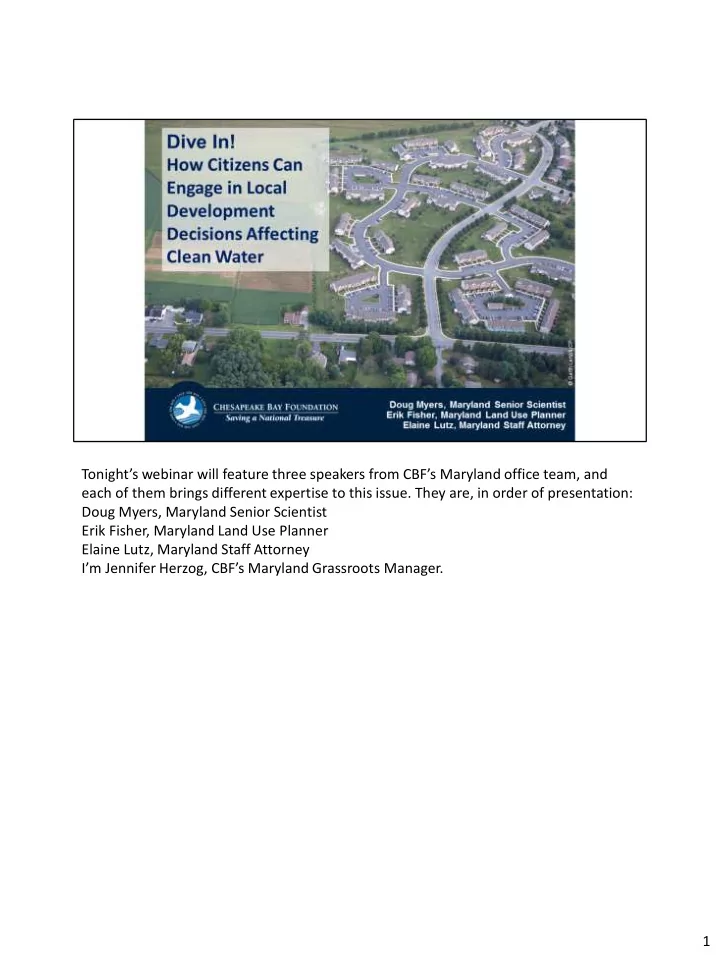
SLIDE 1
Tonight’s webinar will feature three speakers from CBF’s Maryland office team, and each of them brings different expertise to this issue. They are, in order of presentation: Doug Myers, Maryland Senior Scientist Erik Fisher, Maryland Land Use Planner Elaine Lutz, Maryland Staff Attorney I’m Jennifer Herzog, CBF’s Maryland Grassroots Manager. 1
SLIDE 2
We will cover several topics related to this issue this evening. These will include the impacts of development on water quality, considerations for why, when, and how you as citizens could engage in this issue, as well as some guidelines and advice for how you can be most effective in your efforts. I want to stress that this is an OVERVIEW – we can’t possibly cover everything you want or need to know in an hour. This is meant to provide you with a basic foundation and context for beginning to work on these issues. We will be following up with you after the webinar with a lot of additional, detailed resources. Now, I’d like to turn this over to Doug Myers, CBF’s Maryland Senior Scientist.
SLIDE 3 The condition of the upland landscape determines the health of streams, lakes and the Chesapeake Bay no matter how far those water bodies are away from land disturbance. This portion of the presentation will focus on explaining the natural processes that promote and maintain good water quality at both the site and landscape scale and the mechanisms of degradation as land becomes
- developed. Understanding these concepts will make you a better advocate for
your local water body and the Bay.
SLIDE 4 This simplified graphic is useful in describing the overall effect of developing the landscape on water. It is important to stress that both the speed of flow and the quality of what is flowing are affected by hardening the landscape. Much of the damage from over-development occurs from the erosive effects of increased flow in streams near the development. Natural processes of native landscapes
- Storage of raindrops in forest canopy
- Absorption of rainfall by forest “duff”
- Infiltration and treatment of water by forest soils, bacteria and fungi
- Uptake of water and nutrients by plants for growth
- Evapotranspiration
- Recharge of groundwater
- Support of stream interflow (springs and seeps)
- Attenuation of water flows, temperature and pollution from storms
- Fish and wildlife habitat support
aka (delivery and routing of sediments, wood and heat)
SLIDE 5
According to Chesapeake Bay Model simulations, significant progress has been made reducing nitrogen loads from agriculture and wastewater treatment plants. This is mostly through state and federal cost-shared agricultural best management practices and the state Bay Restoration Fund, which pays for wastewater treatment plant upgrades to enhanced nutrient removal technology (ENR). As you can see, however, the loads from urban runoff and septics continue to rise, shining a light on our need to control land development.
SLIDE 6
6 By far, the biggest problem for the Chesapeake Bay is the amount of pollution being dumped into it every single day. Heavy loads of nitrogen, phosphorus, and sediment pollution keep the Bay listed as “impaired” under the federal Clean Water Act. The Bay also suffers from mercury, PCB, bacteria, and other pollutants. The largest source of pollution to the Bay comes from agricultural runoff, which contributes roughly 40 percent of the nitrogen entering the Chesapeake Bay. Despite pollution-reduction efforts across sources, stormwater runoff is the only major category of nitrogen pollution that is still growing (pollution from septic systems, a smaller source, is also growing). Agriculture is the largest source of pollution that we still have to tackle on an appropriate scale, but the combined effects of urbanization (to the right of the red line) are a larger source when considered together. The Bay can never be saved if we don’t reduce the amount of pollution coming in from excess nitrogen, phosphorous and suspended sediment.
SLIDE 7 On the right side, we can see the runoff generated by a single cleared construction site. Without proper stabilization with grass, straw or gravel, mud pollution from this site during its construction can be more damaging than pollution that site will generate for the rest of its life. On the left, imagine the scale of mud pollution from a site of this size to local tributaries of the Patuxent River on any given rainy day. Sediment particles also contain attached phosphorus molecules. Not only will the suspended sediment choke fish gills and smother invertebrates and vegetation in the stream, but the phosphorus that will get released downstream from there can fuel up to 10 separate phytoplankton blooms in the Patuxent sucking dissolved oxygen out of the
- water. The compaction of the soil from heavy construction equipment removes
air spaces necessary for proper soil function including the storage and filtration
- f rainwater. A recently constructed home site while green looking at the surface
is just as impermeable as concrete. Proper post-construction management should include stockpiling the topsoil before construction and re-incorporating it with compost to remediate the effects of soil compaction.
SLIDE 8
There are a number of “Forest Interior Dwelling Species” (FIDS) that reside in Maryland’s remnant deep forests. Over 25 species of hawks, owls and neotropical migrant bird species require large patches of intact forest to survive. As these patches get smaller and further apart, these birds are doomed. The landscaped lawns and parks that remain favor species that are better adapted to human presence, some of which directly prey upon or steal nesting sites from the FIDS. Forest retention within the development footprint requires increasing density of lots, clustering development to one part of the property and maintaining intact forest reserves. Replanting disturbed areas, while important will take decades to replace the functions lost from a native mature forest. Impervious surfaces that replace forest cover have a devastating effect on nearby streams.
SLIDE 9
Once the site has been developed, the increased volume and speed at which the water travels can pick up oils and greases from vehicles, bacteria from wildlife and pet waste, and leaves and trash that will clog storm drains causing street flooding. Proper engineering design that includes infiltration basins, amended soils, adequate tree cover, constructed wetlands and other “Environmental Site Design” features is necessary to approximate the “woods in good condition” that likely occupied the site prior to development.
SLIDE 10 Science from throughout the US confirms that biological impairment of streams begins to occur once the watershed approaches 3% imperviousness. Sensitive stream invertebrates, amphibians and trout, which require clean, cold water are stressed or disappear. Above 10% imperviousness at the watershed scale, biological function of the stream is impaired and will not likely recover. The map above shows imperviousness in red and the highlighted watersheds that are impaired because of it. Interestingly, the impaired sections of the Middle and Lower Patuxent are as a result of upstream imperviousness from the Upper Patuxent even though the Middle and Lower segments are well below 10%
- imperviousness. This illustrates that once the hydrology (the way water flows
through a stream system) is altered, the effects propagate downstream far from the initial impact.
SLIDE 11
Looked at another way, current Chesapeake Bay Model outputs suggest conversion of farmland to development has a net water quality benefit. However, the conversion of farm land for development not only removes acreage on which food can be grown, but also removes options for restoration in the future. One of the ways urban centers may reach their pollution reduction goals to save the Bay is by negotiating trades of water quality credits with the nearby agriculture sector where pound for pound pollutant load reductions are significantly less expensive. Converting farmland back to forest is the single most effective practice in reducing overall nitrogen, phosphorus and sediment loads to local streams and the bay.
SLIDE 12
These scenarios are presented as a simplified illustration of the pollutant loads associated with development. True land use loading values and post- construction pollutant loads are much more site specific and give credit for certain development patterns, stormwater treatment designs and other best management practices. Citizen engagement to require disclosure of load change calculations is necessary to keep local governments and the state accountable to the Watershed Implementation Plan. The next section of the presentation will describe ways you can insert yourself into the land use decision making framework to help save the bay.
SLIDE 13
SLIDE 14 Thirty years later, developed land covers a substantially increased share of the
- landscape. During this time, the rate of land consumption increased faster than
the rate of population growth. This is “sprawl,” and results in greater impacts per capita on water quality than more compact forms of growth.
SLIDE 15 The Maryland Department of Planning maintains growth forecasting tools, which account for variables such as population growth and local development regulations in projecting the location and extent of new development in future
- years. This graphic is representative of a “business as usual” scenario, if recent
trends remain unchanged into the future.
SLIDE 16 The same increase in population could have much less of an impact on the environment and water quality if Smart Growth principles are followed. Smart Growth strategies include:
- Focused state and regional investments to improve existing infrastructure
- Tax credits and simplified codes to encourage reinvestment and
neighborhood revitalization
- Local land use policies and zoning that discourage sprawl development
The state and many local governments are taking steps to implement smart growth strategies. The Sustainable Communities tax credit program has long been an important fiscal incentive for revitalization. Now, under a law passed in 2012, local jurisdictions are working with the state to adopt “Tier Maps” for growth that focus development in appropriate areas, while conserving important farm and forest lands. More information about Tier Maps can be found in the resources packet accompanying this presentation.
SLIDE 17
Doug has explained the impacts of growth on water quality, and we’ve seen how business as usual – or a concerted effort to do things differently – could have far-ranging impacts on our water quality and quality of life. The remainder of this presentation is focused on how to build and maintain a strong position for success influencing development in your community.
SLIDE 18 The ability to make rules about development activity is an exercise of police power by government to protect the health, safety and welfare of its citizens. Maryland delegates this authority to its local governments. The state sets expectations for the process (and in some cases, big-picture outcomes) of planning, zoning and development review. Within this framework, local governments decide the “what,” “where,” and “when.” The state sets the ground rules, but the action happens – and almost all decisions are made – at the LOCAL LEVEL. (Examples of ground rules about process include public hearings, consistency requirements between comprehensive plans and implementing ordinances, and an expectation that local governments set goals for land preservation and growth within targeted areas. Examples of state expectations for planning
- utcomes are fewer, but are just as critical to achieving the state’s 12 Visions.
Tier mapping is one example. So is the expectation that local governments will work to match up land use plans with TMDL targets for polluted runoff and septic systems through the Water Resources Element.)
SLIDE 19
What ultimately gets built (or re-built) on a site is the product of an extensive management process. It is critical to align your interests with the steps in this process. Generally, the community’s discretion becomes more focused - and your scope of influence becomes narrower - as the conversation about development moves down the ladder, from comprehensive planning, to zoning, to site plan review. This does not mean that the later steps are less important, but it does mean that the general parameters of a development proposal become more firm. Let’s look at this in more detail.
SLIDE 20
The Comprehensive Plan is the place to talk about vision, values, and the major land use and infrastructure strategies that will implement them. Regional growth patterns, roadway expansions, preservation areas, and drinking water protection are examples of policies on the table at this stage. In the example above, residents in the light green area can expect agricultural and other “working lands” activities to continue to dominate the landscape. Citizens living in the yellow and orange areas should expect development activity, provided it is compatible with the existing community and infrastructure is adequate. You probably won’t see a sign along the roadside when a comprehensive plan is up for review. Watch the newspaper, your mail, and the county or municipality’s website for announcements. You can usually subscribe to a list serve for updates.
SLIDE 21 Charles County’s latest comprehensive planning process is a great success story, and a good example of how intervention at the beginning of the land development process can have a major positive impact on the future of a
- community. Mattawoman Creek, which drains the northwestern portion of the
county, is one of the healthiest tributaries on Maryland’s Western Shore, supporting a premiere bass fishery. During the drafting process, the County’s Planning Commission recommended that vast undeveloped areas of the county should be marked for development (encompassed within orange and yellow areas). After extensive public involvement, the county’s Board of Commissioners voted for a much better map, restoring protections for most of the county’s farms and forests (next slide). 21
SLIDE 22
Think of how much time, energy, money and frustration this map saved community members concerned about poorly planned growth! 22
SLIDE 23
The Maryland Department of Planning maintains an archive of adopted local comprehensive plans. You should also be able to find the plan, and any supporting local area studies, plans, and reports on your local jurisdiction’s website.
SLIDE 24 Zoning is the cornerstone of local law that controls the attributes of development, such as permitted uses and densities. Under Maryland law, zoning must be consistent with the comprehensive plan. Zoning is more specific than comprehensive plans, and sets substantial expectations for development that courts usually affirm (both for landowners/developers and the community). Generally, there are three scenarios where a local government can approve a re-zoning:
- 1. To implement a comprehensive plan: either to match local zoning with
designated land uses, or to implement a “Planned Unit Development” floating zone.
- 2. If there has been a change in the character of a neighborhood that warrants
new rules.
- 3. If there was a mistake in the original zoning.
Properties up for re-zoning are usually required to be posted, and adjoining property owners notified by mail.
SLIDE 25
Some local jurisdictions make zoning maps available on their websites. Others require a trip to the Planning & Zoning office.
SLIDE 26
Site and subdivision plans serve to implement the zoning on a given property. At this stage, the focus is squarely on “making it work.” There is still discretion – and Elaine will talk more about this – but the discretion is exercised within the parameters of the zoning: less “how many houses,” and more “where on the property should the houses be located?”. Less “should we develop this forested property,” and more “how much and which part of the forest can we preserve?”
SLIDE 27 Some jurisdictions post a list of development projects currently under review on the internet. A directory of these links (by county) is included in your resource
- packet. The agendas for your local Planning Commission and Board of Zoning
Appeals are another good source of information. These meetings usually follow a regular schedule – bookmark the site and set a recurring calendar reminder!
SLIDE 28
SLIDE 29
There are a variety of ways you can engage on development-related issues: one is by advocating to help create laws that influence development. In essence, this helps to create the rules of the game and make them work more effectively for clean water. You can work to ensure that specific laws and regulations meant to protect and restore clean water are well-applied. You can try to influence a specific proposed development in every aspect. Or, you can also work at a broader level to educate your neighbors and influence how development is perceived and understood in your community, or to urge local government to use its discretion to do a better job of protecting clean water and natural capital in the face of inappropriate development proposals in your community.
SLIDE 30 These environmental laws and associated regulations come into play once you are on the site-specific, project-specific phase of development. The applicability
- f some laws like the Critical Area Act and Forest Conservation Act will depend
- n the specific location and zoning of the project site. Others, like the
Stormwater Management Act of 2007 and the Erosion and Sediment Control laws, are supposed to apply to all projects. The environmental protections of those laws will depend heavily on how faithfully they are implemented and enforced by the local permitting authorities and state agencies. Public pressure
- n both state and local agencies to implement and enforce these laws is critical,
as well as having citizens report violations.
SLIDE 31
The Critical Area Act applies to projects that are within 1,000 square feet of the mean high water line. The three types of land uses are the Resource Conservation Area, Limited Development Area, and Intensely Developed Area. These uses were designated based on existing residential densities at the time the law was enacted. Each county with waterfront Critical Area land was allotted an additional 5% of the land acreage in the Resource Conservation Area to use as “growth allocations,” meaning the county can request a change in land use from a less-developed use to a more intensely developed use. For example, a county can request a growth allocation from the Critical Area Commission to change a resource conservation area to a limited development area. There are regulations controlling where such use changes can occur and how. For example, a new intensely developed area must be converted from an existing limited development area or be next to an existing intensely developed area, and must be served by a public wastewater system. There are many more restrictions and regulations covering growth allocations.
SLIDE 32
The local jurisdiction has considerable discretion when it comes to the development allowed in the Critical Area. A county may choose not to seek a growth allocation, which would limit the development allowed on the parcel. Keeping RCA or LDA designations restricts the development to a smaller, less impactful footprint and also requires complete forest replacement and enhanced habitat protections. Granting a growth allocation to allow IDA means the foot print is unlimited, and less forest protection and replacement. Further, the local jurisdiction is in charge of granting waivers and variances to the regulations. These decisions can be challenged, but if there is public pressure to adhere to environmental laws, those decisions can be avoided in the first place.
SLIDE 33 The FCA applies to any project greater than 40,000 square fee in size outside of the Critical Area. Depending on the zoning, the FCA requires minimum forest
- area. For example, a medium density residential area requires 25% forestation
- n the site, while a commercial or industrial area requires only 15%. However,
before reaching those minimums, the local jurisdiction is supposed to require as much protection of “priority” forest as possible. THIS IS A HIGHLY DISCRETIONARY ACT. Full and proper implementation of forest conservation relies heavily on public pressure and input. The local jurisdiction’s code will tell you which department or agency has approval authority for forest conservation issues.
SLIDE 34 The Forest Conservation Act process: developer submits a Forest Stand Delineation (FSD) documenting the natural resources, trees, forest stands, wetlands, streams, and steep slopes. These features have various protection
- requirements. Then a Forest Conservation Plan (FCP), which places the
buildings among the documented natural resources and calculates any forest removal and reforestation requirements. Since these reforestation efforts don’t happen until after a long period of development, it is critical that locals keep an eye on whether the required reforestation actually happens. 34
SLIDE 35
The Stormwater Management Act and associated regulations requires all new development to be done with “environmental site design to the maximum extent practicable,” better known as ESD to the MEP. While stormwater management practices are better than nothing, it is best to avoid impervious surface in the first place through smaller site design and greater conservation of natural areas.
SLIDE 36
A critical consideration to the effectiveness of stormwater management requirements is obviously whether they are adhered to, or not. Local jurisdictions can grant waivers, variances and exemptions to stormwater management laws and regulations. Citizens should watch whether such waivers and exemptions are granted frequently and review the justifications. A waiver cannot be granted where it would adversely impact water quality. Citizens should check local codes to see the standards and ensure that local jurisdictions are doing an analysis of the impact of waivers. Again, there is a lot of local discretion here.
SLIDE 37 Erosion and Sediment Control laws and regulations require a development to have a erosion prevention plan that complies with state and local laws and
- guidance. Erosion has devastating impacts on local waters.
Proper erosion control through ground stabilization can reduce off-site mud pollution by 90-99%. Permanent or temporary stabilization is required within three calendar days for steep slopes, and seven calendar days for other areas that are not being actively graded. While state and local agencies are supposed to inspect construction sites fairly regularly, most local governments are understaffed.
SLIDE 38 Through citizen-staffed surveys, CBF and partners have been able to improve compliance with erosion and sediment control laws in every local jurisdiction subject to the survey. It is critical that citizens notice and report construction sites that are not actively grading and have not properly stabilized exposed soil. The Maryland Department of the Environment has a website that contains numbers for each local jurisdiction’s responsible agency: http://www.mde.state.md.us/programs/Water/StormwaterManagementProgram/ SoilErosionandSedimentControl/Pages/programs/waterprograms/sedimentandst
- rmwater/erosionsedimentcontrol/index.aspx
SLIDE 39
Engaging in the decision-making process locally is crucial to protecting local water quality and the Bay. Here are just a few of those reasons. Some of these reasons are about giving voice to those who can’t speak up for themselves – animals, and future residents not yet here – and some are about “self- preservation:” protecting public health, reducing risk, and watching your pocketbook.
SLIDE 40 You have the best interests of your community at heart – and most of your “neighbors” – fellow residents, local businesses, planning staff, and elected officials do, too. These suggestions represent a ‘good neighbor’ approach that, practiced over the long haul, will grow your credibility within your community on growth issues. Credibility, combined with people power, is a primary path to effective engagement on growth decisions. “Pick your battles” doesn’t mean let some important things go. It means keeping the focus on the core issues you are concerned about rather than picking a specific position
- r – especially – picking on the people involved in the development process.
Finally, a thought on communication: values and emotion are key elements. They are part of who we are as people, and will help you find common ground with others. It is also important to get your values registered as constituent concerns with your decision-
- makers. This is especially important and influential in a process that is largely about
vision and values, like a comprehensive plan. BUT you can’t make a compelling case on values and emotion alone: especially in a site-specific context, you need to have relevant facts about how your values are being negatively impacted by that specific project to back up what you’re asking for. You also will need to be concise in contexts
SLIDE 41
like a public hearing, when you often have only 2-3 minutes to say, “This value is important to me for this reason; this value is being negatively impacted by this project; and here is how.” 40
SLIDE 42 Developers, local government officials, and citizens can represent different interests without resorting to adversarial approaches. Fights are expensive: they can cost money, time, relationships, credibility, and in many cases, the fight itself precludes the creativity and partnership needed to arrive at the best solution. Sometimes it is necessary to stand up and say, “NO!” In many cases, it is enough to share your values, your stories, the knowledge you’ve gained from your research, and to use the language
- f solutions. And then encourage as many others as you can to come with you and do
the same.
SLIDE 43 As you may know, CBF engages on development issues, too. The nature of our
- rganization, mission, and resources guides us to engage more intensively on
policies or proposals with certain attributes, some of which are listed on this
- slide. Through this lens, we work on a daily basis to position our members and
all Maryland citizens for success at the local level. We are thankful for the passion, courage and perseverance of our members who carry out the work of advocating for clean water in town and county halls across the state.
SLIDE 44 We will also be following up with you to provide you with this resource, which CBF put together in 2004. There’s still much of it that is very relevant and applicable to what you will be doing, and there will be a page of updates inserted into the document so anything outdated or obsolete will be updated and
- corrected. There are also companion guides on many of the laws and other
regulations that Elaine highlighted in her remarks. We will be sending you these.
SLIDE 45
Your citizen’s guide will also cover the detailed process of how to look at and mark up plans to assess areas of impact from a proposed development. The process of marking up a plan isn’t difficult, but the step-by–step instructions in this guide will be helpful. It’s also not a process that is well-suited to a webinar context, but it is something that we may consider for a future in-person workshop if you let us know you are interested.
SLIDE 46 In addition to providing you with the citizen’s guide, we will be sending you a form that you can use in a couple of ways: 1) To guide your own information-gathering and strategic thinking about a particular project, and 2) To provide us with information that will help us decide whether CBF can put staff directly on the project, and also help us guide you in your own engagement
The form includes both basic information about the project and its impacts, as well as some strategic considerations like possible points of leverage and goal- setting for your efforts. It also includes space to report back on the kinds of things you are hearing at public meetings and hearings. This kind of information is important for knowing what the prevailing views of the community are on a development project, where you might find potential allies, and what elected
- fficials and opinion leaders are thinking.
SLIDE 47 So, as follow-up to this webinar, you can expect a couple of things: First, an email, with: 1) Links to important resources, like Citizens Guides on both development and on some
- f the laws that Elaine discussed earlier, and lots more. We will also include a PDF of
this presentation, which will have detailed notes. 2) A request for your feedback on what you are interested in learning next on this issue. We can plan and host additional webinars, or an in-person session, to help you move ahead in your knowledge on this issue. These are just a couple of ideas that we came up with while trying to decide the scope of this webinar – what we couldn’t include but thought was worth putting in a bike rack to consider for a later session. 3) The development proposal information form: try it out, give us feedback on how it works for you; collect information and send it over to us – this is really important information we will definitely use. Finally, stay in touch – we can’t promise that we have the capacity to engage on every
- project. Our goal is to help you do this important on-the-ground work more effectively
in your own communities. So, we are certainly available for advice and coaching as you begin your efforts…
SLIDE 48
And above all – THANK YOU for taking the time to spend with us tonight, and especially for all you do, every day, to celebrate and champion clean water across the watershed and in your own communities. Here’s how you can reach us.