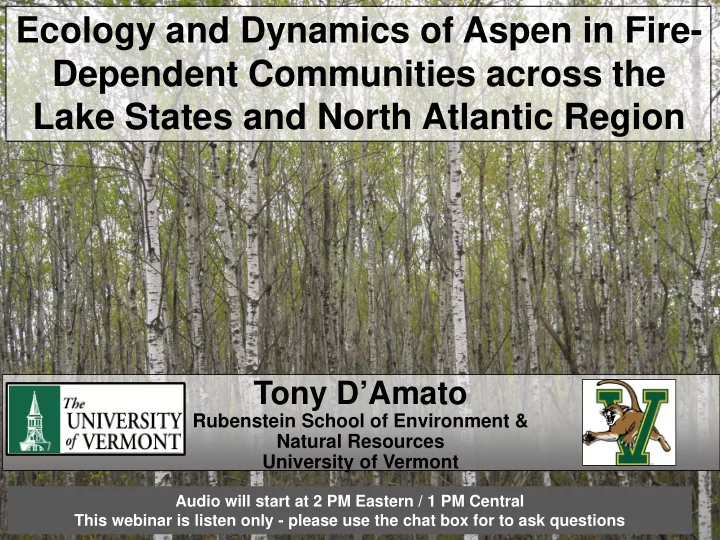
SLIDE 1 Ecology and Dynamics of Aspen in Fire- Dependent Communities across the Lake States and North Atlantic Region
Tony D’Amato
Rubenstein School of Environment & Natural Resources University of Vermont
Audio will start at 2 PM Eastern / 1 PM Central This webinar is listen only - please use the chat box for to ask questions
SLIDE 2 Outline
- Review of aspen silvics
- Historic distribution and ecology of aspen
across Lake States and North Atlantic
- Aspen developmental pathways and
disturbance response across sites
- Integrating structural legacies in aspen
silviculture
SLIDE 3
Aspen silvics
SLIDE 4 Aspen silvics
Species Shade tolerance Effective rotation ages Site requirements Big-tooth aspen Very intolerant 50-70 High; best development
sands/sandy loams Quaking aspen Very intolerant 40-50, 50-60 Low; best development
- n sandy and silt loams
- Aspen requires disturbance across space and time to maintain
dominance on a site
- Large openings (> 1 acre)
- Shorter rotations to maintain rootstocks
- Aspen dominance on a particular site does not always indicate it is a
“good site” (i.e., SI > 70 ft) to promote aspen for production
SLIDE 5 Aspen silvics
- Primary modes of reproduction
– Root suckers
– Arise from adventitious buds in roots – Stimulated by decrease in auxin from parent stem – Require warm (> 55°F), aerated soil conditions – Faster early growth than regeneration from seedling
- rigin (inherit root system and carbohydrates from parent
tree)
SLIDE 6 Aspen silvics
– If objectives involve naturally regenerating aspen- dominated stand, at least 10-20 ft2/ac of overstory aspen is needed (~50 TPA across site)
SLIDE 7 Aspen silvics
- Primary modes of reproduction
– Wind-dispersed seed
– Seed dispersal between May-June (often miles) – Good seed years every 4-5 years – Limited longevity (2-4 weeks) – Requires moist, mineral soil seedbed
SLIDE 8
Historic distribution of aspen
SLIDE 9 Northeastern US
- Very minor component of historic and contemporary landscape
- Early successional stage for many dominant forest types in
region (northern hardwoods, spruce-fir, oak-pine)
Historic distribution of aspen
From Thompson et al. (2013)
SLIDE 10
"Temporary" successional stage resulting from fire or windthrow (Westveld 1956)
SLIDE 11
- Greater site-level dominance in western Lake
States
- Existed most often as component of mixed
species communities
SLIDE 12 Historic distribution of aspen
From: Schulte et al. (2007)
Change in aspen dominance from presettlement to present
- Post-cutover rise in aspen dominance has been maintained
through clearcut harvesting in many regions
- Regional homogeneity due to loss of conifer species and
spatial complexity in distribution of aspen forests historically maintained by natural disturbance
SLIDE 13
Aspen development across sites
SLIDE 14
Superior NF, MN
pine stands (~65 yr) on shallow soils over Precambrian bedrock
events:
- 1999: derecho damages over 200,000
ha
- 1999-2002: Extensive salvage
- perations to reduce resulting fuel
loads and risk
- Frost/snow-free conditions
- 2007: Ham Lake fire burns 14,800 ha,
including all salvaged sites
Fire-dependent sub-boreal model
SLIDE 15
Blowdown, Salvage, Fire Blowdown Sampled 6 study sites per disturbance condition in 2009 Control Fire Blowdown, Fire
1999- 2002 salvage, 07 fire 1999 blowdown 2007 fire 2007 fire
SLIDE 16
Shift towards aspen dominance with compound disturbance D’Amato et al. (2011)
Fire-dependent sub-boreal model
SLIDE 17 Abies balsamea Picea mariana Thuja occidentalis Cornus canadensis
Alnus rugosa Amelanchier arborea Diervilla lonicera Corylus cornuta Populus tremuloides Vaccinium myrtilloides (61%) (16%)
Simplification
community and shift towards disturbance- adapted species
SLIDE 18 Treatment Species richness Species diversity Dissimilarity§ Blowdown-Salvage-Fire 16.17 (11, 19)a 2.2 (2.0, 2.3)a 0.46 (0.21, 0.71)a Blowdown-Fire 15.80 (13, 20)ab 1.9 (1.2, 2.2)a 0.68 (0.63, 0.71)b Fire 17.17 (15, 19)a 2.0 (1.7, 2.2)a 0.71 (0.46, 0.89)b Blowdown 16.17 (10, 22)a 1.7 (0.9, 2.4)a 0.69 (0.56, 0.83)c Control 10.50 (8, 16)b 1.7 (1.1, 1.9)a 0.63 (0.25, 0.88)c
§ Sørensen’s index of dissimilarity
Compounding of disturbance effects at stand-scale via salvage logging reduced microhabitat heterogeneity and homogenized plant community composition
Disturbance effects on composition
SLIDE 19
1973 blowdown, 1974 fire
Fire-dependent sub-boreal model
Blowdown- Fire dynamic has recent and historic precedent
Toronto Star Archives
SLIDE 20 Wet-mesic developmental model
Northern wet-mesic boreal hardwood conifer forest (MHn44)
- Most common aspen-dominated forest type in MN
- Glacial lake deposits, stagnation moraines, and till plains
- High local water table (~460 year rotation for stand-replacing
fire; MN DNR 2003)
SLIDE 21 Wet-mesic developmental model
Reinikainen et al. (2012)
- Chronic defoliation events from forest tent caterpillar represent
important driver of complex mixed-species, multi-cohort aspen stands on mesic sites
- Even-aged aspen monoculture is land use legacy
- Consistent with work in western Canada highlighting variability
in aspen age structures beyond single-cohort model
SLIDE 22
Management response across sites
SLIDE 23 Chippewa NF (silty loam) Ottawa NF (clayey) Huron NF (sandy)
Aspen-birch
Long-term Soil Productivity Study
SLIDE 24 Stem only harvest (SOH) Whole tree harvest (WTH) Forest Floor Removal (FFR) No additional compaction Heavy compaction Moderate compaction
Organic matter removal
Long-term Soil Productivity Study
SLIDE 25 Photo credit: USFS 1994
SLIDE 26
Removing residues did not reduce above-ground biomass on silty loam or clayey soils Removing residues did reduce above-ground biomass on sandy soils. The most severe disturbance treatments led to greater shrub biomass on silty loam soils.
Long-term Soil Productivity Study
Treatment impacts on aboveground biomass after 15 years
Curzon et al. (2014)
SLIDE 27 %
a ab b
Stem-only harvest Whole-tree harvest WTH + Forest floor removal
Long-term Soil Productivity Study
Treatment impacts on tree biomass after 15 years
disproportionately reduced tree biomass 15 years post-harvest on sandy soils.
and smaller diameters
SLIDE 28
- Multiple developmental pathways and ecological
conditions following disturbances, including fire,
- ften ignored
- Aspen productivity on fire-dependent sites most
sensitive to harvest impacts
- Restoration of fire to achieve ecological objectives and
encourage other historically common associates (e.g., jack pine)
Management response across sites
SLIDE 29
Integrating disturbance legacies
SLIDE 30 Integrating disturbance legacies
- Importance of structural retention for biodiversity
- bjectives widely recognized (and enforced)
- Aspen silvics present challenge in relation to retention
due to intolerance and auxin regulation of sprouting
- Retention of 10-15 ft2/ac has been shown to reduce sucker
height growth and densities by 40-50%
SLIDE 31 Integrating disturbance legacies
- Application of aggregate reserve patches
minimizes influence of residuals and maintains
- ther species options on site
SLIDE 32 Integrating disturbance legacies
a a b b
2 m 7 m 22 m 42 m
42 m
Density (stems/m2)
- Effects of aggregates on tree
regeneration
Aggregate center Edge Open Curzon et al. (2017)
SLIDE 33
- General homogeneity of current aspen resource and
its management masks historic complexity of these systems
- Simplicity of silviculture has provided important,
reliable timber base for region, but often ignores range of development patterns for these forests
- Integration of structural legacies and broad
compositional conditions historically characterizing these systems is critical for sustaining biodiversity and long-term resilience
Conclusions
SLIDE 34
- Co-PIs: B. Palik (USFS), J. Bradford (USGS), S. Fraver
(UMaine), R. Slesak (MFRC), M. Curzon (UMN)
- Funding: Joint Fire Sciences Program, USFS Northern
Research Station, MN Forest Resources Council, USDA/DOE BRDI, MN Environment and Natural Resources Trust Fund
- A. Mahaffey (Forest Guild)
- Field assistants: N. Aspelin, S. Erlandson, S. Jones, D.
Kastendick, J. Kragthorpe, L Patty, Z, Patty, and J. Smith
- Superior National Forest: B. Anderson, M Beckwith, K.
McTighe, and B. Schueller
Acknowledgements
SLIDE 35
SLIDE 36
@LSFireScience LakeStatesFireSci.net
2017-2018 Webinar Series Webinars are every Month on Third Thursday October 2017 through April 2018 Sta tarts ts Octobe ctober 19, 2 , 2017