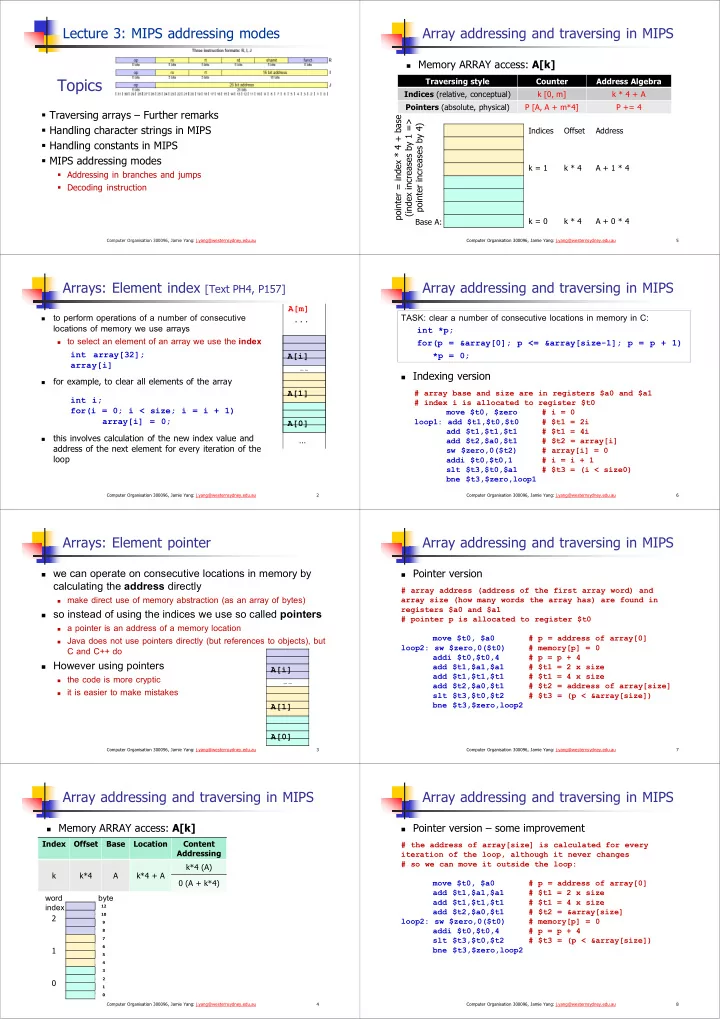
Topics Traversing style Counter Address Algebra Indices (relative, - - PDF document

topics
SMART_READER_LITE
LIVE PREVIEW

Topics Traversing style Counter Address Algebra Indices (relative, - - PDF document

Lecture 3: MIPS addressing modes Array addressing and traversing in MIPS Memory ARRAY access: A[k] Topics Traversing style Counter Address Algebra Indices (relative, conceptual) k [0, m] k * 4 + A Pointers (absolute, physical) P [A, A +


slide-1
SLIDE 1

Topics

  • Traversing arrays – Further remarks
  • Handling character strings in MIPS
  • Handling constants in MIPS
  • MIPS addressing modes
  • Addressing in branches and jumps
  • Decoding instruction

Computer Organisation 300096, Jamie Yang: j.yang@westernsydney.edu.au

Lecture 3: MIPS addressing modes Arrays: Element index [Text PH4, P157]

2 Computer Organisation 300096, Jamie Yang: j.yang@westernsydney.edu.au

for example, to clear all elements of the array int array[32]; array[i] int i; for(i = 0; i < size; i = i + 1) array[i] = 0;

to perform operations of a number of consecutive locations of memory we use arrays

 to select an element of an array we use the index

this involves calculation of the new index value and address of the next element for every iteration of the loop

… …

A[0] A[1] A[i] … A[m] ...

Arrays: Element pointer

3 Computer Organisation 300096, Jamie Yang: j.yang@westernsydney.edu.au

 we can operate on consecutive locations in memory by

calculating the address directly

 make direct use of memory abstraction (as an array of bytes)

 so instead of using the indices we use so called pointers

 a pointer is an address of a memory location  Java does not use pointers directly (but references to objects), but

C and C++ do

 However using pointers

 the code is more cryptic  it is easier to make mistakes

… …

A[0] A[1] A[i]

Array addressing and traversing in MIPS

 Memory ARRAY access: A[k]

4 Computer Organisation 300096, Jamie Yang: j.yang@westernsydney.edu.au

Index Offset Base Location Content Addressing k k*4 A k*4 + A k*4 (A) 0 (A + k*4) word index byte 2 1

12 10 9 8 7 6 5 4 3 2 1

Array addressing and traversing in MIPS

 Memory ARRAY access: A[k]

5 Computer Organisation 300096, Jamie Yang: j.yang@westernsydney.edu.au

Base A: Address Indices Offset k = 0 k = 1 k * 4 k * 4 A + 0 * 4 A + 1 * 4 Traversing style Counter Address Algebra Indices (relative, conceptual) k [0, m] k * 4 + A Pointers (absolute, physical) P [A, A + m*4] P += 4

Array addressing and traversing in MIPS

6 Computer Organisation 300096, Jamie Yang: j.yang@westernsydney.edu.au

 Indexing version

# array base and size are in registers $a0 and $a1 # index i is allocated to register $t0 move $t0, $zero # i = 0 loop1: add $t1,$t0,$t0 # $t1 = 2i add $t1,$t1,$t1 # $t1 = 4i add $t2,$a0,$t1 # $t2 = array[i] sw $zero,0($t2) # array[i] = 0 addi $t0,$t0,1 # i = i + 1 slt $t3,$t0,$a1 # $t3 = (i < size0) bne $t3,$zero,loop1

TASK: clear a number of consecutive locations in memory in C: int *p; for(p = &array[0]; p <= &array[size-1]; p = p + 1) *p = 0;

Array addressing and traversing in MIPS

7 Computer Organisation 300096, Jamie Yang: j.yang@westernsydney.edu.au

 Pointer version

# array address (address of the first array word) and array size (how many words the array has) are found in registers $a0 and $a1 # pointer p is allocated to register $t0 move $t0, $a0 # p = address of array[0] loop2: sw $zero,0($t0) # memory[p] = 0 addi $t0,$t0,4 # p = p + 4 add $t1,$a1,$a1 # $t1 = 2 x size add $t1,$t1,$t1 # $t1 = 4 x size add $t2,$a0,$t1 # $t2 = address of array[size] slt $t3,$t0,$t2 # $t3 = (p < &array[size]) bne $t3,$zero,loop2

Array addressing and traversing in MIPS

8 Computer Organisation 300096, Jamie Yang: j.yang@westernsydney.edu.au

 Pointer version – some improvement

# the address of array[size] is calculated for every iteration of the loop, although it never changes # so we can move it outside the loop: move $t0, $a0 # p = address of array[0] add $t1,$a1,$a1 # $t1 = 2 x size add $t1,$t1,$t1 # $t1 = 4 x size add $t2,$a0,$t1 # $t2 = &array[size] loop2: sw $zero,0($t0) # memory[p] = 0 addi $t0,$t0,4 # p = p + 4 slt $t3,$t0,$t2 # $t3 = (p < &array[size]) bne $t3,$zero,loop2

slide-2
SLIDE 2

Array addressing and traversing in MIPS

9 Computer Organisation 300096, Jamie Yang: j.yang@westernsydney.edu.au

 Comparison

the index version had to calculate new value of i for every iteration of the loop: 7 instructions per iteration

the pointer version calculated size once only outside the loop: 4 instructions per iteration

modern compilers have the ability to produce the more efficient pointer-like code for the array version

While loop again (EXERCISE)

# actual start of the main program # implements a while loop while (save[i] == k) i = i + j; # alternative form: Loop: if (save[i] != k) go to Exit i = i + j; go to Loop; Exit:

10 Computer Organisation 300096, Jamie Yang: j.yang@westernsydney.edu.au

While loop

# variables i, j and k are in registers $s3, $s4 and $s5 # address of save is in $s6

# Allocate 10-word array save .data .align 2 # aligning will be explained later .globl save save: .word 0, 0, 0, 0, 0, 0, 0, 6, 3, 2 .globl main .text main: # main has to be a global label addu $s7, $0, $ra # save the return address in $ra # Initialize variables add $s3, $0, $0 # i=0 (initial value) addi $s4, $0, 1 # j=1 add $s5, $0, $0 # k=0 (what if k=7 -> addi $s5,$0,7) la $s6, save # $s6 = save[] (using la)

11 Computer Organisation 300096, Jamie Yang: j.yang@westernsydney.edu.au

While loop cont

Loop: add $t1, $s3, $s3 # 2*i ($s3 has i) add $t1, $t1, $t1 # 4*i ($t1 has 4*i –- the offset) add $t1, $t1, $s6 # $s6 = save[]; $t1 = save[] + 4*i # lw $t0, 0($t1) # gets save[i] # bne $t0, $s5, Exit # $s5 has k add $s3, $s3, $s4 # $s3 has i j Loop # Exit:

12 Computer Organisation 300096, Jamie Yang: j.yang@westernsydney.edu.au

While loop cont

# Output the value of i to see how far we got .data .globl message1 message1: .asciiz "\nThe value of i is: " #string to print .text li $v0, 4 # la $a0, message1 # la used here syscall li $v0, 1 # add $a0, $0, $s3 # syscall # Usual stuff at the end of the main addu $ra, $0, $s7 # restore the return address jr $ra # return to the main program add $0, $0, $0 # nop

13 Computer Organisation 300096, Jamie Yang: j.yang@westernsydney.edu.au

Processing text

14 Computer Organisation 300096, Jamie Yang: j.yang@westernsydney.edu.au

 Computers can process any information represented

as numbers

characters can be processed if they are represented as numbers

 ASCII (American Standard Code for Information

Interchange – refer to the table in the last slide)

8 bits (one byte) used to represent a character

256 possible combinations

 EBCIDC

another 8-bit code, introduced by IBM

 Unicode

16 bits per character, Java …

Storing characters

15 Computer Organisation 300096, Jamie Yang: j.yang@westernsydney.edu.au

 We want to pack 4 characters into each word

 ‘Have a … …’ [0A0000101048010010006101100001760111011020 …]  need a convention on how bytes are ordered in a word

 this is called endianness

 two ways are used

 pack characters starting at the most significant bit (big end)  pack characters starting at the least significant bit (little end)

 Storing an 8-bit character in a 32-bit word would be

wasteful

1 1 1 1 1 1 1 1 1 1 1 1 1 1 1 1 1 1 1 1 1 1 1 1

HP_AppA.pdf P43

Special instructions

16 Computer Organisation 300096, Jamie Yang: j.yang@westernsydney.edu.au

 we might use lw and sw to transfer characters bundled

into words between memory and registers

 we would need to extract single bytes to process text

(masking?)

 since character processing is so common (4th design

principle), special instructions are provided

 lb register, address

 loads a byte from memory into rightmost byte of the register

 sb register, address

 stores the rightmost byte of the register in memory

1 1 1 1 1 1 1 1 1 1 1 1 1 1 1 1 1 1 1 1 1 1 1 1 1 1 1 1 1 1 1 1 1 1 1 1

slide-3
SLIDE 3

Character strings

17 Computer Organisation 300096, Jamie Yang: j.yang@westernsydney.edu.au

 text consists of strings of characters

 strings have variable length

 three choices

1. reserve the first position of the string to store its length 2. create a structure consisting of an integer to store length, and a variable length character string 3. use last position of the string to mark its end by storing a terminating character

 3rd choice is commonly used

 C sets the last byte to zero  a byte whose value is zero is called Null in ASCII

MIPS directives for strings

18 Computer Organisation 300096, Jamie Yang: j.yang@westernsydney.edu.au

 .ascii “sample character string”

 stores the characters in memory packed in consecutive bytes  this string occupies 23 bytes of memory  strings are enclosed in double quotes

 .asciiz “sample character string”

 adds a null byte at the end of the string  this string occupies 24 bytes of memory

 special characters follow C conventions

 new line \n  tab \t  double quote \”

A-48 (PH3) or B-48 (PH4) explains directive .asciiz

Strings in MIPS [EXERCISE]

19 Computer Organisation 300096, Jamie Yang: j.yang@westernsydney.edu.au

C code to copy string y to string x using the Null byte as a terminating character

char x[], y[]; int i = 0; //counter while(y[i]!= 0) { x[i] = y[i]; i = i + 1; }

MIPS assembly language code

# base address for x and y is in $a0 and $a1 # i is in $s0 add $s0,$zero,$zero # i = 0 (initialisation) L1: add $t1,$a1,$s0 # address of y[i]; not 4*i (word) lb $t2,0($t1) # load character y[i] to $t2 add $t3,$a0,$s0 # address of x[i]; not 4*i (word) sb $t2,0($t3) # x[i] = y[i] addi $s0,$s0,1 # i = i + 1 (update; byte by byte) bne $t2,$zero,L1 # if y[i] != 0 (the NUL char)

1 1 1 1 1 1 1 1 1 1 1 1

18 19 1A 1B 1C

lb / sb  

Constants

 Small constants are used quite frequently  Solutions?

  • 1. build hard-wired registers (like $zero) for constants
  • 2. define 'typical constants' in memory and load them
  • 3. put constants in instructions themselves

 We call constant operands immediate operands

 this way of accessing data is called immediate addressing 20 Computer Organisation 300096, Jamie Yang: j.yang@westernsydney.edu.au

e.g., a = a + 4 addi $sp,$sp,4 # add immediate (add 4) slti $t0,$s2,35 # common use of constants is comparison

4th principle of good design: Make the common case fast

See Text: HP4, P86

Constants continued

 I-type Instruction with immediate operands

21 Computer Organisation 300096, Jamie Yang: j.yang@westernsydney.edu.au

  • p

rs rt constant 6 bits 5 bits 5 bits 16 bits

Large constant: I-type instructions limit to 16-bit constants, HOW do we load a 32-bit constant into a 32-bit register? For example: 1110101010101011 1010101010101010

New "load upper immediate" takes care of higher order 16 bits: lui $t0, 1110101010101011

Then we must get the lower order 16 bits right, i.e.,

  • ri $t0, $t0, 1010101010101010

1110101010101011 0000000000000000 0000000000000000 1010101010101010 1110101010101011 1010101010101010

  • ri

$t0 immediate

Large constants cont.

 MIPS assembler provides a pseudo instruction

22 Computer Organisation 300096, Jamie Yang: j.yang@westernsydney.edu.au

li register, constant # load immediate

 the constant must be broken at some stage either by the

compiler, or the assembler (as in MIPS)

a temporary register $at is used for this purpose

this is why it is reserved (NOT enforced by hardware!) lui reg, const1 # const1 := constant >> 16

  • ri reg, reg, const2 # const2 := constant AND 0x0000ffff

1110101010101011 1010101010101010 replaced with

Addresses in loads/stores

 lw and sw are I-type instructions

 lw rt, address

# e.g. lw $t0, 32($s3)

 address: constant [offset] + contents of a register rs [base] 23 Computer Organisation 300096, Jamie Yang: j.yang@westernsydney.edu.au

 how about:

  • p

rs rt constant [offset] 6 bits 5 bits 5 bits 16 bits

.data labelx: .word 235 # define number ‘235’ .text lw $t0, labelx # I-type instruction

labelx address is 32-bit long, BUT constant field is only 16 bits

these lw/sw are treated by the assembler as pseudoinstructions

substituted with lui and common lw/sw See Text: HP4, P128-P133

Load instructions

 so far we saw

24 Computer Organisation 300096, Jamie Yang: j.yang@westernsydney.edu.au

 another useful load instruction

load computed address, NOT the contents of the location

this is another case when we need a 32-bit immediate value la register, address # pseudoinstruction A: .word 11,12,13,14,15,16,17 #Array definition A[7], see Lab 4 la $s3, A lw $s4, 8($s3) li register, constant # pseudoinstruction # translate into more # than 1 common instr. lw register, address # e.g. lw $t0, 32($s3) # or lw $t0, labelx

slide-4
SLIDE 4

Addresses in Jumps, part 1

 the simplest addressing is in jump instruction

25 Computer Organisation 300096, Jamie Yang: j.yang@westernsydney.edu.au

 such instruction use another format: J-type

j Label # Next instruction is at Label

 …but address field is still only 26 bits, not 32 bits

required by the address (e.g. Loop address) , what to do?

  • p

address 6 bits 26 bits Loop: add $t1, $s3, $s3 # … … lw $t0, 0($t1) # bne $t0, $s5, Exit # add $s3, $s3, $s4 # j Loop #

Addresses in Jumps, part 2

 as each instruction is 4 byte long, we only need to

address words (not individual bytes – cells), so:

 26-bit address field can represent 28-bit byte address

 the 4 missing bits are provided by leaving the upper 4

bits of the PC (Program Counter) unchanged

26 Computer Organisation 300096, Jamie Yang: j.yang@westernsydney.edu.au

PC<31,28> address field in the instruction 0 0 4 bits 26 bits 2 bits word index byte 2 1

12 10 9 8 7 6 5 4 3 2 1

Addresses in Branches

 Instructions:

27 Computer Organisation 300096, Jamie Yang: j.yang@westernsydney.edu.au

 Format (I-Type):

bne $t4,$t5,Label #Next instruction is at Label if $t4!=$t5 beq $t4,$t5,Label #Next instruction is at Label if $t4==$t5

 we only have 16 bits for the address  this limits the size of the program to 216, not an

acceptable option

  • p

rs rt constant 6 bits 5 bits 5 bits 16 bit address

Addresses in Branches: PC-relative addressing

 we could specify a register (like in lw and sw, e.g.

lw $t0, 32($s3)) and add it to address

 so next PC = register + branch_address

 which register to use

 most branches are local (principle of locality), used in loops

and if statements

 use Program Counter (PC)  we can branch within 215 words either way from the current

instruction (not 216 , leaving one bit for direction)

 this is called PC-relative addressing: const(PC)  MIPS uses the address of the next instruction, PC + 4

 by the time when address is calculated PC has been already

incremented

28 Computer Organisation 300096, Jamie Yang: j.yang@westernsydney.edu.au

… PC

Branching far away

 if a branch is to a far-away location (beyond the 16 bit

limit)

 the assembler replaces the branch with a pair of instructions  for example: 29 Computer Organisation 300096, Jamie Yang: j.yang@westernsydney.edu.au

 becomes

beq $s0,$s1,L1 add . . . bne $s0,$s1,L2 j L1 L2: add . . .

Addressing mode summary

30 Computer Organisation 300096, Jamie Yang: j.yang@westernsydney.edu.au

PH4 Section 2.10, P132

I-type instructions R-type instructions I-type instructions I-type instructions J-type instructions

6 bits 5 bits 5 bits 5 bits 5 bits 6 bits 17 18 8 32

Instruction Formats

Three instruction format: R, I, J

31 Computer Organisation 300096, Jamie Yang: j.yang@westernsydney.edu.au 

Instruction assembling that converts mnemonic format to machine code

R-type instruction: add $t0, $s1, $s2 rt rs rd 18 17 8

  • p

rs rt rd shamt funct

[mnemonic]

0 0 0 0 0 0 1 0 0 0 1 1 0 0 1 0 0 1 0 0 0 0 0 0 0 0 1 0 0 0 0 0

[assembled] add

2 3 2 4 2

0x bin dec Home EXERCISE

Examples of translating machine instructions

32 Computer Organisation 300096, Jamie Yang: j.yang@westernsydney.edu.au

See Text: HP4, P134; instruction decoding.pdf on vUWS

Home EXERCISE

slide-5
SLIDE 5

Revision: Memory access

33 Computer Organisation 300096, Jamie Yang: j.yang@westernsydney.edu.au

Given var: .word 32 Which of the following is to load the address of var to register $s1? 1) la $s1, var 2) lw $s1, var 3) li $s1, var

Given arr: .word 0, 0, 0, 0, 0, 0, 0, 6, 3, 2 Which of the following is the correct algebra to calculate the address

  • f arr[i]?

1) arr+4*i 2) arr+4+i 3) (arr+i)*4

Given arr: .word 0, 0, 0, 0, 0, 0, 0, 6, 3, 2 and assume array base and index are in registers $a0 and $t0. Is the following code legal in syntax? add $t1,$t0,$t0 add $t1,$t1,$t1 lw $t2, $t1($a0)

Recommended readings

34 Computer Organisation 300096, Jamie Yang: j.yang@westernsydney.edu.au

Text readings are listed in Teaching Schedule and Learning Guide PH4: eBook is available PH5: no eBook on library site yet PH5: companion materials (e.g.

  • nline sections for further readings)

http://booksite.elsevier.com/978012 4077263/?ISBN=9780124077263

ASCII TABLE

35 Computer Organisation 300096, Jamie Yang: j.yang@westernsydney.edu.au

See ascii_chart.pdf on vUWS