Total Estimated Recoverable Storage - TERS for Aquifers in GMA 9 - - PowerPoint PPT Presentation

total estimated recoverable storage ters for aquifers in
SMART_READER_LITE
LIVE PREVIEW

Total Estimated Recoverable Storage - TERS for Aquifers in GMA 9 - - PowerPoint PPT Presentation

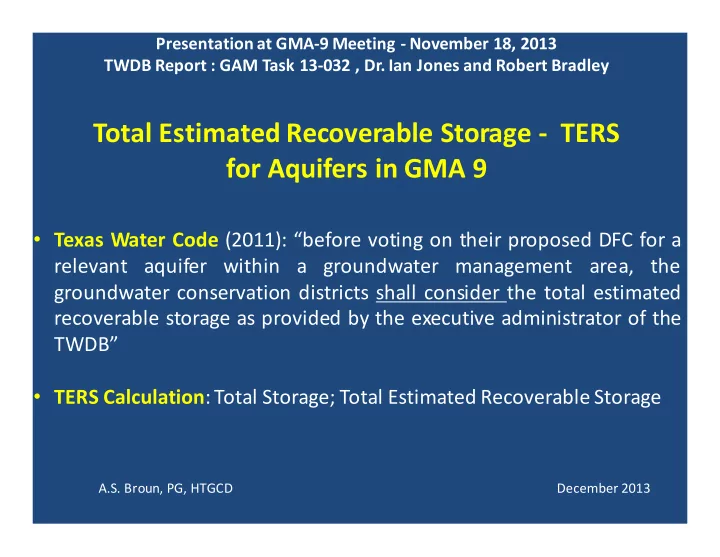
Presentation at GMA-9 Meeting - November 18, 2013 TWDB Report : GAM Task 13-032 , Dr. Ian Jones and Robert Bradley Total Estimated Recoverable Storage - TERS for Aquifers in GMA 9 Texas Water Code (2011): before voting on their proposed


slide-1
SLIDE 1

Presentation at GMA-9 Meeting - November 18, 2013 TWDB Report : GAM Task 13-032 , Dr. Ian Jones and Robert Bradley

Total Estimated Recoverable Storage - TERS for Aquifers in GMA 9

  • Texas Water Code (2011): “before voting on their proposed DFC for a

relevant aquifer within a groundwater management area, the groundwater conservation districts shall consider the total estimated recoverable storage as provided by the executive administrator of the TWDB”

  • TERS Calculation:Total Storage; Total Estimated Recoverable Storage

A.S. Broun, PG, HTGCD December 2013

slide-2
SLIDE 2

Definitions

  • Total Storage: the volume of groundwater that can

be released by completely draining the aquifer. Data required for calculation: area, water level - aquifer bottom (saturated thickness), and aquifer storage properties (specific yield for unconfined aquifers)

  • HTGCD Trinity Aquifer: total district area; average

water level from historical TWDB data base; Paleozoic as aquifer bottom; storage properties from TWDB 2011 GAM (Hutchison) assumes Trinity Aquifer unconfined

slide-3
SLIDE 3

Area: HTGCD Boundary

Water level

Paleozoic : aquifer bottom, confining unit Trinity Aquifer

Saturated interval area x specific yield x saturated interval = total storage = drained volume Specific yield values: 0.01 to 0.3 (limestone .14 avg.)

Total Storage

slide-4
SLIDE 4

Definitions

  • Total Estimated Recoverable Storage – TERS: “the

estimated amount of groundwater within an aquifer that accounts for recovery scenarios that range between 25 and 75% of the porosity-adjusted aquifer volume; assume that between 25 and 75% of groundwater held within an aquifer can be removed by pumping” (Texas Administrative Code, 2011)

slide-5
SLIDE 5

Area: HTGCD Boundary

Water level

Paleozoic : aquifer bottom, confining unit Trinity Aquifer

Total Estimated Recoverable Storage

25% 75%

unsaturated interval

slide-6
SLIDE 6

Hill Country Trinity Aquifer – HTGCD

  • Total storage calculated at: 550,000 acre feet
  • Total Estimated Recoverable Storage:

25% of total storage: 137,500 acre feet 75% of total storage: 412,000 acre feet

DFC : 30’ average regional drawdown -50 years

(less than 20’ in HTGCD) : 9,100 acre feet/year

slide-7
SLIDE 7

Concerns

  • The TERS values for the Trinity Aquifer in HTGCD, as stated in

the TWDB Report, are best used for regional studies. Volumetric analyses without local control are controversial.

  • The averaged values used for saturated thicknesses and

specific yield are not representative of the rapid lithofacies changes in the Trinity section.

  • No consideration is given to producibility. How long would it

take to produce (drain) the TERS? Close spacing required to recover that volume of water in low flow-rates normally seen in Hays County would not be practical.

  • Method does not distinguish water quality or changes to

surface water - groundwater interaction caused by pumping.

slide-8
SLIDE 8

More Concerns

  • Hickory Aquifer (Paleozoic): Unit is projected

south of Blanco County into northwest corner of Hays County subsurface. Total storage of 58,000 acre feet assigned to District.

  • San Antonio segment of the Edwards (BFZ)

Aquifer: minor fraction of aquifer within HTGCD along irregular eastern boundary. 4,500 acre feet

  • f total storage assigned to District.
  • No action required by HTGCD.
slide-9
SLIDE 9

CONCLUSIONS

  • HTGCD to consider Trinity Aquifer TERS values

for next DFC calculation.

  • Until reliable model available for Trinity using

local data base, use TERS with caution.

  • “The volume of water contained in …. an

aquifer is of interest, of more concern is how much water can be released from storage” Driscoll, 1986