Total Solution for Melamine Analysis by Agilent Total Solution for - - PowerPoint PPT Presentation

total solution for melamine analysis by agilent total
SMART_READER_LITE
LIVE PREVIEW

Total Solution for Melamine Analysis by Agilent Total Solution for - - PowerPoint PPT Presentation

Total Solution for Melamine Analysis by Agilent Total Solution for Melamine Analysis by Agilent SPE, LC, GC/MS and Triple Quadrupole LC/MS SPE, LC, GC/MS and Triple Quadrupole LC/MS SPE, LC, GC/MS and Triple Quadrupole LC/MS SPE, LC, GC/MS and


slide-1
SLIDE 1

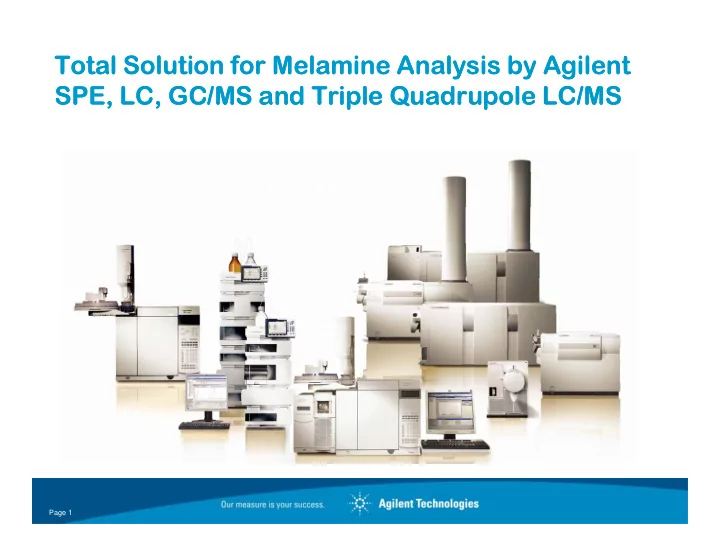
Total Solution for Melamine Analysis by Agilent Total Solution for Melamine Analysis by Agilent SPE, LC, GC/MS and Triple Quadrupole LC/MS SPE, LC, GC/MS and Triple Quadrupole LC/MS SPE, LC, GC/MS and Triple Quadrupole LC/MS SPE, LC, GC/MS and Triple Quadrupole LC/MS

Page 1

slide-2
SLIDE 2

Agilent Solutions for Analyzing Melamine in Food Agilent Solutions for Analyzing Melamine in Food

Broadest portfolio of solutions lets you select the protocol that meets your needs

GC/MS method: rapid screening and confirmation

LC th d ti tit ti

LC method: routine quantitation Triple Quadrupole LC/MS: sensitive and selective for screening, confirmation, and

quantitation q

SampliQ SPE: removes milk matrix interferences

Agilent innovative technologies for better lab productivity and faster results

Backflush using innovative Capillary Flow Technology minimizes the requirement for

sample preparation and shortens the GC cycle time up to five-fold

Fast data review software for faster analysis time. High-sensitivity melamine analysis with Triple Quadruopole LC/MS

B d l tf li t t diff t l i d

Broad column portfolio to meet different analysis needs

Page 2 Page 2

slide-3
SLIDE 3

Why Agilent for Melamine Analysis? Why Agilent for Melamine Analysis?

Agilent expertise in food safety:

Experience with melamine analysis: supported US FDA and Chinese government to

develop standard methods (China GB) develop standard methods (China GB)

Extensive collaborations with government and private food labs around the world Hundreds of publications by Agilent scientists

Reliable analytical systems for continuous lab operation: Reliable analytical systems for continuous lab operation:

Proven reliability through a large installed base in food laboratories worldwide: private

labs, government labs, and industry labs

Agilent support: Agilent support:

Support to keep systems running at top performance and ensure uninterrupted lab

  • peration

Training courses to meet customers’ needs Training courses to meet customers needs A large selection of columns for LC- and GC-based applications and SPE sample

preparation for melamine analysis

Page 3 Page 3

slide-4
SLIDE 4

Agilent Offers Solutions to Meet Different Needs Agilent Offers Solutions to Meet Different Needs

  • SPE Sample Preparation: SampliQ SCX is used to remove complex sample interferences.
  • GC/MS: J&W DB5-ms capillary column, TMS derivatization for sample screening and

confirmation. Optional backflush based on Agilent’s Capillary Flow Technology can minimize the requirement of sample preparation and shorten the GC cycle time up to five-fold.

  • HPLC: Reversed-phase Zorbax SB-C8 column in ion-pair mode for routine quantitation
  • HPLC: Reversed phase Zorbax SB C8 column in ion pair mode for routine quantitation

Optional rapid resolution LC method: RRHT column to significantly increase speed Alternative Ion-Exchange LC method: Zorbax 300SCX Ion-Exchange column to eliminate the d f i i t E t t h ith Chi GB LC QQQ th d f fi ti need for ion-pair reagent. Easy to match with China GB LC-QQQ method for confirmation.

  • Triple Quadrupole LC/MS: Zorbax Rx-Sil column is employed to run in hydrophilic

interaction mode (HILIC) to better match with electrospray (ESI) LC/MS, provides extremely simple sensitive and selective testing for both melamine and cyanuric acid analysis simple, sensitive, and selective testing for both melamine and cyanuric acid analysis. Alternative Ion-Exchange Zorbax 300SCX column can be used for the analysis of melamine in dairy products.

Page 4 Page 4

slide-5
SLIDE 5

GC/MS Methods GC/MS Methods

GC/MS is used for sample screening and confirmation. Improved method using Capillary Flow p g p y Technology to reduce run time and sample preparation

Page 5

slide-6
SLIDE 6

Standard GC/MS Method Standard GC/MS Method

Screening, confirmation, and quantitation in various matrices for the presence of melamine and related compounds p p US FDA published method has detailed procedure http://www.cfsan.fda.gov/~frf/lib4423.html Sample needs to be derivatized before injection into GC/MS Analysis time can be long due to sample matrix Analysis time can be long due to sample matrix

Page 6 Page 6

slide-7
SLIDE 7

GC/MS Sample Preparation Procedure GC/MS Sample Preparation Procedure

Weigh ~ 0.5 g sample Transfer 40 µL filtrate to a GC vial Add 20 mL of methanol

Evaporate to dryness (70 ˚C, nitrogen)

Sonicate for 30 minutes Add 50 L idi 50 L BSTFA Centrifuge for 6 minutes Add 50 µL pyridine, 50 µL BSTFA Filter using 0.45 µm filter Incubate at 70 ˚C for 30 min E t ti TMS D i ti Extraction TMS-Derivatives

Page 7 Page 7

slide-8
SLIDE 8

GC/MS Experimental Conditions GC/MS Experimental Conditions

GC Conditions

Inlet Temp EPC, Split/Splitless @ 250 ºC Injection Volume 1 µL, Split 3:1 Carrier Gas Helium, Constant Flow Mode, 1.3 mL/min Oven Program 75 ºC (1 min); 30 ºC /min to 300 ºC (1 min) Post Run 300 ºC hold 5 min Transfer Line 280 ºC

MS Conditions

MS EI SIM/S MS EI, SIM/Scan Solvent Delay 4.2 min MS Temp 230 ºC (Source); 150 ºC (Quad) Scan Modemass range (40-450 amu) SIM Mode Ion melamine: 342, 327*, 171, 99; cyanuric acid: 345*, 330, 188) 7890A/5975C with MSD ChemStation E.01.00 or later Column: HP-5ms 19091S-433 30 m x 0.25 mm x 0.25 µm

Ordering information:

Column: HP 5ms 19091S 433 30 m x 0.25 mm x 0.25 µm Or DB-5ms 122-5532 30 m x 0.25 mm x 0.25 µm

Page 8 Page 8

slide-9
SLIDE 9

Chromatogram of GC/MS Method Chromatogram of GC/MS Method

4.5e+08 Abundance

Real Milk Powder Sample

3e+08 3.5e+08 4e+08

p

2e+08 2.5e+08 3e+08 5e+07 1e+08 1.5e+08 5.00 10.00 15.00 20.00 25.00 30.00 35.00 40.00 45.00 50.00 55.00 60.00 65.00 70.00 Time-->

Page 9 Page 9

slide-10
SLIDE 10

Data Analysis: SIM/Scan for Simultaneous Data Analysis: SIM/Scan for Simultaneous Confirmation and Confirmation and Quantitation Quantitation with Backflush with Backflush Confirmation and Confirmation and Quantitation Quantitation with Backflush with Backflush

2 8e+08 3e+08 3.2e+08 Abundance 1 +08 1.2e+08 1.4e+08 1.6e+08 1.8e+08 2e+08 2.2e+08 2.4e+08 2.6e+08 2.8e+08

Cyanuric Acid tri-TMS Melamine tri-TMS

4.50 5.00 5.50 6.00 6.50 7.00 7.50 8.00 8.50 9.00 2e+07 4e+07 6e+07 8e+07 1e+08 Time--> Abundance 3500000 4000000 4500000 5000000 5500000 6000000 6500000 500000 1000000 1500000 2000000 2500000 3000000 3500000

Real Milk Powder Sample

4.50 5.00 5.50 6.00 6.50 7.00 7.50 8.00 8.50 9.00 Time--> Page 10 Page 10

slide-11
SLIDE 11

Improved GC/MS Method with Backflush* Improved GC/MS Method with Backflush*

Optional backflush to improve lab productivity Compliant with FDA, China GB method but faster A il t li bl d t C ill Fl T h l Agilent reliable and easy-to-use Capillary Flow Technology based backflush can minimize the requirement of sample preparation and shorten the GC cycle time up to five-fold Requires additional hardware and method setup Requires additional hardware and method setup

*See detail in application note on www.agilent.com/chem/melamine

Page 11 Page 11

pp g

slide-12
SLIDE 12

Backflush GC/MS Configuration Backflush GC/MS Configuration

3-way splitter used for backflush AUX EPC used for makeup gas supply

5975C

7683B ALS

g pp y

MSD

Column

7890A GC

Ordering information:

Same as FDA, China GB GC/MS configuration PLUS: Capillary Flow Technology 3-way splitter: P/N G3183B + Aux EPC: G1530-63309

Page 12 Page 12

slide-13
SLIDE 13

Experimental Conditions Experimental Conditions

GC/MS conditions:

Same as standard GC/MS method

Backfl sh Conditions Backflush Conditions

Restrictor 0.71 m x 180 µm id Outlet pressure 2 psi (60 psi for post-run)

Easy tool to develop a backflush method using

p p ( p p ) Backflush duration 5 min

backflush method using your MSD ChemStation

Page 13 Page 13

slide-14
SLIDE 14

Using Backflush Can Reduce Run Time 5 Using Backflush Can Reduce Run Time 5-

  • fold

fold

1.2e+07 1.4e+07 Abundance

Without backflush and baking the column for more than 50 min at 300 ºC

5.00 10.00 15.00 20.00 25.00 30.00 35.00 40.00 45.00 50.00 55.00 60.00 65.00 2000000 4000000 6000000 8000000 1e+07 Time-->

B kfl h

4000000 6000000 8000000 1e+07 1.2e+07 1.4e+07 Abundance

Backflush 5 min

Saving 55 min

5.00 10.00 15.00 20.00 25.00 30.00 35.00 40.00 45.00 50.00 55.00 60.00 65.00 2000000 4000000 Time--> 1.2e+07 1.4e+07 Abundance 5.00 10.00 15.00 20.00 25.00 30.00 35.00 40.00 45.00 50.00 55.00 60.00 65.00 2000000 4000000 6000000 8000000 1e+07 Time-->

Blank run after backflush - successfully cleaned the column

Page 14 Page 14

slide-15
SLIDE 15

Summary for GC/MS Methods Summary for GC/MS Methods

R id i d fi ti f l i d l t d d Rapid screening and confirmation for melamine and related compounds. SIM/Scan can be used for simultaneous confirmation and quantitation. Backflush helped reduce run time from 75 min to 15 min. No need for SPE clean-up, but requires derivatization. No need for SPE clean up, but requires derivatization. Agilent’s improved method is fully compliant with FDA, China GB methods.

Page 15 Page 15

slide-16
SLIDE 16

SPE Sample Preparation SPE Sample Preparation

Agilent’s newly introduced SampliQ SCX SPE removes complex sample matrix interferences from milk and related products. interferences from milk and related products.

Page 16

slide-17
SLIDE 17

SPE Method for LC and LC/MS/MS SPE Method for LC and LC/MS/MS

Step1:Extraction Step2: SPE Clean‐up

Milk, milk powder, yogurt & ice‐cream

W i h 2 i 50 L b

SampliQ SCX cartridge Condition: SampliQ SCX cartridge Condition: using 3 mL methanol + 3 mL water

Weigh 2 g into 50‐mL tube

add 15 mL 5% TCA solution + 5 mL acetonitrile Wash: Load: Load: the above extract1 5 mL acetonitrile Sonicate for 10 min, vertically shake for 10 min, centrifuge at 4000 rpm for 10 min

using 3 mL water + 3 mL methanol at <1 mL/min Dry the cartridge by applying vacuum

El t i 6 L 5% i Filter the supernatant, bring to 25.0 mL with 5% TCA solution Elute: using 6 mL 5% ammonium hydroxide in methanol C ll t Collect: Evaporate to dryness under N2 (50º C), reconstitute in 1.0 mL mobile phase and filter into a LC vial (5.0 mL of the above extract + 5.0 mL)1 water for SPE clean‐up

Page 17

Ordering information: SampliQ P/N: 5982-3236 (3 mL, 60mg)

slide-18
SLIDE 18

HPLC Methods* HPLC Methods*

FDA, China GB standard reversed-phase method is used for routine quantitation Optional Rapid Resolution LC (RRLC) method can significantly increase sample g y p throughput Agilent-developed Ion Exchange Agilent-developed Ion Exchange Chromatography (IEC) method is a better match with China GB LC-QQQ method for l i l i i d i d t melamine analysis in dairy products

*See detail in application note on www.agilent.com/chem/melamine

Page 18

pp g

slide-19
SLIDE 19

Reversed Reversed-

  • Phase LC

Phase LC (recommended by FDA, China GB)

(recommended by FDA, China GB)

Routine quantitation method in various matrices for the presence of melamine US FDA reference method with detailed procedure US FDA reference method with detailed procedure http://www.fda.gov/cvm/melamine04022007.htm No need for derivatization, but requires SPE cleanup

Page 19 Page 19

slide-20
SLIDE 20

Reversed Reversed-

  • phase LC Conditions

phase LC Conditions

Column: Column: Zorbax SB Zorbax SB‐C8, 4.6 mm x 250 mm x 5 µm C8, 4.6 mm x 250 mm x 5 µm Buffer: Buffer: 10 mM citric acid 10 mM sodium 10 mM citric acid 10 mM sodium Buffer: Buffer: 10 mM citric acid, 10 mM sodium 10 mM citric acid, 10 mM sodium

  • ctane sulfonate, adjusted to pH 3.0
  • ctane sulfonate, adjusted to pH 3.0

Mobile phase: Mobile phase: 92:8 buffer: acetonitrile 92:8 buffer: acetonitrile Flow rate: Flow rate: 1.5 mL/min 1.5 mL/min Injection volume: Injection volume: 20 µL 20 µL Column thermostat: Column thermostat: 30˚C 30˚C Detection wavelength: Detection wavelength: 240 nm 240 nm Run time: Run time: 20 min 20 min

Ordering information:

LC system: Any Agilent LC (1200 HPLC, 1200SL RRLC or 1120 Compact LC) Column: Zorbax SB-C8 4 6 mm x 250 mm x 5 µm (P/N: 880975-906)

Page 20

Column: Zorbax SB-C8 4.6 mm x 250 mm x 5 µm (P/N: 880975-906)

Page 20

slide-21
SLIDE 21

Reversed Reversed-

  • phase LC: yogurt Sample

phase LC: yogurt Sample

mAU 12 5 15 17.5

20 µg/mL Melamine

2.5 5 7.5 10 12.5 min 2 4 6 8 10 12 14 16 18

  • 2.5

mAU 2 2.5

Melamine

  • 0.5

0.5 1 1.5 min 2 4 6 8 10 12 14 16 18

  • 1

Contaminated yogurt sample after clean-up by SampliQ SCX SPE cartridge (PN: 5982-3267)

Page 21

after clean up by SampliQ SCX SPE cartridge (PN: 5982 3267)

slide-22
SLIDE 22

Optional Rapid Resolution LC (RRLC) Method Optional Rapid Resolution LC (RRLC) Method

Rapid routine quantitation in various matrices for the presence

  • f melamine

Total analysis time less than 6 min Total analysis time less than 6 min No need for derivatization, but requires SPE cleanup

Page 22

slide-23
SLIDE 23

RRLC Conditions RRLC Conditions

Column: Column: Zorbax SB Zorbax SB‐C8 RRHT, 4.6 mm x 50 mm C8 RRHT, 4.6 mm x 50 mm x1.8 x1.8 µm µm Buffer: Buffer: 10 mM citric acid, 10 mM sodium 10 mM citric acid, 10 mM sodium

  • ctane sulfonate, adjusted to pH 3.0
  • ctane sulfonate, adjusted to pH 3.0

Mobile phase: Mobile phase: 92:8 buffer: acetonitrile 92:8 buffer: acetonitrile Fl t Fl t 1 5 L/ i 1 5 L/ i Flow rate: Flow rate: 1.5 mL/min 1.5 mL/min Injection volume: Injection volume: 8 µL 8 µL Column thermostat: Column thermostat: 30 ˚C 30 ˚C Detection wavelength Detection wavelength 240 nm 240 nm Detection wavelength: Detection wavelength: 240 nm 240 nm Run time: Run time: 6 min 6 min

Ordering information:

LC system: Agilent 1200 RRLC system Column: Zorbax SB-C8 RRHT 4 6 mm x 50 mm x 1 8 µm (P/N:827975-906)

Page 23

Column: Zorbax SB-C8 RRHT, 4.6 mm x 50 mm x 1.8 µm (P/N:827975-906)

Page 23

slide-24
SLIDE 24

RRLC Method RRLC Method – – Linear Dynamic Range Linear Dynamic Range

Melamine, DAD1 A Area = 17 7609855*Amt 3 0706106 Area 1250 5

  • Rel. Res%(1): 21.771

Area = 17.7609855*Amt -3.0706106 750 1000 1250 4 250 500 1 2 3 Correlation: 0.99996 Amount[wt%] 50

Page 24 Page 24

slide-25
SLIDE 25

RRLC Result: Yogurt Sample RRLC Result: Yogurt Sample

  • same sample, more than 3 times faster

mAU 2.5 3 3.5

0.8 µg/mL Melamine

0.5 1 1.5 2 min 0.5 1 1.5 2 2.5 3 3.5 mAU 2 5 3 3.5

Melamine

0.5 1 1.5 2 2.5 min 0.5 1 1.5 2 2.5 3 3.5

Contaminated yogurt sample ft l b S liQ SCX SPE t id (PN 5982 3267) after clean-up by SampliQ SCX SPE cartridge (PN: 5982-3267)

slide-26
SLIDE 26

RRLC Result : Liquid Milk RRLC Result : Liquid Milk

mAU 2 3 4 DAD1 A, Sig=240,4 Ref=off (MELAMINE0930\MELAMINE 2008-09-30 18-43-35\MEL000002.D)

Melamine Liquid milk, 0.3 mg/kg

标准样品: 0.8ppm

min 0.5 1 1.5 2 2.5 3 3.5 1 2.877 mAU 4 DAD1 A, Sig=240,4 Ref=off (MELAMINE0930\MELAMINE 2008-09-30 18-43-35\MEL000003.D)

g g Melamine

min 0.5 1 1.5 2 2.5 3 3.5 1 2 3 2.873 DAD1 A Sig=240 4 Ref=off (MELAMINE0930\MELAMINE 2008 09 30 18 43 35\MEL000007 D)

0.8 µg/mL Standard

BNF奶粉: 0.6ppm

mAU 1 2 3 4 DAD1 A, Sig=240,4 Ref=off (MELAMINE0930\MELAMINE 2008-09-30 18-43-35\MEL000007.D) 2.879

Liquid milk spiked with 8 µg/mL melamine Melamine

min 0.5 1 1.5 2 2.5 3 3.5

Page 26 Page 26
slide-27
SLIDE 27

Alternative LC Method Alternative LC Method – – Ion Exchange Chromatography (IEC)

Ion Exchange Chromatography (IEC)

Fast , simple way for routine quantitation of melamine in milk and related products Compatible with China GB LC‐QQQ method for confirmation Compatible with China GB LC QQQ method for confirmation Not an FDA or China GB standard LC method but a simple and faster method for the analysis of melamine in milk Less interference from milk matrix components Less interference from milk matrix components

Page 27

slide-28
SLIDE 28

IEC Conditions IEC Conditions

Column: ZORBAX 300SCX 4.6 x 150 mm, 5 µm B ff 50 M i f t l ti Buffer: 50 mM ammonium formate solution, adjust pH to 3.0 with formic acid Mobile phase: 15:85 buffer: acetonitrile Fl t 1 0 L/ i Flow rate: 1.0 mL/min. Injection volume: 10 µL Column thermostat: 30 ˚C Detection wavelength: 240 nm g Run time: 5.5 min

O d i i f ti Ordering information:

LC system: Any Agilent LC (1200 HPLC, 1200SL RRLC, or 1120 Compact LC) Column: ZORBAX 300SCX 4.6 mm x 150 mm x 5 µm (P/N 883952-704)

Page 28 Page 28

slide-29
SLIDE 29

IEC Method Result IEC Method Result

mAU

M l i M l i

0.2 0.3 0.4

Melamine: Melamine: LOD 0.05 ug/mL, S/N=3.9 LOD 0.05 ug/mL, S/N=3.9

  • 0.1

0.1

  • 0.4
  • 0.3
  • 0.2

min 1 2 3 4 5

  • 0.5

Page 29 Page 29

slide-30
SLIDE 30

IEC IEC – – Milk Powder Sample Milk Powder Sample

mAU 80

Melamine Melamine

60 80 20 40

Note: no SPE clean-up was used for sample

min 1 2 3 4 5

Page 30 Page 30

slide-31
SLIDE 31

HPLC Methods Summary HPLC Methods Summary

LC methods are suitable for routine quantitation.

SPE sample cleanup to eliminate matrix interferences. SPE sample cleanup to eliminate matrix interferences. FDA, China GB Reversed-phase LC method is easy to set up with the most commonly used HPLC mode and column, but requires the use of an environmentally unfriendly ion pairing reagent as buffer and longer environmentally unfriendly ion-pairing reagent as buffer and longer retention time. Optional RRLC significantly improved the speed of analysis. Agilent-developed IEC method eliminates the need for the ion-pair reagent; it is simple, fast, more forgiven to matrix interferences and a better match with LC/MS/MS better match with LC/MS/MS.

Page 31 Page 31

slide-32
SLIDE 32

Triple Quadrupole LC/MS Methods* Triple Quadrupole LC/MS Methods*

Highly sensitive and selective method for Highly sensitive and selective method for screening, quantitation and confirmation HILIC th d i f d b FDA h HILIC method is referenced by FDA research method for the analysis of melamine & cyanuric acid y Ion-exchange is referenced by China GB method for the analysis of melamine in method for the analysis of melamine in dairy products

*See detail in application note on www agilent com/chem/melamine

Page 32

See detail in application note on www.agilent.com/chem/melamine

slide-33
SLIDE 33

Triple Quadrupole LC/MS with HILIC Triple Quadrupole LC/MS with HILIC Chromatography Chromatography Chromatography Chromatography

Simple sensitive and selective for screening confirmation and Simple, sensitive, and selective for screening, confirmation, and quantitation N d f d i ti ti b t i SPE l No need for derivatization but requires SPE cleanup Simultaneously analyze melamine and cyanuric acid

Page 33 Page 33

slide-34
SLIDE 34

HPLC HPLC Parameters for Triple Quadrupole LC/MS Parameters for Triple Quadrupole LC/MS HILIC Method HILIC Method HILIC Method HILIC Method

HPLC system : Agilent 1200 RRLC Column : Agilent Zorbax‐Rx Sil, 2.1 x 150 mm, 5 µm P/N 883700‐901 I j ti V l 10 L Injection Volume : 10 µL Temp : 40 ˚C Flow rate : 0.2 mL/min / Mobile phase : A ‐ 5 mM Ammonium acetate@Water : B ‐ 5 mM Ammonium acetate@ACN Isocratic : 95% B

Page 34 Page 34

slide-35
SLIDE 35

MS Parameters for Triple Quadrupole LC/MS MS Parameters for Triple Quadrupole LC/MS HILIC Method HILIC Method HILIC Method HILIC Method

MS system Agilent LC/MS/MS QQQ Ion source ESI Polarity Positive and Negative Nebulizer gas Nitrogen Nebulizer gas Nitrogen Ion spray voltage 4000V Source temperature 350 ˚C Resolution Q1 (unit) Q3 (unit) Scan mode Multiple Reaction Monitoring (MRM) Segment Segment 1= 0~4 min negative for cyanuric acid g g g y Segment 2= 4~6 min positive for melamine Delta EMV 600 V

Page 35 Page 35

slide-36
SLIDE 36

MRM Conditions MRM Conditions

Dwell Fragmentor (ms) (V) Collision Engergy Time Compound Precursor Product 9.9 Melamine 127 85 200 100 20 127 68 200 100 35 127 68 200 100 35

Page 36 Page 36

slide-37
SLIDE 37

Triple Quadrupole LC/MS HILIC Method Result Triple Quadrupole LC/MS HILIC Method Result -

  • Spiked 50 ppb

Spiked 50 ppb Spiked 50 ppb Spiked 50 ppb

Corn Meal Wheat Gluten Rice Protein

Page 37 Page 37

slide-38
SLIDE 38

Triple Quadrupole LC/MS with HILIC Triple Quadrupole LC/MS with HILIC Chromatography Chromatography - High Selectivity and Sensitivity High Selectivity and Sensitivity Chromatography Chromatography - High Selectivity and Sensitivity High Selectivity and Sensitivity

Melamine 50 ppt Melamine 50 ppt pp pp S/N=16.0 (pk S/N=16.0 (pk‐pk) pk)

Noise Noise

Page 38 Page 38

slide-39
SLIDE 39

Triple Quadrupole LC/MS Triple Quadrupole LC/MS –

– Ion

Ion‐Exchange LC Exchange LC‐MS MS Simple sensitive and selective for screening confirmation and Simple, sensitive, and selective for screening, confirmation, and quantitation of melamine in milk products N d f d i ti ti b t i SPE l No need for derivatization but requires SPE clean up

Page 39 Page 39

slide-40
SLIDE 40

Triple Quadrupole LC/MS Ion Triple Quadrupole LC/MS Ion-

  • Exchange

Exchange LC LC Conditions Conditions

HPLC system 1200 LC system with binary pump Column Agilent Zorbax 300SCX, 2.1×150 mm, 5 µm P/N: 883952‐704 Injection Volume 10 µL Flow rate 0.2 mL/min Temperature 40 °C p Mobile phase A‐‐‐10 mM NH4Ac/acetic acid pH adjusted to 3.0; B‐‐‐ACN A:B=20:80 A:B=20:80 Run time 10 min

Page 40 Page 40

slide-41
SLIDE 41

Triple Quadrupole LC/MS Ion Triple Quadrupole LC/MS Ion-

  • Exchange MS

Exchange MS Conditions Conditions

MS system Agilent 6410A LC/MS/MS Ion source ESI Ion source ESI Polarity Positive Nebulizer gas Nitrogen Ion spray voltage 4000V Dry gas temperature 350 °C Dry gas flow rate 9 L/min Dry gas flow rate 9 L/min Nebulizer pressure 40 psi Resolution Q1 (unit) Q3 (unit) Scan mode M ltiple Reaction Monitoring (MRM) Scan mode Multiple Reaction Monitoring (MRM)

Page 41 Page 41

slide-42
SLIDE 42

Triple Quadrupole LC/MS Ion Triple Quadrupole LC/MS Ion-

  • Exchange Result

Exchange Result – – Milk Powder Milk Powder

Melamine assay: 18.3 ppb

Milk Powder Milk Powder

Page 42 Page 42

slide-43
SLIDE 43

Triple Quadrupole LC/MS Ion Triple Quadrupole LC/MS Ion-

  • Exchange Result

Exchange Result – – Calibration Curve Calibration Curve

LOQ: limit of quantitation ( S/N>10) peak to peak 0.5 ppb LOD: limit of detection (S/N>3) peak to peak 0.2 ppb

Page 43 Page 43

slide-44
SLIDE 44

Triple Quadrupole LC/MS Summary Triple Quadrupole LC/MS Summary

  • Simple, sensitive, and selective for screening, confirmation, and

quantitation quantitation.

  • No need for derivatization but requires SPE cleanup.
  • Zorbax Rx-Sil normal-phase column is employed to run in hydrophilic

interaction mode (HILIC) to match with electrospray (ESI) LC/MS and simultaneously analyze melamine and cyanuric acid.

  • Ion-exchange Zorbax 300SCX column-based method is a simple and

fast equivalent to China GB method.

Page 44 Page 44

slide-45
SLIDE 45

Total Solution for Melamine Analysis Total Solution for Melamine Analysis

  • SPE Sample Preparation: to remove complex sample interferences.
  • GC/MS: for sample screening and confirmation.

O ti l b kfl h t h t th GC l ti t fi f ld Optional backflush to shorten the GC cycle time up to five-fold.

  • HPLC: for routine quantitation

Optional RRLC method: to significantly increase speed p g y p Ion-Exchange LC method: Fast, simple, robust and compatible with LC-QQQ

  • Triple Quadrupole LC/MS: HILIC to better match with electrospray (ESI) LC/MS for both

melamine and cyanuric acid analysis melamine and cyanuric acid analysis. Ion-Exchange – MS for the analysis of melamine in dairy products.

For More Information: For More Information:

Please visits www.agilent.com/chem/melamine.

Page 45 Page 45