Toxic Exposures } Intelligence Positive Psychology - The I Can - - PowerPoint PPT Presentation

toxic exposures
SMART_READER_LITE
LIVE PREVIEW

Toxic Exposures } Intelligence Positive Psychology - The I Can - - PowerPoint PPT Presentation

HEY! My Brain Doesnt Work That Way! Hey ! My Brain Doesnt Work That Way ! or Using the Body to Lead the Mind Understanding Sensory Processing, Strength Based Models, Cloud Theory, Neuroplasticity Teaching and Supporting Self-Regulation


slide-1
SLIDE 1

Hey ! My Brain Doesn’t Work That Way !

  • r

Using the Body to Lead the Mind

Understanding Sensory Processing, Teaching and Supporting Self-Regulation

May 30, 2015 Marc Landry

  • ccupational therapist

marclandryot@gmail.com www.marclandry.ca

sponsored by:

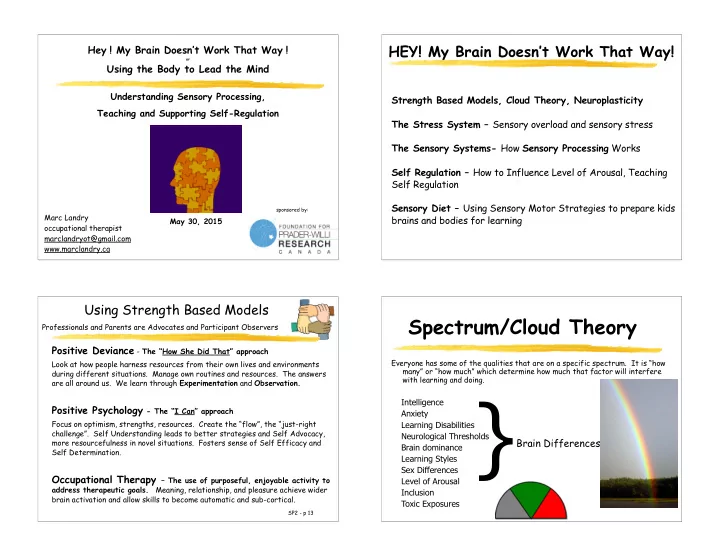
HEY! My Brain Doesn’t Work That Way!

Strength Based Models, Cloud Theory, Neuroplasticity The Stress System – Sensory overload and sensory stress The Sensory Systems- How Sensory Processing Works Self Regulation – How to Influence Level of Arousal, Teaching Self Regulation Sensory Diet – Using Sensory Motor Strategies to prepare kids brains and bodies for learning

Using Strength Based Models

Professionals and Parents are Advocates and Participant Observers

Positive Deviance - The “How She Did That” approach

Look at how people harness resources from their own lives and environments during different situations. Manage own routines and resources. The answers are all around us. We learn through Experimentation and Observation.

Positive Psychology - The “I Can” approach

Focus on optimism, strengths, resources. Create the “flow”, the “just-right challenge”. Self Understanding leads to better strategies and Self Advocacy, more resourcefulness in novel situations. Fosters sense of Self Efficacy and Self Determination.

Occupational Therapy - The use of purposeful, enjoyable activity to

address therapeutic goals. Meaning, relationship, and pleasure achieve wider brain activation and allow skills to become automatic and sub-cortical.

SP2 - p 13

Spectrum/Cloud Theory

Everyone has some of the qualities that are on a specific spectrum. It is “how many” or “how much” which determine how much that factor will interfere with learning and doing.

Intelligence Anxiety Learning Disabilities Neurological Thresholds Brain dominance Learning Styles Sex Differences Level of Arousal Inclusion Toxic Exposures }

Brain Differences

slide-2
SLIDE 2

Hypothalamus in PWS

1 Autonomic control 2 Temperature regulation 3 Thirst and control of body water 4 Appetite control Most clinical and empirical studies document the commonality of hoarding; cognitive rigidity along with the need for sameness, temper outbursts and emotional lability, repetitive and perseverative behaviors and skin-picking. Sensory Issues in the form of an altered sensitivity to pain, failure to exhibit fevers when expected and high rates of skin picking and gouging other body areas are extremely problematic among this group of individuals. Skin picking and other similar self injurious behavior occurs with increased prevalence in PWS. When looking specifically at a population of those with PWS, skin picking is ubiquitous and when quantified, is as prevalent and problematic and in some studies even more so than hyperphagia. It is the source of significant behavior and medical concerns and management challenges. Management is directed towards minimizing both the occurrence and impact of the behavior. To this end, a recent survey of 67 affected children and adolescents documented skin picking in 96% of respondents, which were directly associated with measures of anxiety, inattention,

  • ppositional behaviors, function and quality of life. Thus separate from medical management, behavior

management must be focused on decreasing anxiety and boredom while eliminating opportunities for picking. Poor oral-motor control, muscle hypotonia, decreased pain sensation I SUSPECT LOW REGISTRATION internal with some SENSITIVITY external. 5 5 Endocrine control 6 Emotional reactions 7 Sleep and wakefulness 8 Stress response

Pillars of Brain Health

BDNF (brain-derived neurotrophic factor) increases neurogenesis and synaptogenesis Exercise/Movement (increases energy to brain) Nutrition (Energy and glial support) Stress Management (Brainstem and Limbic Load) Socialization Mental Stimulation (May be work or, better yet, PLAY!) www.nognz.com NEUROPLASTICITY PRUNING NEUROGENESIS SYNAPTOGENESIS

Exercise & Move to Grow Your Brain

They Can’t Pay Attention? Give Them a “Time IN” !!!

Exercise improves cognition/protects neurons

brain systems work better cellular systems in the brain work better stimulates production of GABA in hippocampus this calms brain function, increases stress resistance, reduces fight/ flight reactions, triggers growth of new neurons

Movement cures a bad mood

improves impulse control, attention, motivation, balances arousal, anxiety regulation, entire pre-frontal area

see http://www.johnratey.com http://www.youtube.com/watch?v=hBSVZdTQmDs www.bokskids.org

Factors in AROUSAL

Sensation and Emotion are neurobiologically hard wired together and affect thinking (reticular system, amygdala, locus coeruleus, etc.)

sensation feeling thinking

Is it sensory? YES! sensory overload increases arousal I s i t e m

  • t

i

  • n

a l ? Y E S !

Increased emotions lead to over-arousal, make it harder to use cognition to balance out.

Is it cognition? YES!

We can think ourselves into a frenzy!

slide-3
SLIDE 3

We retrieve memories and formulate action plans according to the level of arousal of our body. Gray zone level

  • f arousal

connects with memories and responses from

  • ther lethargic

and mellow situations from the past. Green zone level

  • f arousal

connects with memories and responses from

  • ther calm and

alert situations from the past. Red zone level

  • f arousal

connects with memories and responses from

  • ther agitated

and frazzled situations from the past.

Stress Response System

(primarily sympathetic activation) TOP-DOWN Stress can be caused by your thinking, by difficulties, problems, etc BOTTOM-UP Stress can be caused by SENSORY OVERLOAD, busy environments, too much stimulation, etc. LOW AROUSAL Low Neurological Arousal can be due to sensory processing, sensory deprivation, being tired, ill, etc.

The Senses are important to learning !

EXTEROCEPTORS v Interoceptors

A U D I T O R Y t a s t e t a c t i l e V I S U A L s m e l l

proprioception "the felt sense" kinesthetic vestibular

vibration light period/rhythm burning freezing pressure(cut) irritation(chem) pain liquid antenna sensing systems

  • ral input itching

first “pain” second “pain” intuition warmth cold nociception chemoreception electric field magnetism accessory olfactory system

12

I need my socks just so, and either love or hate being in bare feet. I always walk on tip toes I seem to have weak gross motor skills I hate being tickled or cuddled I seem to be unaware

  • f touch or pain and

may touch others too soft or too hard. I complain about the tags in my clothing I am a picky eater and resist new foods

  • r textures

I have selective hearing

  • r am uni-sensory

I cry and shield my eyes from sun and

  • ther bright lights

I hate having my hair washed, brushed, cut I have trouble focusing or concentrating I smell everything I chew on everything I seem to have weak fine motor skills I have difficulty dressing myself My posture is weak when I am still I am very sensitive to loud sounds, especially blenders, vacuums, etc.

Signs of Sensory Processing Differences:

slide-4
SLIDE 4

Additional Senses - These are really systems rather than organs. They are hidden, automatic, we are not aware of them and have little control over them. The Vestibular System – Balance/Gravity Processes information about movement and the position of the head in relation to gravity. This enables us to maintain our balance while still or in motion. Information is processed via the tiny fluid filled semicircular canals in the inner ear, as well as utricle and saccule via the medulla. Vestibular nucleii communicate with reticular activating system, limbic system, as well as cerebellum, motor areas, visual cortex. Vestibular processing anomalies are common in persons with autism. The Proprioceptive System – Pressure/Force/Position Processes information about body position through the muscles and joints. Application of regular proprioceptive feedback to the muscles through firm, deep pressure and heavy work, is recommended for many people, because it has been shown to have an organizing effect on the central nervous systems. Kinesthesia – Movement A sense built using information from vestibular and proprioceptive systems as well as stretch and touch receptors. Kinesthesia gives us a sense of what parts of our body are moving and how so. Function requires good proprioception, vestibular function, and felt sense (via arousal system). The Felt Sense – State/whole of emotion/consciousness The Felt Sense is how we experience the fullness of sensation and knowledge about

  • urselves as an organism. This includes internal sensations and synthesis of

different sensations. The felt sense unifies lots of scattered data and infers

  • meaning. The felt sense (developed in insula?) communicates to my nervous system

what is my overall experience in my environment. It is influenced by all sensory input as well as emotions, thoughts, intentions. It is always present, always changing, it is the most basic experience of being alive as an entity. Feeling comfortable, safe, nervous, anxious, happy, are examples. In some contexts (i.e. Eugene Gendlin), the felt sense can be perceived in the body and changes and moves.

For more on the felt sense, see Waking The Tiger by Peter Levine, pgs. 8, 66, 67, 68, 69 and Focusing by Eugene Gendlin

Sensory input

M o d u l a t i o n

habituation vs. sensitization

I n t e r p r e t a t i o n I n t e g r a t i o n

behaviour a t t e n t i

  • n

mood Quality of Movement

Responses

R e g i s t r a t i o n T h i n k i n g

Information Processing

t a c t i l e visual auditory taste smell vestibular proprioceptive kinesthetic felt sense

Attention focuses Modulation Modulation seeks to inhibit ‘Involuntary Attention’

16

Focused Attention Involuntary Attention

slide-5
SLIDE 5

Sensory Modulation Continuum S h u t d

  • w

n

  • A

t t e n t i

  • n

W i t h d r a w a l O r i e n t a t i

  • n

A t t e n d i n g H y p e r f

  • c

u s E s c a l a t i

  • n

A p p r

  • a

c h

/

A v

  • i

d F i g h t

/

F l i g h t S h u t d

  • w

n H a b i t u a t i

  • n

Hard to pay attention Hypo/Under- responsive High Neurological Threshold Poor Registration Sensation Seeking Good Learning State Calm/Alert Attentive Interested Able to Engage with Affect Over-stimulated Hyper/Over-Responsive Low Neurological Threshold Sensitive to Stimuli Sensation Avoiding

Full Range of Responses to Internal/External Sensory Input

Hypo-responsive Behaviors involve:

  • A slow response to a sensory stimuli, requiring high intensity or

increased duration of the stimulus to invoke an observed behavioral response.

  • the person does not respond easily
  • frequently you will see accompanying signs of low tone
  • the child may appear disinterested or lethargic

Hyper-responsive Behaviors involve: A quick or intense response to a sensory stimulus that most other persons perceive as benign. This response results in "fight, flight, fright or freeze). A sensory defensive response is an "emotional" or "visceral" reaction, mediated by the sympathetic nervous system and not under conscious control.

  • Begins with a dump of adrenaline and stress hormones
  • In more extreme cases the child may be aggressive in

response to a gentle touch, or may cry excessively or withdraw when there is too much noise or activity around them. Sensory defensiveness is a descriptor of the aversive or defensive reactions that one may exhibit to sensory stimuli that is not usually considered noxious or

  • verwhelming. The child may respond protectively even though he may

consciously know that the stimulus is not a threat.

Under-Responsive Over-Responsive

slide-6
SLIDE 6

✴Decrease amount of stimuli in environment. ✴Teach child regulating strategies (vest, squeeze, pressure) ✴Provide discriminatory input, (proprioception, body mapping) ✴Use predictable patterns of visual/auditory routines. ✴Provide headphones/white noise ✴Decrease angular and alerting movement. ✴Use chair ball (soft)

Talk to these kids, help them to label and describe sensory experiences and then move on. Social stories work well. Gradually expose them to increasing doses of input, allow them to desensitize at their own rate. HELP THEM TO FEEL SAFE !

✴Honour the child’s need to reduce sensory input (the world feels

dangerous).

✴Gradually broaden sensory processing experiences within the child’s

rituals and habits. Use favourite activities and materials, but gradually increase intensity.

✴Carefully construct events to introduce a wider range of sensory

experiences so the child can habituate to them.

✴Take something the child is comfortable and happy with and expand

sensory qualities.

✴Reduce stress by following the child’s lead and don’t be directing.

When agitated, allow quiet time, allow the child to decompress. Minimize the use of language.

Emotional Regulation

  • Emotional Regulation is a function of the neocortex (human brain) and

the limbic system or mesocortex (mamallian brain). In the cortex, we build meaning for our emotions.

  • We reason with ourselves and tell ourselves stories to help us feel
  • calm. The frontal cortex can moderate and dampen the reactions of

the amygdala and inhibit over-activation of emotional responses.

  • Requires language areas and frontal/executive areas to work together.
  • “Social Stories” (Carol Gray) can help children to achieve Emotional

Regulation by reducing the load on the amygdala.

  • In OT jargon, this is a form of self regulation that we call “top down”
  • r “third order” Self Regulation.
  • Emotional Regulation is not possible if the body is too agitated, or if

fear or anger have cut off the neocortex or cognitive brain.

slide-7
SLIDE 7

Oetter’s Stages of Self Regulation

First order - self regulation is dependent on the autonomic nervous system and its interconnections with the reticular formation and the limbic system. They function to regulate temperature, tone, sleep/wake, monitor for survival, etc. Typically, no conscious control over this area. Automatic Second order - self regulation is reflected in sensorimotor strategies to achieve, maintain and change situation appropriate states. Sensorimotor input and feedback help

  • rganize states, ie. Foot tapping, rocking, thumb sucking, doodling. Using the body to

lead the mind Third order - emergence of higher level cognitive (cortical) skills. At this stage, problem solving abilities and the use of verbal and internal language for organization allow the individual to monitor, plan and evaluate regulatory strategies. “Just this much more and then I will treat myself to…” or “If I don’t get it done, such and such will happen.” Using the mind to lead the body. This can also be called Emotional Regulation, as it is referred to in psychological and educational jargon.

What are Your Sensory-Motor Preferences ?

  • Chew gum
  • sip water
  • hard candy
  • crunchies
  • bite nails
  • smoke
  • popcorn
  • coffee
  • mints
  • sweets
  • rub tongue inside

mouth

  • chew on pencil/

straw

  • Rock, spin on chair
  • squirm/shift in

chair

  • roll head
  • rock body
  • run, jump
  • tap objects or

body parts

  • stretch
  • isometrics
  • balance chair
  • n 2 legs
  • shake feet, etc.
  • Twist hair
  • fidget in pocket
  • cool shower
  • warm bath
  • rub fingers or

clothes on skin

  • hands about mouth

area

  • play with ears, nails,

necklace, sleeve, chin, pencil, pocket contents

  • stare at movement

(fire, fish, rain, clouds, sand and oil toys, spinning things, etc.)

  • Avoid bright light
  • listen to calm or

lively music?

  • Sing or talk to self
  • gravitate toward

rhythm

  • avoid loud noises
  • more intense

reactions than others to unexpected sensory input around you.

Regulatory strategies may include all sensory pathways:

tactile eg. constantly touching objects, one's face or hands; fidget items visual eg. stares out the window, stares at objects in the hand; use slow movement or exaggerate movement, face away from activity ; proprioceptive eg. jumps , pushes, bounces; increase the awareness of gravity, wall pushes, chair push-ups, provide touch pressure vestibular eg. seeks movement with pacing, rocking, or spinning; provide movement in linear , lateral or orbital planes, rocking chair, beach ball seat auditory eg. squeals, hums, repeats directions;slow down communication to allow time for processing, expand the vowel in a word to increase attention to the key word, emphasize action words, use white noise, calm music, headphones to improve focus

  • ral eg. sucks a soother, thumb; eats food, sips drink, chews objects or clothing, oral

motor overflow; provide food to chew or suck; provide a water bottle, chew straws

  • lfactory eg. smells or sniffs objects, make comments re smell

“How Does Your Engine Run?” A Leader’s Guide to The Alert Program™ for Self-Regulation Mary Sue Williams Sherry Shellenburger TherapyWorks Inc. www.alertprogram.com

slide-8
SLIDE 8

FAST SLOW

Teaching Self Regulation (The Alert Program™)

Stage One: Identifying Engine Speeds 1. Child learns engine words or zone colours 2. Adults label their own engine levels 3. Child develops awareness of the feel of engine speeds, using adult’s labels as guides 4. Child learns to identify and label levels for himself 5. Child labels levels for himself Stage Two: Experimenting with Methods to Change Engine Speeds 6. Adults introduce sensory-motor methods to change engine levels 7. Adults identify sensory-motor preferences and sensory hypersensitivities 8. Child begins experimenting with choosing strategies Stage Three: Regulating Engine Speeds 9. Child chooses strategies independently 10. Child uses strategies independently, outside of sessions 11. Child learns to change engine speeds when options are limited 12. Child continues receiving support.

Red Zone – How Does it Feel?

How does my head feel How does my neck/shoulder feel? How do my arms and hands feel? How does my chest feel? How does my stomach feel? How do my legs feel? How does my breathing feel? What else do I feel? What seems to be easiest to notice?

This is half of self regulation - noticing when I am leaving the green zone

Sensory Diet

  • A sensory diet is a balance of activity, exploration and sensation, unique to

an individual, which meets the needs of that individual's sensory system and allows for calm-alert state and wide-brain activation.

  • Its purpose is to help the person become more focused, adaptable, and

skillful.

  • Most people are able to seek and get tactile, proprioceptive, and vestibular

input through their day, as needed, meeting their own sensory needs. That is, most people get their sensory diet met by choosing from the sensory buffet that is always around us in the sensory world.

  • When an individual has not been able to do this, his/her sensory needs have

not been fully met, and this makes it difficult to regulate one’s own state of being and to be available for age appropriate learning and functioning.

slide-9
SLIDE 9

Sensory Diet

From Diana Henry’s “Tools for Teens” www.henryot.com

When I want to keep my engine running “Just right“ What Works? What Bothers Me?

Mouth Mouth Move Move Touch Touch Look Look Listen Listen Smell Smell Pressure / Heavy Work Pressure / Heavy Work

The other half of self regulation - what will help and what will not

Calming slow, rhythmical, pressure, warmth, sweet Alerting fast, changing, cold, sour Organizing deep, heavy, sustained, pulling, pushing

Sensory Diet

Calming activities help to decrease hyper-responsiveness to stimulation.

Deep pressure to head, trunk, shoulders, hands Heavy work as in dragging and pushing or Carrying a weighted backpack Swinging slowly and rhythmically Slow controlled rocking Cuddling & backrubs with pressure Mat sandwich or bean bag press Heavy Work/Proprioception

Self-Calming activities can be initiated by the child or done independently

Specifically asking for or initiating any of the above Calming activities Sucking on a frozen fruit bar or spoon of peanut butter Rubbing hands together Using Palms to press on the sides of the head Wrapping self in a rug or blanket Hugging self (around knees and trunk) Learning to use a rocking chair and swing Going to a quiet area and hugging a blanket or stuffed animal Snuggling into a beanbag chair Brushing hands, sitting on hands

Calming is slow, rhythmical, pressure, warmth, sweet

slide-10
SLIDE 10

Organizing activities help the child to attend and to regulate responses.

Examples include: Pushing or pulling heavy loads Hanging from the hands Being upside down Longer periods of jumping on a trampoline Heavy chewing (gum, fruit roll up, licorice)

Alerting activities help the child to focus longer and be

more alert.

Examples include: Bouncing on the therapy ball Brief jumping on a trampoline Crunchy chewing cold/sour in the mouth

Alerting is fast, changing, cold, sour Organizing is deep, heavy, sustained, pulling, pushing

Some Sensory Diet and Self Regulation Equipment

Sensory TOOLS for grounding and regulating

Can improve listening, thinking, language functions, focus. These only work when kept to the self. They provide the body with movement and touch input. Older students can create their own inventories.

In Your Mouth !

Alerting Foods cold, sour, tart, spicy, minty, crunchy Calming Foods warm, smooth, sweet All Purpose Foods (deep pressure through jaw from chewing) chewy and crunchy foods may belong in this category Non Foods: water, gum, straws to suck, blow or chew, bubble toys aquarium tubing is great for sucking, blowing, and chewing. You can also get plastic hose for water cooler or hospital use that is high quality.

See oral motor section at www.fdmt.ca online store

“Our Chewable Jewels (right) are made from FDA approved food grade silicone and are Phthalate, BPA, PVC, Latex and Lead free products!”

In Your Mouth !

slide-11
SLIDE 11

MOVEMENT!!!!

  • Small movement, big movement, now and then

movement, constant movement

  • Up & down, back and forth, side to side,

round and round (orbital and centrifugal)

  • Movement of mouth/hands/feet can

happen/help when whole body movement is not an option. (mouth items, fidgets, exercise band)

  • Dynamic sitting provides movement input (chair

ball, move’n’sit cushion, t-stool, kneeling).

  • Increased gravity can decrease need for

movement (weighted products, proprioception).

MOVEMENT!!!!

PantoSwing PantoMove The B1

the best chair in the world!

Hokki Stool Zuma Cantilever Zuma Rocker Standing Ask Eric McHaffie eric@jmclimited.ca

Conquer Portable Mini Exercise Bike https://www.theinsidetrainer.com/office-exercise-equipment/ movin sit disc o sit

Move & Work

43

https://www.theinsidetrainer.com/office-exercise-equipment/

Some Sensory Diet and Self Regulation Equipment

Sensory TOOLS for grounding and regulating

Can improve listening, thinking, language functions, focus. These only work when kept to the self. They provide the body with movement and touch input. Older students can create their own inventories.

slide-12
SLIDE 12

Heavy

Involves Pressure/Force and provides a lot of calming sensory feedback from the body. Also promotes core strength and stability, for increased strength and endurance Promote Heavy Work throughout the day, but direct a person to it: When reaching overload when s/he can’t focus or be still, when something challenging is coming, when s/he needs a break from something challenging, when s/he needs to wind down a bit. Before, during, and after collaborative problem solving™ Ross Greene Note what games and jobs work well for the person and when (in general). DO the DETECTIVE WORK! Take cues from what the person’s body is telling you.

Heavy Work

Heavy “Jobs”

Haul groceries into the house and put things away. (include climbing and hands and knees) Sweeping, mopping, wiping boards, desks, raking, mowing, beating a rug Dragging hose, leaf bags, wheelbarrow, cart of balls or playground supplies Pull linens off of the bed and drag down stairs. Move the sofa or classroom furniture Carry laundry basket, carry pots or buckets of water, sand, dirt Move books, office supplies, boxes of paper, trash cans, recycling, lumber, firewood Chopping, sawing, hammering

Heavy Play

Dragging out the box of books, toys Magic Carpet – Kids pull each other on a piece of rug or blanket Walk like different animals (include plenty of 4 leg creatures, i.e. bear, crab, etc Jump on a mini trampoline or rebounder 2 people sit face to face and rock to “row your boat” with rope or inner tube around them Fall into a bean bag chair Encourage hands and knees play with cars, animals (one hand plays, one hand holds you up) Sidewalk chalk, playing in a wet sandbox Tug of war, Pushing games, medicine ball Swinging from rings, bars, jungle gym, hockey Broad jump, jumping off of platforms and playscapes

Handling Stress Implementing Change

Common reactions to stress are ESCAPE and AVOIDANCE. These interfere with task performance and need to be worked on. Baseline cortisol levels set in first 6 years of life. Stress challenges us to adapt or cope, and these are better strategies than avoidance. Stress that makes us stronger is usually moderate, predictable, and patterned, unless it happens when the individual/system is overloaded. Stress (cortisol) damages the hippocampus, involved in new memory/learning. Neurological reactions to stress and anxiety can be neurotoxic if not modulated. Perceptions of what is stressful can change, and are often controlled by autonomic function (sensory processing) and emotional and cognitive factors. Rather than avoiding a stressor, we can seek to reduce the reaction we generate to the stressor. Learning to expect and accept stress can help to take the power away from our stress reactions. What is stressful for a child can be very different from what you might expect, and is very different for different brain types, different environments, families Stress factors: anxiety, demands, energy levels, illness, toxins, sleep, diet, love, movement

Environment vs. Sensory Processing Style The Environment can be the Stressor

Visual-

  • Is the lighting is too bright or shining directly into the child’s eyes.
  • The flicker of fluorescent lighting or computer monitors may be bothersome.
  • Look at what is in the child’s usual line of view, is it visually overstimulating (i.e. too

bright, too cluttered)?

  • Keep visual tasks and work area clear, neat, and meaningful.
  • Some children will miss important visual cues because of competing visual input.
  • Does the child need to process some or all of his/her work in a separate calm area?
  • Are there too many things or people in the visual field between the child and the teacher?
  • Is there a quiet area that is darker than the general environment and visually calming

to withdraw to for calming purposes?

Auditory-

  • Is the noise level too high? The child may need to work in a quieter area to decrease
  • stimulation. (Just how loud and disorganizing is your lunch room?)
  • Would white noise help? (Headphones by themselves or with accompanying soft sounds,

such as ocean or nature music, classical or new age music)

  • Is the child too near to fans, heaters, discussion groups?
  • Why do the bells need to be that loud? Put a muffler on it. You may need to take

extra precautions for fire alarms. The hypersensitive child with autism may need to be absent or leave immediately.

  • Constant streams of language can be very stressful with a language processing delay/disability.
slide-13
SLIDE 13

Auditory - (cont)

  • Rhythm is often tolerated better than loud speech.
  • Try adding a carpet to absorb noise, or place slit tennis balls under the chair legs.
  • Some children don’t hear their name called when attending to distracting background

noise, others make continuous sounds to try to block out the background noise.

  • Are excess noises muffled in the quiet area? Use room dividers, carpeting, blankets, and other soft,

sound absorbing textures. Tactile

  • Note reactions to hard and soft materials.
  • Observe differences due to temperature of items (metals are colder).
  • The child may avoid different textures. If the child does not tolerate play-dough, glue,

fingerpaint, mud, and other goopy textures these may need to be introduced very gradually.

  • If the child will only hold items with his/her fingertips, tactile hand desensitization may need to precede
  • activities. Handling things from a “feelie box”, brushing the hands, or starting with a deep lotion hand

massage are examples.

  • A hard chair may feel cold to the child, if so, use a pad or cushion.
  • Provide a variety of textured materials and objects in the quiet area.
  • Is the child’s clothing well tolerated? Transitions, including seasonal changes in clothing, may need to be

slow and gradual. Don’t fuss over long sleeve vs. short sleeve. It may be necessary to allow the child to leave on coat/jacket until ready to have it off.

  • Have the child be first or last in line if lightly bumping or touching peers is irritating.
  • The sound or feel of water may be irritating or scary, especially when unexpected or not in control.

Environment vs. Sensory Processing Style The Environment can be the Stressor

Vestibular-

  • Some children will crave movement and seek the feeling of heights and swings. Assess

safety factors (balance and grip on swing). Generally, the child who craves these sensations can handle them.

  • Try incorporating movement into activities (getting materials, sharpen pencil, etc.)

Or allow short movement breaks during tasks/chores.

  • Try sitting on a ball, air cushion, t-stool, allow alternate positions
  • Is the child fearful of heights, stairs, ladders on slides? If so, beware of stands or

stairs with no back (you can see through to behind them), as they are more

  • threatening. Gravitational Insecurity is real and is rooted in neurology, not behaviour.
  • Plan an alternative route if a child is not ready to use an escalator or an elevator.
  • Children who are fearful of heights or movement may react with fear on playgrounds.
  • ften, remaining on the periphery and watching others may help. The child may

need to very gradually explore a playground area, in isolation, at a quiet time of the day.

Environment vs. Sensory Processing Style

Sensory Web sites

Henry's Occupational Therapy Services. www.henryot.com Diana Henry lists her strategies for occupational therapists, teachers and parents. Southpaw Inc. Sensory Integration Products www.southpawenterprises.com www.incrediball.ca therapy balls, chair balls, etc www.flaghouse.ca physical education and therapy supplies

Brain Links

zQuantum Physics www.whatthebleep.com zhttp://www.brainhighways.com http://www.johnratey.com http://www.youtube.com/watch?v=hBSVZdTQmDs www.bokskids.org

www.nognz.co

Reading List

Amen, Daniel Change your Brain, Change your Life 1999 Dispenza, Joe, DC Evolve Your Brain – The Science of Changing Your Mind 2007 Doidge, Norman, MD The Brain that Changes Itself 2007 Green, Ross The Explosive Child 2010 Green, Ross Lost in School 2009 Levine, Mel A Mind at a Time 2002 Lehrer, Jonah How We Decide 2009 Perry, Bruce and Szalavitz, Maia The Boy who was Raised as a Dog 2007 Born For Love 2010 Pert, Candace Molecules of Emotion 1997 Sarno, John The Mindbody Prescription 1998 Stock-Kranowitz, Carol The Out of Sync Child The Out of Synch Child Has Fun 52

www.marclandry.ca Visit my website for the following:

“Workshop Materials” Recommended Reading and Links Self Regulation gauges Relaxation Book & Social Stories Fine Motor Planner “What Works” “Red Zone” and “Safe Place” forms Teaching Self Regulation Handout The Scarfe Papers (“Play”) Advocacy Support My Newsletters Resources Information about my private practice (“About Me”)