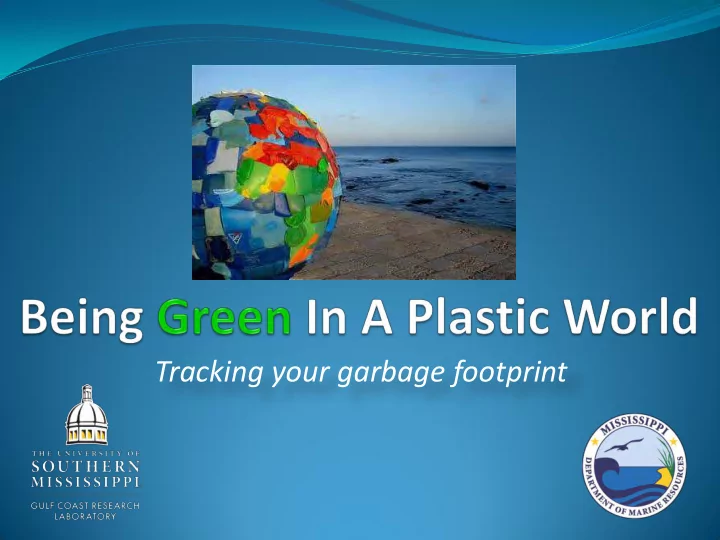
Tracking your garbage footprint Marine Debris Environmental & - - PowerPoint PPT Presentation

tracking your garbage footprint marine debris
SMART_READER_LITE
LIVE PREVIEW

Tracking your garbage footprint Marine Debris Environmental & - - PowerPoint PPT Presentation

Tracking your garbage footprint Marine Debris Environmental & Human Impact The Great Biodegredation Debate Micro-Plastics and Bioaccumulation How To Be Green In A Plastic World Any type of man-made, organic or inorganic


slide-1
SLIDE 1

Tracking your garbage footprint

slide-2
SLIDE 2

 Marine Debris  Environmental & Human Impact  The Great Biodegredation Debate  Micro-Plastics and Bioaccumulation  How To Be Green In A Plastic World

slide-3
SLIDE 3

 Any type of man-made, organic or inorganic material

dispersed into the water system, ending up in the

  • cean, becoming caught in gyres and spread by
  • currents. Ending up on the shore, suspended in the

water column or on the ocean floor.

slide-4
SLIDE 4

What happens to trash after you throw it away?

On-Shore sources Off-Shore sources

slide-5
SLIDE 5

Land to water pollution effects:

 Degradation of the quality and health of our oceans  Damage to marine habitats  Irrevocable harm to marine life  Significant risks to human health and safety

slide-6
SLIDE 6

Entanglement

slide-7
SLIDE 7

Ghost Fishing

slide-8
SLIDE 8

An Oily Mess

slide-9
SLIDE 9

Human Health & Safety

slide-10
SLIDE 10

Four Factors

slide-11
SLIDE 11
slide-12
SLIDE 12
slide-13
SLIDE 13

Biodegradable Plastics?

1.) Break up into plastic polymers (micro plastics) — Yes 2.) Break up into CO2 + H2O by way of microorganisms (mineralization) — No

slide-14
SLIDE 14

Pieces of plastic debris ≤ 5 mm Primary Sources

slide-15
SLIDE 15

“Although useful and desirable for many purposes, the indestructibility of petroleum-based plastic is a growing concern because of its accumulation in the environment.”

  • Paetau et.al Iowa State University 1994

Secondary Sources

slide-16
SLIDE 16

 1.)Polyethylene  2.) Polypropylene  3.) Polystyrene  4.) Polyvinyl Chloride

slide-17
SLIDE 17

“Plastic resin pellets concentrate such poisons to levels as high as a million times their concentration in the water as free-floating substances.” (Hideshoge Takada- Tokyo University)

Polychlorinated Biphenyl’s (PCB’s) Dichlorodiphenyl Trichloroethane (DDT)

slide-18
SLIDE 18
slide-19
SLIDE 19

Bioaccumulation

slide-20
SLIDE 20

Brown Pelican, Bald Eagle, Osprey VS DDT

slide-21
SLIDE 21
slide-22
SLIDE 22

Reduce

 Paper or Plastic?! … Neither!

 Use Reusable Shopping Bags

 14 plastic bags contain enough petroleum to drive a car a

mile!

 380 billion plastic bags or wraps are thrown away in

America each year!

  • Making paper bags emits 70% more

global warming gases than the production of plastic bags.

slide-23
SLIDE 23

Reuse

 Just say NO to beverages in plastic bottles

 Most bottled water is filtered tap water

 Explore alternative storage options

slide-24
SLIDE 24

Recycle

 Check with your local recycling center for acceptable items

slide-25
SLIDE 25

 Mississippi Coastal Clean-Up: October 20th, 2012  Mississippi Marine Debris Removal & Prevention

Project: 2012-2014

 Pick up trash you see it… even if it isn’t yours!

slide-26
SLIDE 26

 The ultimate solution to pollution is a reduction

in consumption of persistent pollutants.

 Be aware of what you buy; a conscience consumer

is a smart consumer

 Participate in or start a local trash clean up in your

area!

slide-27
SLIDE 27