Traditional view of language A connectionist approach to sentence - - PowerPoint PPT Presentation

traditional view of language a connectionist approach to
SMART_READER_LITE
LIVE PREVIEW

Traditional view of language A connectionist approach to sentence - - PowerPoint PPT Presentation

Traditional view of language A connectionist approach to sentence processing (Elman, 1991) S NP VI . | NP VT NP . Language knowledge largely consists of an explicit grammar that determines what NP N | N RC sentences are part of a language


slide-1
SLIDE 1

Traditional view of language

Language knowledge largely consists of an explicit grammar that determines what sentences are part of a language

Isolated from other types of knowledge—pragmatic, semantic, lexical(?)

Language learning involves identifying the single, correct grammar of the language Grammar induction is underconstrained by the linguistic input given lack of explicit negative evidence

Impossible under near-arbitrary positive-only presentation (Gold, 1967)

Language learning requires strong innate linguistic constraints to narrow the range of possible grammars considered

1 / 22

Statistical view of language

Language environment has rich distributional regularities

May not provide correction but is certainly not adversarial (cf. Gold, 1967)

Language learning requires only that knowledge across speakers converges sufficiently to support effective communication No sharp division between linguistic vs. extra-linguistic knowledge

Effectiveness of learning depend both on the structure of the input and on existing knowledge (linguistic and extra-linguistic)

Distributional information can provide implicit negative evidence

Example: implicit prediction of upcoming input Sufficient for language learning when combined with domain-general biases

2 / 22

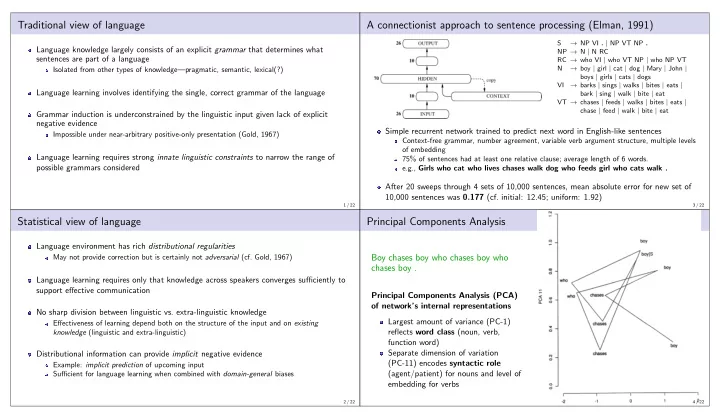
A connectionist approach to sentence processing (Elman, 1991)

S → NP VI . | NP VT NP . NP → N | N RC RC → who VI | who VT NP | who NP VT N → boy | girl | cat | dog | Mary | John | boys | girls | cats | dogs VI → barks | sings | walks | bites | eats | bark | sing | walk | bite | eat VT → chases | feeds | walks | bites | eats | chase | feed | walk | bite | eat

Simple recurrent network trained to predict next word in English-like sentences

Context-free grammar, number agreement, variable verb argument structure, multiple levels

  • f embedding

75% of sentences had at least one relative clause; average length of 6 words. e.g., Girls who cat who lives chases walk dog who feeds girl who cats walk .

After 20 sweeps through 4 sets of 10,000 sentences, mean absolute error for new set of 10,000 sentences was 0.177 (cf. initial: 12.45; uniform: 1.92)

3 / 22

Principal Components Analysis

Boy chases boy who chases boy who chases boy .

Principal Components Analysis (PCA)

  • f network’s internal representations

Largest amount of variance (PC-1) reflects word class (noun, verb, function word) Separate dimension of variation (PC-11) encodes syntactic role (agent/patient) for nouns and level of embedding for verbs

4 / 22

slide-2
SLIDE 2

Sentence comprehension

Traditional perspective Linguistic knowledge as grammar, separate from semantic/pragmatic influences on performance (Chomsky, 1957) Psychological models with initial syntactic parse that is insensitive to lexical/semantic constraints (Ferreira & Clifton, 1986; Frazier, 1986) Problem: Interdependence of syntax and semantics The spy saw the policeman with a revolver The spy saw the policeman with binoculars The bird saw the birdwatcher with binoculars The pitcher threw the ball The container held the apples/cola The boy spread the jelly on the bread Alternative: Constraint satisfaction Sentence comprehension involves integrating multiple sources of information (both semantic and syntactic) to construct the most plausible interpretation of a sentence (MacDonald et al.,

1994; Seidenberg, 1997; Tanenhaus & Trueswell, 1995)

5 / 22

Sentence Gestalt Model (St. John & McClelland, 1990)

Trained to generate thematic role assignments of event described by single-clause sentence Sentence constituents (≈ phrases) presented one at a time After each constituent, network updates internal representation of sentence meaning (“Sentence Gestalt”) Current Sentence Gestalt trained to generate full set of role/filler pairs (by successive “probes”)

Must predict information based on partial input and learned experience, but must revise if incorrect

6 / 22

Event structures

14 active frames, 4 passive frames, 9 thematic roles Total of 120 possible events (varying in likelihood)

7 / 22

Sentence generation

Given a specific event, probabilistic choices of

Which thematic roles are explicitly mentioned What word describes each constituent Active/passive voice

Example: busdriver eating steak with knife

the-adult ate the-food with-a-utensil the-steak was-consumed-by the-person someone ate something

Total of 22,645 sentence-event pairs

8 / 22

slide-3
SLIDE 3

Acquisition

Sentence types Active syntactic: the busdriver kissed the teacher Passive syntactic: the teacher was kissed by the busdriver Regular semantic: the busdriver ate the steak Irregular semantic: the busdriver ate the soup

Results Active voice learned before passive voice Syntactic constraints learned before semantic constraints Final network tested on 55 randomly generated unambiguous sentences

Correct on 1699/1710 (99.4%) of role/filler assignments

9 / 22

Implied constituents

10 / 22

Online updating and backtracking

11 / 22

Semantic-syntactic interactions

Lexical ambiguity Concept instantiation Implied constituents

12 / 22

slide-4
SLIDE 4

Noun similarities

13 / 22

Verb similarities

14 / 22

Summary: St. John and McClelland (1990)

Syntactic and semantic constraints can be learned and brought to bear in an integrated fashion to perform online sentence comprehension Approach stands in sharp contrast to linguistic and psycholinguistic theories espousing a clear separation of grammar from the rest of cognition

15 / 22

Sentence comprehension and production (Rohde)

Extends approach of Sentence Gestalt model to multi-clause sentences Trained to generate learned “message” representation and to predict successive words in sentences when given varying degrees of prior context

16 / 22

slide-5
SLIDE 5

Training language

Multiple verb tenses

e.g., ran, was running, runs, is running, will run, will be running

Passives Relative clauses (normal and reduced) Prepositional phrases Dative shift

e.g., gave flowers to the girl, gave the girl flowers

Singular, plural, and mass nouns 12 noun stems, 12 verb stems, 6 adjectives, 6 adverbs Examples

The boy drove. An apple will be stolen by the dog. Mean cops give John the dog that was eating some food. John who is being chased by the fast cars is stealing an apple which was had with pleasure.

17 / 22

Encoding messages with triples

The boy who is being chased by the fast dogs stole some apples in the park .

18 / 22

Message encoder

Methods Triples presented in sequence For each triple, all presented triples queried three ways (given two elements, generate third) Trained on 2 million sentence meanings Results Full language Triples correct: 91.9% Components correct: 97.2% Units correct: 99.9% Reduced language (≤10 words): Triples correct: 99.9%

19 / 22

Training: Comprehension (and prediction)

Methods No context on half of the trials Context was weak clamped (25% strength) on other half Initial state of message layer clamped with varying strength Results Correct query responses with comprehended message: Without context: 96.1% With context: 97.9%

20 / 22

slide-6
SLIDE 6

Testing: Comprehension of relative clauses

Single embedding: Center- vs. Right-branching; Subject- vs. Object-relative

CS: A dog [who chased John] ate apples. RS: John chased a dog [who ate apples]. CO: A dog [who John chased] ate apples. RO: John ate a dog [who the apples chased].

Empirical Data Model

21 / 22

Testing: Production

Methods Message initialized to correct value and weak clamped (25% strength) Most actively predicted word selected for production No explicit training Results 86.5% of sentences correctly produced.

22 / 22