SLIDE 1 Slide 1 / 273 Slide 2 / 273
Geometry
Transformations
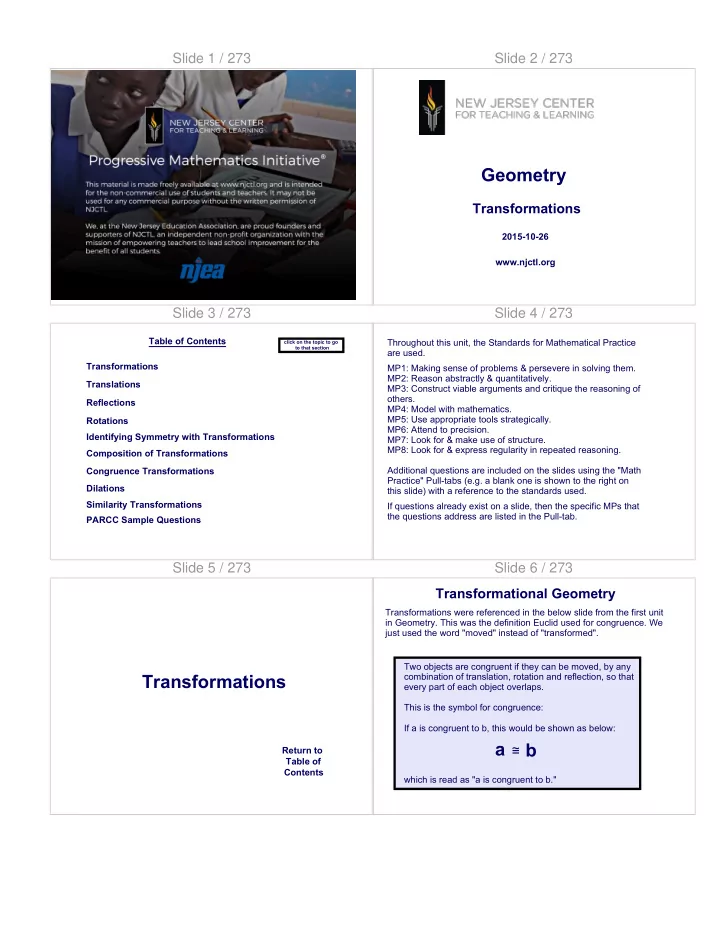
2015-10-26 www.njctl.org
Slide 3 / 273
Table of Contents Reflections Translations Rotations Composition of Transformations Transformations
click on the topic to go to that section
Dilations Congruence Transformations Similarity Transformations Identifying Symmetry with Transformations PARCC Sample Questions
Slide 4 / 273
Throughout this unit, the Standards for Mathematical Practice are used. MP1: Making sense of problems & persevere in solving them. MP2: Reason abstractly & quantitatively. MP3: Construct viable arguments and critique the reasoning of
MP4: Model with mathematics. MP5: Use appropriate tools strategically. MP6: Attend to precision. MP7: Look for & make use of structure. MP8: Look for & express regularity in repeated reasoning. Additional questions are included on the slides using the "Math Practice" Pull-tabs (e.g. a blank one is shown to the right on this slide) with a reference to the standards used. If questions already exist on a slide, then the specific MPs that the questions address are listed in the Pull-tab.
Slide 5 / 273
Transformations
Return to Table of Contents
Slide 6 / 273
Two objects are congruent if they can be moved, by any combination of translation, rotation and reflection, so that every part of each object overlaps. This is the symbol for congruence: If a is congruent to b, this would be shown as below: which is read as "a is congruent to b."
a b
Transformations were referenced in the below slide from the first unit in Geometry. This was the definition Euclid used for congruence. We just used the word "moved" instead of "transformed".
Transformational Geometry ≅
SLIDE 2 Slide 7 / 273 Transformational Geometry
Even though the idea that objects are congruent if they can be moved so that they match up is an underlying idea of geometry, it was not used directly by Euclid. Nor have we used that idea directly in this course, so far. Instead Euclid developed what we now call Synthetic Geometry, based on the idea that we can construct objects which are congruent. That's what we've been using so far.
Slide 8 / 273 Transformations
The reason for that is that although two objects could look the same, that doesn't prove that they are the same. We would never accept as a proof that two figures in a drawing look like they would line up, therefore they are congruent. However, with analytic geometry, it became possible to exactly "move" an object and prove if all its points lined up with a second
If so, the objects are congruent. This is transformational geometry.
Slide 9 / 273
In 1872 Felix Klein created an approach to mathematics based on using transformations to prove objects congruent.
Transformations
Transformational Geometry built on the synthesis of algebra and geometry created by Analytic Geometry. It led to a further synthesis with Group Theory and other forms of mathematics which were being developed in more advanced algebra. We will explore this using transformations on the Cartesian plane to prove that figures are congruent or similar. Felix Klein 1849 - 1925
Slide 10 / 273
First, let's review the ideas of rigid transformations and then we'll develop some new notation to keep those ideas straight. Remember, rigid transformations move an object without changing its size or shape. They include translations, rotations and reflections. Dilations are NOT rigid transformations since they change the size of the object, even though they preserve its shape.
Transformations Slide 11 / 273
A transformation of a geometric figure is a mapping that results in a change in the position, shape, or size of the figure. In the game of dominoes, you often move the dominoes by sliding them, turning them or flipping them. Each of these moves is a type of transformation. translation - slide rotation - turn reflection - flip
Transformations Slide 12 / 273
In a transformation, the original figure is the preimage, and the resulting figure is the image. In the examples below, the preimage is green and the image is pink.
Transformations
SLIDE 3 Slide 13 / 273
Some transformations (like the dominoes) preserve distance and angle measures. These transformations are called rigid motions. To "preserve distance" means that the distance between any two points of the image is the same as the distance between the corresponding points of the preimage. Since distance is preserved in rigid motions, so will other measurements in the figures that rely on distance. For example, both the perimeter and area of the shape will remain the same after the completion of a rigid motion. To "preserve angles" means that the angles of the image have the same measures as the corresponding angles in the preimage.
Transformations Slide 14 / 273
Translation- slide Rotation-turn Dilation - Size change Reflection- Flip Which of these is a rigid motion?
Transformations Slide 15 / 273
A transformation maps every point of a figure onto its image and may be described using arrow notation ( ). Prime notation (' ) is sometimes used to identify image points. In the diagram below, A' is the image of A.
A B C' B' A' C
ΔABC ΔA'B'C' ΔABC maps onto ΔA'B'C' Note: You list the corresponding points of the preimage and image in the same order, just as you would for corresponding points in congruent figures or similar figures.
Transformations Slide 16 / 273
1 Does the transformation appear to be a rigid motion? Explain. A Yes, it preserves the distance between consecutive points. B No, it does not preserve the distance between consecutive points. Image Preimage
Slide 17 / 273
2 Does the transformation appear to be a rigid motion? Explain. A Yes, distances are preserved. B Yes, angle measures are preserved. C Both A and B. D No, distances are not preserved.
Image Preimage
Slide 18 / 273
3 Which transformation is not a rigid motion? A Reflection B Translation C Rotation D Dilation
SLIDE 4 Slide 19 / 273
4 Which transformation is demonstrated? A Reflection B Translation C Rotation D Dilation
Slide 20 / 273
5 Which transformation is demonstrated? A Reflection B Translation C Rotation D Dilation
Slide 21 / 273
6 Which transformation is demonstrated? A Reflection B Translation C Rotation D Dilation
Slide 22 / 273
m
7 Quadrilateral ABCD below is reflected about line m. After the reflection, how is the perimeter of A'B'C'D' be related to the perimeter of ABCD? A Because reflection is a rigid motion that preserves the distance between consecutive points, the perimeter will remain the same. B Because reflection is not a rigid motion and does not preserve the distance between consecutive points, the perimeter will change.
Slide 23 / 273
8 Quadrilateral ABCD below is rotated 180°. After the rotation, how is the area of A'B'C'D' be related to the area
A Because rotation is a rigid motion that preserves the distance between consecutive points, the area will remain the same. B Because rotation is not a rigid motion and does not preserve the distance between consecutive points, the area will change.
Slide 24 / 273
Translations
Return to Table of Contents
SLIDE 5
Slide 25 / 273
A translation is a transformation that maps all points of a figure the same distance in the same direction.
Translations
A C A' B' B C'
Slide 26 / 273
That means that any line drawn from a point on the preimage to the corresponding point on the image will be of equal length. AA' = BB' = CC'
Translations
A C A' B' B C'
Slide 27 / 273
That also means that the lengths of the sides of the preimage and image will be the same. AB = A'B', BC = B'C', AC = A'C'
Translations
A C A' B' B C'
Slide 28 / 273
A C A' B' B C' And, that the corresponding angles in the preimage and image are congruent.
Translations
m∠A = m∠A' m∠B = m∠B' m∠C = m∠C'
Slide 29 / 273
A C A' B' B C'
Translations
So far, so good...but if I'm given these two triangles, how do I prove them congruent based on using transformations. That's made possible by adding in Analytic Geometry through the use of a Cartesian plane.
Slide 30 / 273
A C A' B' B C' If I can show that translating each of the vertices of ΔABC in the same way results in them lining up with all the vertices of ΔA'B'C' then we have proven those Δs ≅.
Translations
SLIDE 6 Slide 31 / 273
A C A' B' B C' In this case, we show below that each preimage vertex is translated to each image vertex by translating up 4 units (positive y-direction) and 10 units right (positive x-direction).
Translations Slide 32 / 273
A C A' B' B C'
Translations
While, strictly speaking, we need to do that for every point, not just every vertex, we can be confident that once the endpoints line up, so will all of the points on the line segements that connect them.
Slide 33 / 273
A C A' B' B C'
Translations
The letter "T" means "translation" and the two numbers in its subscript are the units moved along the x-axis and the the y- axis in order to transform ΔABC into ΔA'B'C' . The symbol → indicates that transformation. The order of the subscripts is the same as it is for an
The notation to describe this translation is: T<10,4>: (ΔABC) → ΔA'B'C'
Slide 34 / 273 Translations in the Coordinate Plane
A A' B B' C C' D D' Each (x, y) pair in ABCD is mapped to (x + 9, y - 4). You can use the function notation T<9, -4>: (ABCD) = A'B'C'D' to describe the translation. B is translated 9 units right and 4 units down.
Slide 35 / 273
D F E
Finding the Image of a Translation
T<-2, 5> : (ΔDEF) → ΔD'E'F' What are the coordinates of the preimage and image vertices? D ( ) D' ( ) E ( ) E' ( ) F ( ) F' ( ) Graph the image of ΔDEF. Draw DD', EE' and FF'. What relationships exist among these three segments? How do you know?
Slide 36 / 273
P P' Q Q' R R' S S'
Writing a Translation Rule
Write a translation rule that maps PQRS → P'Q'R'S'.
SLIDE 7
Slide 37 / 273
9 In the diagram, ΔA'B'C' is an image of ΔABC. Which rule describes the translation? A T<-5,-3> : (ΔABC) B T<5,3> : (ΔABC) C T<-3,-5> : (ΔABC) D T<3,5> : (ΔABC)
Slide 38 / 273
10 If T<4, -6>: (JKLM) → (J'K'L'M'), what translation maps J'K'L'M' onto JKLM? A B C D T<4, -6>: (J'K'L'M') T<6, -4>: (J'K'L'M') T<6, 4>: (J'K'L'M') T<-4, 6>: (J'K'L'M')
Slide 39 / 273
11 ΔRSV has coordinates R(2, 1), S(3, 2), and V(2, 6). A translation maps point R to R' at (-4, 8). What are the coordinates of S' for this translation? A (-6, -4) B (-3, 2) C (-3, 9) D (-4, 13) E none of the above
Slide 40 / 273
Reflections
Return to Table of Contents
Reflections Activity Lab (Click for link to lab)
Slide 41 / 273
A reflection is a transformation of points over a line. This line is called the line of reflection. In this case, the line of reflection is line m. The result looks like the preimage was flipped over the line; the preimage and the image have opposite orientations.
Reflection
A B C A B C A' B' C' line of reflection m m
Slide 42 / 273 Reflection
A B C A' B' C' Any point of the image which lies on the line of reflection maps onto itself. In this case, B = B'.
SLIDE 8
Slide 43 / 273 Reflection
A B C A' B' C' Lines which connect corresponding points on the image and pre- image are bisected by, and are perpendicular to, the line of reflection. In this case, line m is the perpendicular bisector of AA' and CC'. m
Slide 44 / 273 Reflection
A B C A' B' C' m The reflection across m that maps ΔABC → ΔA'B'C' is written as Rm : ΔABC → ΔA'B'C The subscript after "R" is the name of the line of reflection.
Slide 45 / 273
When reflecting a figure, reflect the vertices and then draw the sides. Reflect ABCD over line r. Label the vertices of the image.
A B C D r Reflection
Click here to see a video
Slide 46 / 273
Reflect WXYZ over line s. Label the vertices of the image.
s W X Y Z
Hint: Turn page so line of symmetry is vertical
Reflection Slide 47 / 273
Reflect MNP over line t. Label the vertices of the image.
t M N P
Where is the image of N? Why?
Reflection Slide 48 / 273
X A B C D 12 Which point represents the reflection of X? A point A B point B C point C D point D E None of the above
SLIDE 9
Slide 49 / 273
13 Which point represents the reflection of X? A point A B point B C point C D point D E none of the above X A B C D
Slide 50 / 273
14 Which point represents the reflection of X? A point A B point B C point C D point D E none of the above X A B C D
Slide 51 / 273
D A B C 15 Which point represents the reflection of D? A point A B point B C point C D point D E none of these
Slide 52 / 273
16 Is a reflection a rigid motion? Yes No
Slide 53 / 273 Reflections in the Coordinate Plane
Since reflections are perpendicular to and equidistant from the line of reflection, we can find the exact image of a point or a figure in the coordinate plane.
Slide 54 / 273 Reflections in the Coordinate Plane
Reflect A, B, & C over the y-axis. A B C Ry-axis :(A) → A' Ry-axis :(B) → B' Ry-axis :(C) → C' How do the coordinates of each point change when the point is reflected over the y-axis?
SLIDE 10 Slide 55 / 273
M K L J
Reflections in the Coordinate Plane
Rx-axis :(JKLM) → (J'K'L'M') Draw the vertices and then the image. How do the coordinates of a point change when it is reflected over the x-axis?
Slide 56 / 273
M J K L
Reflections in the Coordinate Plane
Ry-axis :(JKLM) → (J'K'L'M') Draw the vertices and then the image. How do the coordinates of a point change when it is reflected over the y-axis?
Slide 57 / 273
A B D C
Reflections in the Coordinate Plane
Ry=x :(A, B, C, D) → (A', B', C', D') Draw the line y = x. Then draw the points A', B', C', and D' How do the coordinates of a point change when it is reflected over the line y = x?
Slide 58 / 273
A B C
Reflections in the Coordinate Plane
Rx=2 :(ΔABC) →:(ΔA'B'C') Draw ΔA'B'C' Can you determine how the coordinates of a point change when it is reflected
*Hint: draw line of reflection first
Slide 59 / 273
M N P Q
Reflections in the Coordinate Plane
Ry=-3 :(MNPQ) → (M'N'P'Q') Draw M'N'P'Q' Can you determine how the coordinates of a point change when it is reflected
Slide 60 / 273
A B C E D F
- 1. Rx-axis(A)
- 2. Ry-axis(B)
- 3. Ry=1(C)
- 4. Rx=-1(D)
- 5. Ry=x(E)
- 6. Rx=-2(F)
Find the Coordinates of Each Image
SLIDE 11 Slide 61 / 273
17 The point (4, 2) reflected over the x-axis has an image of ______. A (4, 2) B (-4, -2) C (-4, 2) D (4, -2)
Slide 62 / 273
18 The point (4, 2) reflected over the y-axis has an image of _____. A (4, 2) B (-4, -2) C (-4, 2) D (4, -2)
Slide 63 / 273
19 B has coordinates (-3, 0). What would be the coordinates of B' if B is reflected over the line x = 1? A (-3, 0) B (4, 0) C (-3, 2) D (5, 0)
Slide 64 / 273
20 The point (4, 2) reflected over the line y = 2 has an image of _____. A (4, 2) B (4, 1) C (2, 2) D (4, -2)
Slide 65 / 273
21 Triangle ABC is graphed in the coordinate plane with vertices A(1, 1), B(3, 4), and C(-1, 8) as shown in the figure. A B C D Part A Triangle ABC will be reflected across the line y = 1 to form ΔA'B'C'. Select all quadrants
- f the xy-coordinate plane
that will contain at least one vertex of ΔA'B'C'. PARCC Released Question - EOY - Calculator Section - Question #14
Slide 66 / 273
22 Triangle ABC is graphed in the coordinate plane with vertices A(1, 1), B(3, 4), and C(-1, 8) as shown in the figure.
Students type their answers here
Part B Triangle ABC will be reflected across the line y = 1 to form ΔA'B'C'. What are the coordinates of B'? PARCC Released Question - EOY - Calculator Section - Question #14
SLIDE 12 Slide 67 / 273
Rotations
Return to Table of Contents Rotations Activity Lab (Click for link to lab)
Slide 68 / 273
P x° A A' B' B C' C A B C P Rotations are the third, and final, rigid transformation. A rotation is usually described by the number of degrees (including direction) and the center of rotation. In this case, we will rotate xº clockwise around the point P.
Rotations Slide 69 / 273
P x° A A' B' B C' C The center of rotation, P, is never changed by the rotation: P = P'. This is always true, whether P is part of the figure or
This can be useful in solving problems.
Rotations Slide 70 / 273
P x° A A' B' B C' C For any point other than P: PB' ≅ PB. That means that the distance from the center of rotation to a point's preimage is the same as the distance to that point's image.
Rotations Slide 71 / 273
P x° A A' B' B C' C The measure of the angle whose vertices are a point's preimage, the center of rotation and the point's image is equal to the measure of the angle of rotation. The m∠BPB' = xº
Rotations Slide 72 / 273
P x° A A' B' B C' C Rotations in the counterclockwise direction are considered positive. Rotations in the clockwise direction are considered negative.
Rotations
SLIDE 13
Slide 73 / 273
P x° A A' B' B C' C
Rotations
A counterclockwise rotation of xº about point P is written: r(x°,P) In this case, since the rotation is clockwise, the transformation is: r(-x°,P) :(ΔABC) → (ΔA'B'C') Counterclockwise rotations are considered positive. So, mapping this image to its preimage would be written as: r(x°, P):(ΔA'B'C') → (ΔABC)
Slide 74 / 273 Drawing Rotation Images
r(70°,C) :(ΔLOB) → (ΔL'O'B')
O L B C
Slide 75 / 273 Drawing Rotation Images
O L B C
Step 1 Draw a line from C to any vertex, for instance B. r(70°,C) :(ΔLOB) → (ΔL'O'B')
Slide 76 / 273 Drawing Rotation Images
O L B C
Step 1 Draw a line from C to any vertex, for instance B. r(70°,C) :(ΔLOB) → (ΔL'O'B')
Slide 77 / 273
r(70°,C) :(ΔLOB) → (ΔL'O'B')
Drawing Rotation Images
O L B C
Step 2 Place a protractor along the line with it's center at the center of rotation, C, and draw a ray at a 70º angle from line CO (CCW since this rotation is positive). All angle measures must be centered on C, the center of rotation.
Slide 78 / 273
r(70°,C) :(ΔLOB) → (ΔL'O'B')
Drawing Rotation Images
O L B C
Step 3. Use a compass to make a line segment on the new ray the same length as CB.
SLIDE 14 Slide 79 / 273 Drawing Rotation Images
r(70°,C) :(ΔLOB) → (ΔL'O'B')
O L B C
Step 4. Label the new point B'.
B '
Slide 80 / 273 Drawing Rotation Images
r(70°,C) :(ΔLOB) → (ΔL'O'B')
O L B C
Step 4. Repeat for all vertices.
B' L'
Slide 81 / 273 Drawing Rotation Images
r(70°,C) :(ΔLOB) → (ΔL'O'B')
O L B C
Step 4. Repeat for all vertices.
B' L' O'
Slide 82 / 273
B' L' O L B C O'
Drawing Rotation Images
r(70°,C) :(ΔLOB) → (ΔL'O'B') Step 5. Now, connect the vertices of the rotated object.
Slide 83 / 273
B' L' O L B C O'
Drawing Rotation Images
r(70°,C) :(ΔLOB) → (ΔL'O'B') Step 5. Note that you can rotate the objects so that they
- verlap perfectly...or pretty perfectly.
Click here to see video If you would like to see the steps of constructing a rotation through a video, click the link to the right.
Slide 84 / 273 Drawing Rotation Images
r(100°,C) :(ΔLOB) → (ΔL'O'B')
O L B C
SLIDE 15
Slide 85 / 273 Drawing Rotation Images
Draw the image created by r(-80°,C) :(ΔLOB). O L B C
Slide 86 / 273
A (3, 4) A' (-4, 3)
Rotations in the Coordinate Plane
r(90°,O): (x, y) → (-y, x )
Slide 87 / 273
A (3, 4) A' (-4, 3)
Rotations in the Coordinate Plane
r(90°, O): (x, y) = r(-270°, O): (x, y) So, it's also true that... r(-270°, O): (x, y) = (-y, x ) A 90º rotation in one direction around the origin has the same effect as a 270º rotation in the opposite direction.
Slide 88 / 273
A' (-3, -4) A (3, 4)
Rotations in the Coordinate Plane
r(180°,O): (x, y) → (-x, -y)
Slide 89 / 273
A' (-3, -4) A (3, 4)
Rotations in the Coordinate Plane
r(180°,O): (x, y) = r-180°,O: (x, y) So, therefore, r(-180°,O): (x, y) → (-x, -y) And since a 180º rotation around the origin has the same effect as a -180º rotation, then
Slide 90 / 273
A (3, 4) A' (4, -3)
Rotations in the Coordinate Plane
r(-90°,O): (x, y) → (y, -x )
SLIDE 16
Slide 91 / 273
A (3, 4) A' (4, -3)
Rotations in the Coordinate Plane
r(270°,O): (x, y) = r(-90°,O): (x, y) So, the same rule applies r(270°, O): (x, y) → (y, -x) A 90º rotation in one direction around the origin is equal to a 270º rotation in the opposite direction.
Slide 92 / 273
A (3, 4) A' (4, -3)
Rotations in the Coordinate Plane
r(-90°,O): (x, y) → (y, -x ) A 90º rotation in one direction around the origin is equal to a 270º rotation in the opposite direction. r(270°,O): (x, y) = r(-90°,O): (x, y) So, the same rule applies r(270°, O): (x, y) → (y, -x)
Slide 93 / 273
A' (3, 4)
Rotations in the Coordinate Plane
r(360°,O): (x, y) = (x, y)
Slide 94 / 273 Graphing Rotation Images
a) Draw PQRS PQRS has vertices P(1, 1), Q(2, 6), R(5,8) and S(8, 4).
Slide 95 / 273
Q R S P PQRS has vertices P(1, 1), Q(2, 7), R(5,9) and S(9, 4).
Graphing Rotation Images
r(90°, O) :(PQRS) → (P'Q'R'S') b) Draw P'Q'R'S'
Slide 96 / 273
Q' R' S' P' Q R S P
Graphing Rotation Images
r(90°, O) :(PQRS) → (P'Q'R'S') b) Draw P'Q'R'S' r(90°, O) :(x, y) → (-y, x) P(1,1) → P'(-1,1) Q(2,7) → Q'(-7,2) R(5,9) → R'(-9,5) S(9,4) → S'(-4,9) PQRS has vertices P(1, 1), Q(2, 7), R(5,9) and S(9, 4).
SLIDE 17 Slide 97 / 273
23 Square ABCD has vertices A(3, 3), B(-3, 3), C(-3, -3), and D(3, -3). Which of the following images has the same location as A? A B C D r(90°, O) :(C) r(-90°, O) :(B) r(270°, O) :(C) r(180°, O) :(D)
Slide 98 / 273
24 PQRS has vertices P(1, 5), Q(3, -2), R(-3, -2), and S(-5, 1). What are the coordinates of Q' after ? A (-2, -3) B (2, 3) C (-3, 2) D (-3, -2) r(270°, O) :(Q)
Slide 99 / 273 Identifying a Rotation Image
P A T N E O A regular polygon has a center that is equidistant from its vertices. Segments that connect the center to the vertices divide the polygon into congruent triangles. You can use this fact to find rotation images
a) Name the image of E for a 72° rotation counterclockwise about O. b) Name the image of P for a 216° rotation clockwise about O. c) Name the image of AP for a 144° rotation counterclockwise about O. PENTA is a regular pentagon with center O.
Slide 100 / 273
25 MATH is a regular quadrilateral with center R. Name the image of M for a 180º rotation counterclockwise about R. A M B A C T D H H M A T R
Slide 101 / 273
H M A T R 26 MATH is a regular quadrilateral with center R. Name the image of AT for a 270º rotation clockwise about R. A MA B AT C TH D HM
Slide 102 / 273
27 HEXAGO is a regular hexagon with center M. Name the image of G for a 300º rotation counterclockwise about M. A A B X C E D H E O H E O X G A M
SLIDE 18
Slide 103 / 273
28 HEXAGO is a regular hexagon with center M. Name the image of OH for a 240º rotation clockwise about M. A HE B AG C EX D AX E OG H E O X G A M
Slide 104 / 273
29 Triangle ABC is shown in the xy-coordinate plane. A Will remain the same B Will not remain the same The triangle is rotated 180° counterclockwise around the point (3, 4) to create triangle A'B'C'. Indicate whether each of the listed features of the image will or will not be the same as the corresponding feature in the original triangle. The coordinates of A' PARCC Released Question - EOY - Calculator Section - Question #4 - SMART Response Format
Slide 105 / 273
30 Triangle ABC is shown in the xy-coordinate plane. A Will remain the same B Will not remain the same The triangle is rotated 180° counterclockwise around the point (3, 4) to create triangle A'B'C'. Indicate whether each of the listed features of the image will or will not be the same as the corresponding feature in the original triangle. The coordinates of C' PARCC Released Question - EOY - Calculator Section - Question #4 - SMART Response Format
Slide 106 / 273
31 Triangle ABC is shown in the xy-coordinate plane. A Will remain the same B Will not remain the same The triangle is rotated 180° counterclockwise around the point (3, 4) to create triangle A'B'C'. Indicate whether each of the listed features of the image will or will not be the same as the corresponding feature in the original triangle. The perimeter of A'B'C' PARCC Released Question - EOY - Calculator Section - Question #4 - SMART Response Format
Slide 107 / 273
32 Triangle ABC is shown in the xy-coordinate plane. A Will remain the same B Will not remain the same The triangle is rotated 180° counterclockwise around the point (3, 4) to create triangle A'B'C'. Indicate whether each of the listed features of the image will or will not be the same as the corresponding feature in the original triangle. The area of A'B'C' PARCC Released Question - EOY - Calculator Section - Question #4 - SMART Response Format
Slide 108 / 273
33 Triangle ABC is shown in the xy-coordinate plane. A Will remain the same B Will not remain the same The triangle is rotated 180° counterclockwise around the point (3, 4) to create triangle A'B'C'. Indicate whether each of the listed features of the image will or will not be the same as the corresponding feature in the original triangle. The measure of ∠B' PARCC Released Question - EOY - Calculator Section - Question #4 - SMART Response Format
SLIDE 19
Slide 109 / 273
34 Triangle ABC is shown in the xy-coordinate plane. A Will remain the same B Will not remain the same The triangle is rotated 180° counterclockwise around the point (3, 4) to create triangle A'B'C'. Indicate whether each of the listed features of the image will or will not be the same as the corresponding feature in the original triangle. The slope of A'C' PARCC Released Question - EOY - Calculator Section - Question #4 - SMART Response Format
Slide 110 / 273
Identifying Symmetry with Transformations
Return to Table of Contents
Slide 111 / 273
Shapes that can be mapped onto itself with one or more transformations are said to have symmetry. The two main types of symmetry are line symmetry (or reflection symmetry) and rotational symmetry. Let's examine each of these terms in more detail.
Symmetry with Transformations Slide 112 / 273 Line of Symmetry
A line of symmetry is a line of reflection that divides a figure into 2 congruent halves. These 2 halves reflect onto each other.
Slide 113 / 273 Draw Lines of Symmetry Where Applicable
A B C D E F
Slide 114 / 273
M N O P Q R
Draw Lines of Symmetry Where Applicable
SLIDE 20
Slide 115 / 273 Draw Lines of Symmetry Where Applicable Slide 116 / 273
35 How many lines of symmetry does the following have? A one B two C three D none
Slide 117 / 273
36 How many lines of symmetry does the following have? A 10 B 2 C 100 D infinitely many
Slide 118 / 273
37 How many lines of symmetry does the following have? A none B one C nine D infinitely many
Slide 119 / 273
38 How many lines of symmetry does the following have? A none B one C two D infinitely many
J
Slide 120 / 273
39 How many lines of symmetry does the following have? A none B one C two D infinitely many
H
SLIDE 21 Slide 121 / 273
40 How many lines of symmetry does the following have? A none B 5 C 7 D 9
Slide 122 / 273 Rotational Symmetry
For example, a 3-bladed fan has rotational symmetry. There are 2 copies of the 3-bladed fan to the right. Separate them and rotate one of them to see the rotational symmetry. It occurs at 120º & 240°. A circle has infinite rotational symmetry. A figure has rotational symmetry if there is at least one rotation less than 360º about a point so that the preimage is the image.
Slide 123 / 273
Do the following have rotational symmetry? If yes, what are the degrees of rotation? List all angles that apply.
b.
Rotational Symmetry Slide 124 / 273
Do the following regular shapes have rotational symmetry? If yes, what are the degrees of rotation? List all angles that apply. In general, what is the rule that can be used to find the smallest degree of rotation for a regular polygon?
Rotational Symmetry Slide 125 / 273
41 Does the following figure have rotational symmetry? If yes, what is the smallest degree of rotational symmetry? A yes, 90º B yes, 120º C yes, 180º D no
S
Slide 126 / 273
42 Does the following figure have rotational symmetry? If yes, what is the smallest degree of rotational symmetry? A yes, 90º B yes, 120º C yes, 180º D no
SLIDE 22 Slide 127 / 273
43 Does the following figure have rotational symmetry? If yes, what is the smallest degree of rotational symmetry? A yes, 90º B yes, 120º C yes, 180º D no
Slide 128 / 273
44 Does the following figure have rotational symmetry? If yes, what is the smallest degree of rotational symmetry? A yes, 18º B yes, 36º C yes, 72º D no
Slide 129 / 273
45 The figure shows two perpendicular lines s and r intersecting at point P in the interior of a trapezoid. Line s bisects both bases of the trapezoid. Which transformation will always carry the figure onto itself? Select all that apply. A a reflection across line r B a reflection across line s C a rotation 90° clockwise about point P D a rotation 180° clockwise about point P E a rotation 270° clockwise about point P r s P PARCC Released Question - EOY - Non-Calculator - Question #2
Slide 130 / 273 Symmetry Extension with Constructions
Symmetries can be used to construct regular polygons, because of their unique shape. The example below shows how 1 isosceles triangle can be rotated (or reflected) repeatedly to create the regular
Using these principles, let's complete 3 constructions.
Slide 131 / 273 Construction of an Equilateral Triangle
An equilateral triangle is the foundation for some other constructions that we will be encountering later on, so we're going to start with constructing this shape.
- 1. Construct a segment of any length.
Slide 132 / 273 Construction of an Equilateral Triangle
- 2. Take your compass and place the tip on one endpoint
& make an arc. Your arc should be about 90° (1/4 of a circle).
SLIDE 23 Slide 133 / 273
- 3. Take your compass and place the tip on the other
endpoint & make an arc that intersects your 1st arc.
Construction of an Equilateral Triangle Slide 134 / 273 Construction of an Equilateral Triangle
- 4. Make a point where your two arcs intersect. Connect your
3 points.
C
Slide 135 / 273 Construction of an Equilateral Triangle
Try this! Create an equilateral triangle using the segment below. 1)
Slide 136 / 273 Construction of an Equilateral Triangle
Try this! Create an equilateral triangle using the segment below. 2)
Slide 137 / 273 Construction of an Equilateral Triangle w/ rod, string & pencil
- 1. Construct a segment of any length.
Slide 138 / 273 Construction of an Equilateral Triangle w/ rod, string & pencil
- 2. Place your rod on one endpoint & the pencil on the other.
Extend your pencil to make an arc. Your arc should be about 90° (1/4 of a circle).
SLIDE 24 Slide 139 / 273 Construction of an Equilateral Triangle w/ rod, string & pencil
- 3. Switch the places of your rod & pencil tip. Make an arc that
intersects your 1st arc.
Slide 140 / 273 Construction of an Equilateral Triangle w/ rod, string & pencil
- 4. Make a point where your two arcs intersect. Connect your 3
points.
C
Slide 141 / 273 Construction of an Equilateral Triangle w/ rod, string & pencil
Try this! Create an equilateral triangle using the segment below. 3)
Slide 142 / 273 Construction of an Equilateral Triangle w/ rod, string & pencil
Try this! Create an equilateral triangle using the segment below. 4)
Slide 143 / 273
Video Demonstrating Constructing Equilateral Triangles using Dynamic Geometric Software Click here to see video
Slide 144 / 273 Construction of a Regular Hexagon
- 1. Construct a segment of any length.
SLIDE 25 Slide 145 / 273 Construction of a Regular Hexagon
- 2. Create a circle with your center at one endpoint. It
doesn't matter which one you use.
Slide 146 / 273 Construction of a Regular Hexagon
- 3. Take your compass and place the tip on the other
endpoint & make an arc that intersects your 1st arc. This point of intersection creates an equilateral triangle.
Slide 147 / 273 Construction of a Regular Hexagon
- 4. Repeat step #3 using the new point of intersection as the
- vertex. This point of intersection creates another equilateral
triangle. Keep repeating this step until you reach point B.
Slide 148 / 273 Construction of a Regular Hexagon
- 5. Connect all of the intersection points created by the
compass arcs and the circle to create your regular hexagon (shown in red). Note: The additional diagonals are drawn (in purple) to show how a regular hexagon is created by rotating an equilateral triangle 60 degrees repeatedly (or as a result of continuous reflections with the radii of the circle).
Slide 149 / 273 Construction of a Regular Hexagon
Try this! Construct a regular hexagon using the segment below. 5)
Slide 150 / 273 Construction of a Regular Hexagon
Try this! Construct a regular hexagon using the segment below. 6)
SLIDE 26
Slide 151 / 273
Videos Demonstrating Constructing a Regular Hexagon using Dynamic Geometric Software Click here to see hexagon video
Slide 152 / 273
Composition of Transformations
Return to Table of Contents
Slide 153 / 273
J K L M J' K' L' M' K'' J'' L'' M'' When an image is used as the preimage for a second transformation it is called a composition of transformations.
Composition of Transformations
The example below shows a reflection about the y-axis followed by a rotation of 90° clockwise about the origin.
Slide 154 / 273
A A' B B' C C'
Glide Reflections
If two figures are congruent and have opposite orientations (but are not simply reflections of each other), then there is a translation and a reflection that will map one onto the other. A glide reflection is the composition of a glide (translation) and a reflection across a line parallel to the direction of translation. Notation for a Composition Ry = -2 T<1, 0> (ΔABC) Note: The " " above means the word "after". So, the notation above can be read as "a reflection about the line y = -2 after a translation 1 unit to the right". Therefore, transformations are performed right to left.
Slide 155 / 273
A B C Graph the glide reflection image of ABC. Δ 1.) Rx-axis T<-2, 0> : (ΔABC)
Glide Reflections Slide 156 / 273
A B C Graph the glide reflection image of ABC. Δ 2.) Ry-axis T<0, -3> : (ΔABC)
Glide Reflections
SLIDE 27 Slide 157 / 273
A B C Graph the glide reflection image of ABC. Δ 3.) Rx = -1 T<-2, -3> : (ΔABC)
Glide Reflections Slide 158 / 273
X Y Z Translate ΔXYZ by using a composition of reflections. Reflect
- ver x = -3 then over x = 4. Label the
first image ΔX'Y'Z' and the second ΔX"Y"Z". 1.) What direction did ΔXYZ slide? How is this related to the lines of reflection? 2.) How far did ΔXYZ slide? How is this related to the lines
Make a conjecture.
Composition of Reflections Slide 159 / 273
46 FGHJ is translated using a composition of reflections. FGHJ is first reflected over line r then line s. How far does FGHJ slide? A 5" B 10" C 15" D 20"
r s 10" F G J H
Slide 160 / 273
47 FGHJ is translated using a composition of reflections. FGHJ is first reflected over line r then line s. Which arrow shows the direction of the slide? A B C D
r s 10" F G J H
A B C D Slide 161 / 273
48 FGHJ is translated using a composition of reflections. FGHJ is first reflected over line s then line r. How far does FGHJ slide? A 5" B 10" C 20" D 30"
r s 10" F G J H
Slide 162 / 273
49 FGHJ is translated using a composition of reflections. FGHJ is first reflected over line s then line r. Which arrow shows the direction of the slide? A B C D
r s 10" F G J H
A B C D
SLIDE 28 Slide 163 / 273 Rotations as Composition of Reflections
m A B C P C' B' A' A" C" B" 160º 80º n Where the lines
intersect, P, is center of rotation. The amount of rotation is twice the acute, or right, angle formed by the lines of reflection. The direction of rotation is clockwise because rotating from m to n across the acute angle is clockwise. Had the triangle reflected over n then m, the rotation would have been counterclockwise.
Slide 164 / 273
r 20º A B C D E s If ABCDE is reflected over r then s: What is the angle of rotation? What is the direction of the rotation?
Rotations as Composition of Reflection Slide 165 / 273
r s 20º A B C D E If ABCDE is reflected over s then r: What is the angle of rotation? What is the direction of the rotation?
Rotations as Composition of Reflection Slide 166 / 273
A B C D E r s 90º If ABCDE is reflected over s then r: What is the angle of rotation? What is the direction of the rotation?
Rotations as Composition of Reflection Slide 167 / 273
A B C D E r s 110 º
If ABCDE is reflected over s then r: What is the angle of rotation? What is the direction of the rotation?
Rotations as Composition of Reflection Slide 168 / 273
50 If the image of ΔABC is the composite of reflections over e then f, what is the angle of rotation? A 40º B 80º C 160º D 280º 40º e A B C
f
SLIDE 29 Slide 169 / 273
51 What is the direction of the rotation if the image of ΔABC is the composite of reflections first over e then f? A Clockwise B Counterclockwise 40º e f A B C
Slide 170 / 273
52 If the image of ΔABC is the composite of reflections over f then e, what is the angle of rotation? A 90º B 180º C 270º D 360º
e f A B C
Slide 171 / 273
53 What is the direction of rotation if the image of ΔABC is the composite of reflections first over f then e? A Clockwise B Counterclockwise e f A B C
Slide 172 / 273
54 If the image of ΔABC is the composite of reflections over e then f, what is the angle of rotation? A 280º B 140º C 80º D 40º 140º e f A B C
Slide 173 / 273
55 What is the direction of the rotation if the image of ΔABC is the composite of reflections first over e then f? A Clockwise B Counterclockwise 140º e A B C
Slide 174 / 273
56 Triangle ABC has vertices at A(1, 2), B(4, 6), and C(4, 2) in the coordinate plane. The triangle will be reflected
- ver the x-axis and then rotated 180° about the origin to
form ΔA'B'C'. What are the vertices of ΔA'B'C'? A A'(1, -2), B'(4, -6), C'(4, -2) B A'(-1, -2), B'(-4, -6), C'(-4, -2) C A'(-1, 2), B'(-4, 6), C'(-4, 2) D A'(1, 2), B'(4, 6), C'(4, 2)
PARCC Released Question - EOY - Calculator - Question #12
SLIDE 30 Slide 175 / 273
57 Quadrilateral ABCD and EFGH are shown in the coordinate plane. A A translation 3 units to the right followed by a reflection across the x-axis B A rotation of 180° about the
C a translation of 12 units downward, followed by a reflection across the y-axis D a reflection across the y-axis, followed by a reflection across the x-axis E a reflection across the line with equation y = x. Part A: Quadrilateral EFGH is the image
- f ABCD after a transformation or
sequence of transformations. Which could be the transformation
- r sequence of transformations?
Select all that apply? PARCC Released Question - EOY - Calculator - Question #21
Slide 176 / 273
58 Quadrilateral ABCD and EFGH are shown in the coordinate plane. Part B: Quadrilateral ABCD will be reflected across the x-axis and then rotated 90° clockwise about the origin to create quadrilateral A'B'C'D'. What will be the y-coordinate of B'? PARCC Released Question - EOY - Calculator - Question #21
Slide 177 / 273
Congruence Transformations
Return to Table of Contents
Slide 178 / 273
Translation Rotation The transformations below are isometries.
Isometry
An isometry is a transformation that preserves distance or length. Reflection
Slide 179 / 273
If two or more isometries are used in a composition, the result will also be an isometry.
Isometry
Glide Reflection
Slide 180 / 273 Congruent Figures
Two figures are congruent if and only if there is a sequence of one
- r more rigid motions that maps one figure onto another.
AB = _____ BC = _____ AC = _____ m∠A = m∠ ____ m∠B = m∠ ____ m∠C = m∠ ____ m A B C A' B' C' D F E The composition Rm T<2, 3> :(ΔABC) = (ΔDEF) Since compositions of rigid motions preserve angle measures and distances the corresponding sides and angles have equal
- measures. Fill in the blanks below:
SLIDE 31
Slide 181 / 273
Because compositions of rigid motions take figures to congruent figures, they are also called congruence transformations, which is another name for "isometries".
Identifying Congruence Transformations
What is the congruence transformation, or isometry, that maps ΔXYZ to ΔABC? s A B C X Y Z
Slide 182 / 273
Use congruence transformations to verify that ΔABC ≅ ΔDEF. 1. 2.
Using Congruence Transformations Slide 183 / 273
To show that ΔABC is an equilateral triangle, what congruence transformation can you use that maps the triangle onto itself? Explain. A
m n p P
B C
Using Congruence Transformations Slide 184 / 273
59 Which congruent transformation maps ABC to DFE?
A B r(180°, O) C Rx-axis T<5, 0> D Rx-axis r(90°, O)
T<-5,5> Δ Δ
Slide 185 / 273
60 Which congruence transformation does not map ΔABC to ΔDEF?
A r180°, O B T<0, 6> Ry-axis C D
Slide 186 / 273
61 Which of the following best describe a congruence transformation that maps ΔABC to ΔDEF? A a reflection only B a translation only C a translation followed by a reflection D a translation followed by a rotation B A C F E D
SLIDE 32 Slide 187 / 273
62 Quadrilateral ABCD is shown below. Which of the following transformations of ΔAEB could be used to show that ΔAEB is congruent to ΔDEC? A a reflection over DB B a reflection over AC C a reflection over line m D a reflection over line n
A m B n C D E
Slide 188 / 273
Dilations
Return to Table of Contents
Slide 189 / 273
Pupil Dilated Pupil A dilation is a transformation whose preimage and image are
- similar. Thus, a dilation is a similarity transformation.
It is not, in general, a rigid motion. Every dilation has a center and a scale factor n, n > 0. The scale factor describes the size change from the original figure to the image.
Dilation Slide 190 / 273
A' A B' B C' C R'=R
A dilation with center R and scale factor n, n > 0, is a transformation with the following properties:
- The image of R is itself (R' = R)
- For any other point B, B' is on RB
- RB' = n ● RB or n = RB'
RB
Dilation Slide 191 / 273 2 Types of Dilations
A dilation is an enlargement if the scale factor is greater than 1. A dilation is a reduction if the scale factor is less than one, but greater than 0. scale factor
scale factor
scale factor
scale factor
scale factor
scale factor
Slide 192 / 273
The symbol for scale factor is n. A dilation is an enlargement if n > 1. A dilation is a reduction if 0 < n < 1. What happens to a figure if n = 1?
Dilations
SLIDE 33 Slide 193 / 273
Corresponding angles are congruent. A B C D A' B' C' D' 6 3 18 9 The ratio of corresponding sides is which is the scale factor (n) of the dilation.
Finding the Scale Factor
image = preimage
Slide 194 / 273
The dashed line figure is a dilation image of the solid-line figure. D is the center of dilation. Tell whether the dilation is an enlargement or a
- reduction. Then find the scale factor of the dilation.
D 3 6 D 9 6
D
1 2 Reduction; 1/2 ANSWER Reduction; 2/3 Enlargement; 3; length of entire segment = 9
Dilations
ANSWER ANSWER
Slide 195 / 273
The dashed line figure is a dilation image of the solid-line figure. D is the center of dilation. Tell whether the dilation is an enlargement or a
- reduction. Then find the scale factor of the dilation.
D 8 4
D 4 4 Enlargement; 2 Enlargement; 2
Dilations
ANSWER ANSWER
Slide 196 / 273
63 Is a dilation a rigid motion? Yes No
Slide 197 / 273
64 Is the dilation an enlargement or a reduction? What is the scale factor of the dilation? A enlargement, n = 3 B enlargement, n = 1/3 C reduction, n = 3 D reduction, n = 1/3 F F' 8 24
Slide 198 / 273
65 Is the dilation an enlargement or reduction? What is the scale factor of the dilation? A enlargement, n = 3 B enlargement, n = 1/3 C reduction, n = 3 D reduction, n = 1/3 F F' 8 24
SLIDE 34 Slide 199 / 273
66 Is the dilation an enlargement or reduction? What is the scale factor of the dilation? A enlargement, n = 2 B enlargement, n = 1/2 C reduction, n = 2 D reduction, n = 1/2 H H' 2 4
Slide 200 / 273
67 Is the dilation an enlargement or reduction? What is the scale factor of the dilation? A enlargement, n = 2 B enlargement, n = 3 C enlargement, n = 6 D not a dilation R R' 5 10 11 33
Slide 201 / 273
68 The solid-line figure is a dilation of the dashed-line figure. The labeled point is the center of dilation. Find the scale factor of dilation. A 2 B 3 C 1/2 D 1/3 X 3 6
Slide 202 / 273
69 A dilation maps triangle LMN to triangle L'M'N'. MN = 14
- in. and M'N' = 9.8 in. If LN = 13 in., what is L'N' ?
A 13 in. B 14 in. C 9.1 in. D 9.8 in.
Slide 203 / 273
Draw the dilation image ΔB′C′D′ D(2, X)(ΔBCD)
Drawing Dilation Images
Steps
construct ray XB.
measure XB. 3.Construct XB' by constructing a congruent segment on ray XB so that XB' is twice the distance
4.Repeat steps 1 - 3 with points C and D.
X
1 in 0.5 in 2.5 in 5 in B' C' D' B C D Click here to watch a video
Slide 204 / 273
D E F C F' E' D' A B D C A' C' D' B' Note: When dilating by a scale factor of 0.5, you need to find the midpoint of your segments.
- a. ) D(0.5, B)(ABCD) b. ) D(2, C)(ΔDEF)
A B D C D E F C ANSWER
Draw Each Dilation Image
ANSWER
SLIDE 35 Slide 205 / 273 Dilations in the Coordinate Plane
Suppose a dilation is centered at the origin. You can find the dilation image of a point by multiplying its coordinates by the scale factor. A' (4, 6) A(2, 3) Scale factor 2, (x, y) (2x, 2y) Notation D2 (A) = A'
Slide 206 / 273
To dilate a figure from the origin, find the dilation images of its vertices.
Graphing Dilation Images
ΔHJK has vertices H(2, 0), J(-1, 0.5), and K(1, -2). What are the coordinates of the vertices of the image of ΔHJK for a dilation with center (0, 0) and a scale factor 3? Graph the image and the preimage.
Slide 207 / 273 Dilations NOT Centered at the Origin
A B D C C' A' D' B' In this example, the center of dilation is NOT the origin. The center of dilation D(-2, -2) is a vertex of the original figure. This is a reduction with scale factor 1/2. Point D and its image are the same. It is important to look at the distance from the center of dilation D, to the
- ther points of the figure.
If AD = 6, then A'D' = 6/2 = 3. Also notice AB = 4 and A'B' = 2, etc.
Slide 208 / 273
D E F
Draw the dilation image of ΔDEF with the center of dilation at point D with a scale factor 3/4.
Dilations Slide 209 / 273
70 What is the y-coordinate of the image (8, -6) under a dilation centered at the origin and having a scale factor of 1.5? A -3 B -8 C -9 D -12
Slide 210 / 273
71 What is the x-coordinate of the image (8, -6) under a dilation centered at the origin and having a scale factor of 1/2? A 4 B 8 C -6 D -3
SLIDE 36
Slide 211 / 273
72 What is the y-coordinate of the image (8, -6) under a dilation centered at the origin and having a scale factor of 1/2? A 4 B 8 C -6 D -3
Slide 212 / 273
73 What is the x-coordinate of the image of (8, -6) under a dilation centered at the origin and having a scale factor of 3? A 8 B -2 C 24 D -6
Slide 213 / 273
74 What is the x-coordinate of the image of (8, -6) under a dilation centered at the origin and having a scale factor of 1.5? A 3 B 8 C 9 D 12
Slide 214 / 273
75 What is the y-coordinate of the image of (8, -6) under a dilation centered at the origin and having a scale factor of 3? A -8 B -2 C -24 D -18
Slide 215 / 273
76 What is the x-coordinate of (4, -2) under a dilation centered at (1, 3) with a scale factor of 2? A 7 B -2 C -7 D 8
Draw a graph w/ your two points. Hint:
Slide 216 / 273
77 What is the y-coordinate of (4, -2) under a dilation centered at (1, 3) with a scale factor of 2? A 7 B -2 C -7 D 8
Draw a graph w/ your two points. Hint:
SLIDE 37 Slide 217 / 273
78 In the coordinate plane, ΔABC has vertices at A(1, -2), B(1, 0.5), C (2, 1); and ΔDEF has vertices at D(4, -3), E(4, 2), F(6, 3). Select an answer from each group of choices to correctly complete the sentence. The triangles are similar because ΔDEF is the image of ΔABC under a dilation with center A (0, 0) B (1, -2) C (-2, -1) D 2 E 3 F 4 and scale factor PARCC Released Question - EOY - Non-Calculator Section - Question #7
Slide 218 / 273
79 The figure shows AC and PQ intersecting at point B. A'C' and P'Q' will be the images of lines AC and PQ, respectively, under a dilation with center P and scale factor 2. A parallel to B perpendicular to C the same line as D parallel to E perpendicular to F the same line as and line P'Q' will be _____________________ PQ. P B C A Q Select one of the choices from each group given below to complete the sentence. Line A'C' will be _____________________ AC PARCC Released Question - EOY - Calculator Section - Question #6
Slide 219 / 273
80 In the coordinate plane shown, ΔABC has vertices A(-4, 6), B(2, 6) and C(2, 2) What is the scale factor that will carry ΔABC to ΔDEF? PARCC Released Question - EOY - Calculator Section - Question #9
Slide 220 / 273
81 In the coordinate plane shown, ΔABC has vertices A(-4, 6), B(2, 6) and C(2, 2)
Students type their answers here
What is the center of dilation that will carry ΔABC to ΔDEF? PARCC Released Question - EOY - Calculator Section - Question #9
Slide 221 / 273
82 In the coordinate plane, line p has a slope of 8 and a y-intercept
- f (0, 5). Line r is the result of dilating line p by a scale factor of 3
with a center (0, 3). What is the slope and y-intercept of line r? A Line r has a slope of 5 and y-intercept of (0, 2). B Line r has a slope of 8 and y-intercept of (0, 5). C Line r has a slope of 8 and y-intercept of (0, 9). D Line r has a slope of 11 and y-intercept of (0, 8). PARCC Released Question - PBA - Non-Calculator Section - Question #3
Slide 222 / 273
83 Line segment AB with endpoints A(4, 16) and B(20, 4) lies in the coordinate plane. The segment will be dilated with a scale factor of 3/4 and a center at the origin to create A'B'. What will be the length of A'B'? A 15 B 12 C 5 D 4 PARCC Released Question - PBA - Calculator Section - Question #4
SLIDE 38
Slide 223 / 273 Released PARCC Exam Question
The following question from the released PARCC exam uses what we just learned and combines it with what we learned earlier to create a challenging question. Please try it on your own. Then we'll go through the process we used to solve it.
Slide 224 / 273
This is a great problem and draws on a lot of what we've learned. Try it in your groups. Then we'll work on it step by step together by asking questions that break the problem into pieces. PARCC Released Question - PBA - Calculator Section - Question #9
Slide 225 / 273
84 What have we learned that will help solve this problem? A Construction of a Dilation w/ a compass & straightedge B The Definition of a Dilation C Similar triangles have proportional corresponding parts D All of the above
Slide 226 / 273
85 What can you see from this drawing? A ΔACB and ΔA'CB' are similar B The value of the scale factor, k C The corresponding sides of ΔACB and ΔA'CB' are proportional D A and C only C A A' B B'
Slide 227 / 273
86 What should be the first statement in our proof? A A'B' = k AB B A'B' is the image of AB after a dilation centered at point C with a scale factor of k, where k > 0 C The image of point C is itself. That is, C' = C. D For any point P other than C, the point P' is on CP, and CP' = k CP.
Slide 228 / 273
87 Since we know that a dilation is occurring, what should be the second statement in our proof? A The image of point C is itself. That is, C' = C. B CA' = k CA C CB' = k CB D B and C only
SLIDE 39
Slide 229 / 273
88 What reason justifies the 2nd statement in our proof? A Division Property of Equality B Transitive Property of Equality C Reflexive Property of Congruence D Definition of Dilation
Slide 230 / 273
89 Since we know that CA' = k CA & CB' = k CB, what should be the third statement in our proof? A The image of point C is itself. That is, C' = C. B CA'/CA = k C CB'/CB = k D B and C only
Slide 231 / 273
90 What reason justifies the 3rd statement in our proof? A Division Property of Equality B Transitive Property of Equality C Reflexive Property of Congruence D Definition of Dilation
Slide 232 / 273
91 Because we know that CA'/CA = k & CB'/CB = k, what can we say as our 4th statement? A k = k B CA'/CA = CB'/CB C ∠C ≅ ∠C D ΔACB ~ ΔA'CB'
Slide 233 / 273
92 What reason justifies the 4th statement in our proof? A Division Property of Equality B Transitive Property of Equality C Reflexive Property of Congruence D Substitution Property of Equality
Slide 234 / 273
93 So far, we have 2 sides that are proportional. What can we add as our 5th statement? A k = k B CA'/CA = CB'/CB C ∠C ≅ ∠C D ΔACB ~ ΔA'CB'
SLIDE 40
Slide 235 / 273
94 What reason justifies the 5th statement in our proof? A Division Property of Equality B Transitive Property of Equality C Reflexive Property of Congruence D Substitution Property of Equality
Slide 236 / 273
95 Since we have 2 sides that are proportional and a pair of angles that are congruent. What can we add as our 6th statement? A A'B'/AB = k B CA'/CA = CB'/CB = A'B'/AB C ∠C ≅ ∠C D ΔACB ~ ΔA'CB'
Slide 237 / 273
96 What reason justifies the 6th statement in our proof? A Side-Side-Side Similarity B Angle-Angle Similarity C Side-Angle-Side Similarity D Definition of Similar Polygons
Slide 238 / 273
97 If we know that the two triangle are similar, what can we add as our 7th statement? A A'B'/AB = k B CA'/CA = CB'/CB = A'B'/AB C ∠C ≅ ∠C D A'B' = k AB
Slide 239 / 273
98 What reason justifies the 7th statement in our proof? A Definition of a Dilation B Multiplication Property of Equality C Division Property of Equality D Definition of Similar Polygons
Slide 240 / 273
99 If we know that CA'/CA = CB'/CB = A'B'/AB and an earlier statement showing proportions, what can we add as our 8th statement? A A'B'/AB = k B CA'/CA = CB'/CB = A'B'/AB C ∠C ≅ ∠C D A'B' = k AB
SLIDE 41 Slide 241 / 273
100 What reason justifies the 8th statement in our proof? A Substitution Property of Equality B Multiplication Property of Equality C Division Property of Equality D Transitive Property of Equality
Slide 242 / 273
101 If we know that A'B'/AB = k, what can we add as our 9th statement? A A'B'/AB = k B CA'/CA = CB'/CB = A'B'/AB C ∠C ≅ ∠C D A'B' = k AB
Slide 243 / 273
102 What reason justifies the 9th statement in our proof? A Substitution Property of Equality B Multiplication Property of Equality C Division Property of Equality D Transitive Property of Equality
Slide 244 / 273
Below is a completed version of the proof that we just wrote. Given: A'B' is the image of AB after a dilation centered at point C and with a scale factor k, k > 0. Prove: A'B' = k AB
Statements Reasons
1) A'B' is the image of AB after a dilation centered at point C and with a scale factor k, k > 0.
1) Given
2) CA' = k CA; CB' = k CB 2) Definition of a Dilation 3) CA'/CA = k; CB'/CB = k 3) Division Property of Eq. 4) CA'/CA = CB'/CB 4) Transitive or Substitution Property of Equality 5) ∠C ≅ ∠C 5) Reflexive Property of ≅ 6) ΔACB ~ ΔA'CB' 6) SAS ~ 7) A'B'/AB = CA'/CA = CB'/CB 7) Definition of Similar Polygons 8) A'B'/AB = k 8) Transitive or Substitution Property of Equality 9) A'B' = k AB 9) Multiplication Property of Equality
Slide 245 / 273
Similarity Transformations
Return to Table of Contents
Slide 246 / 273 Warm Up
- 1. Choose the correct choice to complete the sentence.
Rigid motions and dilations both preserve angle measure / distance.
- 2. Complete the sentence by filling in the blanks.
___________preserve distance; ___________ do not preserve distance.
- 3. Define similar polygons on the lines below.
______________________________________________________ ______________________________________________________ ______________________________________________________ rigid motions dilations
SLIDE 42 Slide 247 / 273
Triangle GHI has vertices G(-4, 2), H(-3, -3) and N(-1, 1). Suppose the triangle is translated 4 units right and 2 units up and then dilated by a scale factor of 2 with the center of dilation at the origin. Sketch the resulting image of the composition of transformations. Step 1 Draw the original figure. Step 2 T<4, 2> (ΔGHI) G' (___, ___) H' (___, ___) I' (___, ___) Step 3 D2(ΔG'H'I') G" (___, ___) H"(___, ___) I" (___, ___)
Drawing Transformations Slide 248 / 273
Δ LMN has vertices L(0, 2), M(2, 2), and N(0, 1). For each similarity transformation, draw the image.
Drawing Transformations Slide 249 / 273
ΔLMN has vertices L(0, 2), M(2, 2), and N(0, 1). For each similarity transformation, draw the image.
- 2. D2 ○ r(270°, O)(ΔLMN )
Drawing Transformations Slide 250 / 273 Describing Transformations
What is a composition of transformations that maps trapezoid ABCD onto trapezoid MNHP?
Slide 251 / 273
For each graph, describe the composition of transformations that maps ΔABC onto ΔFGH A B C H F G 1.
Describing Transformations Slide 252 / 273
1. A B C G F H 2.
Describing Transformations
For each graph, describe the composition of transformations that maps ΔABC onto ΔFGH
SLIDE 43 Slide 253 / 273
Rotate quadrilateral ABCD 90° counterclockwise Dilate it by a scale factor of 2/3 Translate it so that vertices A and M coincide. ABCD ~ MNPQ
Similar Figures
Two figures are similar if and only if there is a similarity transformation that maps one figure onto the other. Rotate ΔLMN 180° so that the vertical angles coincide. Dilate it by some scale factor x so that MN and JK coincide. ΔLMN ~ ΔLJK Identify the similarity transformation that maps one figure onto the
- ther and then write a similarity statement.
A D C B 9 in. 6 in. 6 in. 4 in. N Q M P M N L K J Answer Answer
Slide 254 / 273
103 Which similarity transformation maps ΔABC to ΔDEF? A B C D
Slide 255 / 273
104 Which similarity transformation does not map ΔPQR to ΔSTU? A B C D
Slide 256 / 273
105 Which of the following best describes a similarity transformation that maps ΔJKP to ΔLMP? A a dilation only B a rotation followed by a dilation C a reflection followed by a dilation D a translation followed by a dilation M P L K
J
Slide 257 / 273
106 Triangle KLM is the pre-image of ΔK'L'M', before a transformation. Determine if these two figures are similar. A is B is not C dilation of scale factor -0.5 centered at the origin D dilation of scale factor 1 centered at the origin E dilation of scale factor 1.5 centered at the origin F translated left 0.5 and up 1.5 G translated left 1.5 and up 0.5 Select from the choices below to correctly complete the sentence. Triangle KLM _____________ similar to ΔK'L'M', which we can determine by a ____________________________. PARCC Released Question
Question #5
Slide 258 / 273
PARCC Sample Questions
Return to Table of Contents The remaining slides in this presentation contain questions from the PARCC Sample Test. After finishing this unit, you should be able to answer these questions. Good Luck!
SLIDE 44 Slide 259 / 273
Question 2/7
Topic: Identifying Symmetry w/ Transformations PARCC Released Question - EOY
Slide 260 / 273
Question 7/7
- a. (0,0)
- b. (1,-2)
- c. (-2,-1)
- d. 2
- e. 3
- f. 4
Topic: Dilation PARCC Released Question - EOY
Slide 261 / 273
Question 4/25
Topic: Rotation PARCC Released Question - EOY
Slide 262 / 273
Question 6/25
- a. parallel to
- b. perpendicular to
- c. the same line as
a. b. c. a. b. c. Topic: Dilation PARCC Released Question - EOY
Slide 263 / 273
Question 9/25
Topic: Dilation PARCC Released Question - EOY
Slide 264 / 273
Question 12/25
Topic: Composition of Transformations PARCC Released Question - EOY
SLIDE 45
Slide 265 / 273
Question 14/25
Topic: Reflection PARCC Released Question - EOY
Slide 266 / 273
Question 14/25
Topic: Reflection PARCC Released Question - EOY
Slide 267 / 273
Question 21/25
Topic: Composition of Transformations PARCC Released Question - EOY
Slide 268 / 273
Question 21/25
Topic: Composition of Transformations PARCC Released Question - EOY
Slide 269 / 273
Question 21/25
Topic: Composition of Transformations PARCC Released Question - EOY
Slide 270 / 273
Question 3/7
Topic: Dilation PARCC Released Question - PBA
SLIDE 46 Slide 271 / 273
Question 5/7
Topic: Similarity Transformations PARCC Released Question - PBA a. a. b. c. d. e. b.
- a. is
- b. is not
- c. dilation of scale factor 1.5 centered
at the origin
- a. dilation of scale factor -0.5 centered
at the origin
- b. dilation of scale factor 1 centered at
the origin
- d. translation left 0.5 and up 1.5
- e. translation left 1.5 and up 0.5
Slide 272 / 273
Question 4/11
Topic: Dilation PARCC Released Question - PBA
Slide 273 / 273
Question 9/11
Topic: Dilation PARCC Released Question - PBA