Transitions for the Sacramento-San Joaquin Delta Jay R. Lund Civil - - PowerPoint PPT Presentation

transitions for the sacramento san joaquin delta
SMART_READER_LITE
LIVE PREVIEW

Transitions for the Sacramento-San Joaquin Delta Jay R. Lund Civil - - PowerPoint PPT Presentation

Transitions for the Sacramento-San Joaquin Delta Jay R. Lund Civil and Environmental Engineering Center for Watershed Sciences University of California - Davis 1 Californias Water Supply System Diverse water supplies Mostly in


slide-1
SLIDE 1

1

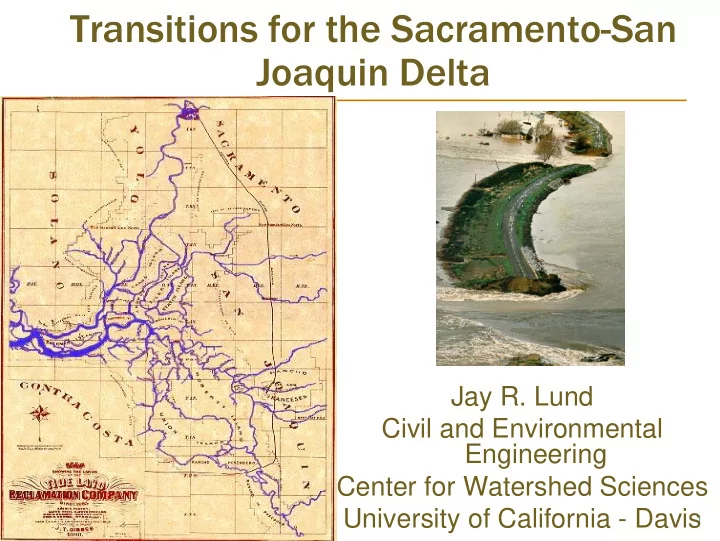
Transitions for the Sacramento-San Joaquin Delta

Jay R. Lund Civil and Environmental Engineering Center for Watershed Sciences University of California - Davis

slide-2
SLIDE 2

2

California’s Water Supply System

Diverse water supplies

– Mostly in north – Mostly in wet season

Diverse water demands

– Mostly central & south – Mostly in dry season

Extensive use of

aqueducts, reservoirs, and groundwater

Sacramento-San

Joaquin Delta is the major “hub”

slide-3
SLIDE 3

3

Who depends on the Delta?

  • S. California – 30% of

water supplies

Bay Area – 30% of

water supplies directly, another 40% upstream

Southern Central Valley

– 4 maf directly and 4 maf upstream

Delta farmers – 1+ maf Sacramento Valley –

4+ maf taken upstream; water leasing by IDs The Delta

slide-4
SLIDE 4

4

  • 1. Pre-European

Sacramento-San Joaquin Delta

Formed 6,000 years

ago

Estuary from a drown

river confluence

740,000 acres of

marshland & waterways

Largest estuary in the

western Pacific Ocean

Delta, 1905

slide-5
SLIDE 5

5

San Francisco Estuary and Delta: 1848 and today

http://sfbay.wr.usgs.gov/access/yearbook.html

slide-6
SLIDE 6

6

  • 2. Agricultural

Sacramento-San Joaquin Delta

1850s - present Leveeing wetlands –

1,100 miles

540,000 acres of

farmland

Early major

irrigation

Rapid land

subsidence

Rising costs to

maintain levees

Early extinctions

slide-7
SLIDE 7

7

Delta Island Subsidence

slide-8
SLIDE 8

8

  • 3. Water Supply

Sacramento-San Joaquin Delta

1950s - present Major water export

projects

540,000 acres of

farmland

Continued land

subsidence

Worsening water quality

and risks for export users

– Drinking water treatment – Salinity and crop yields

slide-9
SLIDE 9

9

The “Big Gulp”: 6.5 Magnitude Earthquake

causing 20-Island Failure

0 – 6 hours: Islands flood with fresh water 0 – 6 hours: Islands flood with fresh water

slide-10
SLIDE 10

10

6.5 Magnitude Earthquake causing 20-Island failure

12 – 24 hours: Salt water intruding into Delta 12 – 24 hours: Salt water intruding into Delta

slide-11
SLIDE 11

11

6.5 Magnitude Earthquake causing 20-Island failure

1 – 7 days: Salt water throughout Delta 1 – 7 days: Salt water throughout Delta

slide-12
SLIDE 12

12

Months to years of saline Delta

30 days: A saline estuary 30 days: A saline estuary

slide-13
SLIDE 13

13

Problems of California’s Sacramento-San Joaquin Delta

Physical instability

– Land subsidence – Sea level rise – Floods – Earthquakes

Ecosystem instability

– Habitat alteration – Invasive species

Economic instability

– High costs to repair islands – Worsening water quality for

  • agric. & urban users
slide-14
SLIDE 14

14

Delta of Tomorrow Will be Different

Large bodies of

  • pen water and

higher sea level

Increased salinity,

habitat variability

Higher water

quality costs – even if all islands remain intact

Based on economic value of land and assets, many islands not worth repairing after flooding (blue)

slide-15
SLIDE 15

15

Transition Problems and Options

Re-flooding some

islands, habitat, and the Delta’s economy

Fish habitat and water

  • perations

Water supplies

– Southern Delta exports – CCWD – Delta farmers – North Bay Aqueduct

Jones Tract 2004 (above) and Liberty Island since 1998

slide-16
SLIDE 16

16

Land use with Permanently Re- flooded Islands

Island repair funding and

policies

Identifying islands

lacking compelling state interest

Aid and incentives for

transition

Urbanization in Delta

slide-17
SLIDE 17

17

A Changing Delta Ecosystem

Habitat plans for

– Climate change – Sea level rise – Permanent levee failures – New invasive species

Favor diverse habitat and

flow for multiple species

Plan to make mistakes; they

will happen.

Experimentation and

detailed modeling needed – Include flooding at least

  • ne island
slide-18
SLIDE 18

18

Fish Population Viability Estimates

slide-19
SLIDE 19

19

Long-Term Water Export Alternatives

Current Strategy: through the Delta Peripheral Canal: around the Delta Dual Conveyance: both through and around the Delta No Exports: use

  • ther water sources

and use less

slide-20
SLIDE 20

20

Likely performance of each long-term water export strategy

Economic Cost ($Billions/year) Likelihood of Fish Viability (%)

No Exports Peripheral Canal Dual Conveyance Through- Delta Exports

20 40 60 80 100 0.5 1 1.5 2 2.5 3

Delta smelt

slide-21
SLIDE 21

21

The Delta: A Legal History

1850/1861: Swamp Land Act 1933:

California Water Plan

1959:

State Water Project – Delta Protection

1978:

SWRCB Water Quality Control Plan

1982:

Peripheral Canal Referendum

1986:

SWRCB v US – “Racanelli Decision”

1992

Delta Protection Act & CVPIA (federal)

1994:

Bay-Delta Accord

2000:

CALFED Bay-Delta Program ROD

2005:

ESA Biological Opinions

2007:

Judge Wanger ESA Decision

21

slide-22
SLIDE 22

22

The Delta: What’s Changed?

2004:

Jones Tract Levee Failure

2005:

Reviewing Delta Programs – CALFED Finance Plan & Budget Cuts – Governance, Budget & Policy Reviews – Ecosystem Crisis/Pelagic Organism Decline – Hurricane Katrina – Levee Failure Risk

2006:

Changing Course – California Bay-Delta Authority – Zero Budget – Delta Vision – SB 1574 & Executive Order – Delta Levee Program/DRMS – Delta Land-Use Decisions

2007-08: Creating Delta Vision & Strategic Plan

22

slide-23
SLIDE 23

23