TRANSLAMINAR PLY FRACTURE TOUGHNESS OF ADVANCED COMPOSITES R. F. - - PDF document

translaminar ply fracture toughness of advanced composites
SMART_READER_LITE
LIVE PREVIEW

TRANSLAMINAR PLY FRACTURE TOUGHNESS OF ADVANCED COMPOSITES R. F. - - PDF document

18 TH INTERNATIONAL CONFERENCE ON COMPOSITE MATERIALS TRANSLAMINAR PLY FRACTURE TOUGHNESS OF ADVANCED COMPOSITES R. F. Teixeira 1 *, S. T. Pinho 1 , P. Robinson 1 , 1 Department of Aeronautics , Imperial College London , London, UK * Corresponding


slide-1
SLIDE 1

18TH INTERNATIONAL CONFERENCE ON COMPOSITE MATERIALS

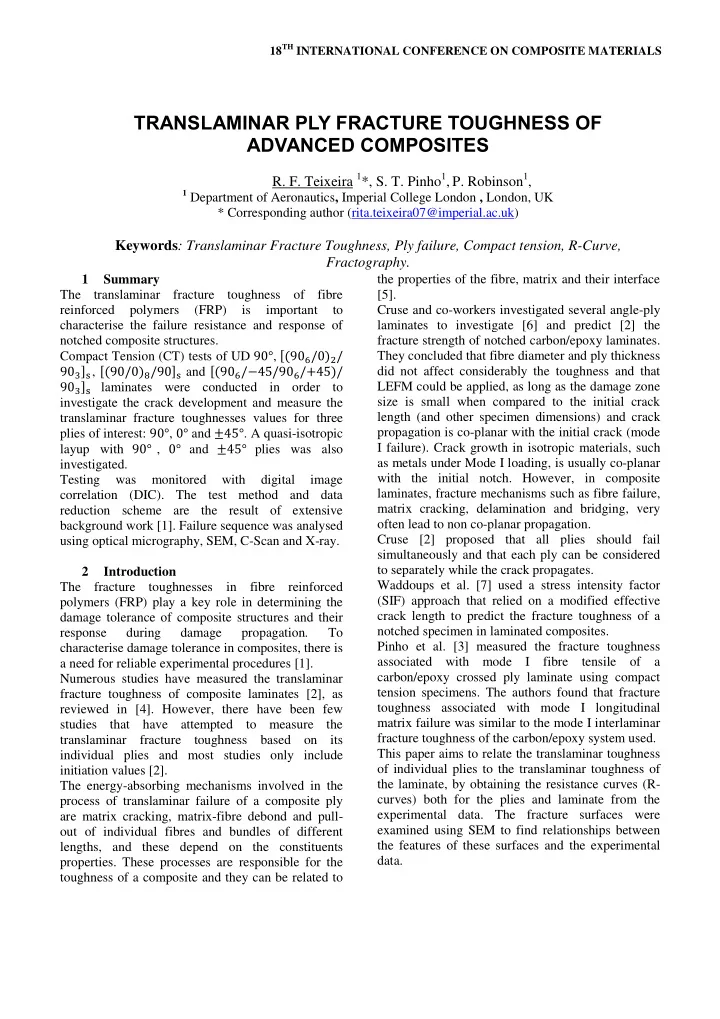
1 Summary The translaminar fracture toughness of fibre reinforced polymers (FRP) is important to characterise the failure resistance and response of notched composite structures. Compact Tension (CT) tests of UD , [ ] , [ ] and [ ] laminates were conducted in order to investigate the crack development and measure the translaminar fracture toughnesses values for three plies of interest: , and . A quasi-isotropic layup with , and plies was also investigated. Testing was monitored with digital image correlation (DIC). The test method and data reduction scheme are the result of extensive background work [1]. Failure sequence was analysed using optical micrography, SEM, C-Scan and X-ray. 2 Introduction The fracture toughnesses in fibre reinforced polymers (FRP) play a key role in determining the damage tolerance of composite structures and their response during damage propagation. To characterise damage tolerance in composites, there is a need for reliable experimental procedures [1]. Numerous studies have measured the translaminar fracture toughness of composite laminates [2], as reviewed in [4]. However, there have been few studies that have attempted to measure the translaminar fracture toughness based on its individual plies and most studies only include initiation values [2]. The energy-absorbing mechanisms involved in the process of translaminar failure of a composite ply are matrix cracking, matrix-fibre debond and pull-

  • ut of individual fibres and bundles of different

lengths, and these depend on the constituents

  • properties. These processes are responsible for the

toughness of a composite and they can be related to the properties of the fibre, matrix and their interface [5]. Cruse and co-workers investigated several angle-ply laminates to investigate [6] and predict [2] the fracture strength of notched carbon/epoxy laminates. They concluded that fibre diameter and ply thickness did not affect considerably the toughness and that LEFM could be applied, as long as the damage zone size is small when compared to the initial crack length (and other specimen dimensions) and crack propagation is co-planar with the initial crack (mode I failure). Crack growth in isotropic materials, such as metals under Mode I loading, is usually co-planar with the initial notch. However, in composite laminates, fracture mechanisms such as fibre failure, matrix cracking, delamination and bridging, very

  • ften lead to non co-planar propagation.

Cruse [2] proposed that all plies should fail simultaneously and that each ply can be considered to separately while the crack propagates. Waddoups et al. [7] used a stress intensity factor (SIF) approach that relied on a modified effective crack length to predict the fracture toughness of a notched specimen in laminated composites. Pinho et al. [3] measured the fracture toughness associated with mode I fibre tensile of a carbon/epoxy crossed ply laminate using compact tension specimens. The authors found that fracture toughness associated with mode I longitudinal matrix failure was similar to the mode I interlaminar fracture toughness of the carbon/epoxy system used. This paper aims to relate the translaminar toughness

  • f individual plies to the translaminar toughness of

the laminate, by obtaining the resistance curves (R- curves) both for the plies and laminate from the experimental data. The fracture surfaces were examined using SEM to find relationships between the features of these surfaces and the experimental data.

TRANSLAMINAR PLY FRACTURE TOUGHNESS OF ADVANCED COMPOSITES

  • R. F. Teixeira 1*, S. T. Pinho1, P. Robinson1,

1 Department of Aeronautics, Imperial College London , London, UK

* Corresponding author (rita.teixeira07@imperial.ac.uk)

Keywords: Translaminar Fracture Toughness, Ply failure, Compact tension, R-Curve, Fractography.

slide-2
SLIDE 2

3 Experimental method and data reduction Compact Tension (CT) specimens [3] with dimensions and orientation shown in Fig. 1 were used. The material system used in this work was the unidirectional carbon-epoxy prepeg T800s/M21 manufactured by Hexcel. The elastic properties were measured using standard tests (Table 1). All the laminate configurations were manufactured using hand layup and cured in an autoclave according to the manufacture recommendations. A wet saw was used to cut the rectangular plates into the specimen’s geometry (Fig. 1). The 8 mm holes were drilled using a carbide tipped drill. The notch was machined using a diamond coated disk-saw to guarantee an accurate and sharp crack tip. Micrographs of the crack tip are presented in Fig. 2. Six CT specimens of each layup were tested using an Instron machine with a 10 kN load cell, except for the [ ] layup where a 1 kN load cell was used since much lower loads were expected for these

  • specimens. Each specimen was loaded to a constant

displacement rate of 0.5 mm/min with being in the direction of the applied load. All the experiments have been monitored with digital image correlation (DIC). The ARAMIS DIC camera was mounted on a tripod, which was positioned facing the testing machine, perpendicular to the surface of the specimen. Two spotted stickers were attached to the pin loads in order to better identify the specimen displacement during testing. Testing was conducted to investigate the translaminar fracture toughnesses for each ply of interest, , and as well as quasi-isotropic laminates: , [ ] and [ ] , respectively. A fifth layup [ ] was analysed to better understand the failure interaction between and plies. A compliance calibration method [1] was used for data reduction. This method used Finite Element analysis to infer the crack length corresponding to each stage

  • f

crack propagation from the experimental elastic compliance. A half CT specimen was modelled using the FE ABAQUS

  • package. Models were 1 mm thick and a 1 N load

was applied at the position of the loading pin. The elastic properties for each layup were calculated according to lamination theory. The critical strain energy release rate was calculated using the change in compliance, , with crack length : (1) The compliance calibration curve was obtained by FE, in approximately 1 mm increments, to capture the full compliance versus crack length response, for each layup of interest. The calibrated vs. data was plotted and fitted according to: (2) where , , and were calculated to best fit the experimental data. These constants were used with the experimental compliance to calculate the corresponding crack length. For the fracture toughness tests, an effective crack length, , could be determined using the elastic compliance measured from the load displacement curve of the test specimens: (3) The critical strain energy release rate was then determined using: (4) One of the main advantages of this data reduction method is that it does not rely on the observation of the surface of the specimen. The external plies of the specimen do not reflect the actual crack tip growth since the crack front is not constant. Once the critical energy release rate for the laminate is obtained, the critical energy release rate for the ply of interest is calculated by accounting for the toughness corresponding to matrix cracking in the

  • layers. This procedure neglects other damage

modes such as delamination, as well as any interaction between matrix cracking and the fibre dominated failure modes, and assumes that a single matrix crack parallel to the pre-crack occurs in the

  • layers. This approximation appears to be

acceptable as the toughness of mode I fibre tensile failure contribution is considerably more important than that of the matrix. It has been proposed [2] that a through thickness mode I crack for a general

  • rthotropic laminate

can be related to the corresponding ply simply by a law of mixtures expressed as:

(5) where

represents the critical strain energy

release rate for the laminate, represents the

slide-3
SLIDE 3

3 TRANSLAMINAR PLY FRACTURE TOUGHNESS OF ADVANCED COMPOSITES

critical strain energy release rate for each ply i, is total laminate thickness and is the individual thickness of each ply. 4 Results A stick-slip crack typically between 2 and 2.5 mm was found in all CT specimens during testing. Upon reaching the critical load, fracture propagated consistently and stably (high number of crack jumps) and arrested at some lower value of load. Fig. 3 shows a typical load-displacement curves for the [ ] specimens. The elastic compliance was measured directly from the load-displacement curve after each crack growth ( ). No measurements were taken for mm where the rate of change of becomes large [3] (leading to higher sensitivity to experimental error) and also due to the proximity of the crack tip to the back edge of the specimen. All the specimens exhibited a clear R-Curve effect as observed for representative specimens in Fig. 5. For each specimen, an initiation value can be defined as the first toughness measurement, while the propagation values were defined simply as any toughness value obtained for crack lengths greater than 0 mm. The average critical energy release rates

  • btained for initiation is 0.3 kJ/m2, 152 kJ/m2, 29.9

kJ/m2, 88.9 kJ/m2 with a standard deviation of 8.7%, 23.4%, 18.5% and 4.3% for the [ ], [ ] , [ ] and [ ] , respectively. Since the R- curves seem to converge, a propagation value for the critical energy release rate could be defined. The average propagation critical energy release rate is 2.7 kJ/m2, 237 kJ/m2, 149 kJ/m2, 140 kJ/m2 with a standard deviation 9%, 11%, 9.7% and 10.5% for the [ ] , [ ] , [ ] and [ ] , respectively. Scanning electron microscopy was used to identify fractographic features and to differentiate fracture surfaces in all layups (cross-ply and quasi-isotropic). Typical images of the fractured surfaces are shown in Fig. 6. 5 Discussion The fracture surfaces presented loosen fibres due to the high fibre volume fraction (57%) in this prepeg (Fig. 4). The path of crack growth was roughly in the same plane as that of the starter crack in all

  • laminates. At the end of each test, fibre bridging was
  • bserved in every layup which, therefore, caused the

laminate toughness to increase. The cross ply laminates showed a stepped pull-out that could be observed in the plies (Fig. 6(a)). Micrographs also supported this observation (Fig. 7). The [ ] specimens exhibited a saw tooth like pull out pattern in the 45° plies (Fig. 4). Fibre bundles failed in a zig-zagg

  • manner. Ply splitting and delamination are visible on

the fracture surface. Both [ ] and [ ] fracture surfaces exhibited flat regions in the plies, and blocks of fibres pulled-out in the (Fig 4 and 6(a)). In fact, the fracture surface in the plies consisted mainly of bundles rather than single fibres, increasing therefore the laminate’s toughness (Fig. 6(a)). The extensive pull-out observed in the [ ] specimens (Fig. 4) is slightly greater than the one observed in the cross-ply laminate, which is typical of multidirectional laminates with delamination. The quasi-isotropic specimens (Fig. 6(b)) exhibited more complex fracture surfaces. The failure mechanisms observed included delamination, fibre bridging, ply splitting and fibre fracture. Fibre pull-

  • ut featured in all of the fracture surfaces and was

mainly consisted of bundles of fibres. Delamination was observed between plies and its adjacent

  • layers. This promoted off-axis splitting in the

plies which induced further delamination. Before initiation, a load drop on the load-displacement curve took place which revealed the occurrence of delamination on the - interface. The maximum load in the respective load-displacement curve corresponds to fibre failure of the 0° plies. No defined cusps could be found, which hindered the determination of the crack propagation direction due to the low resin content of this prepeg. As a first approach, the law of mixtures [2] was used to relate the fracture toughness of individual plies to that of the laminate, as SEM images (Fig 6) showed some delamination between plies, which indicates that each ply may have failed relatively independently:

slide-4
SLIDE 4

(6) where a, b, c are the fraction of each angle ply in the laminate. The experimental value for the propagation translaminar fracture toughness in the quasi- isotropic laminate exceeded the predicted one calculated from Equation 6 by while the initiation value differs by 40 . 6 Conclusions This study presents the experimental work from compact tension tests of , [ ] , [ ] and [ ] laminates, using the carbon-epoxy system T800s/M21, that were conducted in order to measure the translaminar fracture toughnesses values for different plies of interest: , and . The material showed a high fracture toughness when compared to other carbon/epoxy systems, namely T300/920 and T300/913 [7]. This can be explained by the high amount of individual fibre pull out verified from the analysis of the fracture surfaces using SEM. In addition, the fracture of T800s/M21 is more stable than the carbon/epoxy systems mentioned. Several toughening mechanisms were observed using SEM, such as fibre bridging, debonding and fibre pull-out. The translaminar initiation and propagation fracture toughness values

  • f

individual plies were successfully measured and used to predict the translaminar fracture toughness of a quasi-isotropic

  • laminate. The predictions differed from the

experimental results by 4%. 7 Acknowledgments The funding provided by Airbus and FCT (Fundação para a Ciência e a Tecnologia) to make this research possible and participation in this conference is gratefully acknowledged.

  • Fig. 1. Two pin loaded CT specimen dimensions and

fibre directions.

  • Fig. 2 – Micrograph of a notch manufactured with a

diamond coated saw. Modulus (GPa) Major Poisson’s ratio Longitudinal Transverse Shear 160 9.3 4.2 0.33 Table 1 - T800s/M21 material properties.

slide-5
SLIDE 5

5 TRANSLAMINAR PLY FRACTURE TOUGHNESS OF ADVANCED COMPOSITES

  • Fig. 3 – Load displacement curve for [

] laminate.

  • Fig. 4 – SEM fracture surface of a [

] specimen.

  • Fig. 5. R-Curves during propagation.

is two

  • rders of magnitude smaller than the other in the

graph.■ - , ▲- [ ] , ◊

  • [ ] and × - [ ] .

The horizontal line represents the predicted fracture toughness for the quasi-isotropic laminate.

  • Fig. 6. – Cross-ply (a) and quasi-isotropic (b) laminate

fracture surfaces.

0,5 1 1,5 2 0,5 1 1,5 2 2

Load [kN] displacement [mm]

50 100 150 200 250 300 350 2 4 6 8 10

GIc [kJ/m2] Δa [mm]

(a) (b)

slide-6
SLIDE 6

18TH INTERNATIONAL CONFERENCE ON COMPOSITE MATERIALS

  • Fig. 7 – Micrographs (10x) of cross-ply (top) and quasi-isotropic laminates (bottom).
  • Fig. 8 - X-ray of cross-ply specimen.
  • Fig. 9 – X-ray of quasi-isotropic specimen.

References

[1] M.J. Laffan, S.T. Pinho, P. Robinson, L. Iannucci, “Measurement of the in situ ply fracture toughness associated with mode I fibre tensile failure in FRP. Part I:Data Reduction”. Composites Science and Technology, 2010. 70(4): p. 606-613. [2] T.A. Cruse, “Tensile Strength

  • f

Notched Composites”. Journal of Composite Materials, Vol. 7 (April 1973), p. 218. [3] S. T. Pinho , P. Robinson and L. Iannucci, “Fracture toughness of the tensile and compressive fibre failure modes in laminated composites”, Composites Science and Technology, vol. 66, p. 2069, 2006. [4] M.J. Laffan, S.T. Pinho, P. Robinson, L. Iannucci, “Translaminar Fracture Toughness Testing: A Review”. to be submitted in Composites Science and Technology, 2011 . [5] J.K. Wells and P.R. Beaumont, “Crack-tip energy absorption processes in fibre composites.”. Journal Of Materials Science, 1991, vol. 20, p. 2735. [6] T.A. Cruse , J.R. Osias, “Exploratory Development

  • n Fracture Mechanics of Composite Materials”, Air

Force materials Laboratory Report, 1974. [7] M.E. Waddoups, J.R. Eisenmann and B.E. Kaminski, “Macroscopic Fracture Mechanics of Advanced Composite Materials”, Journal

  • f

Composite Materials, vol. 5, p. 446, 1971.

[8] M.J. Laffan, S.T. Pinho, P. Robinson, L. Iannucci,

“Measurement of the in-situ ply fracture toughness associated with mode I fibre tensile failure in FRP. Part II: Size and lay-up effects”. Composites Science and Technology, 2010. 70(4): p. 614. [9] H.J. Konish, Jr., J.L. Swedlow and T.A. Cruse, “Experimental Investigation

  • f

Fracture in Advanced Fiber Composite”. Journal of Composite Materials, Vol. 6 (1972), p. 114.