transmitter bearing estimation or How to do synthetic aperture - - PowerPoint PPT Presentation

transmitter bearing estimation
SMART_READER_LITE
LIVE PREVIEW

transmitter bearing estimation or How to do synthetic aperture - - PowerPoint PPT Presentation

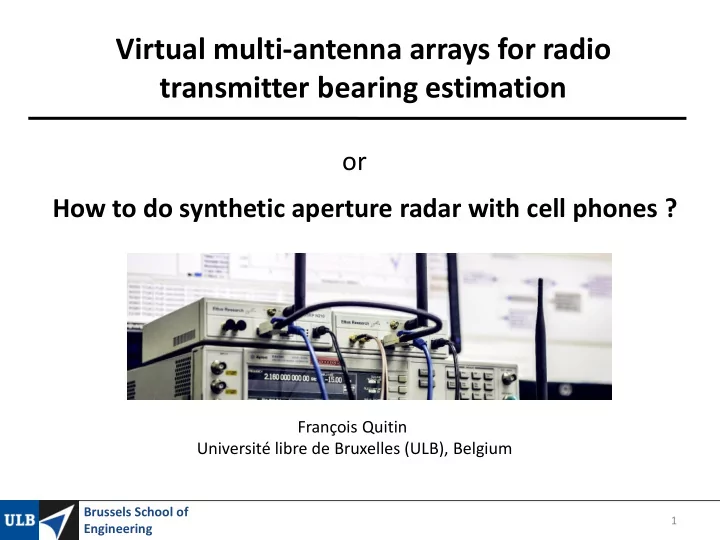
Virtual multi-antenna arrays for radio transmitter bearing estimation or How to do synthetic aperture radar with cell phones ? Franois Quitin Universit libre de Bruxelles (ULB), Belgium Brussels School of 1 Engineering Virtual AOA


slide-1
SLIDE 1

Brussels School of Engineering

  • r

1

Virtual multi-antenna arrays for radio transmitter bearing estimation

François Quitin Université libre de Bruxelles (ULB), Belgium

How to do synthetic aperture radar with cell phones ?

slide-2
SLIDE 2

Brussels School of Engineering

Virtual AOA estimation / Synthetic aperture radar

  • Tx sends multiple packets (e.g. synch’ signal)
  • Rx receives packets at multiple points along its trajectory

each received packet can be seen as a « virtual » antenna element conventional MIMO AOA techniques

2

we want to measure the AOA of a Tx

slide-3
SLIDE 3

Brussels School of Engineering

Outline

  • Method description

Difference with conventional MIMO AOA

  • Algorithms for LO offset and AOA estimation
  • IMU sensor processing
  • Implementation and results

3

Virtual AOA estimation

slide-4
SLIDE 4

Brussels School of Engineering

Difference between V-AOA and MIMO-AOA

1) Position of « virtual antenna elements » depends on the movement of Rx 2) LO offset introduce phase rotation in received packets

4

2 main differences in V-AOA case:

Tx Rx trajectory λ/2 λ/2 Tx

slide-5
SLIDE 5

Brussels School of Engineering

LO offset between Tx and Rx

  • LO offset between Tx and Rx

net effect: frequency difference/offset 𝜕0 between Tx and Rx

  • Receiver receives different packets (suppose no movement):

– at time 𝑢0: 𝑠 𝑛 – at time 𝑢1: 𝑠 𝑛 𝑓𝑘2𝜌𝑔

0 𝑢1−𝑢0

– at time 𝑢2: 𝑠 𝑛 𝑓𝑘2𝜌𝑔

0 𝑢2−𝑢0 5

… introduces a phase rotation in Rx packets

Tx Rx does not move

slide-6
SLIDE 6

Brussels School of Engineering

AOA estimation: system description

  • Transmitter sends packet with known header
  • Receiver correlates received baseband samples with (known)

header

Phase of peak of correlation function corresponds to the phase of the channel

  • In a Line-of-Sight case (and periodic Tx), the angle is given by

𝜒𝑜 = 𝜒0 + 2𝜌𝑔

0𝑜𝑈 0 + 2𝜌

𝜇 𝑦𝑜 cos 𝜄 + 𝑧𝑜 sin 𝜄

𝑢𝑜 time elapsed between packet 0 and n 𝑦𝑜 change in x-coordinates between packet 0 and n 𝑧𝑜 change in y-coordinates between packet 0 and n

6

System model

slide-7
SLIDE 7

Brussels School of Engineering

AOA estimation: system description

7

Difference with conventional MIMO

Tx Rx trajectory λ/2 λ/2 Tx

𝜒𝑜 = 𝜒0 + 2𝜌𝑔

0𝑜𝑈0 + 2𝜌

𝜇 𝑦𝑜 cos 𝜄 + 𝑧𝑜 sin 𝜄 𝜒𝑜 = 𝜒0 + 2𝜌 𝜇 𝑦𝑜 cos 𝜄 + 𝑧𝑜 sin 𝜄

slide-8
SLIDE 8

Brussels School of Engineering

Outline

  • Method description

Difference with conventional MIMO AOA

  • Algorithms for LO offset and AOA estimation
  • IMU sensor processing
  • Implementation and results

8

Virtual AOA estimation

slide-9
SLIDE 9

Brussels School of Engineering

LO offset and angle estimation

  • Step 1: Receiver stands still

Only LO frequency offset cause phase to change

  • Step 2: Receiver starts moving

LO frequency offset is compensated: Conventional MIMO estimation can be used (MUSIC, ESPRIT, …)

  • Works if LO frequency offset does not

change during movement phase

Movement should be short Compatible with WSSUS assumption!

9

Start- and-stop (SaS) approach

Tx Rx does not move

Tx Rx trajectory

slide-10
SLIDE 10

Brussels School of Engineering

LO offset and angle estimation

The signal model used in MUSIC can be augmented to accound for LO frequency offset 𝐳 𝑛 = 𝐛 𝑔

0, 𝜄 𝑦 𝑛 + 𝐱[𝑛]

with 𝐛 𝑔

0, 𝜄 =

exp 𝑘 2𝜌𝑔

0𝑢1 + 2𝜌

𝜇 𝑦 1 cos 𝜄 + 𝑧 1 sin 𝜄 exp 𝑘 2𝜌𝑔

0𝑢2 + 2𝜌

𝜇 𝑦 2 cos 𝜄 + 𝑧 2 sin 𝜄 ⋮ exp 𝑘 2𝜌𝑔

0𝑢𝑂 + 2𝜌

𝜇 𝑦 𝑂 cos 𝜄 + 𝑧 𝑂 sin 𝜄  MUSIC (or beamforming) can use this signal model and do joint search

  • ver 𝑔

0 and 𝜄

10

Joint estimation

slide-11
SLIDE 11

Brussels School of Engineering

Outline

  • Method description

Difference with conventional MIMO AOA

  • Algorithms for LO offset and AOA estimation
  • IMU sensor processing
  • Implementation and results

11

Virtual AOA estimation

slide-12
SLIDE 12

Brussels School of Engineering

LO offset and angle estimation

  • Fraction of wavelength accuracy required

D-GPS insufficient!

  • If antenna non-isotropic: orientation required
  • Only relative position is required
  • WSSUS assumption

Movement should be limited

  • We use a 3D-Inertial Measurement Unit (IMU)

Contains accelerometers and gyroscopes Solution will drift from truth, but integration time is short due to WSSUS, so error will remain limited

12

Determining 𝒚𝒐 and 𝒛𝒐

Rx trajectory

slide-13
SLIDE 13

Brussels School of Engineering

Strap-down IMU

  • accelerometers => measures acceleration along each axis
  • gyroscope => measures angular speed around each axis

– Measurements are done in body frame, but positions needs to be known in navigation frame – Note: gravitation of ~9.78 m/s^2 (along D-axis) is always measured by accelerometer(s)

13

= IMU attached to vehicle

slide-14
SLIDE 14

Brussels School of Engineering

IMU processing

  • Initial position/orientation need to be known
  • Problems:

1) how to estimate initial orientation ? => use gravitation vector 2) how to estimate IMU biases ? => calibration procedure 3) Augment stability by using nonholonomic constraints

14

Can be processed in EKF/UKF

Initial Orientation Angular speeds (rad/s) Accelerations (m/s^2)

slide-15
SLIDE 15

Brussels School of Engineering

Outline

  • Method description

Difference with conventional MIMO AOA

  • Algorithms for LO offset and AOA estimation
  • IMU sensor processing
  • Implementation and results

15

Virtual AOA estimation

slide-16
SLIDE 16

Brussels School of Engineering

Implementation

  • Carrier frequency: 1 GHz
  • Tx and Rx use GPSDO with OCXO LO

(20 ppb accuracy)

  • Tx sends 3G primary sequence

– 128 samples long @ 1.8 MHz sample rate – Periodicity: 0.667 ms, but only one packet out of 15 considered 𝑈0 = 10 ms

  • Rx sample rate = 3.6 MHz

16

Transmitter and receiver: USRP-N210

transmitter

slide-17
SLIDE 17

Brussels School of Engineering

Implementation

  • Rx performs correlation in FPGA

Sends both correlation function (« peaks ») and BB samples to host

  • Rx accumulates 3 peaks (host

processor)

Increased SNR

  • Peak detector in host processor

Phase of peak is written to output file

  • IMU: XSens MTi-10 (automotive-

grade)

  • Parallel thread to read IMU data @

200 Hz

IMU values written to output file

17

Receiver details

receiver

slide-18
SLIDE 18

Brussels School of Engineering

Experimental setup

  • IMU z-axis placed parallel to vertical axis

Error of few ° cannot be avoided!

  • Turntable still for 30 s

then turned by 180° (about 5 s) Radius of 30, 40 and 50 cm

18

in anaechoic chamber => only LOS

slide-19
SLIDE 19

Brussels School of Engineering

Experimental setup

19

note the « vertical » IMU placement

turntable USRP-N210 antenna IMU

slide-20
SLIDE 20

Brussels School of Engineering

IMU processing

20

Initial orientation: (pitch,roll)=( -0.79°, 3.18°)

g along z-axis Small acceleration and deceleration along x-axis Rotation around z-axis Yaw changes from 180° to 0° Speeds mainly along x-axis Speeds along y-axis:

  • Centrifugal force
  • Integration

errors

slide-21
SLIDE 21

Brussels School of Engineering

IMU processing

21

Final estimated trajectory

  • Estimated trajectory drifts off at the end of movement
  • Room for improvement!

– Introduce nonholonomic constraints (already done for standstill) – Improve bias estimation – Improve EKF/UKF parameters (requires to know process model accurately)

slide-22
SLIDE 22

Brussels School of Engineering

AOA estimation

22

Stop-and-Start approach

Packet phases before LO offset compensation Packet phases after LO offset compensation Phase change due to movement Rx movement from IMU MUSIC spectrum with peak close to 90° Phase noise and drift

16 16.5 17 17.5 1 2 3 4 5 6 7 Time (s) Phase (rad) Phase before freq. offset compensation

slide-23
SLIDE 23

Brussels School of Engineering

AOA estimation

AOA estimation error

– Zero-mean – Standard deviation Larger (virtual) arrays have better accuracy Consistent with conventional MIMO theory

23

SaS approach: notes about MUSIC

slide-24
SLIDE 24

Brussels School of Engineering

AOA estimation

  • Augmented signal model

– joint search over 𝑔

0 and 𝜄

24

Joint estimator

slide-25
SLIDE 25

Brussels School of Engineering

AOA estimation

AOA estimation error

– Zero-mean – Standard deviation Larger (virtual) arrays have better accuracy Performance of joint estimation worse than SaS approach, but more flexible !

25

Joint estimator

slide-26
SLIDE 26

Brussels School of Engineering

E-310 implementation

  • Why not ?
  • Use embedded IMU and SDR
  • Test with low(er)-quality IMU and TCXO
  • Possible to mount on (autonomous) vehicles

26

Why?

slide-27
SLIDE 27

Brussels School of Engineering

E-310 implementation

27

Architecture

Filter banks AD 9361 RFIC Artix-7 FPGA XILINX ZYNQ 7020 PS-Dual Core ARM A9 IMU GPS receiver USRP E310

Tx chains and 2nd Rx chain deactivated Correlator and peak detector Capturing IMU and RF data IMU processing MUSIC algo.

slide-28
SLIDE 28

Brussels School of Engineering

E-310 implementation

  • Gyroscope bias: can be measured at standstill
  • Accelerometer bias:

IMU placed at all kind of orientations (but static!), N realizations Find biases by solving least-squares problem (sphere-fit):

𝑏𝑦1 − 𝑐𝑏𝑦 2 + 𝑏𝑧1 − 𝑐𝑏𝑧

2 + 𝑏𝑨1 − 𝑐𝑏𝑨 2 = 𝑕2

⋮ 𝑏𝑦𝑂 − 𝑐𝑏𝑦 2 + 𝑏𝑧𝑂 − 𝑐𝑏𝑧

2 + 𝑏𝑨𝑂 − 𝑐𝑏𝑨 2 = 𝑕2 28

Determining IMU biases

Example for IMU placed at a lot

  • f orientations (more or less

along main axes)

slide-29
SLIDE 29

Brussels School of Engineering

E-310 implementation

  • Through use of an unscented Kalman filter
  • Use nonholonomic constraints when standing still

𝑤𝑦 = 𝑤𝑧 = 𝑤𝑨 = 0

  • Standstill is estimated by looking at accelerometers

29

IMU processing

slide-30
SLIDE 30

Brussels School of Engineering

E-310 implementation

  • MPU-9150 IMU in controlled experiment

30

IMU analysis results

slide-31
SLIDE 31

Brussels School of Engineering

E-310 implementation

  • Things go south pretty quickly …
  • Movement should remain short !!!

Anyway required for WSSUS assumption

31

IMU analysis results

Movement time ~ 10 seconds Movement time ~ 4 seconds

slide-32
SLIDE 32

Brussels School of Engineering

V-AOA estimation

Even with single-antenna transceivers, it is possible to do localization! Integration with other sensors (IMU, GPS, …) To-do list …

  • wrap up E310 implementation
  • Integrate IMU navigation uncertainty from EKF/UKF with the

actual AOA estimation

  • Multipath environment
  • Robotic application: what are the « best » trajectories for

accurate estimation ?

32

Conclusion and to-do List

slide-33
SLIDE 33

Brussels School of Engineering

Thank you !

33

slide-34
SLIDE 34

Brussels School of Engineering

Localization in cellular wireless networks

  • Received signal strength (RSS)

requires path loss models (which one?) fading around path loss curve can be huge!

34

… does not work very well

slide-35
SLIDE 35

Brussels School of Engineering

Localization in cellular wireless networks

  • Time-of-Arrival / Time-Difference-of-Arrival (TOA/TDOA)

works better at high bandwidths requires nodes to be synchronized (down to ns accuracy) requires stringent control of hardware delays sensitive to multipath

35

… does not work very well

GPS synchronization: measured TDOA (ground truth = 0 ns)

slide-36
SLIDE 36

Brussels School of Engineering

Localization in cellular wireless networks

  • Angle-of-Arrival (AOA)

requires multi-antenna array expensive and large form factors! sensitive to multipath

36

… does not work very well

slide-37
SLIDE 37

Brussels School of Engineering

AOA estimation: system description

𝜒𝑜 = 𝜒𝑜−1 + 2𝜌𝑔

0Δ𝑢𝑜 +

𝛾 ⋅ Δ 𝑠

𝑜 + 2𝜌𝜉Δ𝑢𝑜

𝑔 frequency offset between Tx and Rx Δ𝑢𝑜 time between packets n-1 and n 𝛾 wave vector Δ 𝑠

𝑜

displacement vector between packets n-1 and n 𝜉 Doppler shift between Tx and Rx

 small in considered cases, can be ignored

37

Received packets angle

  • Freq. offset

Rx movement Doppler shift

slide-38
SLIDE 38

Brussels School of Engineering

IMU processing

  • At standstill, only gravitation vector is measured [1]

Gravitation vector is always along D(own)-axis Can be used to determine pitch/roll

38

Initial orientation determination

[1] S.O.H. Madgwick, A.J.L. Harrison, and R. Vaidyanathan, “Estimation of IMU and MARG orientation using a gradient descent algorithm,” in Rehabilitation Robotics (ICORR), 2011 IEEE International Conference on, June 2011, pp. 1–7.

𝑕 = 9,78 𝑛/𝑡2

slide-39
SLIDE 39

Brussels School of Engineering

IMU processing

  • Imagine an IMU with an inclination of 0.5°

Inclination of 0.5° leads to an acceleration along the x-axis of 𝑕 ⋅ sin 𝜄 = 0,085 m/s2 double-integrate this: after 5 s, error in distance is > 1 m Not exactly sub-wavelength accuracy…

39

Why is initial orientation so important ?

𝑞𝐸 𝑞𝐹 𝑕 = 9,78 𝑛/𝑡2