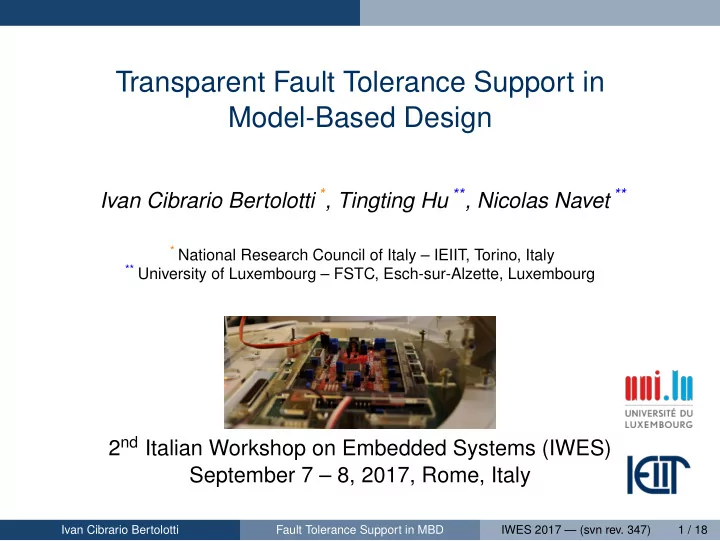
Transparent Fault Tolerance Support in Model-Based Design Ivan - - PowerPoint PPT Presentation

transparent fault tolerance support in model based design
SMART_READER_LITE
LIVE PREVIEW

Transparent Fault Tolerance Support in Model-Based Design Ivan - - PowerPoint PPT Presentation

Transparent Fault Tolerance Support in Model-Based Design Ivan Cibrario Bertolotti * , Tingting Hu ** , Nicolas Navet ** * National Research Council of Italy IEIIT, Torino, Italy ** University of Luxembourg FSTC, Esch-sur-Alzette,


slide-1
SLIDE 1

Transparent Fault Tolerance Support in Model-Based Design

Ivan Cibrario Bertolotti *, Tingting Hu **, Nicolas Navet **

* National Research Council of Italy – IEIIT, Torino, Italy ** University of Luxembourg – FSTC, Esch-sur-Alzette, Luxembourg

2nd Italian Workshop on Embedded Systems (IWES) September 7 – 8, 2017, Rome, Italy

Ivan Cibrario Bertolotti Fault Tolerance Support in MBD IWES 2017 — (svn rev. 347) 1 / 18

slide-2
SLIDE 2

Outline

Overview and Motivation Fault Tolerance Framework Fault Injection Capabilities Conclusion

Ivan Cibrario Bertolotti Fault Tolerance Support in MBD IWES 2017 — (svn rev. 347) 2 / 18

slide-3
SLIDE 3

Overview and Motivation

The CPAL Language

Cyber Physical Action Language A high-level DSL to model, simulate, verify, and implement CPSs It can express both functional and non-functional behaviors It can be executed in real time on an embedded platform, by means of an interpreter Simulation and execution are timing equivalent The language natively supports multiple periodic and/or event-driven processes, each modeled by means of a Mealy Finite State Machine (FSM)

Ivan Cibrario Bertolotti Fault Tolerance Support in MBD IWES 2017 — (svn rev. 347) 3 / 18

slide-4
SLIDE 4

Overview and Motivation

The CPAL Language

Sample Process

processdef P(params) { common { code } state Warning { code }

  • n (cond) {code} to Alarm_Mode;

after (time) if (cond) to Normal_Mode; finally { code } } process P: inst[period,offset][cond](args); @cpal:time:inst{ annotation code }

Elementary execution step

Activation Condition Annotation code Transition condition? Transition code Move to new state common code State code finally code Continuation? True True False False True

Scheduler Process

False

Ivan Cibrario Bertolotti Fault Tolerance Support in MBD IWES 2017 — (svn rev. 347) 4 / 18

slide-5
SLIDE 5

Overview and Motivation

Using CPAL

A “Real-World” Modeling Language C-like syntax Suitable as an implementation language Schedulability analysis and timing-accurate simulation Run-time introspection (e.g. for overload detection) Goals

Use CPAL to model a communication protocol for fault tolerance (interactive consistency) Compare it with another prominent language (Promela)

Ivan Cibrario Bertolotti Fault Tolerance Support in MBD IWES 2017 — (svn rev. 347) 5 / 18

slide-6
SLIDE 6

Overview and Motivation

Using CPAL

A “Real-World” Modeling Language C-like syntax Suitable as an implementation language Schedulability analysis and timing-accurate simulation Run-time introspection (e.g. for overload detection) Goals

Use CPAL to model a communication protocol for fault tolerance (interactive consistency) Compare it with another prominent language (Promela)

Ivan Cibrario Bertolotti Fault Tolerance Support in MBD IWES 2017 — (svn rev. 347) 5 / 18

slide-7
SLIDE 7

Overview and Motivation

CPAL vs. Promela — Main Remarks

Promela is meant for verification, rather than execution

Non-determinism is at the core of the language No I/O support No floating point data types It can be translated to C and Java (with varying success)

CPAL supports timing-accurate simulation and interpreted execution

Non-determinism must be avoided in most real systems No formal proofs (except for schedulability analysis) Executable model The execution platform is decoupled from the application

Ivan Cibrario Bertolotti Fault Tolerance Support in MBD IWES 2017 — (svn rev. 347) 6 / 18

slide-8
SLIDE 8

Fault Tolerance Framework

Fault-Tolerant CPSs

As CPSs become more and more software intensive, software defects tend to become the major source of faults Fault tolerance enables a system to tolerate software faults after its development Few work is done on automatic fault tolerance analysis and implementation at the system design phase Goals

Improve system dependability . . . . . . without affecting its functional behavior and timings Full integration with MBD workflow

Ivan Cibrario Bertolotti Fault Tolerance Support in MBD IWES 2017 — (svn rev. 347) 7 / 18

slide-9
SLIDE 9

Fault Tolerance Framework

Fault-Tolerant CPSs

As CPSs become more and more software intensive, software defects tend to become the major source of faults Fault tolerance enables a system to tolerate software faults after its development Few work is done on automatic fault tolerance analysis and implementation at the system design phase Goals

Improve system dependability . . . . . . without affecting its functional behavior and timings Full integration with MBD workflow

Ivan Cibrario Bertolotti Fault Tolerance Support in MBD IWES 2017 — (svn rev. 347) 7 / 18

slide-10
SLIDE 10

Fault Tolerance Framework

Model-Based FT System Design/Development

Drive the process of By Simul. Guide the selection

  • f

Analysis Fault Tolerance Mechanisms Fault Models Fault Injection Techniques Dependability Quantifier & Analyzer Code Generation Original System Models Applied to Derive Code transf. Inject faults by code transformation Satisfied Failed Re-selection Original System Models Model Patched with Suitable Fault Tolerance Mechanism FT-enhanced System Models

Ivan Cibrario Bertolotti Fault Tolerance Support in MBD IWES 2017 — (svn rev. 347) 8 / 18

slide-11
SLIDE 11

Fault Tolerance Framework

N-Version Programming (NVP)

N-fold replication of the same computation, carried out by means of N software modules, called member versions (software diversity) Member versions run in parallel, operating on the same inputs Result reached by consensus (e.g. majority voting) Requires member versions to generate comparison vectors at predefined cross-check points Feedback to the member versions depending on the result (terminate/continue, recovery)

Ivan Cibrario Bertolotti Fault Tolerance Support in MBD IWES 2017 — (svn rev. 347) 9 / 18

slide-12
SLIDE 12

Fault Tolerance Framework

N-Version Programming (NVP)

N-fold replication of the same computation, carried out by means of N software modules, called member versions (software diversity) Member versions run in parallel, operating on the same inputs Result reached by consensus (e.g. majority voting) Requires member versions to generate comparison vectors at predefined cross-check points Feedback to the member versions depending on the result (terminate/continue, recovery)

Ivan Cibrario Bertolotti Fault Tolerance Support in MBD IWES 2017 — (svn rev. 347) 9 / 18

slide-13
SLIDE 13

Fault Tolerance Framework

NVP Framework

Initiator M1 M2 Mx

Voter

C-Vector1 C-Vector2 C-Vectorn status1 status2 statusn

Outputs from the original process Inputs to the original process User-provided member versions Framework component

Based on software patterns, automatic code-generation friendly, cross-check points set at execution step boundaries

Ivan Cibrario Bertolotti Fault Tolerance Support in MBD IWES 2017 — (svn rev. 347) 10 / 18

slide-14
SLIDE 14

Fault Tolerance Framework

Main Achievements

Fault-tolerant mechanisms are kept independent from the logic of the application System designers may explore their use early in the design phase, focusing only on the application-dependent functional logic Minimal or no user involvement in low-level implementation details A C-language implementation derived from the model is also available (when direct model execution is impractical) The same methodology can be applied to other fault tolerant mechanisms

Ivan Cibrario Bertolotti Fault Tolerance Support in MBD IWES 2017 — (svn rev. 347) 11 / 18

slide-15
SLIDE 15

Fault Injection Capabilities

Software Fault Injection

Motivation No fault tolerance framework can be considered complete without the ability of injecting faults into the model Very powerful, well-understood assessment technique Time consuming, requires extensive know-how Goals

Automate software fault injection Integrate it with the design flow . . . . . . by means of software patterns

Ivan Cibrario Bertolotti Fault Tolerance Support in MBD IWES 2017 — (svn rev. 347) 12 / 18

slide-16
SLIDE 16

Fault Injection Capabilities

Software Fault Injection

Motivation No fault tolerance framework can be considered complete without the ability of injecting faults into the model Very powerful, well-understood assessment technique Time consuming, requires extensive know-how Goals

Automate software fault injection Integrate it with the design flow . . . . . . by means of software patterns

Ivan Cibrario Bertolotti Fault Tolerance Support in MBD IWES 2017 — (svn rev. 347) 12 / 18

slide-17
SLIDE 17

Fault Injection Capabilities

What Can We Model? — Fault Categories

Global State: State information resides in a pool of RAM statically allocated at link time → Its corruption can model various kinds of memory corruption Activation Arguments: Processes access state information through arguments, passed by value or by reference → Better granularity (down to the process activation level) Instance Variables: Local (stack-based) process storage is often implemented differently than global storage → Support the distinction between how different kinds of memory fail Control Flow Disruption: Most details of control flow are hidden in the model → Tampering with state transition conditions provides a useful surrogate

Ivan Cibrario Bertolotti Fault Tolerance Support in MBD IWES 2017 — (svn rev. 347) 13 / 18

slide-18
SLIDE 18

Fault Injection Capabilities

How? — Injection Mechanisms and Patterns

External Injector: One or more processes are dedicated to fault injection → Keeps a clean boundary between the normal behavior

  • f a system and its fault profile, centralized approach

Common/Finally Blocks: They are executed before and after state-specific code upon process activation → They can also access activation arguments and local variables, per-instance behaviors are possible Annotation-Based Injector: CPAL supports annotations to express non-functional properties of a program and isolate them from functional properties → With respect to common/finally, they can also affect state transitions

Ivan Cibrario Bertolotti Fault Tolerance Support in MBD IWES 2017 — (svn rev. 347) 14 / 18

slide-19
SLIDE 19

Fault Injection Capabilities

Summary Table

Fault category Mechanism Global state Activation arguments Local variables Control flow External process(es)

  • Pre/post conditions
  • Annotation-based
  • Results

Software fault injection of data errors can be effectively performed at the DSL level More limited modeling of code changes is possible, too All patterns can be fully automated

Ivan Cibrario Bertolotti Fault Tolerance Support in MBD IWES 2017 — (svn rev. 347) 15 / 18

slide-20
SLIDE 20

Fault Injection Capabilities

Summary Table

Fault category Mechanism Global state Activation arguments Local variables Control flow External process(es)

  • Pre/post conditions
  • Annotation-based
  • Results

Software fault injection of data errors can be effectively performed at the DSL level More limited modeling of code changes is possible, too All patterns can be fully automated

Ivan Cibrario Bertolotti Fault Tolerance Support in MBD IWES 2017 — (svn rev. 347) 15 / 18

slide-21
SLIDE 21

Fault Injection Capabilities

Summary Table

Fault category Mechanism Global state Activation arguments Local variables Control flow External process(es)

  • Pre/post conditions
  • Annotation-based
  • Results

Software fault injection of data errors can be effectively performed at the DSL level More limited modeling of code changes is possible, too All patterns can be fully automated

Ivan Cibrario Bertolotti Fault Tolerance Support in MBD IWES 2017 — (svn rev. 347) 15 / 18

slide-22
SLIDE 22

Conclusion

Ongoing Work

Automatic code generation and instrumentation Complete the implementation of the fault tolerance and fault injection framework Operate only at the DSL level, for modularity and applicability to other languages Design an appropriate annotation-based language extension to this purpose Consider further fault tolerance and injection mechanisms

Ivan Cibrario Bertolotti Fault Tolerance Support in MBD IWES 2017 — (svn rev. 347) 16 / 18

slide-23
SLIDE 23

Conclusion

Further Reading

Nicolas Navet and Loïc Fejoz. CPAL: High-level abstractions for safe embedded systems. In Proc. of the ACM International Workshop on Domain-Specific Modeling (DSM), pages 35–41, October 2016. Ivan Cibrario Bertolotti, Tingting Hu, and Nicolas Navet. Model-based design languages: A case study. In Proc. 13th IEEE International Workshop on Factory Communication Systems (WFCS), pages 1–6, May 2017. Nicolas Navet, Ivan Cibrario Bertolotti, and Tingting Hu. Software patterns for fault injection in CPS engineering. In Proc. 22nd IEEE International Conference on Emerging Technologies and Factory Automation (ETFA), pages 1–6, September 2017 (to appear). Tingting Hu, Ivan Cibrario Bertolotti, and Nicolas Navet. Towards seamless integration of N-Version Programming in model-based design. In Proc. 22nd IEEE International Conference on Emerging Technologies and Factory Automation (ETFA), pages 1–8, September 2017 (to appear).

Ivan Cibrario Bertolotti Fault Tolerance Support in MBD IWES 2017 — (svn rev. 347) 17 / 18

slide-24
SLIDE 24

Thank You

THANK YOU FOR YOUR ATTENTION

Ivan Cibrario Bertolotti Fault Tolerance Support in MBD IWES 2017 — (svn rev. 347) 18 / 18