Trauma in Pregnancy Disclosures UCSF AIM Conference Consultant, - - PowerPoint PPT Presentation

trauma in pregnancy disclosures ucsf aim conference
SMART_READER_LITE
LIVE PREVIEW

Trauma in Pregnancy Disclosures UCSF AIM Conference Consultant, - - PowerPoint PPT Presentation

6/8/2018 Trauma in Pregnancy Disclosures UCSF AIM Conference Consultant, Bloomlife Technology Deirdre Lyell, MD Professor, Maternal-Fetal Medicine Stanford Investor, ZenFlow Medical Director, Labor and Delivery Associate Division


slide-1
SLIDE 1

6/8/2018 1

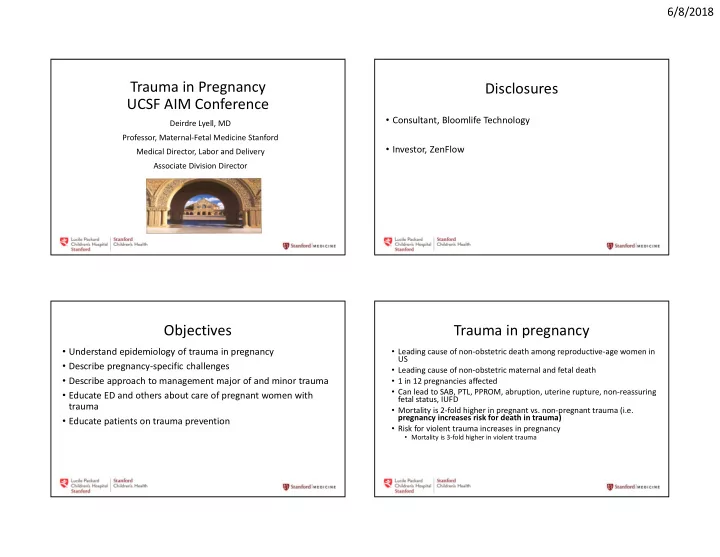
Trauma in Pregnancy UCSF AIM Conference

Deirdre Lyell, MD Professor, Maternal-Fetal Medicine Stanford Medical Director, Labor and Delivery Associate Division Director

Disclosures

  • Consultant, Bloomlife Technology
  • Investor, ZenFlow

Objectives

  • Understand epidemiology of trauma in pregnancy
  • Describe pregnancy-specific challenges
  • Describe approach to management major of and minor trauma
  • Educate ED and others about care of pregnant women with

trauma

  • Educate patients on trauma prevention

Trauma in pregnancy

  • Leading cause of non-obstetric death among reproductive-age women in

US

  • Leading cause of non-obstetric maternal and fetal death
  • 1 in 12 pregnancies affected
  • Can lead to SAB, PTL, PPROM, abruption, uterine rupture, non-reassuring

fetal status, IUFD

  • Mortality is 2-fold higher in pregnant vs. non-pregnant trauma (i.e.

pregnancy increases risk for death in trauma)

  • Risk for violent trauma increases in pregnancy
  • Mortality is 3-fold higher in violent trauma
slide-2
SLIDE 2

6/8/2018 2

Causes

  • Pregnancy:

more MVC and assault

  • Less falls

Pregnancy-specific challenges

  • Airway: aspiration risk, increased soft-tissue edema
  • Hemodynamics: vitals more difficult to interpret
  • Younger population; hemorrhagic shock may show late
  • Distorted anatomy altering surgical possibilities
  • Two patients
  • Limited experience in EDs
  • Limited professional guidelines

Physiologic changes in pregnancy

  • Blood volume increases by 20% (8 weeks) to 50% by 32 weeks
  • Heart rate increases 15-20 beats/min
  • Underestimation or failure to recognize severity or extent of injury or

blood loss

  • Cardiac output increases
  • Physiologic anemia
  • Supine position decreases cardiac output by 25-30%
  • Fibrinogen elevation; normal or decreased levels are abnormal

Outcomes of trauma in pregnancy

  • Fractures, dislocations, sprains and strains are the most

common

  • Depends on mechanism and severity of trauma, gestational age
  • Uterus is protected in pelvis until about 12 weeks
  • Bladder is displaced upward and vulnerable
  • Placental abruption, uterine rupture, direct fetal injury
  • Placental abruption: cause of 50-70% of losses
slide-3
SLIDE 3

6/8/2018 3

Placental abruption

  • Accounts for 50-70% of trauma-related losses
  • Major trauma: up to 50% (most common >16 weeks)
  • Minor trauma: 2-4%
  • Most common mechanisms that result in abruption:
  • MVCs (50%), assaults (5%), falls (3%)

Placental abruption

  • Elastic myometrium vs. inelastic placenta
  • Shearing or blunt injury
  • Amniotic fluid is not compressible
  • Coup-contrecoup injury
  • Immediate or delayed for several hours

Placental abruption diagnosis

  • Clinical: bleeding,

contractions, pain, uterine rigidity, non-reassuring FHR, late decelerations, or asymptomatic

  • Abnormal labs: fibrinogen,

platelets

  • Ultrasound? Most not seen.

Subchorionic hematoma is suggestive

Blausen.com staff (2014). “Medical gallery of Blausen Medical 2014” p. 42 WikiJournal of Medicine

Penetrating uterine trauma

  • 9% of maternal abdominal injuries
  • 73% gunshot wounds, 23% stabbings, 4% shotgun
  • Bowel is displaced peripherally
  • Uterus is anterior to the great vessels
  • Maternal mortality 3-4% (decreased from non-pregnant)
  • Fetal injury and mortality 73%
  • Fetal loss: 71% of gunshot wounds, 43% of stabbings to the

uterus

slide-4
SLIDE 4

6/8/2018 4

Major trauma

  • Same approach as if were not pregnant
  • Primary survey:
  • identify and treat life-threatening injuries
  • few minutes
  • stabilize mother first
  • Secondary survey
  • fetal assessment
  • vaginal and rectal exam

Primary survey

  • ABCDE
  • Airway and C-spine protection. O2 sats > 95%
  • Breathing and ventilation
  • Circulation and hemorrhage control.
  • Uterine displacement. Volume. Fibrinogen >200 mg/dL
  • Disability. Assign injury severity score.
  • Exposure. Remove all clothing. Assess for wounds, ecchymoses

Secondary survey

  • After initial stabilization, evaluate for specific maternal injuries,

assess fetal well-being

  • Vaginal exam (if no previa): dilation, bleeding, ROM?
  • Fetal assessment
  • Other radiologic exams
  • Pearl
  • Reactive NST suggests good maternal perfusion

Radiology

  • Radiology: FAST survey for intra-abdominal fluid
  • Pericardial, perihepatic, perisplenic, peripelvic space
  • Can eliminate need for unnecessary CT scan
  • Other imaging as needed
  • No single radiologic study threatens fetal well-being
  • None > 5 rads (x-ray, CT scan, MRI)
  • Hall EJ. Scientific view of low-level radiation risks. Radiographics 1991;11:509–18
slide-5
SLIDE 5

6/8/2018 5

Radiology

Royal Women’s Hospital, Melbourne: state’s major obstetric trauma center, Among women who experienced high-risk (severe) trauma,

  • nly 19% received recommended radiologic assessment
  • Plain x-rays are often used to avoid CT
  • No single radiologic study exceeds the maximal recommended

fetal exposure to radiation

Question

When the ED calls and asks which radiologic imaging studies they should order for a woman who underwent a major MVC at 20 weeks, your best answer is:

  • A. X-rays only
  • B. What would you order if she weren’t

pregnant?

  • C. Why are you calling me?

X

  • r

a y s

  • n

l y W h a t w

  • u

l d y

  • u
  • r

d e r i f s h . . . W h y a r e y

  • u

c a l l i n g m e ?

0% 5% 95%

Perimortem Cesarean

  • If the uterus is at or above the umbilicus
  • Cardiopulmonary resuscitation
  • Left uterine displacement
  • If delivery is thought to benefit mother
  • “Five minute rule”:
  • Initiate delivery within 4 minutes
  • Deliver by 5 minutes
  • Simulation

How can we help in major trauma?

  • “What would you do if she weren’t pregnant? Do that.”
  • Estimate gestational age. Umbilicus: ~20 weeks
  • Uterine displacement (>20 weeks?)
  • Manual or wedge, 15 degree lateral tilt
  • Advise on radiologic studies
  • Advise on maternal evaluation
  • Normal vital signs, fibrinogen
  • Advise on fetal evaluation after primary survey
slide-6
SLIDE 6

6/8/2018 6

Minor trauma

  • 90% of trauma in pregnancy
  • 60-70% of fetal losses

Fetal monitoring

  • Contractions <q10 minutes: up to 20% risk of abruption
  • EFM is more sensitive for detecting abruption than ultrasound,

KB, or physical exam

  • No validated minimum
  • Most abruptions diagnosed 2-6 hours after injury
  • Delayed placental abruption rare
  • unlikely if no contractions, normal FHR pattern over 4-6 hours
  • Deliver if deteriorating fetal status

Fetal monitoring

  • Contractions >q10 minutes: up to 20% risk of abruption
  • EFM is more sensitive for detecting abruption than ultrasound,

KB, or physical exam

  • No validated minimum
  • Most abruptions diagnosed 2-6 hours after injury
  • Delayed placental abruption rare
  • unlikely if no contractions, normal FHR pattern over 4-6 hours
  • Deliver if deteriorating fetal status

Fetal monitoring: how long?

  • Generally 2-6 hours if minor injury, normal FHR tracing
  • Good negative predictive value
  • Consider continuous EFM 24-48 hours if:
  • uterine tenderness, vaginal bleeding, abdominal bruising, category II

FHR pattern, contractions q10 minutes/hour, cervical dilation

  • multiple or severe maternal injuries
  • hemodynamically unstable mother
  • abnormal laboratory studies (KB, fibrinogen)
  • abnormal imaging studies
slide-7
SLIDE 7

6/8/2018 7

Ultrasound

  • Individualize use
  • Placental location
  • Gestational age
  • Abruption: likely if subchorionic hematoma is seen
  • 75% are not identified by ultrasound

Immunizations

  • Anti-D Immune globulin: Rh negative, bleeding or abdominal

trauma

  • Quantification by Kleihauer-Betke
  • KB for non-Rh negative women?
  • Tetanus vaccine. Administer if:
  • Dirty wound:
  • If <3 doses or unknown (add tetanus immune globulin)
  • If >3 doses but >5 years since last dose
  • Clean wound:
  • >3 doses but >10 years since last dose
  • <3 doses or unknown vaccination

Motor vehicle injuries

  • 170,000 MVCs/year
  • The leading cause of
  • non-obstetric maternal death
  • traumatic fetal death
  • 1-3% of live born infants are

exposed

  • Seat belt use reduces adverse

maternal and fetal outcomes

https://www.cdc.gov/prams/pdf/snapshot- report/motorvehicleinjuries.pdf

Correct seat belt use

  • Approximately half of fetal

losses could be prevented by correct seat belt use

  • Klinich KD, AJOG 2008
  • ACOG: women should be

counseled during prenatal care about proper seat belt use

  • CDC: 53% of women counseled

during prenatal care

https://www.cdc.gov/prams/pdf/snapshot- report/motorvehicleinjuries.pdf

slide-8
SLIDE 8

6/8/2018 8

Finally

  • Evaluate for domestic

violence

Trauma in Pregnancy UCSF AIM Conference

Deirdre Lyell, MD Professor, Maternal-Fetal Medicine Stanford Medical Director, Labor and Delivery Associate Division Director