Treating MS patients earlier in the disease progression may affect - - PowerPoint PPT Presentation

treating ms patients earlier in the disease
SMART_READER_LITE
LIVE PREVIEW

Treating MS patients earlier in the disease progression may affect - - PowerPoint PPT Presentation

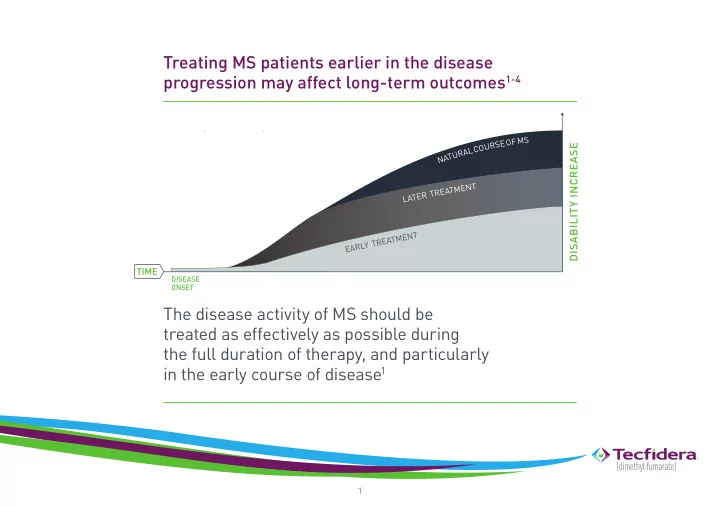
Treating MS patients earlier in the disease progression may affect long-term outcomes 1-4 M S F O E S R U DISABILITY INCREASE O C L A R U T A N T N E M T A E R T R E T A L T N E M T A E R T Y L R A E


slide-1
SLIDE 1

1

Treating MS patients earlier in the disease progression may affect long-term outcomes1-4 The disease activity of MS should be treated as effectively as possible during the full duration of therapy, and particularly in the early course of disease

1

DISABILITY INCREASE

DISEASE ONSET

N A T U R A L C O U R S E O F M S L A T E R T R E A T M E N T E A R L Y T R E A T M E N T

TIME

slide-2
SLIDE 2

2

Introducing oral TECFIDERA: Strong efficacy for first-line treatment of RRMS

Safety and efficacy demonstrated in two pivotal phase III trials in RRMS, DEFINE and CONFIRM, including over 2600 patients5,6

  • Two phase III trials, including one with an active comparator arm,

were conducted in order to meet approval requirements from regulatory authorities

  • DEFINE: 2-year, randomised, double-blind, placebo-controlled phase III

study in 1234 patients with RRMS

  • CONFIRM: 2-year, randomised, double-blind, placebo-controlled

phase III study in 1417 patients with RRMS, including glatiramer acetate as a reference comparator

slide-3
SLIDE 3

3

As shown by ARR, significant reductions vs placebo at 2 years5

In the DEFINE study

TECFIDERA reduced the number of relapses by approximately 50% in RRMS

The annualised relapse rate (ARR) in each treatment group was calculated as the total number of relapses experienced in a group divided by the total number of subject-years

  • n study at 2 years (minus the time on

alternative MS medication) for that group.

53%

0.5 0.4 0.3 ARR Placebo

(n=408)

P<0.001 TECFIDERA

240 mg BID (n=410)

0.2 0.1 0.0

0.36 0.17

ARR REDUCTION

DEFINE: 2-year multicentre, randomised, double-blind, placebo-controlled study in 1234 patients with RRMS.5 BID=twice a day. * Treatment-naive and previously treated patients.

DEFINE Study OVERALL POPULATION* IN DEFINE STUDY

  • In the primary endpoint measurement, TECFIDERA reduced the

proportion of RRMS patients who relapsed by 49%5

slide-4
SLIDE 4

4

DEFINE Study

As shown by EDSS, significant delay in disability progression vs placebo over 2 years5

In the DEFINE study

TECFIDERA delayed physical disability progression

38%

HR=0.62 95% CI (0.44, 0.87)

P=0.005

0.27 0.16

Placebo (n=408) TECFIDERA 240 mg BID (n=410) Proportion of Patients With Confirmed Progression 0.3 0.2 0.1 0.0 48 72 24 96 Weeks

REDUCTION IN DISABILITY PROGRESSION

DEFINE: 2-year multicentre, randomised, double-blind, placebo-controlled study in 1234 patients with RRMS.5 CI=confidence interval, EDSS=Expanded Disability Status Scale, HR=hazard ratio. * Treatment-naive and previously treated patients.

OVERALL POPULATION* IN DEFINE STUDY

slide-5
SLIDE 5

5

As shown by ARR, significant reductions vs placebo at 2 years6

In the rater-blinded, reference comparator CONFIRM study

TECFIDERA reduced ARR in RRMS

0.5 0.4 0.3 ARR 0.2 0.1 0.0

29%

Glatiramer acetate

SC 20 mg QD (n=350)

P=0.01

0.29

Placebo

(n=363) 0.40

44%

0.5 0.4 0.3 ARR Placebo

(n=363)

TECFIDERA

240 mg BID (n=359)

0.2 0.1 0.0 P<0.001

0.22 0.40

ARR REDUCTION

CONFIRM Study OVERALL POPULATION* IN CONFIRM STUDY

CONFIRM: 2-year multicentre, randomised, double-blind, placebo-controlled study in 1417 patients with RRMS.6 BID=twice a day QD=once a day. * Treatment-naive and previously treated patients.

slide-6
SLIDE 6

6

DEFINE: 2-year multicentre, randomised, double-blind, placebo-controlled study in 1234 patients with RRMS.5 CONFIRM: 2-year multicentre, randomised, double-blind, placebo-controlled study in 1417 patients with RRMS.6 BID=twice a day * Treatment-naive and previously treated patients.

DEFINE Study CONFIRM Study OVERALL POPULATION* IN DEFINE AND CONFIRM STUDIES

As shown by EDSS, delay in disability progression vs placebo over 2 years5,6

Physical disability progression with TECFIDERA

0.3 Placebo

(n=408)

TECFIDERA

240 mg BID (n=410)

0.2 0.1 0.0

0.27 0.16

HR=0.62 95% CI (0.44, 0.87)

P=0.005 Proportion of Patients With Confirmed Progression 0.3 Placebo

(n=363)

TECFIDERA

240 mg BID (n=359)

0.2 0.1 0.0

0.17 0.13

Proportion of Patients With Confirmed Progression

HR=0.79 95% CI (0.52-1.19)

P=0.25

(NOT SIGNIFICANT) REDUCTION IN DISABILITY PROGRESSION

21%

REDUCTION IN DISABILITY PROGRESSION

38%

27% AND 17% OF PLACEBO-TREATED PATIENTS EXPERIENCED DISABILITY PROGRESSION IN THE DEFINE AND CONFIRM STUDIES, RESPECTIVELY5,6

slide-7
SLIDE 7

7

Treatment-naive patients: significant reduction in ARR vs placebo at 2 years7

In the DEFINE study

TECFIDERA reduced ARR in treatment-naive patients

* Had not received prior medication for the treatment of MS.

67%

0.3 ARR Placebo

(n=181)

P<0.05 TECFIDERA

240 mg BID (n=187)

0.2 0.1 0.0

0.26 0.09

ARR REDUCTION DEFINE: 2-year multicentre, randomised, double-blind, placebo-controlled study in 1234 patients with RRMS.5

DEFINE Study

46% OF BID PATIENTS IN DEFINE HAD NOT RECEIVED ANY PRIOR MS MEDICATION

TREATMENT-NAIVE PATIENTS* IN DEFINE STUDY

slide-8
SLIDE 8

8

* Had not received prior medication for the treatment of MS.

As shown by EDSS, significant reduction in 12-week disability progression vs placebo at 2 years7

62%

0.3 Placebo

(n=181)

P<0.05 TECFIDERA

240 mg BID (n=187)

0.2 0.1 0.0

0.28 0.12

REDUCTION IN DISABILITY PROGRESSION

Proportion of Patients With Confirmed Progression

In the DEFINE study

TECFIDERA delayed physical disability progression in treatment-naive patients

46% OF BID PATIENTS IN DEFINE HAD NOT RECEIVED ANY PRIOR MS MEDICATION

TREATMENT-NAIVE PATIENTS* IN DEFINE STUDY DEFINE Study

DEFINE: 2-year multicentre, randomised, double-blind, placebo-controlled study in 1234 patients with RRMS.5

slide-9
SLIDE 9

9

Significant reductions vs placebo in incidences of Gd+ lesions, new or newly enlarging T2 lesions, and new T1 hypointense lesions at 2 years5,8

In the DEFINE study

TECFIDERA reduced MRI activity

In the CONFIRM study

  • Patients experienced consistent, statistically significant reductions in the

incidence of MRI-confirmed lesions6

  • TECFIDERA reduced the number of Gd+ lesions by 74%, T2 lesions by 71%,

and T1 lesions by 57% vs placebo at 2 years (P<0.0001) 6

DEFINE: 2-year multicentre, randomised, double-blind, placebo-controlled study in 1234 patients with RRMS.5

85%

RELATIVE REDUCTION OF NEW OR NEWLY ENLARGING T2 LESIONS

90%

RELATIVE ODDS REDUCTION OF GD+ LESIONS AT 2 YEARS

72%

RELATIVE REDUCTION OF NEW T1 LESIONS

1.8 1.5 Mean Number of Gd+ Lesions Placebo

(n=165)

P<0.001 TECFIDERA

240 mg BID (n=152)

1.2 0.9 0.6 0.3 0.0

Gd+

10 8 Mean Number of New T1 Hypointense Lesions Placebo

(n=165)

P<0.0001 TECFIDERA

240 mg BID (n=152)

6 4 2

T1

20 5 15 10 Mean Number of New or Newly Enlarging T2 Lesions Placebo (n=165) P<0.001 TECFIDERA

240 mg BID (n=152)

T2

1.8 0.1 5.7 2.0 17.0 2.6

DEFINE Study

slide-10
SLIDE 10

10

In the DEFINE study

TECFIDERA: strong efficacy for first-line treatment of RRMS TECFIDERA: a combination of strong efficacy and treatment simplicity for first-line treatment in RRMS patients

38

% Delayed progression

  • f physical

disability5

(P=0.005)

EDSS

53

% Proven reduction in relapse rates at 2 years5

(P<0.001)

ARR MRI

Reduced brain lesions in a broad range of MRI measures5,8

Gd+*

90

%

T2*

85

%

T1†

72

%

†(P<0.0001)

*(P<0.001)

slide-11
SLIDE 11

11

DEFINE: Change in Whole Brain Volume9

−0.81 −0.66 −0.64 −0.46 −0.77 −0.55

  • 1.0
  • 0.8
  • 0.6
  • 0.4
  • 0.2

0.0 Baseline to Year 2 Week 24 to Year 2

Placebo (n=163) BG-12 240 mg BID (n=151) BG-12 240 mg TID (n=152)

5

Median % Change in Whole Brain Volume

21%* 5% NS

P< –

30%* 17% NS

slide-12
SLIDE 12

12

CONFIRM: Change in Whole Brain Volume10

6

  • 0.945
  • 0.765
  • 0.660
  • 0.720
  • 0.750
  • 0.745
  • 0.960
  • 0.640
  • 1.2
  • 1.0
  • 0.8
  • 0.6
  • 0.4
  • 0.2

0.0 Change from Baseline to Year 2 Change from Week 24 to Year 2

Placebo (n=144) BG-12 240 mg BID (n=147) BG-12 240 mg TID (n=143) GA (n=161)

Median % Change in Whole Brain Volume

30% P=0.0645 21% P=0.2636 2% P=0.8802 5% P=0.8306 2% P=0.5621 16% P=0.7063

slide-13
SLIDE 13

13

ENDORSE Efficacy: Time to First Relapse – DEFINE, CONFIRM, and ENDORSE Integrated Analysis (ITT Population)

1 Only objective relapses were included in the Kaplan-Meier estimate analysis; patients who did not experience a relapse prior to switching –

Time on Study (weeks) Probability of Relapse Proportion Relapsed at 4 Years 0.1 0.2 0.3 0.4 0.5 0.6 12

469 464 229 223 111 106

24

445 443 212 206 103 102

36

430 423 192 192 95 94

48

417 410 179 177 89 89

60

401 405 171 168 84 88

72

393 392 161 163 81 86

84

379 387 154 149 79 80

96

367 382 146 142 77 77

108

352 363 123 121 69 61

120

339 348 116 111 65 55

132

335 335 113 110 62 53

144

326 322 110 106 60 51

156

319 307 109 103 58 50

168

307 292 106 100 54 48

180

297 282 101 98 52 46

192

272 260 93 93 41 41

DEFINE and CONFIRM ENDORSE

0.496 0.487 0.432 0.409 0.380 0.362 Baseline

501 502 249 248 118 118 Patients at Risk DMF BID/DMF BID DMF TID/DMF TID PBO/DMF BID PBO/DMF TID GA/DMF BID GA/DMF TID

PBO/DMF TID PBO/DMF BID GA/DMF TID GA/DMF BID DMF TID/DMF TID DMF BID/DMF BID

ENDORSE Post Marketing ongoing study Efficacy: Time to First Relapse

DEFINE, CONFIRM, and ENDORSE Integrated Analysis (ITT Population)13

slide-14
SLIDE 14

14

ENDORSE Efficacy: Time to Disability Progression by EDSS (24-Week Confirmation) – DEFINE, CONFIRM, and ENDORSE Integrated Analysis (ITT Population)

2 –

Probability of Confirmed Disability Progression 0.1 0.2 0.3 Baseline

501 502 249 248 118 118

12

469 464 229 223 111 106

24

445 443 212 206 103 102

36

430 423 192 192 95 94

48

417 410 179 177 89 89

60

401 405 171 168 84 88

72

393 392 161 163 81 86

84

379 387 154 149 79 80

96

367 382 146 142 77 77

108

352 363 123 121 69 61

120

339 348 116 111 65 55

132

335 335 113 110 62 53

144

326 322 110 106 60 51

156

319 307 109 103 58 50

180

297 282 101 98 52 46

192

272 260 93 93 41 41

0.231 0.214 0.199 0.168 0.164 0.154 Time on Study (weeks) 168

307 292 106 100 54 48 Patients at Risk DMF BID/DMF BID DMF TID/DMF TID PBO/DMF BID PBO/DMF TID GA/DMF BID GA/DMF TID

Proportion Progressed at 4 Years

DEFINE and CONFIRM ENDORSE

PBO/DMF TID PBO/DMF BID GA/DMF TID GA/DMF BID DMF TID/DMF TID DMF BID/DMF BID

ENDORSE Post Marketing ongoing study Efficacy: Time to Disability Progression by EDSS (24-Week Confirmation)

DEFINE, CONFIRM, and ENDORSE Integrated Analysis (ITT Population)14

slide-15
SLIDE 15

15

TECFIDERA showed a manageable tolerability profile

  • These events were mostly mild to moderate8
  • GI and flushing events tended to begin early in the course of treatment

(primarily in month 1)8 — For patients who experience these events, they may continue to occur intermittently throughout TECFIDERA treatment Gastrointestinal (GI) and flushing events were the most common adverse events8

Adverse event* Placebo TECFIDERA

240 mg BID

Diarrhoea 10% 14% Nausea 9% 12% Upper abdominal pain 6% 10% Abdominal pain 4% 9% Vomiting 5% 8% Dyspepsia 3% 5% Flushing 4% 34%

* For other adverse events please see label.

slide-16
SLIDE 16

16

Integrated Analysis: Incidence of Flushing Events* and Gastrointestinal Events† by Study Month

2

*Flushing events include the preferred terms flushing, hot flush, erythema, generalized erythema, burning sensation, skin burning sensation, feeling hot, and hyperemia;

†gastrointestinal events include the preferred terms in the level 2 subordinate standardized MedDRA queries gastrointestinal nonspecific inflammations or gastrointestinal nonspecific

symptoms and therapeutic procedures. BID=twice daily; TID=3 times daily. Selmaj K et al. Presented at ECTRIMS; October 10–13, 2012; Lyon, France. P484.

Placebo (n=408) BG-12 240 mg BID (n=410) BG-12 240 mg TID (n=416) 10 5 25 30 35 20 15 1 2 3 4 5 6 7 8 9 10 11 12 24 Month Patients (%) 30 25 20 15 10 5 1 2 3 4 5 6 7 8 9 10 11 12 24 Month Patients (%) 35

Flushing Events Gastrointestinal Events

Integrated Analysis: Incidence of Flushing Events* and Gastrointestinal Events† by Study Month

*Flushing events include the preferred terms flushing, hot flush, erythema, generalized erythema, burning sensation, skin burning sensation, feeling hot, and hyperemia; †gastrointestinal events include the preferred terms in the level 2 subordinate standardized MedDRA queries gastrointestinal nonspecific inflammations or gastrointestinal nonspecific symptoms and therapeutic procedures. BID=twice daily; TID=3 times

  • daily. Selmaj K et al. Presented at ECTRIMS; October 10–13, 2012; Lyon, France. P484.
slide-17
SLIDE 17

17 * Long-term use of aspirin is not recommended for the management of flushing. Potential risks associated with aspirin should be considered prior to co-administration with TECFIDERA.8

Measures to improve tolerability8 GI Flushing Starting dose of 120 mg twice a day for 7 days

  • Temporary dose reduction of TECFIDERA to

120 mg BID; within 1 month, the recommended dose of 240 mg BID orally should be resumed

  • Taking with food
  • Administration of 325-mg (or equivalent) non-enteric

coated aspirin* prior to TECFIDERA dosing

  • Measures designed to help minimize

GI and flushing adverse events

slide-18
SLIDE 18

18

DEFINE: Lymphocyte Counts

1

0.5 1.0 1.5 2.0 2.5 3.0 Mean Lymphocyte Count (×109/L) BL 8 12 24 36 48 60 72 84 96 4

LLN

n=407 (baseline) to 245 (week 96) n=410 (baseline) to 271 (week 96) n=416 (baseline) to 268 (week 96)

Note: LLN is lower limit in standard unit; if multiple values were given for LLN of any parameter, the highest LLN is shown. DEFINE=Determination of the Efficacy and Safety of Oral Fumarate in Relapsing-Remitting MS; BID=twice daily; TID=3 times daily; LLN=lower limit of normal; BL=baseline; MS=multiple sclerosis. Biogen Idec, data on file.

Placebo BG-12 240 mg BID BG-12 240 mg TID

Visit (weeks)

Hematology Parameters: Mean Values over Time Placebo BG-12 240 mg BID BG-12 240 mg TID

DEFINE: Lymphocyte Counts

Note: LLN is lower limit in standard unit; if multiple values were given for LLN of any parameter, the highest LLN is shown. DEFINE=Determination

  • f the Efficacy and Safety of Oral Fumarate in Relapsing-Remitting MS; BID=twice daily; TID=3 times daily; LLN=lower limit of normal;

BL=baseline; MS=multiple sclerosis. Biogen Idec, data on file.

slide-19
SLIDE 19

19

Low discontinuation due to incidence of GI and flushing events

Events leading to discontinuation8 TECFIDERA

240 mg BID

GI 4% Flushing 3%

THE INCIDENCE OF GI AND FLUSHING (THE MOST COMMON ADVERSE EVENTS) LEADING TO DISCONTINUATION WAS GENERALLY LOW8

slide-20
SLIDE 20

20

TECFIDERA showed a favourable safety profile8

  • The overall incidences of renal adverse reactions were similar

for TECFIDERA and placebo — There was a small difference between TECFIDERA BID (9%) and placebo (7%) for proteinuria

  • Infection risk and serious infection rate with TECFIDERA were

comparable with placebo

  • No increased incidence of serious infections observed in patients with

lymphocyte counts <0.8x10⁹/l or <0.5x10⁹/l

  • Lymphocyte counts decreased by approximately 30% over the

first year, then plateaued — Mean and median lymphocyte counts remained within normal limits

The long-term, clinical significance of these effects is not known.

slide-21
SLIDE 21

21

In clinical trials, a total of 2468 patients have received TECFIDERA and been followed for periods up to 4 years with an overall exposure equivalent to 3588 person-years8

  • Approximately 1056 patients have received more than 2 years
  • f treatment with TECFIDERA
  • The experience in uncontrolled clinical trials

isconsistent with the experience in the placebo- controlled clinical trials

slide-22
SLIDE 22

22

Monitoring requirements8

Complete blood counts Every 6 to 12 months thereafter and as clinically indicated Hepatic function tests Renal function tests

Month O 2 1 3 4 5 6

AFTER 6 MONTHS, ASSESSMENTS CAN BE ACCOMPLISHED WITH A SINGLE BLOOD DRAW AND URINE SAMPLE AT 6- TO 12-MONTH INTERVALS AND AS CLINICALLY INDICATED

slide-23
SLIDE 23

23

In the DEFINE study

TECFIDERA: a new oral treatment for RRMS patients

  • ffering strong efficacy, manageable tolerability, and

a favourable safety profile

REDUCTION OF PHYSICAL DISABILITY

STRONG EFFICACY YOU WANT FOR FIRST-LINE TREATMENT5

ARR EDSS

REDUCTION IN RELAPSE RATES

MRI

85%

(P<0.001)

T2

38%

(P=0.005)

EDSS

53%

(P<0.001)

ARR

90%

(P<0.001)

Gd+

Proven reduction in relapse rates at 2 years Delayed progression of physical disability Reduced brain lesions in a broad range

  • f MRI measures
slide-24
SLIDE 24

24

SIMPLICITY THEY NEED FOR FIRST-LINE TREATMENT7

SAFETY AND MONITORING

Favourable safety profile with monitoring aligned with clinical practice

TWICE-DAILY ORAL DOSING

Day Night

slide-25
SLIDE 25

25

TECFIDERA oral dosing

120-mg capsules have a green cap and white body printed with “BG-12 120 mg” in black ink on the body8

Start with 120 mg

AM PM

Continue with 240 mg

240-mg capsules have a green cap and a green body printed with “BG-12 240 mg” in black ink on the body8

AM PM

  • Twice-daily TECFIDERA should be taken with food morning and evening
slide-26
SLIDE 26

26 1. Gold R, Hartung H-P, Stangel M, Wiendl H, Zipp F. Therapeutic goals of platform and escalation therapies for relapsing-remitting multiple sclerosis. Akt Neurol. 2012;39:342– 350. 2. Leray E, Yaouang J, Le Page E, et al. Evidence for a two-stage disability progression in multiple sclerosis. Brain. 2010;133:1900-1913. 3. Confavreux C, Vukusic S, Moreau T, Adeleine P. Relapses and progression of disability in multiple sclerosis. N Engl J Med. 2000;343(20):1430-1438. 4. Confavreux C, Vukusic S, Adeleine P. Early clinical predictors and progression of irreversible disability in multiple sclerosis: an amnesic process. Brain. 2003;126:770- 782. 5. Gold G, Kappos L, Arnold DL, et al; DEFINE Study Investigators. Placebo-controlled phase 3 study of oral BG-12 for relapsing multiple sclerosis. N Engl J Med. 2012;367(12):1098-1107. 6. Fox RJ, Miller DH, Phillips JT, et al; CONFIRM Study Investigators. Placebo-controlled phase 3 study of oral BG-12 or glatiramer in multiple sclerosis. N Engl J Med. 2012;367(12):1087-1097. 7. Bar-Or A, Gold R, Kappos L, et al. Effect of BG-12 in subgroups of patients with relapsing–remitting multiple sclerosis: findings from the DEFINE study. Poster presented at: 64th Annual Meeting of the American Academy of Neurology; April 21-28, 2012, New Orleans; LA. P01.130.

  • 8. TECFIDERA Summary of Product Characteristics. Biogen Idec.
  • 9. *P<0.05 vs placebo, based on ANCOVA on ranked data, adjusted for region and normalized brain volume at baseline/week 24. DEFINE=Determination of the Efficacy and Safety
  • f Oral Fumarate in Relapsing-Remitting MS; NS=not statistically significant vs placebo; BID=twice daily; TID=3 times daily; ANCOVA=analysis of covariance; MS=multiple
  • sclerosis. Arnold DL et al. Presented at AAN; April 21–28, 2012; New Orleans, LA. S11.003.
  • 10. CONFIRM=Comparator and an Oral Fumarate in Relapsing-Remitting MS; BID=twice daily; TID=3 times daily; GA=glatiramer acetate; MS=multiple sclerosis. Biogen Idec,

data on file.

  • 11. Adjusted mean and 95% CI based on negative binomial regression, adjusted for region and baseline volume of T2 lesions at the start of DEFINE and CONFIRM; data after

subjects switched to alternative MS medications were excluded. DMF, dimethyl fumarate. Miller DH, et al. Presented at: ECTRIMS, October 2–5, 2013, Copenhagen, Denmark. Poster P1004.

  • 12. The MOGISS reflects the impact of GI-related events on the patient during the 24 hours prior to data entry. P2.227. Fox EJ et al, P2.227 AAN 2014
  • 13. Only objective relapses were included in the Kaplan-Meier estimate analysis; patients who did not experience a relapse prior to switching to alternative MS medications or

withdrawal from study were censored at the time of switch/withdrawal. *Two years in DEFINE/CONFIRM and 2 years in ENDORSE. DMF, dimethyl fumarate. Gold R, et al. Presented at: ECTRIMS, October 2–5, 2013, Copenhagen, Denmark. Poster P538.

  • 14. Subjects were censored if they withdrew from study or switched to alternative MS medication without a progression. DMF, dimethyl fumarate. Gold R, et al. Presented at:

ECTRIMS, October 2–5, 2013, Copenhagen, Denmark. Poster P538.

  • 15. Dimethyl Fumarate: A review of its use in patients with Relapsing- Remitting Multiple Sclerosis Celeste B. Burness- Emma D. Decks CNS Drugs DOI

10.1007/s40263-014-0155-5 published online: March 13th 2014