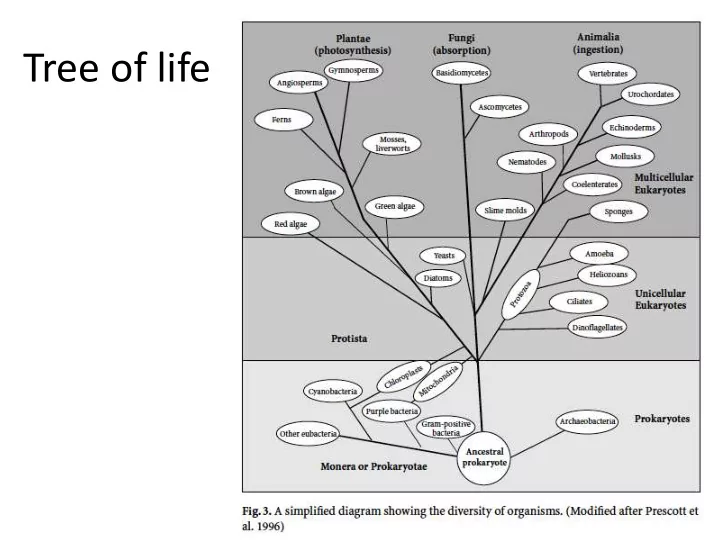
Tree of life Microbial Diversity Nutritional diversity Soil - PowerPoint PPT Presentation
Tree of life Microbial Diversity Nutritional diversity Soil bacteria Schizomycetes Myxobacteria Genus Orders Myxococcus Pseudomonas Chondrococcus Eubacteria Archangium Polyangium Actinomycetes Cytophaga
Tree of life
Microbial Diversity
Nutritional diversity
Soil bacteria Schizomycetes Myxobacteria • Genus • Orders – Myxococcus – Pseudomonas – Chondrococcus – Eubacteria – Archangium – Polyangium – Actinomycetes – Cytophaga – Sporocytophaga • “Bacteria” • 10 7 -10 9 /g soil • “Swarm” • consume insoluble • 10 6 /ml water organics • Intercellular “communication”
Soil archaebacteria
Soil fungus
Eukaryotes + Prokaryote
Introduction • What are soils? • What are the general processes involved? • How to microorganisms (and plants) contribute?
Rock weathering & decay • Primary material must be broken down to smaller pieces – Increased surface area/volume ratio – Increased binding of nutrients – Release/binding of metals – Niche formation / chemical gradients
Soil texture • Sand v. clay • Porosity and retention – Microorganisms – Air (aeration) – Moisture – Surface Area • Influences?
Minerals
Microbial processes Epilithic lichens • Mechanism – Physical (rhizine penetration) – Chemical (lichen-organic acids) – Crustose cover undergoes differential wetting and drying (and heat transfer) • Results – Grain detachment – Detachment by fractional heating
Microbial processes Epilithic free living algae • Mechanisms – Photosynthesis / alkalinisation of rock surfaces – Extracellular polymeric substances (EPS) • Results – Dissolution of rock – Protective surface biofilm
Microbial processes Chasmolithic and endolithic cyanobacteria, algae, chemo- organotrophic bacteria and fungi • Mechanisms – Physical (swelling) – Chemical (acids, polysaccharides) through EPS – Differential heating due to pigments (melanins) – Turgor pressure • Results – Exfoliation, chipping, pitting – Increased porosity – Surface parallel cracking
Microbial processes • Ideas of biological attack – Photosynthesis (alkalinisation) by algae and lichens – Chemolithotrophic organisms (e.g …) • Sulfate oxidising bacteria (sulfuric acid) • Ammonia oxidising bacteria (nitric acid) – Heterotrophic bacteria • Consumption of organics • Production of CO 2 (CO 2 + H 2 O = H 2 CO 3 )
Organics
Organics - terminology
Organic matter Mineralisation Partial decomposition • • Formation of complex Complete breakdown into inorganic components organic radicals • Polymerisation humus – Carbon dioxide – Nitrate / ammonia – Sulfate • Humus – Phosphate – Small % of soil • Fate – (+) water capacity – Re-mobilised by biota – (+) aggregation – Redox changes – (+) negative charge – Gas transformation – Leach through pores – (+) soil fertility – Sorb on to particles
Organic matter • Plant litter most organic matter • Some exceptions – Lichens – Cyanobacteria – Fungi • Some other bacteria that produce biomass from CO 2 (inorganic C) • Assimilated (biomass) / partly mineralised
Plant compounds Storage materials (intracellular) • Proteins • Starch • Sugars • Chlorophyll • Pigments
Plant compounds Structural materials • Cellulose • Hemicelluloses (polysaccharides that surround fibres) • Lignins (stabilisers) • Tannins (chemical defenses)
Plant materials Storage materials (intracellular) • Easily broken down and assimilated.
Other compounds Microbial compounds Black carbon
Humification
Humification • Factors affecting decomposition – Water potential – Oxygen supply – Temperature – Nutrients – pH
Humification • Complex process – Plant products degradable products monomers microbial biomass – Plant products un-degradable (incl. slow) products re-assembled – oxidized to humic precursors (humic and fulveric acids) – complexation with clays and metal hydroxides • Truthfully, very little is known of the process (esp. “rapid re-synthesis of microbial biomass to polysaccharide and proteinaceous moeities in the humic fractions)”
Organic matter and humus • Affects coexistence of plants, animals and microbes • Regulate nutrient flux to microbes • Hormonal role to plants • (+) cation exchange capacity • Buffer pH • (+) water capacity • Dark colour helps warm soil
Soil aggregation AZ Master Gardener, ag.arizona.edu
Soil aggregation • Benefits of aggregate abundance and stability – Plant growth – Resistance to erosion – Soil organic matter turnover – Organism (incl. mesofauna and microfauna) abundance, activity and diversity
Microbial metabolites • Polysaccharides – Root exudates - carbohydrates – Bacterial EPS – polysaccharides, proteins, nucleic acids • Glomalin – Abruscular mycorrhyzal fungi – Recalcitrant – Insoluble to water • Lipids
Biofilms
Microbial methods to improve soil aggregation • Rhisophere microbial communities • Organic residues • Inoculation with microorganism • Calcite-forming bacteria (bio-cementation)
Recommend
More recommend
Explore More Topics
Stay informed with curated content and fresh updates.