Tree removal in urban open space Overview - Program of works - - - PowerPoint PPT Presentation

tree removal in urban open space overview
SMART_READER_LITE
LIVE PREVIEW

Tree removal in urban open space Overview - Program of works - - - PowerPoint PPT Presentation

Tree removal in urban open space Overview - Program of works - Community reaction and expectation - Evolution of the approach - Tree removal guidelines - Case studies 2 Program of works - Retarding basins are temporary dams - Multi purpose


slide-1
SLIDE 1

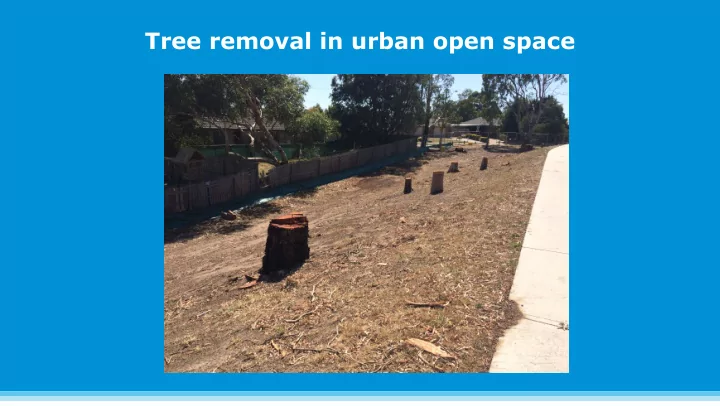
Tree removal in urban open space

slide-2
SLIDE 2

Overview

  • Program of works
  • Community reaction and expectation
  • Evolution of the approach
  • Tree removal guidelines
  • Case studies

2

slide-3
SLIDE 3

Program of works

3

  • Retarding basins are temporary dams
  • Multi purpose use. Parks, sporting fields, schools, golf courses
  • Melbourne Water obliged to manage dam safety risks
  • 60 retarding basins upgraded
  • Often trees need to be removed
slide-4
SLIDE 4

4

slide-5
SLIDE 5

Community reaction

5

Key influences

  • Publically accessible
  • Purpose of the facility
  • Local demographics
  • Mobilised community due to other projects

Primarily community engagement projects

slide-6
SLIDE 6

Evolution of approach

6

  • Early projects carried out consultation in a traditional manner
  • Moved to focusing on councils first
  • Tailoring solutions to each site
  • Inconsistencies in planning controls
  • Social and environmental equity
  • Tree removal guidelines – best practice
slide-7
SLIDE 7

Tree removal guidelines

7

  • Catalogue of options
  • Wildlife handling
  • Seed collection and donation – indigenous groups
  • Replanting
  • Hollowing logs
  • Wood turning
  • Mulch to community groups
slide-8
SLIDE 8

8

slide-9
SLIDE 9

Southern package of retarding basins upgrades

9

  • Passionate and emotional community
  • Escalating on social media including political involvement
  • Adoption of best practice avoided reputational damage
  • Captured approach in Tree Removal Guidelines
slide-10
SLIDE 10

Southern package of retarding basins upgrades

10

  • Everyone in the team needs to play their role
  • Community engagement advisor – COMACON
  • Melbourne Water – Project Manager and broader team
  • Contractors – JH-KBR
  • Designers - GHD
slide-11
SLIDE 11

Eastern package of retarding basins upgrades

11

  • 8 retarding basins upgraded
  • Planning permit applications currently being assessed
  • Wildlife handling consultant involved from the start
  • Tree removal guidelines appear to be effective…
slide-12
SLIDE 12
slide-13
SLIDE 13

Aim of Presentation:

  • Who is HMS? Services and staff/specialists
  • Key projects including Melbourne Water/JHG/KBR JV Retarding Basin Upgrade Project and

DCLCRP-Lend Lease/CPB

  • Challenges faced eg vocal community groups, difficult clients/contractors (tree cutters), social media etc
  • Presented environmental initiatives to clients which meet project, planning, community and stakeholder needs

along with great sustainable and responsible environmental outcomes and benefits.

  • Early project planning is the key: tender stage!
  • Engage early in order to resource a project, budget, seek engagement, planning and permission, streamline the

project on ground.

  • Timing is critical when dealing with fauna eg; removing/disturbing vegetation
  • Every community has different needs. You just need to find their motivators- listen and address their concerns
  • Engage with our clients, contractors and consultants!
slide-14
SLIDE 14

Who is Habitat Management Services?

  • Commenced operations in 2004
  • Based in Melbourne outer North/North East
  • Has operated throughout VIC, NSW, SA, QLD and U.S.A
  • Company consists of Zoologists, Ecologists, Botanists, Environmental

Planners/Auditors, GIS specialists, Drone Pilots, Environmental Educators etc

  • Specialise in Road, Rail, Pipeline, Water, Power, Wind and Property

Developing etc

  • Project Profile includes Melbourne Water RB’s, Westgate Tunnel, Monash

Freeway, DCLCRP, NEPA, SPA, Yan Yean Road Upgrade, Western Road Upgrades, Peninsula Link, Murray Basin Rail Upgrade, M80 Upgrade, KPFEP, Ravenhall Prison, Local Government Hazardous Tree Removal, Metro Tunnel, ARTC Projects, Bald Hill Windfarm, Mount Mercer Powerline etc.

  • Melbourne Water RB’s
slide-15
SLIDE 15
slide-16
SLIDE 16

Organisation Chart

Director-Mark W Director-Tanya W Manager & Principal Zoologist/Ecologist OH& S Leader Tanya White Administration Manager Naomi Read Assistant Manager Senior Zoologist/Ecologist

  • Dr. Amanda Dare

Senior Zoologist/Ecologist Lauren Tworkowski Field Zoologist/Ecologist (herpetologist)

  • Dr. Zak Atkins

Field Zoologist/ Ecologist/Botanist Daniel Miller Field Botanist/Ecologist Jami Butler Field Zoologist/Ecologist Emily Robertson Field Zoologist/Ecologist Victoria Sperring Senior Zoologist/Ecologist/Botanist Michael Cincotta Field Zoologist/Ecologist Kristin Semmens Field Zoologist Christine Hall

slide-17
SLIDE 17

Permits, Approvals & Legislation

  • The work that Habitat Management Services delivers is governed by a number of

permits, approvals and legislation.

  • All native fauna is protected under the Wildlife Act of 1975.
  • To conduct any fauna surveying including trapping, spotlighting etc-issued with a

Research Permit and Management Authorisation by the Animal Ethics Committee (AEC) and Approved by the Wildlife and Small Institutions Animal Ethics Committee (WSIAEC)

  • Animal spotter/Catcher is under a Wildlife Permit (Wildlife Act of 1975) issued by

the DELWP

  • The EPBC Act 1999 and the FFG Act 1988 is also state and federal legislation that

protects threatened species at a state and international level.

  • Permit to Take Protected Flora-also issued by DELWP.
slide-18
SLIDE 18

Motivators? Client, Community, Environment

Client *Don’t want Project Delays *Don’t want Negative Publicity *Engage, work with and on board community *Guided by Environmental approvals/legislation *Incentives eg; ISCA, Internal requirements etc. Community *Sense of community pride *Concerns about Landscape change *Environmental concern *Project intrusion such as noise, dust, increase in traffic etc Environment *Responsible and right thing to do *Protected by Planning permits/legislation *Providing alternatives for Fauna *Improving degraded areas through enhancement *Engage with community with various actions eg; revegetation, nest box building etc

slide-19
SLIDE 19

Key Messages

  • Engagement between client and specialists- during the tendering phase so there is a full understanding of what may
  • r will be required.
  • Plan and preparing project in relation to possible environmental challenges eg significant fauna, flora, pre-clearance

findings, translocation sites.

  • Present scenarios and possible solutions
  • Develop key environmental actions and outcomes for project eg; ISCA, community engagement, community forums

etc.

  • Develop a budget based on key findings eg nest boxes, extra arborist requirements, fauna ladders, seed collection,

greenhouse etc.

  • Engage with client (especially comms dept), stakeholders and community as early as possible including making

everyone’s life easy. Streamline processes!

  • Client to liaise with community as early as possible. This may include seeking approvals for translocation, nest boxes etc
  • Bring contractors and environmental specialists together to preplan resources, equipment required and expectations.
  • Be solution focused. Win Win!
  • Future planning including revegetation/landscaping (specific for fauna), seed supplies etc
  • Celebrate the good things your project achieves.
  • Take people on a journey!
slide-20
SLIDE 20

Liaise with Client

  • Conduct all the necessary

searches/literature reviews

  • Meet with PM, Engineers,

Comms, Enviro reps

  • Discuss requirements,

timing, contractors, community and engagement opportunities (identify them eg schools, scouts etc)

  • Methods to inform the

community

  • This should be conducted

at least one month prior to clearing if possible!!!

On-Site Inspections

  • HMS (with tree cutters) to

conduct a walk through to identify possible fauna, habitat and engagement

  • pportunities.
  • If habitat present, identify

equipment required, access, translocation sites etc

  • Identify detailed
  • pportunities to engage

the community eg wood, mulch, nest box building, seed collection etc

  • Conduct a pre-clearance

inspection no more than 3- 5 days prior to clearing

Clearing Activities

  • Liaise with the tree

removal company prior to clearing

  • Ensure the tree removal

contractors are aware of Zoologists requirements

  • Ensure that tree removal

contractors are aware they may be required to partake in preserving components of the tree eg; habitat logs, saw mill timber etc. This includes transporting habitat logs, mulch etc.

  • Discuss opportunities after

clearing eg, revegetation, propagation etc.

Kicking Off? Ticking the Box

slide-21
SLIDE 21

Examples: Engaging and Delivering

  • Seed collection
  • Nest boxes and building
  • Fauna ladders
  • Mulch
  • Timber and bark for indigenous communities
  • Timber for firewood
  • Timber for terrestrial and aquatic habitat
  • Foliage for foraging
  • Revegetation
  • Solutions to problems eg water rat, seagulls, animals in hollows
  • Research opportunities
  • Reuse of hollows, nests etc
slide-22
SLIDE 22

Sustainability: Timber Reuse Options

Mulch Foliage for foraging/food Hollows Seeds Wood/Logs Bark

slide-23
SLIDE 23
slide-24
SLIDE 24

SEEDS: Where do they go?

slide-25
SLIDE 25

Educating & Engaging Young Minds

slide-26
SLIDE 26

Timber Reuse: Re-purposing-Indigenous Community

slide-27
SLIDE 27

Timber Reuse: Re-purposing back into the Community-Art/Furniture/Sculptures etc

slide-28
SLIDE 28

Timber Reuse: Re-purposing back into the Environment

slide-29
SLIDE 29

Habitat Enhancement

slide-30
SLIDE 30

Responsible Wildlife Management during Tree Removal

slide-31
SLIDE 31

Finding a Solution: Construction Activities & Environmental Disturbance. Community Engagement

  • Locations: Lee street, Frankston.
  • Site Description: Resident adjacent, drainage

line, vegetation type

  • Key findings during tree removal?
  • Habitat improvement-Nest boxes, ladder etc
  • Construction activities included the use of

earth moving equipment such as dozers and rollers.

  • Resident concern: Strange dirt mounds???
slide-32
SLIDE 32

Solution?

  • Find the root cause? Investigate! Native? Exotic?
  • Strange mounds, grass runs but no sighting.
  • Trapping (Elliots) and camera trap in the front

and backyard

  • Time set and checked?
  • And we wait…..
slide-33
SLIDE 33

Traps & Cameras

slide-34
SLIDE 34

Night 1: Key Findings

slide-35
SLIDE 35

Night 1: Key Findings

slide-36
SLIDE 36

Night 2: Key Findings-Native Swamp Rat

slide-37
SLIDE 37

Follow-Up

  • Relocate any animals immediately down to the

drainage line (within home range)

  • Trap shy animals
  • Limited by temperatures to continue trapping
  • Recommended to slash grass, dig up any shrubs

etc and carefully dig up burrows and relocate any remaining native rats.

  • Upon completion block all back entrances
slide-38
SLIDE 38

Digging for burrows

slide-39
SLIDE 39

Other Initiatives

slide-40
SLIDE 40

Cool Animals

slide-41
SLIDE 41

Thank-You! Questions? Tanya White Managing Director: Principal Zoologist/Ecologist Habitat Management Services Mobile: 0408 700 096 Email: tanyaw@hbtmgt.com Website: www.hbtmgt.com.au