Trip characteristics: length, time of day, purpose, etc. Trip - - PowerPoint PPT Presentation

trip characteristics length time of day purpose etc
SMART_READER_LITE
LIVE PREVIEW

Trip characteristics: length, time of day, purpose, etc. Trip - - PowerPoint PPT Presentation

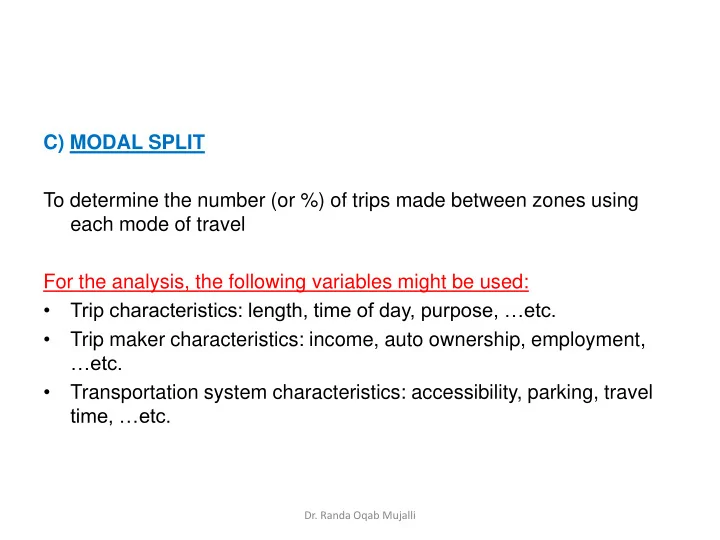
C) MODAL SPLIT To determine the number (or %) of trips made between zones using each mode of travel For the analysis, the following variables might be used: Trip characteristics: length, time of day, purpose, etc. Trip maker


slide-1
SLIDE 1

C) MODAL SPLIT To determine the number (or %) of trips made between zones using each mode of travel For the analysis, the following variables might be used:

  • Trip characteristics: length, time of day, purpose, …etc.
  • Trip maker characteristics: income, auto ownership, employment,

…etc.

  • Transportation system characteristics: accessibility, parking, travel

time, …etc.

  • Dr. Randa Oqab Mujalli
slide-2
SLIDE 2

Types of Modal Split Models

  • (1) Direct Generation of transit trips,
  • (2) Trip End models, and
  • (3) Trip Interchange Modal Split models.
  • Dr. Randa Oqab Mujalli
slide-3
SLIDE 3
  • Dr. Randa Oqab Mujalli

Trip End Models: To determine the % of total person or auto trips that will use a mode, Estimates are made prior to the trip distribution phase based

  • n:
  • land-use or socioeconomic characteristics of the zone.

This method does not incorporate the quality of service.

slide-4
SLIDE 4
  • Dr. Randa Oqab Mujalli

4

slide-5
SLIDE 5
  • Dr. Randa Oqab Mujalli

5

slide-6
SLIDE 6
  • Dr. Randa Oqab Mujalli

6

  • 3. Trip Interchange Models:

In this method, system level-of-service variables are considered, including:

  • relative travel time,
  • relative travel cost,
  • economic status of the trip maker, and
  • relative travel service.
  • Estimates are made after the trip distribution
slide-7
SLIDE 7
  • Dr. Randa Oqab Mujalli

7

  • An example of this procedure is illustrated using the QRS method

which takes account of service parameters in estimating mode choice.

  • The QRS method is based on the following relationship:

t

slide-8
SLIDE 8
  • Dr. Randa Oqab Mujalli

8

slide-9
SLIDE 9
  • Dr. Randa Oqab Mujalli

9

  • In-vehicle time is time spent traveling in the vehicle, and
  • excess time is time spent traveling but not in the vehicle, including

waiting for the train or bus and walking to the station.

  • The impedance value is determined for each zone pair and

represents a measure of the expenditure required to make the trip by either auto or transit.

slide-10
SLIDE 10
  • Dr. Randa Oqab Mujalli

10

  • The data required for estimating mode choice include

(1) distance between zones by auto and transit, (2) transit fare, (3) out-of-pocket auto cost, (4) parking cost, (5) Highway and transit speed, (6) exponent values, b, (7) median income, and (8) excess time, which includes the time required to walk to a transit vehicle and time waiting or transferring. Assume that the time worked per year is 120,000 min.

slide-11
SLIDE 11
  • Dr. Randa Oqab Mujalli

11

slide-12
SLIDE 12
  • Dr. Randa Oqab Mujalli

12

slide-13
SLIDE 13
  • Dr. Randa Oqab Mujalli

13

Logit Models:

  • An alternative approach used in

transportation demand analysis is to consider the relative utility of each mode as a summation of each modal attribute.

  • the choice of a mode is expressed as a

probability distribution.

slide-14
SLIDE 14
  • Dr. Randa Oqab Mujalli

14

  • If two modes, auto (A) and transit (T), are

being considered, the probability of selecting the auto mode A can be written as:

This form is called the logit model

slide-15
SLIDE 15
  • Dr. Randa Oqab Mujalli

15

slide-16
SLIDE 16
  • Dr. Randa Oqab Mujalli

16

slide-17
SLIDE 17
  • Dr. Randa Oqab Mujalli

17

slide-18
SLIDE 18

Approaches

  • Dr. Randa Oqab Mujalli

18

(1) Diversion curves, (2) Minimum time path (all-or-nothing) assignment, and (3) Minimum time path with capacity restraint.

slide-19
SLIDE 19
  • 1. Diversion curves,
  • Dr. Randa Oqab Mujalli

19

slide-20
SLIDE 20
  • 2. Minimum Path Algorithm
  • Dr. Randa Oqab Mujalli

20

  • Why do we need to find the shortest path?
  • –In the trip assignment (or route choice), the

model assumes that people try to travel the minimum-travel-time paths

  • –The problem is finding the minimum-travel-

time paths connecting each O-D pair for a given set of link travel time.

slide-21
SLIDE 21

All-or-Nothing Assignment

  • Dr. Randa Oqab Mujalli

21

  • All trips are assigned on the shortest route

which is the minimum travel time or cost between zones

– Simple and inexpensive to perform – Does not take account of congestion effect

  • Assumes there is no travel time change due to

increased traffic

  • Flow patterns could be unrealistic
  • Can be used for special cases (significantly under-
slide-22
SLIDE 22
  • Dr. Randa Oqab Mujalli

22

  • to determine which route that will be, it is

necessary to find the shortest route from the zone of origin to all other destination zones.

  • The results can be depicted as a tree, referred

to as a skim tree.

  • Each zone is represented by a node in the

network which represents the entire area being examined.

slide-23
SLIDE 23
  • Dr. Randa Oqab Mujalli

23

  • Assign the vehicle trips shown in the following O-D trip table to the

network, using the all-or-nothing assignment technique. To summarize your results, list all of the links in the network and their corresponding traffic volume after loading.

Trips between Zones From/to 1 2 3 4 5 1

  • 100

100 200 150 2 400

  • 200

100 500 3 200 100

  • 100

150 4 250 150 300

  • 400

5 200 100 50 350

  • Origin-Destination Trip Table:
slide-24
SLIDE 24
  • Dr. Randa Oqab Mujalli

24

Highway Network:

slide-25
SLIDE 25
  • Dr. Randa Oqab Mujalli

25

  • The all-or-nothing technique simply assumes

that all of the traffic between a particular

  • rigin and destination will take the shortest

path (with respect to time).

  • For example, all of the 200 vehicles that travel

between nodes 1 and 4 will travel via nodes 1- 5-4.

slide-26
SLIDE 26
  • Dr. Randa Oqab Mujalli

26

Nodes Link Travel From To Path Time Volume 1 2 1-2 8 100 3 1-2,2-3 11 100 4 1-5,5-4 11 200 5 1-5 5 150 2 1 2-1 8 400 3 2-3 3 200 4 2-4 5 100 5 2-4,4-5 11 500 3 1 3-2,2-1 11 200 2 3-2 3 100 4 3-4 7 100 5 3-4,4-5 13 150 4 1 4-5,5-1 11 250 2 4-2 5 150 3 4-3 7 300 5 4-5 6 400 5 1 5-1 5 200 2 5-4,4-2 11 100 3 5-4,4-3 13 50 4 5-4 6 350

slide-27
SLIDE 27
  • Dr. Randa Oqab Mujalli

27

Link Volume Routes taken

  • Vol. Calc.

Vol. 1-2 200 1-2 1-2, 2-3 100 100 100+100=200 2-1 600 2-1 3-2, 2-1 400 200 400+200=600 1-5 350 5-1 450 2-5 2-4, 4-5 5-2 5-4, 4-2 2-3 300 3-2 300 2-4 600 4-2 250 3-4 250 4-3 350 4-5 1300 5-4 700

slide-28
SLIDE 28
  • Assign the vehicle trips shown in the O-D trip table to the

network shown in Figure below using the all-or-nothing assignment technique. Make a list of the links in the network and indicate the volume assigned to each. Calculate the total vehicle minutes of travel. Show the minimum path and assign traffic for each of the five nodes.

  • Dr. Randa Oqab Mujalli
slide-29
SLIDE 29
  • Dr. Randa Oqab Mujalli
slide-30
SLIDE 30
  • Dr. Randa Oqab Mujalli
slide-31
SLIDE 31
  • Dr. Randa Oqab Mujalli

Volume Assigned Attracted trips Node 1050 600+450 1 750 200+300+250 2 650 300+350 3 1550 600+250+700 4 1650 350+1300 5

slide-32
SLIDE 32
  • Dr. Randa Oqab Mujalli