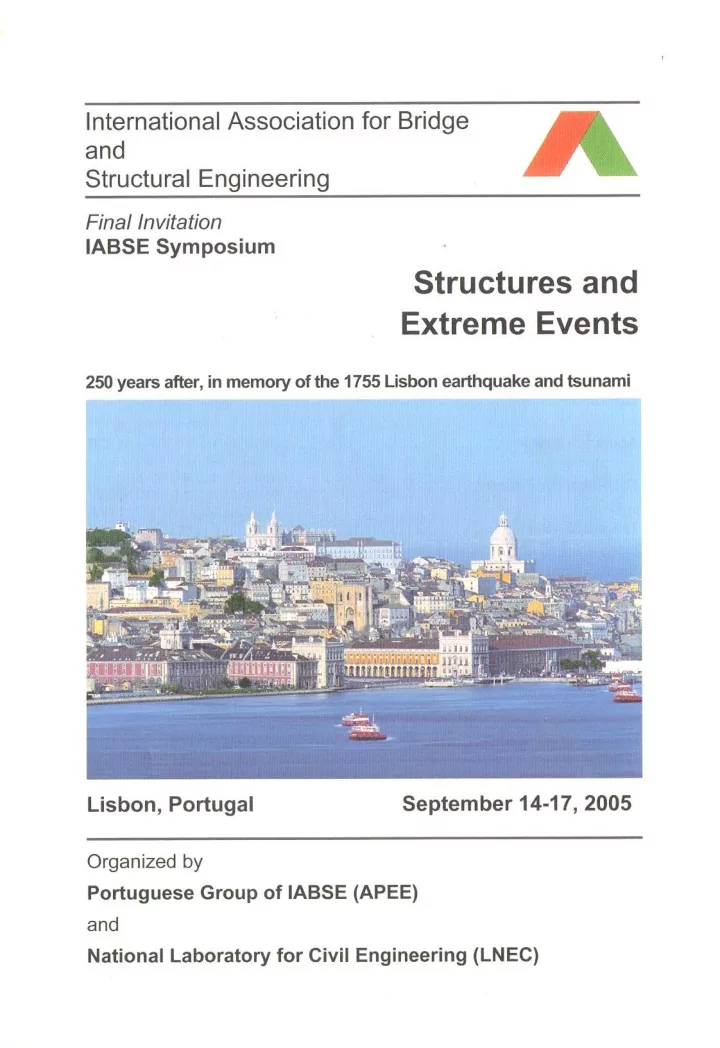
TSUNAMI CONSTRUCTION RISKS IN THE MEDITERRANEAN - OUTLINING MALTAS - - PDF document

tsunami construction risks in the mediterranean outlining
SMART_READER_LITE
LIVE PREVIEW

TSUNAMI CONSTRUCTION RISKS IN THE MEDITERRANEAN - OUTLINING MALTAS - - PDF document

TSUNAMI CONSTRUCTION RISKS IN THE MEDITERRANEAN - OUTLINING MALTAS SCENARIO LISBON 2005 - The Mediterranean region is active with earthquakes and volcanoes, some of them generating tsunamis, 20% which have been damaging. DENIS H CAMILLERI


slide-1
SLIDE 1
slide-2
SLIDE 2

LISBON 2005

DENIS H CAMILLERI MALTA

LIS 123 LIS 123

TSUNAMI CONSTRUCTION RISKS IN THE MEDITERRANEAN - OUTLINING MALTA’S SCENARIO

  • The Mediterranean region is active with

earthquakes and volcanoes, some of them generating tsunamis, 20% which have been damaging.

  • Tsunamis reach local coasts soon after they

have been generated, giving little time, 1 to 30 minutes for warning. The run-up height & inundation zones are important parameters to consider.

  • Due to the vast development that has occurred

around the Mediterranean shoreline over the past century, economic measures are now required to reduce in a reasonable manner the risks from a tsunami event.

slide-3
SLIDE 3

LISBON 2005

DENIS H CAMILLERI MALTA

LIS 123

PHYSICS OF TSUNAMI

  • Tsunami waves are distinguished from
  • rdinary ocean waves by long

wavelength often exceeding 100km and time between crests ranging from 10mins to 1 hour

  • Wind driven waves have a wavelength
  • f 100m to 200m with time between

crests varying from 5 sec to 20 sec

slide-4
SLIDE 4

LISBON 2005

DENIS H CAMILLERI MALTA

LIS 123

BATHYMETRY DATA OF THE MEDITERRANEAN SEA

  • Max. depths encountered in Ionian Sea

exceeding 4000m

  • This is to be compared to 10,000m in the

Pacific

  • In the Tyrrhenium & Ligurian Seas rarely

exceeds 2,000m

  • Malta plateau between Malta & Sicily &

Tunisian Plateau reaching Lampedusa rarely exceeds 200m.

  • Velocity for a 2,000m depth

approximated to 504 km/hr & for a 200m to 159km/hr

slide-5
SLIDE 5

LISBON 2005

DENIS H CAMILLERI MALTA

LIS 123

BATHYMETRY DATA OF THE 72,850 sq m CONTINENTAL SHELF OF MALTA

  • Varies from a gentle slope (1:35) along

Pembroke-Salina stretch Marfa Ridge & Dahlet Qorrot to Marsalforn

  • (1:20) slope Sliema – M’Scala stretch &

Ghar Lapsi area

  • (1:12.5) slope Comino all round
  • (1:5) steep slope on the cliff S-W side of

Malta & Gozo

  • Deep waters of 10-18m encountered in 5-

figured shape Grand Harbour

slide-6
SLIDE 6

LISBON 2005

DENIS H CAMILLERI MALTA

LIS 123

TSUNAMI FORCES

  • As Tsunami approaches land, the wave

slows down, height of wave increases.

  • Deep water close to the shore hampers the

build-up of a high wave

  • Build-up may be 30m for tsunami waves near

earthquake’s epicentre or 15m for tsunamis

  • f distant origin
  • Boulders with masses around 200tons can

be displaced by tsunami surges only 10m deep

  • Wind-driven waves not higher than 12m with

15 tons boulders being washed over 4m sea- walls

  • Flow velocity in recent tsunami ranged from

17- 47 km/hr as compared to 10km/hr for fast flowing river

slide-7
SLIDE 7

LISBON 2005

DENIS H CAMILLERI MALTA

LIS 123

TSUNAMI MAGNITUDE SCALES

m=> log2H Ko=> log2H1/2 Runup m Comments

  • 2

i 0.25 Very light –perceptible only on very sensitive tide gauges ii 1.00 Light – noticed by those living along the flat shore 1 iii 2.00 Rather strong – generally noticed due to flooding of gently sloping coasts. Light sailing vessels carried away on shore. 2

IV

4.00 Strong – flooding of the shore to some

  • depth. Solid structures on the coast
  • injured. Coasts littered with floating

debris. 4

V

16.00 Very strong – general flooding of the shore to some depth. Harbour works damaged. People drowned. Wave accompanied by strong roar.

slide-8
SLIDE 8

LISBON 2005

DENIS H CAMILLERI MALTA

LIS 123

RUNUPS IN METRES WITH THEIR RETURN PERIOD IN YEARS FOR VARIOUS SEAS

Run up- m Mediterra nean/New Zealand Black Sea/Indian Ocean/North America/ Caribbean South America /Hawaii/ South West Pacific 10 250 1000 200 15 1000

  • 750

20

  • 1000

For wave height < 5m & velocity < 5m/s, tsunami

force exceeds 5000 kg/m2 with windows & masonry panels expected to fail at 10-20% of this level

slide-9
SLIDE 9

LISBON 2005

DENIS H CAMILLERI MALTA

LIS 123

MEDITERRANEAN TSUNAMI CHARACTERISTICS In 365AD an M7.7 in Crete created a tsunami reaching Libya, Egypt, Calabria and as far as Spain – only tsunami to have propagated across entire Mediterranean 1.5m run up - return period 100 years 4.0m run up - return period 500 years 7.0m run up - return period 1000 years

slide-10
SLIDE 10

LISBON 2005

DENIS H CAMILLERI MALTA

LIS 123

MEDITERRANEAN REGIONS TSUNAMI HAZARDS

  • W. Mediterranean is less prone than

EAST

  • Strongest tsunamis are excited in the

Aegean Sea, Hellenic & Calabrian areas

  • Greece has had more than 160 events

catalogued over 2000 years, although geological record suggests tsunami may have been smaller than described. Even for the 1956 Aegean Tsunami (V) scientific reports considered inaccurate.

slide-11
SLIDE 11

LISBON 2005

DENIS H CAMILLERI MALTA

LIS 123

CENTRAL MEDITERRANEAN REGIONS TSUNAMI HAZARDS

  • 1000AD – 1975AD

70 tsunamis (II – III) 20 tsunamis (IV) return period 50 years 7 tsunamis (V) return period 133 years 3 tsunamis (VI) return period 350 years

  • 78 triggered by earth quakes

20 triggered by volcanic eruptions 2 triggered by slumps The above has recently been revised with the 100 entries reduced to 70

slide-12
SLIDE 12

LISBON 2005

DENIS H CAMILLERI MALTA

LIS 123

WESTERN MEDITERRANEAN REGION

  • Tsunamis triggered by North African

earthquakes with epicenies close to shoreline (especially Algerian) Recent catalogue has 24 entries over period 220BC – 1980AD In France 25 entries over period 200BC – 1991AD, with 21 recorded in the 19th Century But all tsunami run-up heights do not measure 10’s of cm.

slide-13
SLIDE 13

LISBON 2005

DENIS H CAMILLERI MALTA

LIS 123

HISTORICAL TSUNAMI HAZARD - MALTA

  • Agius de Soldanis recounts how the sea at Xlendi

rolled out to about 1 mile sweeping back “con grande impeto e mormorio” (MMXI) 1693

  • 1908 Messina (MMXI) flooding occurred an hour later

in Msida & M’Xlokk, number of fishing boats damaged high sea level recorded in Grand Harbour.

  • 1973 a recession occurred in Salina bay lowering

depth by 0.6m event accompanied with rumbling noise

  • 1983 sea in front of the Msida parish church flooded

the road

slide-14
SLIDE 14

LISBON 2005

DENIS H CAMILLERI MALTA

LIS 123 Characteristics of the Principal Mediterranean Tsunamigenic Zones – Soloviev 1990

Coastal Region Average recurre nce (years) Intensity-I AverageMaximal Year of last Tsunami Probability

  • f next

tsunami

  • N. Aegean

22 2.4 III 1978 Low Eastern Greece 26 3.1 IV 1956 High

  • S. Turkey

18 2.6 III 1961 High Aegean Sea 9 3.7 X 1968 High HellenicIsland arc 21 3.5 VI 1948 High Cyprus 17? 3.5 V? 1979 Low E Mediterranean 106 3.2 V 1870 Medium

  • W. Greece

14

  • VI

1953 High Corinthian Gulf 20

  • V

1981 Low Albania 31 3.2 IV 1920 High Yugoslavia 20 3.3 V 1979 Low Venetian Gulf 180? 3.0 VI 1511

  • Eastern Italy

52 3.2 V 1889 High Calabria/Sicily 12 3.8 VI 1954 High

  • W. Italy

46 3.5 V 1870 High Ligurian Sea 17 2.8 IV 1914 High Spain 100 3.0 III-IV 1860 High

slide-15
SLIDE 15

LISBON 2005

DENIS H CAMILLERI MALTA

LIS 123

MEDITERRANEAN TSUNAMI VULNERABILITY ASSESSMENT

Disaster and emergency planners will be interested in determining maximum wave run-ups, horizontal inundation and their effect

  • n wave flooding in terms of numbers of deaths and injuries,

the need for response, recovery and rehabilitation activities. This type of flooding disaster would require antidiarrhoeals and antibiotics treatment, together with splints and plaster of Paris for fractures and cuts. Site specific evaluations to tsunami hazard should be drawn up for large and important risks situated in low-lying coastal areas. These might be defined as <3-5m above sea-level or 7-10m in the case of the most hazardous regions. It is of vital importance that disaster managers have detailed information on which buildings, infrastructural works and groups of people are particularly vulnerable to tsunami impacts. When such data is available, cost effective mitigation measures may be developed and applied. This is to be used as a tool for local planning and to determine post-tsunami emergency disaster response.

slide-16
SLIDE 16

LISBON 2005

DENIS H CAMILLERI MALTA

LIS 123

VULNERABILITY OF THE BUILT ENVIRONMENT

  • Number of storeys on each building
  • Description of ground floor
  • Building material age, design
  • Building surroundings
  • Moveable objects
  • Sociological data
  • Economic land use data
  • Land vegetation cover
slide-17
SLIDE 17

LISBON 2005

DENIS H CAMILLERI MALTA

LIS 123

ANTICIPATED TSUNAMI DAMAGE - MALTA

  • Touristic beach concessions & watersports

facilities

  • Yacht marinas
  • Agricultural land – Pwales/Burmarrad villages

with a shoreline bathymetry slope of 1:100 soil erosion & increase in salinity

  • Infrastructural power stations harbour works

Grand Harbour & M’Xlokk – tieing down of equipment important

  • Sea craft in bays more at risk than out at sea
slide-18
SLIDE 18

LISBON 2005

DENIS H CAMILLERI MALTA

LIS 123

RISK ASSESSMENT FOR MEDITERRANEAN (MALTA) TSUNAMI EXPOSURE

As an example, consider a shed next to a quay storing electronic

  • equipment. The height of the quay above the sea level is 1.5m.

It is assumed the shed will resist the impact, but the sea water will enter and cause damage which is practically total. The damage will be calculated for waves at 4m and 7m high, with the return period for Mediterranean estimated at 500 (600) and 1,000 (1,500) years respectively. The damage for a 4m high wave is assumed at 50% and 100% for 7m high. Gross annualized damage rate for a single event X=∑MDR.v/R Where MDR is the mean damage ratio as assumed above, v is the variance factor (safety factor), covering the uncertainty in the determination of the return period R/expected loss combination. X = 50*2/500 + 100 * 2.5/1,000 = 0.45% (Mediterranean overall) X = 50 x 2/600 + 100 X 2.5/1500 = 0.33% (Malta) This alarming rate level achieved shows that sensitive goods should be stored outside tsunami reach.

slide-19
SLIDE 19

LISBON 2005

DENIS H CAMILLERI MALTA

LIS 123 LIS 123

  • Tsunami vulnerability assessments are now to

incorporate parameters relating to on and off-shore protective barriers, distance from the shore, depth of flood water, building construction standards, preparedness activities and amount of warning & ability to move away from flood zone

  • A Risk Assessment has shown an annualised

damage rate of 0.45% (0.33%) for goods stored within a Mediterranean tsunami reach region

  • Noting the societal loss for the recent Indian Ocean

tsunami tragedy to have reached $600 billion, this stresses the importance of installing early warning systems costed at $300 million, noting the considerable amount of lives to be saved.

TSUNAMI CONSTRUCTION RISKS IN THE MEDITERRANEAN (MALTA)