SLIDE 1 EE201/MSE207 Lecture 12
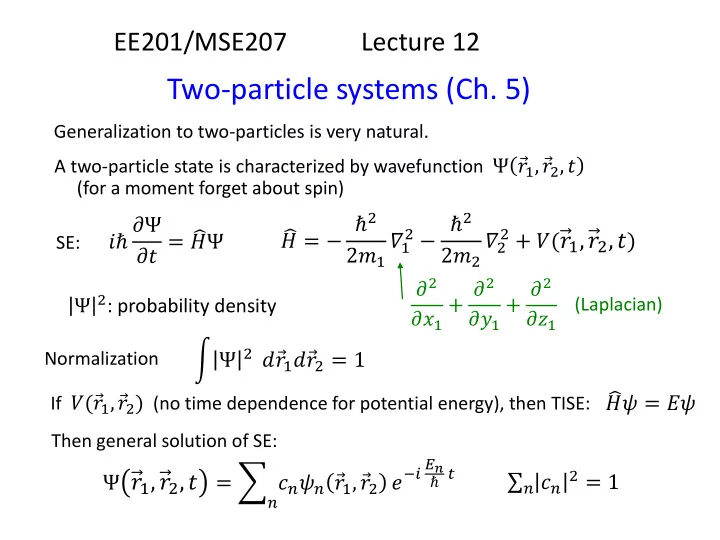
Two-particle systems (Ch. 5)
𝑗ℏ 𝜖Ψ 𝜖𝑢 = 𝐼Ψ
Generalization to two-particles is very natural. A two-particle state is characterized by wavefunction Ψ
𝑠
1,
𝑠
2, 𝑢
(for a moment forget about spin) SE:
𝐼 = − ℏ2 2𝑛1 𝛼
1 2 − ℏ2
2𝑛2 𝛼2
2 + 𝑊(𝑠
1, 𝑠2, 𝑢)
𝜖2 𝜖𝑦1 + 𝜖2 𝜖𝑧1 + 𝜖2 𝜖𝑨1
(Laplacian)
Ψ 2: probability density
Normalization
Ψ 2 𝑒 𝑠
1𝑒
𝑠
2 = 1
If 𝑊(
𝑠
1,
𝑠2) (no time dependence for potential energy), then TISE:
𝐼𝜔 = 𝐹𝜔
Then general solution of SE:
Ψ 𝑠
1, 𝑠2, 𝑢
=
𝑜
𝑑𝑜𝜔𝑜 𝑠
1,
𝑠2 𝑓−𝑗 𝐹𝑜
ℏ 𝑢
𝑜 𝑑𝑜 2 = 1
SLIDE 2
Simplification if 𝑊 = 𝑊( 𝑠
1 −
𝑠
2)
Then the problem reduces to one-particle problem (may be important for excitons) Similar situation in astronomy: two-body problem is essentially one-body problem Classical mechanics Introduce two variables (new coordinates): center of mass
𝑆 = 𝑛1 𝑠
1 + 𝑛2
𝑠
2
𝑛1 + 𝑛2
(moves freely by inertia) difference
𝑠 = 𝑠
1 −
𝑠2
Evolution of 𝑠: Force 𝐺 = −𝛼 𝑊( 𝑠) acts on both particles
𝑠 = 𝐺 𝑛1 + 𝐺 𝑛2 = 𝐺 𝑛1 +𝑛2 𝑛1𝑛2 = 𝐺 𝜈 𝜈 = 𝑛1𝑛2 𝑛1 + 𝑛2
Therefore, evolution of
𝑠 is as for a mass 𝜈 in potential 𝑊
(this is how Earth-Moon problem is analyzed)
SLIDE 3 Quantum mechanics for 𝑊 = 𝑊( 𝑠
1 −
𝑠
2)
𝐼 = − ℏ2 2(𝑛1+𝑛2) 𝛼𝑆
2 − ℏ2
2𝜈 𝛼
𝑠 2 + 𝑊(
𝑠) Derivation 𝜖 𝜖𝑠
1
= 𝜖 𝜖𝑆 𝜖𝑆 𝜖𝑠
1
+ 𝜖 𝜖𝑠 𝜖𝑠 𝜖𝑠
1
= 𝑛1 𝑛1 + 𝑛2 𝜖 𝜖𝑆 + 𝜖 𝜖𝑠 𝜖 𝜖𝑠
2
= 𝑛2 𝑛1 + 𝑛2 𝜖 𝜖𝑆 − 𝜖 𝜖𝑠 𝜖2 𝜖𝑠
1 2 =
𝑛1 𝑛1 + 𝑛2
2 𝜖2
𝜖𝑆2 + 𝜖2 𝜖𝑠2 + 2𝑛1 𝑛1 + 𝑛2 𝜖2 𝜖𝑠 𝜖𝑆 𝜖2 𝜖𝑠
2 2 =
𝑛2 𝑛1 + 𝑛2
2 𝜖2
𝜖𝑆2 + 𝜖2 𝜖𝑠2 − 2𝑛2 𝑛1 + 𝑛2 𝜖2 𝜖𝑠 𝜖𝑆 Kinetic energy for mass 𝑛1 + 𝑛2 at center of mass, kinetic energy of mass 𝜈 at position difference, and potential energy Separation of variables
𝜔 = 𝜔𝑆 𝑆 𝜔𝑠 𝑠 𝐹 = 𝐹𝑆 + 𝐹𝑠
𝐹𝑆 is kinetic energy of free particle with mass 𝑛1 + 𝑛2 For 𝐹𝑠 we need to solve TISE
− ℏ2 2𝜈 𝛼2𝜔𝑠 𝑠 + 𝑊
𝑠 𝜔𝑠
𝑠 = 𝐹𝑠 𝜔𝑠 𝑠
If 𝑊 ≠ 𝑊( 𝑠), then need to solve much more complicated 2-particle TISE
SLIDE 4 Identical particles
In quantum mechanics two electrons are indistinguishable (postulate), similarly two protons, two holes, etc. Surprisingly, this leads to non-trivial consequences. Simple case (two particles in two states, no interaction, no spin)
𝜔 𝑠
1,
𝑠
2 = 𝜔𝑏
𝑠
1 𝜔𝑐(
𝑠
2)
First particle in state 𝑏, second one in state 𝑐 (distinguishable particles) However, for indistinguishable particles 𝜔𝑐
𝑠
1 𝜔𝑏(
𝑠2)
corresponds to the same state Actually, such state is described by wavefunction
𝜔± 𝑠
1,
𝑠
2 = 1
2 𝜔𝑏 𝑠
1 𝜔𝑐
𝑠
2 ± 𝜔𝑐
𝑠
1 𝜔𝑏
𝑠
2
+ for bosons (integer spin), − for fermions (half-integer spin) Generally
𝜔 𝑠
1,
𝑠2 = ±𝜔 𝑠2, 𝑠
1
(+ for bosons, − for fermions)
SLIDE 5
Symmetry for identical particles
Generally (no spin, i.e. the same spin)
𝜔 𝑠
1,
𝑠2 = ±𝜔 𝑠2, 𝑠
1
(+ for bosons, − for fermions)
(new development: “anyons”)
With spin
𝜔 𝑠
1, 𝑇1,
𝑠2, 𝑇2 = ±𝜔 𝑠2, 𝑇2, 𝑠
1, 𝑇1
(exchange of two particles) Proof Introduce exchange operator 𝑄. It satisfies 𝑄2 = 1 and commutes with 𝐼. Therefore common eigenstates, 𝜇2 = 1 𝜇 = ±1. Remark: no such symmetry for different particles (e.g., proton and electron) Pauli exclusion principle Two fermions cannot occupy the same state (“cannot sit on the same chair”) Proof: otherwise 𝜔 = 0 This symmetry changes average distance between particles (exchange correlation, “exchange interaction”)
SLIDE 6
Simple example of exchange correlation
Consider two particles in 1D, occupying states 𝑏 and 𝑐. 3 cases (1) 𝜔 = 𝜔𝑏 𝑦1 𝜔𝑐(𝑦2) distinguishable particles (2) 𝜔 = 1
2 [𝜔𝑏 𝑦1 𝜔𝑐 𝑦2 + 𝜔𝑐 𝑦1 𝜔𝑏(𝑦2)]
bosons (3) 𝜔 = 1
2 [𝜔𝑏 𝑦1 𝜔𝑐 𝑦2 − 𝜔𝑐 𝑦1 𝜔𝑏(𝑦2)]
fermions Let us show that bosons are closer to each other, fermions are farther away. Calculate 𝑦1 − 𝑦2 2 = 𝑦1
2 + 𝑦2 2 − 2〈𝑦1𝑦2〉
Case (1): distinguishable
𝑦1
2 = 𝑦1 2 𝜔 𝑦1, 𝑦2 2 𝑒𝑦1𝑒𝑦2 = 𝑦1 2 | 𝜔𝑏 𝑦1 |2𝑒𝑦1 𝜔𝑐 𝑦2 2𝑒𝑦2 =
= 𝑦2 𝑏× 1 = 𝑦2 𝑏 𝑦2
2 = 𝑦2 𝑐
Similarly
𝑦1𝑦2 = 𝑦1𝑦2 𝜔 𝑦1, 𝑦2
2 𝑒𝑦1𝑒𝑦2 =
= 𝑦1| 𝜔𝑏 𝑦1 |2𝑒𝑦1 𝑦2 𝜔𝑐 𝑦2
2𝑒𝑦2 = 𝑦 𝑏 𝑦 𝑐
(uncorrelated)
SLIDE 7 Case (2): bosons Similarly
Simple example of exchange correlation (cont.)
𝜔 =
1 2 [𝜔𝑏 𝑦1 𝜔𝑐 𝑦2 + 𝜔𝑐 𝑦1 𝜔𝑏(𝑦2)]
𝑦1
2 = 𝑦1 2 𝜔 𝑦1, 𝑦2 2 𝑒𝑦1𝑒𝑦2 =
= 1
2 𝑦1 2 | 𝜔𝑏 𝑦1 |2𝑒𝑦1 𝜔𝑐 𝑦2 2𝑒𝑦2 +
1 2 𝑦1 2 | 𝜔𝑐 𝑦1 |2𝑒𝑦1 𝜔𝑏 𝑦2 2𝑒𝑦2
+ 1
2 𝑦1 2 𝜔𝑏 ∗ 𝑦1 𝜔𝑐 𝑦1 𝑒𝑦1 𝜔𝑐 ∗ 𝑦2 𝜔𝑏 𝑦2 𝑒𝑦2 +
+ 1
2 𝑦1 2 𝜔𝑐 ∗ 𝑦1 𝜔𝑏 𝑦1 𝑒𝑦1 𝜔𝑏 ∗ 𝑦2 𝜔𝑐 𝑦2 𝑒𝑦2 =
1 1
= 1 2 ( 𝑦2 𝑏 + 𝑦2 𝑐) 〈𝑦2
2〉 = 1
2 ( 𝑦2 𝑏 + 𝑦2 𝑐)
(quite natural, since each particle in both states)
SLIDE 8 Case (2): bosons
Simple example of exchange correlation (cont.)
𝜔 =
1 2 [𝜔𝑏 𝑦1 𝜔𝑐 𝑦2 + 𝜔𝑐 𝑦1 𝜔𝑏(𝑦2)]
𝑦1𝑦2 = 𝑦1𝑦2 𝜔 𝑦1, 𝑦2
2 𝑒𝑦1𝑒𝑦2 =
= 1
2 𝑦1 | 𝜔𝑏 𝑦1 |2𝑒𝑦1 𝑦2 𝜔𝑐 𝑦2 2𝑒𝑦2 +
+ 1
2 𝑦1 𝜔𝑏 ∗ 𝑦1 𝜔𝑐 𝑦1 𝑒𝑦1 𝑦2 𝜔𝑐 ∗ 𝑦2 𝜔𝑏 𝑦2 𝑒𝑦2 +
exchange term
𝑦1
2 = 〈𝑦2 2〉 = 1 2 ( 𝑦2 𝑏 + 𝑦2 𝑐)
+ 1
2 𝑦1| 𝜔𝑐 𝑦1 |2𝑒𝑦1 𝑦2 𝜔𝑏 𝑦2 2𝑒𝑦2 +
+ 1
2 𝑦1 𝜔𝑐 ∗ 𝑦1 𝜔𝑏 𝑦1 𝑒𝑦1 𝑦2 𝜔𝑏 ∗ 𝑦2 𝜔𝑐 𝑦2 𝑒𝑦2 =
𝑦 𝑏 𝑦 𝑐
same as line 3 conjugate same as line 1
= 𝑦 𝑏 𝑦 𝑐 + 𝑦 𝜔𝑏
∗ 𝑦 𝜔𝑐 𝑦 𝑒𝑦 2
SLIDE 9
Case (2): bosons
Simple example of exchange correlation: summary
𝜔 = [𝜔𝑏 𝑦1 𝜔𝑐 𝑦2 + 𝜔𝑐 𝑦1 𝜔𝑏(𝑦2)]/ 2
𝑦1
2 = 〈𝑦2 2〉 = 1 2 ( 𝑦2 𝑏 + 𝑦2 𝑐)
𝑦1𝑦2 = 𝑦 𝑏 𝑦 𝑐 + 𝑦 𝜔𝑏
∗ 𝑦 𝜔𝑐 𝑦 𝑒𝑦 2
Case (1): distinguishable particles 𝜔 = 𝜔𝑏 𝑦1 𝜔𝑐 𝑦2
𝑦1
2 = 𝑦2 𝑏
𝑦2
2 = 𝑦2 𝑐
𝑦1𝑦2 = 𝑦 𝑏 𝑦 𝑐
Case (3): fermions 𝜔 = [𝜔𝑏 𝑦1 𝜔𝑐 𝑦2 − 𝜔𝑐 𝑦1 𝜔𝑏(𝑦2)]/ 2
𝑦1
2 = 〈𝑦2 2〉 = 1 2 ( 𝑦2 𝑏 + 𝑦2 𝑐)
𝑦1𝑦2 = 𝑦 𝑏 𝑦 𝑐 − 𝑦 𝜔𝑏
∗ 𝑦 𝜔𝑐 𝑦 𝑒𝑦 2
If 𝜔𝑏(𝑦) and 𝜔𝑐 𝑦 do not overlap, then no difference. If 𝜔𝑏(𝑦) and 𝜔𝑐 𝑦 overlap, then exchange term is non-zero. For case 2 (bosons), 〈𝑦1𝑦2〉 is larger
𝑦1 − 𝑦2 2 is smaller (closer to each other)
For case 3 (fermions), 𝑦1 − 𝑦2 2 is larger (like to be farther away from each other) Exchange correlation (“exchange interaction”, “exchange force”)
SLIDE 10
Molecule of hydrogen (H2 )
𝑏 𝑐
Now need to take spin into account What is spin state of the ground state? (Show that singlet) Ground state: both electrons have 𝑜 = 1, but also have spins If total spin is 0 (singlet), then spin state is
↑↓−↓↑ 2
(antisymmetric to exchange), therefore spatial part should be symmetric (so that total is antisymmetric), therefore case (2) electrons closer to each other covalent bond (actually, electrons repel each other, but attraction to protons is more important) If total spin is 1 (triplet), then spin state is ↑↑ or ↓↓ or
↑↓+↓↑ 2
(all symmetric), therefore spatial part is antisymmetric (case 3) electrons are farther away from each other antibonding state (not stable) Ground state wavefunction
𝜔 = 1 2 𝜔𝑏 𝑠
1 𝜔𝑐
𝑠
2 + 𝜔𝑐
𝑠
1 𝜔𝑏
𝑠2 ↑↓−↓↑ 2
SLIDE 11
Atoms (many electrons)
𝐼 =
𝑘=1 𝑎
− ℏ2 2𝑛 𝛼
𝑘 2−
1 4𝜌𝜁0 𝑎𝑓2 𝑠
𝑘
+ 1 2 1 4𝜌𝜁0
𝑘≠𝑙 𝑎
𝑓2 𝑠
𝑘 − 𝑠 𝑙
and wavefunction must be antisymmetric for exchange of any two electrons (exchange of both positions and spins)
SLIDE 12
Atom of helium (He)
Z=2
What are spins of lowest energy states? If we neglect e-e interaction (approximation), then just two electrons in hydrogen-like atom (𝑎 = 2 instead of 𝑎 = 1)
11 parahelium (𝑡 = 0) 12 orthohelium (𝑡 = 1) 12 parahelium (𝑡 = 0)
Ground state (𝑜 = 1 and 𝑜 = 1) symmetric spatial part of wavefunction antisymmetric spin part, i.e. 𝑡 = 0 (singlet, parahelium) (↑↓−↓↑)/ 2 First excited state (𝑜 = 1 and 𝑜 = 2) If 𝑡 = 0 (singlet, parahelium) spin part of wavefunction is antisymmetric spatial part is symmetric electrons closer to each other higher energy of e-e interaction higher energy If 𝑡 = 1 (triplet, orthohelium) spin part is symmetric spatial part is antisymmetric electrons farther away lower energy