Type inference: Review of the basics 1. For each unknown type, a - - PowerPoint PPT Presentation

type inference review of the basics
SMART_READER_LITE
LIVE PREVIEW

Type inference: Review of the basics 1. For each unknown type, a - - PowerPoint PPT Presentation

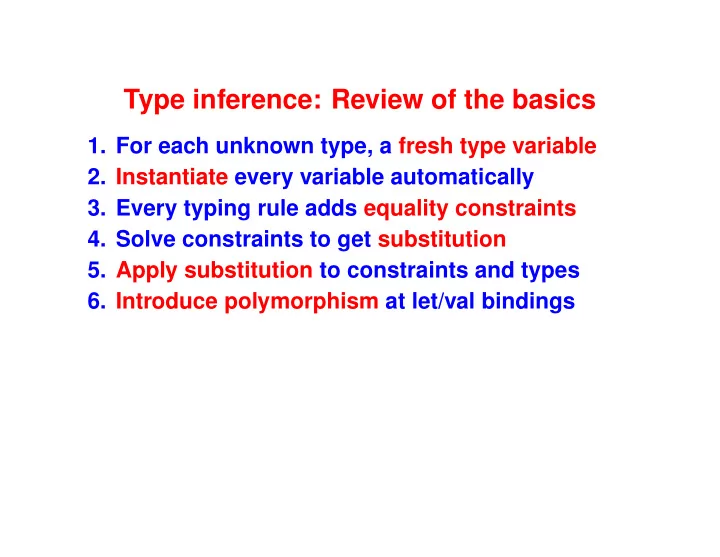
Type inference: Review of the basics 1. For each unknown type, a fresh type variable 2. Instantiate every variable automatically 3. Every typing rule adds equality constraints 4. Solve constraints to get substitution 5. Apply substitution to


slide-1
SLIDE 1

Type inference: Review of the basics

  • 1. For each unknown type, a fresh type variable
  • 2. Instantiate every variable automatically
  • 3. Every typing rule adds equality constraints
  • 4. Solve constraints to get substitution
  • 5. Apply substitution to constraints and types
  • 6. Introduce polymorphism at let/val bindings
slide-2
SLIDE 2

Review: Using polymorphic names

  • > (val cc (lambda (nss) (car (car nss))))
slide-3
SLIDE 3

Using polymorphic names

  • > (val cc (lambda (nss) (car (car nss))))

cc : (forall (’a) ((list (list ’a)) -> ’a))

slide-4
SLIDE 4

Your turn!

Given

empty : (forall [’a] (list ’a)) cons : (forall [’a] (’a (list ’a) -> (list ’a)))

For (cons empty empty) You fill in:

  • 1. Fresh instances
  • 2. Constraints
  • 3. Final type
slide-5
SLIDE 5

Bonus example

  • > (val second (lambda (xs) (car (cdr xs))))

second : ...

  • > (val two

(lambda (f) (lambda (x) (f (f x))))) two : ...

slide-6
SLIDE 6

Bonus example solved

  • > (val second (lambda (xs) (car (cdr xs))))

second : (forall (’a) ((list ’a) -> ’a))

  • > (val two

(lambda (f) (lambda (x) (f (f x))))) two : (forall (’a) ((’a -> ’a) -> (’a -> ’a)))

slide-7
SLIDE 7

Making Type Inference Precise

Sad news:

  • Type inference for polymorphism is undecidable

Solution:

  • Each formal parameter has a monomorphic type

Consequences:

  • The argument to a higher-order function cannot

be mandated to be polymorphic

  • forall appears only outermost in types
slide-8
SLIDE 8

We infer stratified “Hindley-Milner” types

Two layers: Monomorphic types

  • Polymorphic type schemes
  • ::=
  • type variables
j
  • type constructors: int, list
j (1 ; : : : n )
  • constructor application
  • ::=
81 ; : : : n :
  • type scheme

Each variable in

introduced via LET, LETREC, VAL,

and VAL-REC has a type scheme

with 8

Each variable in

introduced via LAMBDA has a

degenerate type scheme

8 : —a type, wrapped
slide-9
SLIDE 9

Representing Hindley-Milner types

type tyvar = name datatype ty = TYVAR

  • f tyvar

| TYCON

  • f name

| CONAPP of ty * ty list datatype type_scheme = FORALL of tyvar list * ty fun funtype (args, result) = CONAPP (TYCON "function", [CONAPP (TYCON "arguments", args), result])

slide-10
SLIDE 10

Key ideas

Type environment

binds var to type scheme
  • singleton :
8 :
  • !
list
  • cc :
8 : list list !
  • car :
8 : list !
  • n :
8 : int

(note empty

8)

Judgment

  • ` e
: gives expression e a type
  • (Transitions inserted by algorithm!)
slide-11
SLIDE 11

Key ideas

Definitions are polymorphic with type schemes Each use is monomorphic with a (mono-) type Transitions:

  • At use, type scheme instantiated automatically
  • At definition, automatically abstract over tyvars
slide-12
SLIDE 12

All the pieces

  • 1. Hindley-Milner types
  • 2. Bound names :
, expressions :
  • 3. Type inference yields type-equality constraint
  • 4. Constraint solving produces substitution
  • 5. Substitution refines types
  • 6. Call solver, introduce polytypes at val
  • 7. Call solver, introduce polytypes at all let forms
slide-13
SLIDE 13

Type-inference algorithm

Given

and e, compute C and such that

C

;
  • ` e
:
  • Idea #2: Extend to list of ei: C
;
  • ` e1
; : : : ;en : 1 ; : : : ; n
  • ` e1
: bool
  • ` e2
:
  • ` e3
:
  • ` IF
(e1 ;e2 ;e3 ) :
  • (IF)

becomes (note equality constraints with

)

C

;
  • ` e1
;e2 ;e3 : 1 ; 2 ; 3

C

^ 1 bool ^ 2
  • 3
;
  • ` IF
(e1 ;e2 ;e3 ) : 3

(IF)

slide-14
SLIDE 14

Apply rule

  • ` e
: 1
  • n
!
  • ` e1
: 1 : : :
  • ` en
: n
  • ` APPLY
(e ;e1 ; : : : ;en ) :
  • (APPLY)

becomes C

;
  • ` e
;e1 ; : : : ;en : f ; 1 ; : : : ; n is fresh

C

^ f
  • 1
  • n
! ;
  • ` APPLY
(e ;e1 ; : : : ;en ) :
  • (APPLY)
slide-15
SLIDE 15

Type inference, operationally

Like type checking:

  • Top-down, bottom up pass over abstract syntax
  • Use
to look up types of variables

Different from type checking:

  • Create fresh type variables when needed
  • Accumulate equality constraints
slide-16
SLIDE 16

Your skills so far

You can complete typeof

  • Takes e and
, returns and C

(Except for let forms.) Next up: solving constraints