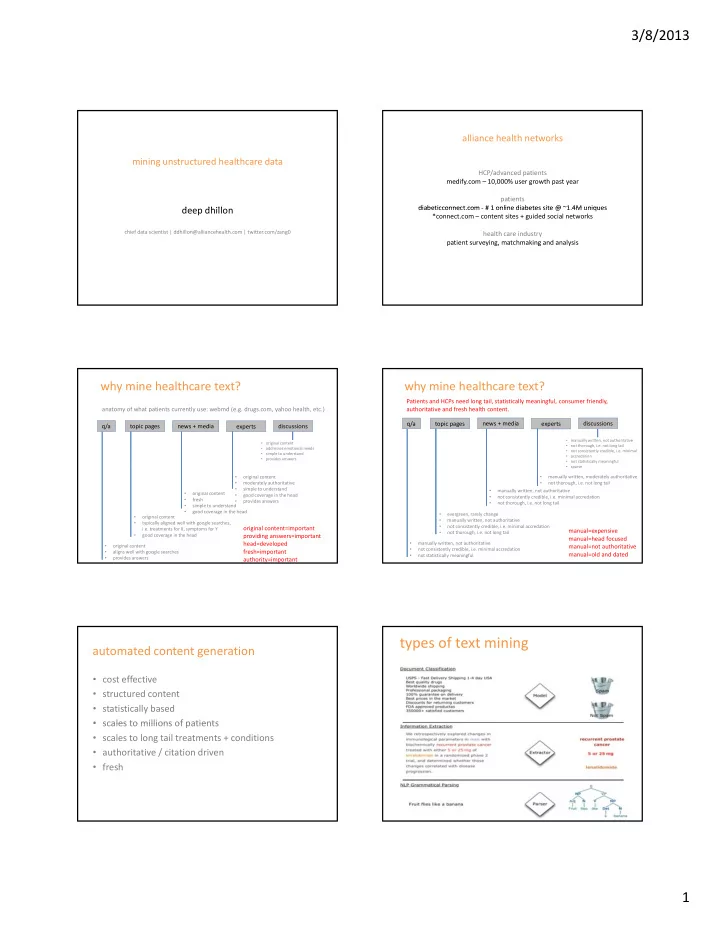
types of text mining automated content generation cost effective - - PDF document

types of text mining
SMART_READER_LITE
LIVE PREVIEW

types of text mining automated content generation cost effective - - PDF document

3/8/2013 alliance health networks mining unstructured healthcare data HCP/advanced patients medify.com 10,000% user growth past year patients diabeticconnect com # 1 online diabetes site @ ~1 4M uniques diabeticconnect.com # 1 online


slide-1
SLIDE 1

3/8/2013 1

mining unstructured healthcare data d dhill deep dhillon

chief data scientist | ddhillon@alliancehealth.com | twitter.com/zang0

alliance health networks

HCP/advanced patients medify.com – 10,000% user growth past year patients diabeticconnect com # 1 online diabetes site @ ~1 4M uniques diabeticconnect.com ‐ # 1 online diabetes site @ 1.4M uniques *connect.com – content sites + guided social networks health care industry patient surveying, matchmaking and analysis

q/a topic pages news + media experts discussions

  • original content
  • addresses emotional needs
  • simple to understand
  • provides answers

anatomy of what patients currently use: webmd (e.g. drugs.com, yahoo health, etc.)

why mine healthcare text?

  • riginal content
  • aligns well with google searches
  • provides answers
  • riginal content
  • typically aligned well with google searches,

i.e. treatments for X, symptoms for Y

  • good coverage in the head
  • riginal content
  • fresh
  • simple to understand
  • good coverage in the head
  • riginal content
  • moderately authoritative
  • simple to understand
  • good coverage in the head
  • provides answers
  • riginal content=important

providing answers=important head=developed fresh=important authority=important Patients and HCPs need long tail, statistically meaningful, consumer friendly, authoritative and fresh health content. q/a topic pages news + media experts discussions

  • manually written, not authoritative
  • not thorough, i.e. not long tail
  • not consistently credible, i.e. minimal
  • accredation
  • not statistically meaningful

why mine healthcare text?

  • manually written, not authoritative
  • not consistently credible, i.e. minimal accredation
  • not statistically meaningful
  • evergreen, rarely change
  • manually written, not authoritative
  • not consistently credible, i.e. minimal accredation
  • not thorough, i.e. not long tail
  • manually written, not authoritative
  • not consistently credible, i.e. minimal accredation
  • not thorough, i.e. not long tail
  • manually written, moderately authoritative
  • not thorough, i.e. not long tail
  • sparse

manual=expensive manual=head focused manual=not authoritative manual=old and dated

automated content generation

  • cost effective
  • structured content
  • statistically based
  • scales to millions of patients
  • scales to millions of patients
  • scales to long tail treatments + conditions
  • authoritative / citation driven
  • fresh

types of text mining

slide-2
SLIDE 2

3/8/2013 2

medify demo

how do we mine text? how do we mine text?

examples curators assignments parser knowledge external repos like UMLS Index Search Page Module

annotate in the product:

  • Easier for people to give explicit GT feedback
  • Channels high visibility error angst productively
  • Channels more GT toward areas most seen by users
  • Override high visibility system mistakes with human data
  • http://www.diabeticconnect.com/discussions/4790
  • https://www.medify.com/internal/annotate/abstract?abstractId=8181575

gt demo:

slide-3
SLIDE 3

3/8/2013 3

2,000 2,500 3,000 3,500 4,000 4,500 5,000

Detailed Signals Preliminary Mining From Discussion Threads

500 1,000 1,500 Medical History - Newly Diagnosed 0% Medical History - S ymptom 3% Lifestyle Adj ustment 6% Medical History - Condition 10% H l / I fl

Distribution of Signals Mined From Diabetic Connect Discussion Threads

Personal Account 12% Treatment Experience 15% Medical History 21% Helper/ Influencer 33%

treatment/symptom/condition/demographic Research (Outcome) Discussion (Gromin) API curator

knowledge base

  • identity (i.e. UMLS id)
  • taxonomical relations
  • hierarchical is_a
  • condition/arthritis/Rhematoid Arthritis
  • synonym relations
  • RA=Rhematoid Arthritis
  • metformim
  • polarity
  • effective=positive
  • ineffective=negative
  • parsing clues (ambiguity)
  • anaphor clues

UMLS document sentence selection shallow tagging

sentence modification dependency tree parse

knowledge abstract parser work flow

1 2 3 4 9

1. sentences w/ high conclusion presence selected 2. shallow entity tagging applied based on umls 3. sentence text is modified to retain entities, optimize for performance, and eliminate unnecessary filler. 4. deep typed dependency parsing of modified text 5. 3 tier text classification applied on BOW + entities 6. SVO triples extracted from dependencies 7. rule based conclusions generated from triples 8. confidence models applied to rule and classifier based conclusions 9. knowledge base used to represent domain and discourse style. 10. errors measured against curated data applied for improvements

triple extraction concluder

3 tier classification annotations 5 6 7 8 10 confidence assignment

message sentence split shallow tagging

sentence modification dependency tree parse

knowledge discussion parser work flow

1 2 3 4 9

1. sentences split from discussion thread messages 2. shallow entity tagging applied based on umls 3. sentence text is modified to retain entities, optimize for performance, and eliminate unnecessary filler. 4. deep typed dependency parsing of modified text for select conclusion types 5. select conclusion type based text classification applied on BOW + entities after dimensionality reduction 6. SVO triples extracted from dependencies 7. rule based conclusions generated from triples 8. rule based KB driven anaphora resolution applied. Classification based conclusions added. 9. knowledge base used to represent domain and discourse style. 10 errors measured against curated data applied for

triple extraction concluder

classification conclusions 5 6 7 8 10

10. errors measured against curated data applied for improvements

anaphora resolution

feature engineering

  • entities, i.e. normalize synonyms, id new

entity types, like social relations

  • entity types, i.e. metformin >

treatment medication treatment_medication

  • phrase driven cues, i.e. [have] [you]

[considered] > suggestion_indicator

slide-4
SLIDE 4

3/8/2013 4

anaphora resolution

  • relation structure, i.e. [person]>takes>it

it refers to treatment (i.e. not condition/symptom), and specifically: medication but not device

  • statistically driven, manually curated cues

i.e. drug > treatment/medication

  • filter

– non matching antecedent candidates – singular/plural agreement

  • score candidates:

– antecedent occurrence frequency – distance (#sents) from antecedent to anaphor – co‐occurrence of anaphor w/ antecedent

technology

  • Lang: Java + Python + Ruby
  • DB: Solr 4, Mongo DB, S3
  • Work: Map Reduce
  • Dependencies: Malt Parser, Stanford Parser
  • Misc: Tomcat, Spring, Mallet, Reverb, Minor Third
  • Tagging: Peregrine + home grown

Data Pipeline

21

Portal 2 Portal N Cache Portal 1 Load Balancer – API Solr 1 Solr 2 Solr N browser Load Balancer – www.medify.com

request transaction flow

questions?

slide-5
SLIDE 5

3/8/2013 5

slide-6
SLIDE 6

3/8/2013 6

Advair: Experts vs. Patients

  • “medicalese” vs. patients words
  • more granularity
  • a story like perspective w/ words
  • f inspiration

My Pulmonologist today said that he had just come from the hospital bedside of a patient with my exact symptoms who is on oxygen and not doing well. If I hadn't been so diligent in following my asthma plan that could easily have been me. His telling me that really hit home. By the way, my Pulmonologist surprised me with his view on many of his patients. He actually got excited and thanked me for being knowledgeable about asthma, understanding my own body and health needs and for following my treatment plan. He said he doesn't get many patients who can actually talk about their disease, symptoms, time frames, treatments/medications, and non‐medical measures they are taking. He also doesn't get many people who ask questions. My response to this: What are people thinking? They need to take control of their own health

  • r noone else will.