Typical Green Revolution vs. Sub- Saharan Africas Immense Diversity - - PowerPoint PPT Presentation

typical green revolution vs sub saharan africa s immense
SMART_READER_LITE
LIVE PREVIEW

Typical Green Revolution vs. Sub- Saharan Africas Immense Diversity - - PowerPoint PPT Presentation

Typical Green Revolution vs. Sub- Saharan Africas Immense Diversity 49 Countries Major Agro-Ecologies from Sea Level to >2,500 MASL > 1,000 Languages 17 Major Food Crops (maize, sorghum, rice, millet, beans, cowpea, banana,


slide-1
SLIDE 1

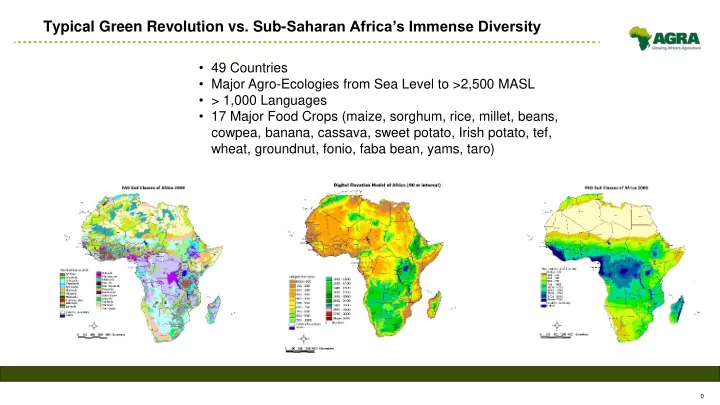
Typical Green Revolution vs. Sub-Saharan Africa’s Immense Diversity

  • 49 Countries
  • Major Agro-Ecologies from Sea Level to >2,500 MASL
  • > 1,000 Languages
  • 17 Major Food Crops (maize, sorghum, rice, millet, beans,

cowpea, banana, cassava, sweet potato, Irish potato, tef, wheat, groundnut, fonio, faba bean, yams, taro)

slide-2
SLIDE 2

1

CROPPING SEASONS IN SELECTED COUNTRIES

January February April May July September October December Burkina Faso Kenya Malawi Mali Mozambique Ethiopia Ghana Nigeria Rwanda Tanzania(No) Tanzania Uganda First Season Second Season

slide-3
SLIDE 3

2

R&D (Public Sector) Production and Marketing (Private Sector) 1 4 1, M T S E E D 2017

Identify strongest univs. Identify breeding teams Identify seed enterprises Identify service providers Establish grant support Develop breeding strategy

  • Est. prod., market strategy

Establish grant support Recruit top-level fellows Establish grant support Establish grant support Oversee training Curriculum oversight Breeding oversight Coordinate BDS training Oversee credit guarantee Thesis research oversight Link breeders to SC’s. Monitor prod’n, marketing Link AD’s to seed co’s Re-integrate students Assist commercialization Link to investment funds Create AD links to farmers

Program for Africa’s Seed Systems (PASS) Value Chain

Other Results:

 670 new crop

varieties developed and released; 431 commercialized;

 501 MSc/PhD’s

graduated;

 114 private, African

seed companies established;

 19,174 agro-dealers

trained, in

  • peration.
slide-4
SLIDE 4

3

Benefits of Improved, Adapted Groundnut Varieties in Uganda

On the left, improved variety bred by Dr. David Okello, NARO On the right, Farmer’s Variety

slide-5
SLIDE 5

4

Benefits of Improved, Adapted Sorghum Varieties in West Africa

Left, local land race. Right, hybrid sorghum variety developed by Dr. Aboubacar Toure, l’Institut de l’Economie Rurale.

slide-6
SLIDE 6

5

Benefits of Improved, Adapted Bean Varieties in Rwanda

In the foreground, improved bush bean variety developed by Augustine Musoni, Rwanda Agricultural Board. In the center, local bean variety. Musoni with improved climbing bean variety.

slide-7
SLIDE 7

6

670 New Crop Varieties Bred and Released

Chickpea, 2 Faba bean, 4 Teff, 4 Banana, 6 Wheat, 8Millet, 14 Pigeon pea, 10 Soybean, 14 Groundnut, 26 Sorghum, 36 Cowpea, 46 Sweet potato, 65 Beans, 82 Cassava, 86 Rice, 90 Maize, 177

slide-8
SLIDE 8

7

COMMUNICATION & PARTNERSHIP UPDATE

Scaling Up Improved Seed Supply via Private, Independent, African Seed Companies

Maslaha Seed Company, Nigeria

Producing certified seed of: maize, rice, pearl millet, sorghum, and cowpea.

slide-9
SLIDE 9

8

COMMUNICATION & PARTNERSHIP UPDATE

Equator Seeds, Uganda

Producing certified seed of: maize, beans, rice, soybean, sorghum, sesame, cowpea and finger millet.

African Seed Companies, Cont.

slide-10
SLIDE 10

9

COMMUNICATION & PARTNERSHIP UPDATE

Peacock Seeds, Malawi

African Seed Companies, Cont.

Producing certified seed of: maize, beans, cowpea, and groundnut.

slide-11
SLIDE 11

10

COMMUNICATION & PARTNERSHIP UPDATE

Faso Kaba Seed Co, Mali

African Seed Companies, Cont.

Producing certified seed of: maize, cowpea, sorghum, millet, rice, and groundnut.

slide-12
SLIDE 12

11

11

20,000 40,000 60,000 80,000 100,000 120,000 140,000 160,000

2,346.3 5,663.5 9,748.5 25,844.8 40,437.0 57,991.6 80,605.4 125,054.7 126,408.0 128,939.0 141,942.6

Certified Seed Production(MT), 2007-2017

2007 2008 2009 2010 2011 2012 2013 2014 2015 2016 2017

slide-13
SLIDE 13

12

12

10,000 20,000 30,000 40,000 50,000 60,000 Liberia DRC Sierra Leone Rwanda South Sudan Mozambique Ghana Niger Mali Kenya Zambia Malawi Tanzania Burkina Faso Nigeria Uganda Ethiopia

20 25 72 185 1,591 1,966 2,247 2,783 2,851 3,048 3,173 3,405 5,791 7,620 23,115 26,703 57,347

Certified Seed Production by Country (MT) in 2017

slide-14
SLIDE 14

13

114 Seed Companies Operating Across 18 Countries

slide-15
SLIDE 15

14

Chickpea, 2 Faba bean, 4 Teff, 4 Banana, 6 Wheat, 8 Millet, 14 Pigeon pea, 10 Soybean, 14 Groundnut, 26 Sorghum, 36 Cowpea, 46 Sweet potato, 65 Beans, 82 Cassava, 86 Rice, 90 Maize, 177

Varieties Released by Crop (670 Vars.)

slide-16
SLIDE 16

15

5 Innovations That Helped to Scale:

  • 1. Develop capacity at national level
slide-17
SLIDE 17

16

5 Innovations That Helped to Scale:

  • 2. Approach seed supply for smallholder farmers as a business
slide-18
SLIDE 18

17

5 Innovations That Helped to Scale:

  • 3. Train African seed companies to produce high-quality seed, at-scale,

including hybrids.

slide-19
SLIDE 19

18

NAFASO 6/11

Burkina Faso

FASO KABA 7/11

Mali

Dryland Seeds(2) 8/11 Seed Tech 8/11

Malawi

Western Seed 7/11 Wienco 7/11 M&B Seeds 10/11

Ghana

Peacock Enterprise Ltd 9/11 Suba Agro 9/11

Tanzania

Dryer

DA-ALLGREEN 11/11

Nigeria

Alheri 2/12

Niger

Pearl Seed 12/11

Uganda

PREMIER SEED (2) 1/12

Plant

Sementes Nzara Yapera 10/12

Mozambique

Dengo Commercial 10/12

Kenya

Fresco 2/13 Boman Seed 3/13

Ethiopia

Funwe 4/13 Chris Kaijuka 5/13 Manoa Seed 8/13 Value Seeds 10/13 Goldagric 10/13 USAID-COOPS 1/14-(4) Meru Agro 3/14 Agri Seed 5/14 U of Nairobi 5/14 Mozseed 6/14 Africasia 6/14

Seed Companies That Have Purchased Seed Processing

  • Equipment. Increase in or new capacity estimated at

8,000MT annual capacity per location. (33) Companies

slide-20
SLIDE 20

19

5 Innovations That Helped to Scale:

  • 4. Increase farmer awareness of the value of higher-yielding seed and

fertilizer.

slide-21
SLIDE 21

20

5 Innovations That Helped to Scale:

  • 5. Build marketing chains where farmers live
slide-22
SLIDE 22

21

New Model for Scaling Technologies in Africa: Private Sector-led Extension

  • Elements of a new approach include:
  • Trusted local advisory services;
  • Inclusive, “whole village” approach;
  • Small “sample” packs to reduce

“adoption risk”

  • Practical technology demo’s under local

conditions;

  • Partnerships between public and private

actors, and farmers;

  • Farmer feedback via farmer field days.

Village 1 Village 4 Village 2 Village 3

slide-23
SLIDE 23

22

Funding Only the Most Direct Actions in Scaling Seeds Cuts out the Public Sector and Ignores the Need for New Technologies.

slide-24
SLIDE 24

23

Lessons Learned on the Journey to Scaling Technologies

  • 1. Public – private partnerships actually work, and take it

further;

  • 2. Political will is critical, and can be nurtured;
  • 3. There is huge untapped potential for SME growth in

African agri-business;

  • 4. National agricultural research systems are a huge

source of innovation;