
SLIDE 1
Implementation of Cross Section Random Sampling Code System for Direct Sampling Method in Continuous Energy Monte Carlo Calculations
Ho Jin Park a, Tae Young Han a, Jin Young Choa
aKorea Atomic Energy Research Institute, 111, Daedeok-daero 989beon-gil, Daejeon, 34057, Korea *Corresponding author: parkhj@kaeri.re.kr
- 1. Introduction
In the conventional nuclear reactor development, the uncertainty of the nuclear core design and analysis code is evaluated and provided by comparing calculated values with measured. Generally, this uncertainty is calculated under conservative conditions. Recently, the Best Estimate Plus Uncertainty (BEPU) method has been widely investigated and utilized for the uncertainty quantification (UQ). In the BEPU method, the uncertainty provides a combination of the best-estimate models under realistic conditions. The best estimate results are calculated by the average values and their uncertainties, which can be calculated by the uncertainties from various inputs. There are two approaches for the uncertainty analysis in the BEPU method. One is the Sensitivity/Uncertainty (S/U) analysis method [1] based on the perturbation techniques and the other is the Direct Sampling Method (DSM) [2,3] by random samplings (RS) of input parameters according to their covariance data. In this study, we developed the McCARD/MIG [4] cross section RS code system for DSM in continuous energy MC calculations. This code system was applied to the Godiva and TMI-1 PWR pin problem for UQ analysis.
- 2. Methods and Results
2.1 Direct Sampling Method (DSM) The mean value of the uncertain input parameter, ui, and the covariance between ui and uj uncertain input parameters are defined by
1
1 ,
K i i k k
u u K
(1)
1
1 cov[ , ] ( )( ). 1
K k k i j i i j j k
u u u u u u K
(2) where K and k are the number of input parameters and the input index. Suppose that Cu is the covariance matrix defined by cov[ui, uj] and that a lower triangular matrix B is known through the Cholesky decomposition
- f Cu, then we have
T u
C B B (3) where BT is the transpose matrix of B. Then, if Cu is symmetrical and positive definite, one can obtain a sample set by:
i
X X B Z (4) where X is the mean vector defined by the mean values from Eq. (1), and Z is a random normal vector calculated directly from a random sampling of the standard normal distribution using the Box-Muller method. Code
(1) 1
u
1st input set i-th input set
1
Q
N
Q
i
Q
1st output i-th output
( ) 1 i
u
( ) 1 N
u
Sampled Input Set
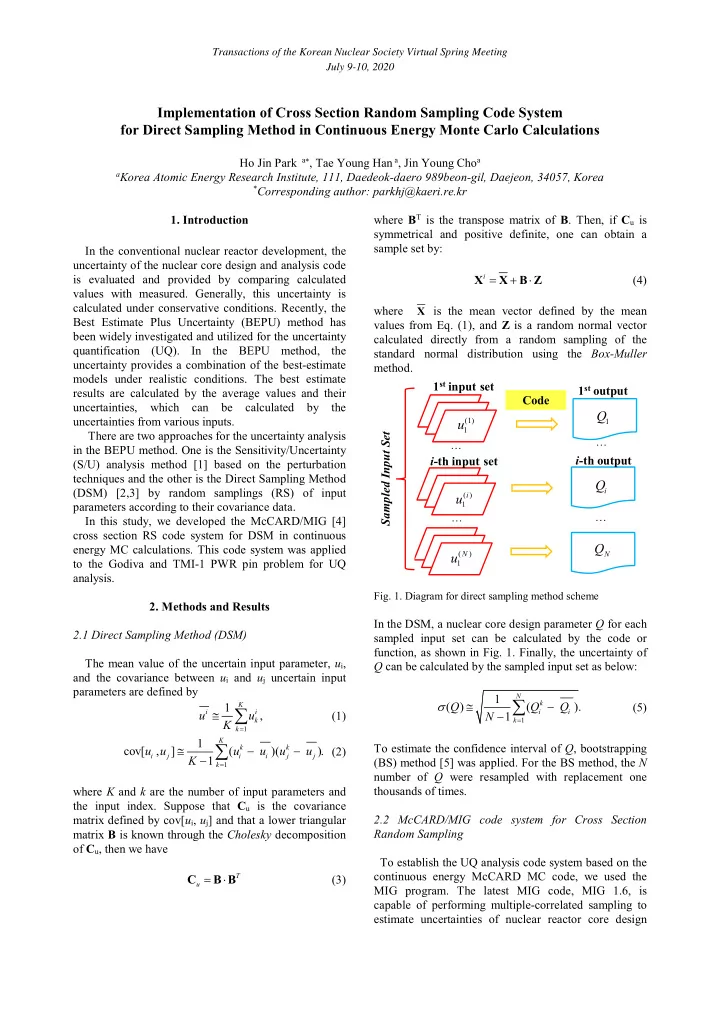
- Fig. 1. Diagram for direct sampling method scheme
In the DSM, a nuclear core design parameter Q for each sampled input set can be calculated by the code or function, as shown in Fig. 1. Finally, the uncertainty of Q can be calculated by the sampled input set as below:
1
1 ( ) ( ). 1
N k i i k
Q Q Q N