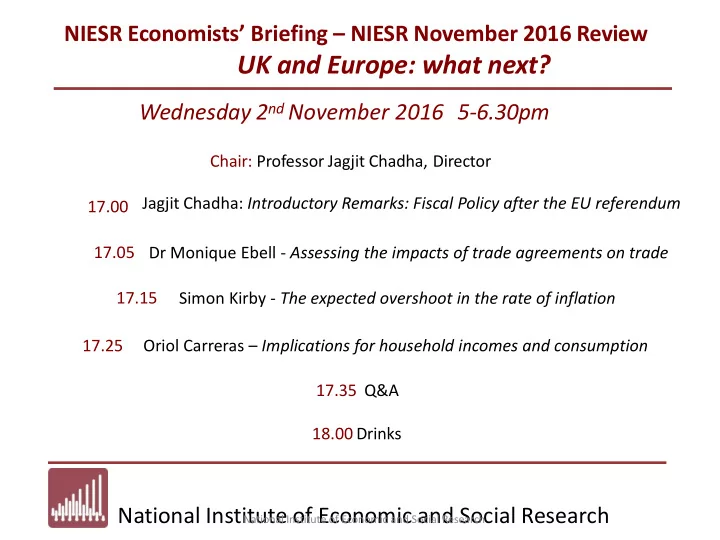
SLIDE 1 National Institute of Economic and Social Research NIESR Economists’ Briefing – NIESR November 2016 Review
UK and Europe: what next?
National Institute of Economic and Social Research
Wednesday 2nd November 2016 5-6.30pm
Chair: Professor Jagjit Chadha, Director 17.00 Jagjit Chadha: Introductory Remarks: Fiscal Policy after the EU referendum 17.05 Dr Monique Ebell - Assessing the impacts of trade agreements on trade 17.15 Simon Kirby - The expected overshoot in the rate of inflation 17.25 Oriol Carreras – Implications for household incomes and consumption 17.35 Q&A 18.00 Drinks
SLIDE 2
National Institute of Economic and Social Research
Jagjit S. Chadha, NIESR
Fiscal Policy after the Referendum
SLIDE 3
National Institute of Economic and Social Research
Exchange Rate: Shock Absorber
SLIDE 4
National Institute of Economic and Social Research
Debt Levels and Costs of Service
SLIDE 5
National Institute of Economic and Social Research
20th Century Debt Consolidations
SLIDE 6 National Institute of Economic and Social Research
Monetary-Fiscal Framework
- Inflation jointly determined by monetary-fiscal
arrangements
- Monetary Framework undermined somewhat by
political comments
- Fiscal Framework is AWOL – need to explain level,
composition, ownership of debt stock
- Institutional design helps flexibility not constrains
- Credibility will be tested by inflation and any fiscal
expansion
SLIDE 7
National Institute of Economic and Social Research
Assessing the Impact of Trade Agreements on Trade
Monique Ebell, Ph.D. NIESR
1 November 2016
SLIDE 8 National Institute of Economic and Social Research
Costs and Benefits of ‘Hard’ Brexit
Assess the impact on UK trade of:
- Leaving the EEA single market
- ‘Trading with the World’, negotiating new free
trade agreements with 3rd countries.
Key point:
- EEA single market involves harmonisation of
regulation, free movement of labour, capital
- Ordinary FTAs generally less comprehensive
SLIDE 9 National Institute of Economic and Social Research
Main Findings
UK may find it difficult to replace the lost trade from leaving the EEA single market:
1) Leaving the EEA single market is associated with substantial decreases in trade, both for goods and for services. 2) Trading with the world? Ordinary FTAs are associated with:
- No increase in services trade
- Comparatively small increases in goods trade
SLIDE 10 National Institute of Economic and Social Research
‘Hard’ Brexit
Estimated reductions in trade with other EEA members from leaving the EEA single market: Estimated reductions in total trade:
Goods Services Single market --> WTO rules with EU 58% - 65% 61% - 65% Single market --> FTA with EU 35% - 44% 61% - 65% Goods Services Single market --> WTO rules with EU 32% - 36% 24% - 26% Single market --> FTA with EU 20% - 25% 24% - 26%
SLIDE 11 National Institute of Economic and Social Research
Trading with the World?
Estimated increases in bilateral trade with 3rd countries from forming a new FTA: Estimated increase in total trade from forming new FTAs:
Goods Services WTO rules FTA with 3rd country 26% - 66% 0% Goods Services WTO rules FTA with China 2% - 5% 0% WTO rules FTA with USA 3% - 8% 0% WTO rules FTA with Australia 0.2% - 0.5% 0% WTO rules FTAs with entire non-EEA WORLD 11% - 29% 0%
SLIDE 12 National Institute of Economic and Social Research
The fine print
- 2014 data on bilateral exports from 42 countries, covering
87% of the UK’s trade:
- All 34 OECD countries, including 23 of EU-28
- BRIICS: Brazil, Russia, India, Indonesia, China, South
Africa plus Malaysia and Hong Kong
- Gravity regression equation for bilateral exports 𝑌𝑗𝑘:
- 𝑌𝑗𝑘 =
𝑓𝑦𝑞 𝛾0 + 𝛾1𝑒𝑗𝑡𝑢𝑗𝑘 + 𝛾2𝑐𝑝𝑠𝑒𝑗𝑘 + 𝛾3𝑚𝑏𝑜𝑗𝑘 + 𝛾4𝑑𝑝𝑚𝑝𝑜𝑧𝑗𝑘 +𝛾5𝑡𝑏𝑛𝑓𝑑𝑝𝑜𝑢𝑗𝑘 + 𝜀1𝐹𝐹𝐵𝑗𝑘 + 𝜀2𝐺𝑈𝐵𝑗𝑘 + 𝛽𝑗 + 𝛿𝑘
SLIDE 13 National Institute of Economic and Social Research
Compare to HMT’s Results
Reductions in goods trade with other EEA members Reductions in services trade with other EEA members Key distinction: HMT use data from 1981-2009, 195 countries But the single market has evolved in 90s and 00s!
NIESR HMT EU Single market --> WTO rules with EU 58% - 65% 54% Single market --> FTA with EU 35% - 44% 42% NIESR HMT EU Single market --> WTO rules with EU 61% - 65%
19%
Single market --> FTA with EU 61% - 65%
14%
SLIDE 14 National Institute of Economic and Social Research
More fine print
- Use latest methods
- Poisson Pseudo-Maximum Likelihood (PPML) estimation
to deal with observations of zero trade, particularly important for services trade.
- Instrumental Variables (IV) approach to deal with
endogeneity, i.e. that might be more likely to form trade agreements with countries we already trade a lot with.
- Use measures of political stability from Polity IV project
as instruments: strongly correlated with EEA membership, but not correlated with bilateral trade.
SLIDE 15 National Institute of Economic and Social Research
‘Hard’ versus ‘Soft’ Brexit
1) ‘Hard’ Brexit
- Substantial losses in both goods and services trade
from leaving the EU/EEA single market 2) ‘Trading with the world’
- No increase in services trade from ordinary FTAs
- Modest increase in goods trade from ordinary FTAs
Bottom line: ‘Hard’ Brexit is likely to be costly. Difficult to see how lost trade from leaving the EU/EEA single market could be replaced with a series of ordinary FTAs.
SLIDE 16 National Institute of Economic and Social Research
Regression Results – Services
(Probit) (Gravity) (3) FTA_services 0.001
EEA 0.951*** 1.033*** Distance
- 4.415***
- 0.613***
- 0.997***
Border
0.401*** 0.147 Lang official
0.545*** 0.538*** Colony
0.253** 0.238** Samecont 0.207
Durable
Polcomp
0.218 Constant 15.548*** 9.269*** 12.309*** (pseudo) R2 0.688 0.883 0.883
SLIDE 17 National Institute of Economic and Social Research
Regression Results – Goods
(Probit) (Gravity) (3) FTA_goods 0.228*** 0.430*** EEA 0.915*** 0.859*** Distance
- 4.415***
- 0.576***
- 0.888***
Border
0.698*** 0.587*** Lang official
0.183 0.074 Colony
0.189* 0.254*** Samecont 0.604*** 0.445*** Durable
Polcomp
0.082* Constant 15.548*** 15.133*** 17.202*** (pseudo) R2 0.688 0.912 0.921
SLIDE 18
National Institute of Economic and Social Research
The expected overshoot in the rate of inflation
National Institute Economic Review Issue 238, November 2016
Simon Kirby
SLIDE 19
National Institute of Economic and Social Research
Forecast Summary
SLIDE 20 National Institute of Economic and Social Research
The outlook for inflation
Source: NiGEM and Bank of England forecasts
1 2 3 4 5 6 7 2005 2007 2009 2011 2013 2015 2017 2019 2021
Nov 16 - NIESR Aug 16 - BoE Aug 16 - NIESR
Forecast
Per cent
Note: BoE report period forecasts for only 3 years ahead
SLIDE 21 National Institute of Economic and Social Research
Sterling’s depreciation (15% in 4 months)
Source: NiGEM database and forecast
10 20 30 40
3 6 9 12 2007 2009 2011 2013 2015 12-month change (per cent) 12-month change (per cent) Input PPI (RHS) CPI (LHS) Output PPI (LHS) Source: ONS. Note: CPI is Consumer Price Index; PPI is Producer Price Index.
Price inflation
SLIDE 22 National Institute of Economic and Social Research
Core inflation around long-run average
1 2 3 4 5 6 1997 2000 2003 2006 2009 2012 2015 12 month change (per cent)
Core Headline
Headline and core CPI inflation rates
Source: ONS
1 2 3 4 5 6 7 2005 2007 2009 2011 2013 2015 2017 2019 2021 Forecast
CPI inflation fan chart (per cent per annum)
Source: NiGEM simulations
SLIDE 23
National Institute of Economic and Social Research
References
Forbes, K., Hjortsoe, I., and Nenova T., (2015) ‘The shocks matter: improving our estimates of exchange rate pass- through’ Discussion Paper No.43, Monetary Policy Committee Unit, Bank of England. Kirby, S., Carreras, O., Meaning, J., Piggott, R. and Warren, R. (2016) ‘Prospects for the UK economy’, National Institute Economic Review, No. 238, pp. F46-78. Kirby, S., and Meaning, J., (2014) ‘Exchange rate pass-through: A view from a global structural model’, National Institute Economic Review, No. 230, pp F59 – 64.
SLIDE 24
National Institute of Economic and Social Research
Implications for household incomes and consumption
National Institute Economic Review Issue 238, November 2016
Oriol Carreras
SLIDE 25 National Institute of Economic and Social Research
Real disposable income growth
1 2 3 4 2004 2008 2012 2016 2020 Per cent per annum RPDI Per capita RPDI
Forecast
SLIDE 26 National Institute of Economic and Social Research
Real consumer wage
100 105 110 115 120 125 130 135 140 145 150 1997 1998 1999 2000 2001 2002 2003 2004 2005 2006 2007 2008 2009 2010 2011 2012 2013 2014 2015 2016 2017 2018 2019 2020 2021 1997 = 100
Forecast
SLIDE 27 National Institute of Economic and Social Research
Real consumer spending growth
1 2 3 4 2004 2008 2012 2016 2020 Per cent per annum Consumption Per capita consumption
Forecast
SLIDE 28 National Institute of Economic and Social Research
Differential impact of inflation across Household income distribution
- Each household has a different consumption basket
and experiences a different inflation rate.
- ONS data can provide a sense of the differential
impact of current rising inflation across the income distribution.
– Import content across COICOP expenditure categories. – Share of household expenditure across each COICOP category.
SLIDE 29 National Institute of Economic and Social Research
Import penetration rate of Household purchases by COICOP division (2005)
5 10 15 20 25 30 35 40 45 Per cent
Source: ONS Consumer Trends, Consumer Price Index and Input-Output analytical tables.
SLIDE 30 National Institute of Economic and Social Research Expenditure shares by COICOP division for households (2014)
10 20 30 40 50 60 70 80 90 100 1 2 3 4 5 6 7 8 9 10 Per cent Other expenditure items Miscellaneous goods and services Restaurants and hotels Education Recreation and culture Health, transport and communication Household goods and services Housing, fuel and power Food, drinks and clothing
Source: ONS Living Costs and Food Survey.
SLIDE 31 National Institute of Economic and Social Research
Differential impact of inflation across Household income distribution
- Food and clothing expenditure categories are
import rich.
- Sustained low mortgage rates.
- Rents likely to keep growing.
- Household in the bottom deciles of income
distribution may experience higher inflation rates than those in the top deciles.
SLIDE 32
National Institute of Economic and Social Research
Forecast Summary
SLIDE 33
National Institute of Economic and Social Research
ADDITIONAL SLIDES
SLIDE 34 National Institute of Economic and Social Research
Fiscal implications of monetary policy
200 400 600 800 1000 1200 1400 2009 2010 2011 2012 2013 2014 2015 2016 £ million Net cash transfer to HM Treasury Interest payment to Bank of England 1 2 3 4 5 2016-17 2017-18 2018-19 2019-20 2020-21 £ billion Lower nominal debt issuance Reduced coupon payments Additional net revenue from expansion of the APF Lower funding cost for pre-existing portion of the APF
Impact of August 2016 monetary policy package on the public finances Redistribution of gilt coupon payments received by the Asset Purchase Facility
Source: ONS. Notes: Accruals accounting basis. Source: DMO, Bank of England and NIESR calculations
SLIDE 35 National Institute of Economic and Social Research
Comparison with August 2016 forecast
- Note: August 2016 forecast in parentheses
- GDP growth: 2016: 2.0% (1.7%), 2017: 1.4% (1.0%), 2018: 2.2% (1.9%)
- CPI inflation rate: 2016: 0.7% (0.5%), 2017: 3.5% (2.5%), 2018: 3.5% (2.8%)
- Unemployment: 2016: 5.0% (5.0%), 2017: 5.4% (5.6%), 2018: 5.3% (5.3%)
- PSNB (% of GDP): 2016-17: 3.7% (3.7%), 2017-18: 3.3%
(3.3%), 2019-20: 0.1% (0.2%), 2020-21: 0.1% (0.0%)
- PSND (% of GDP): 2016-17: 84.6% (86.8%), 2017-18: 84.2%
(86.0%), 2019-20: 79.2% (81.3%), 2020-21: 76.7% (78.6%)
- PSNB target of Charter met (absolute surplus in 2019-20): No (No)