Ultralarge Ultrasmall PCES 5.31 PARTICLE PHYSICS & - - PowerPoint PPT Presentation

ultralarge ultrasmall
SMART_READER_LITE
LIVE PREVIEW

Ultralarge Ultrasmall PCES 5.31 PARTICLE PHYSICS & - - PowerPoint PPT Presentation

Ultralarge Ultrasmall PCES 5.31 PARTICLE PHYSICS & COSMOLOGY The energies needed to probe the unification of the forces are beyond our reach- at 10 16 times higher than at CERN! They only ever existed once- right after the big


slide-1
SLIDE 1

Ultralarge Ultrasmall PARTICLE PHYSICS & COSMOLOGY

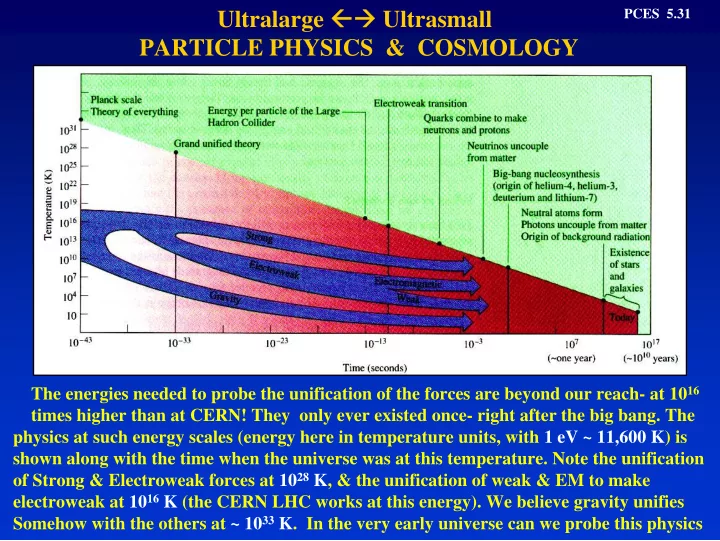
The energies needed to probe the unification of the forces are beyond our reach- at 1016 times higher than at CERN! They only ever existed once- right after the big bang. The physics at such energy scales (energy here in temperature units, with 1 eV ~ 11,600 K) is shown along with the time when the universe was at this temperature. Note the unification

  • f Strong & Electroweak forces at 1028 K, & the unification of weak & EM to make

electroweak at 1016 K (the CERN LHC works at this energy). We believe gravity unifies Somehow with the others at ~ 1033 K. In the very early universe can we probe this physics

PCES 5.31

slide-2
SLIDE 2

Cosmic Distance & Time Scales

When we look out to great distances we also look back in time. So we need to measure large distances – this not easy. Cepheids play a crucial role- these giant pulsating stars have a pulsation period simply & accurately related to their

  • luminosity. They can be seen
  • ut to ~ 108 light yrs with

modern telescopes- we know their real luminosity because some Cepheids are near enough to have their distances measured in other ways (parallax, etc). At much greater distances one relies on supernovae, whose luminosity is known fairly accurately from their spectra. These are so bright they can be seen as far as the farthest galaxies. From all this work we find that the radius of the visible universe is ~ 14 billion (1.4 x 10¹⁰) light years, & the age of the universe is thus ~ 1.4 x 10¹⁰ yrs

LEFT: Supernova in HST deep field- note difference between 1996-7. NGC 4603, @ 108 million lt. yrs ABOVE: Close-up of NGC 4603- some Cepheids are identified in boxes PCES 5.32

slide-3
SLIDE 3

Theories of the Early Universe

PCES 5.33

Theories of the early universe try to combine ideas about string and/or particle physics with gravity theory. This is hard without a proper quantum theory

  • f gravity. There are very strong

theoretical reasons for a modified Big Bang which begins with the quantum tunneling of all of spacetime from a ‘false vacuum’ state into the present universe (in a way reminiscent of the nucleation of a new phase) followed by An extremely fast expansion, or ‘inflation’ (above), and finally a long period

  • f Hubble expansion, still going on. The idea of inflation

is due to Guth.

The timeline of the v e timeline of the very early ry early universe c universe can onl n only be surmis y be surmised ed theoretically, from theoretically, from the standard the standard model of high-energ del of high-energy phy y physics (cf sics (cf slides 5.21-5.27). On slides 5.21-5.27). On sl slide 5.30 the ti ide 5.30 the timeline meline of this

  • f this expansion is

expansion is shown –

  • wn –

as the univ the univers erse rapidly rapidly expa expanded nded it cooled, & after the v it cooled, & after the various arious forces &

  • rces &

particles particles were produced, nuclei were produced, nuclei beg began to n to be synthesized about 1 be synthesized about 1 sec after the Big ec after the Big

  • Bang. Initially this involved protons
  • ng. Initially this involved protons and el

and electrons, but thes ectrons, but these collided to form e collided to form He & He & Li nuclei. T Li nuclei. This stopped after 3 minutes is stopped after 3 minutes when the therm when the thermal energ l energy was too low, was too low, producing the initial concentrations of H, He producing the initial concentrations of H, He, a , and Li nuclei i nd Li nuclei in the primitiv n the primitive univ e univers erse. For a For a long ti long time after this after this the pri the primev eval soup of photons al soup of photons, el electrons, neutrinos, & ectrons, neutrinos, & lig light nuclei nuclei c cooled f

  • led from
  • m m

many billio billions ns of

  • f degr

degrees down to down to a a fe few t w thousa

  • usand. At t
  • nd. At this

is Point, between 372,000 - Point, between 372,000 - 387,000 yrs after the Bi 87,000 yrs after the Big Ban g Bang, a r , a remarkab markable le tra transforma sformation occurred tion occurred - the univ he univers erse bec became transparent (next pag transparent (next page) )

Alan Guth (1947-)

Size of early universe plotted against time

Cosmic Abundance of early nuclei

slide-4
SLIDE 4

Radiation-Matter Decoupling: the Microwave Background

The expansion of the universe, since then, has cooled both these photons, & the condensed gas, down to 2.7 K - the universe is full of photons at this

  • temperature. In the late 1940’s it was realised by Gamow & Alpher that this

‘microwave background’ ought to exist in the universe, and that it would constitute a relic of the conditions in the early universe, at the time of

  • decoupling. This work was mostly ignored at that time.

The discovery of the ‘microwave background’ by Penzias & Wilson in 1964, using a new microwave detector they had developed, thus provided dramatic evidence for the Big Bang, & stimulated a new era in cosmological research.

PCES 5.34 Since 1964 tw o important themes in ‘cosmology’ (the study of the properties & evolution of the universe at these cosmic scales) have been the changing constitution of all the matter in the universe (starting w ith nucleosynthesis in the early universe, follow ed by nucleosynthesis in stars – see pp. 5.11-5.17), & the changes in large-scale structure. This latter study brings together particle physics & general relativity, in the new field of relativistic astrophysics.

The sud The sudden tr tran ansp spar arenc ency o

  • f the universe after nearly

the universe after nearly 300,000 y 300,000 yrs came fr s came from

  • m the de

the decoupling o coupling of matter and f matter and

  • photons. The basic idea is shown at right. In the early hot
  • photons. The basic idea is shown at right. In the early hot

universe, all the H, He, and Li universe, all the H, He, and Li were ionized - were ionized - a ‘plasma of a ‘plasma of nuclei and electrons. However as nuclei and electrons. However as they c they cool they ev

  • ol they even

entually tually boun und into an d into an exp expanding gas o ing gas of neutral atoms. The plasma neutral atoms. The plasma was opaque to photons – was opaque to photons – the hey s y scatter catter o

  • ff the char

the charged ged particles – particles – but th ut the neutral gas e neutral gas was almost transparent. Thus was almost transparent. Thus roughly 300,000 y

  • ughly 300,000 yrs after the Big Bang, the radiat

s after the Big Bang, the radiation decoupled fr ion decoupled from the

  • m the matter, and has been

matter, and has been traveling almost freely ever since, th traveling almost freely ever since, through and around the H, He, and Li. rough and around the H, He, and Li.

A Penzias (1933-) R Wilson (1936-)

Photon propagation before and after decoupling

slide-5
SLIDE 5

Mass distribution in universe, including dark matter Predictions of mass distribution from Zeldovich theory YB Zeldovich (1914-1984)

FLUCTUATIONS in the MICROWAVE BACKGROUND

Beginning in the late 19 ginning in the late 1950 50’s, the rem ’s, the remarkable s rkable self-t lf-taugh aught Soviet theori t Soviet theorist Ze st Zeldovich ldovich pioneered a large ioneered a large part of rel part of relativistic a ativistic astrophy trophysics, ex sics, exploring ing the role o the role of general relativity general relativity in high-energy phenomena such as in high-energy phenomena such as super supernov novae ae, black black holes holes, & t , & the early universe. Among hi early universe. Among his many contrib s many contributions wa utions was the prediction that s the prediction that quantum quantum fluctuations in the energ fluctuations in the energy density of density of the early universe, the early universe, around the around the ti time of ra e of radiation-m diation-matter tter deco decoupl upling, would determine the ng, would determine the later distrib later distribution of m tion of matter in the univers tter in the universe – – thes hese s small fluctuations all fluctuations would act as ‘s would act as ‘seeds eeds’ for the latter

  • r the latter collaps

collapse of matter into g e of matter into galaxies. alaxies. Remarkably, this would lead ot arkably, this would lead ot a a ‘filam ‘filament-like’ nt-like’ structure for the structure for the distrib distribution of g tion of galaxies in the univ alaxies in the univers

  • erse. Moreov

. Moreover , er ,

  • ne would be able to s
  • ne would be able to see

e the initial fluctuations the initial fluctuations even now, because they wo even now, because they would be ‘froz uld be ‘frozen’ n’ into the into the microw microwave background at ave background at the tim the time of decoup

  • f decoupling.

ling. Much w ork since then has confirmed Zeldovich’s basic ideas. Observations of the distribution of galaxies both now & in the distant past (back to w hen the galaxies first formed, revealed by deep space photos of supernovae & galaxies), show the predicted pattern of voids &

  • filaments. Fluctuations in the microw ave

background, mapped in great detail, confirm the inflationary universe picture PCES 5.35 Results from the COBE observations The WMAP observation of the microwave background – the blow- up shows the polarisation

slide-6
SLIDE 6

The MYSTERY of DARK MATTER

One of the nicest things about science is the way quite unexpected phenomena turn up, flatly contradicting accepted views. The existence of a hidden component of the universe first showed itself in the peculiar dynamics of the outer parts of galaxies (which rotated much faster than they should). We now have v. extensive evidence for this ‘dark’ component (it bends light & holds clusters

  • f galaxies together), with a

fermionic part called ‘dark matter’ and a bosonic part called ‘dark energy’. Less than 5 % of the universe is in the form of visible matter.

We still do not know w hat dark matter is – ideas range from new particles, eg ‘axions’, to more traditional neutrinos, & ‘junk’ (brow n dw arfs, planets, neutron stars). This accounts for only ~25% of the total mass. The remaining dark energy is, right now , a complete

  • mystery. It has a crucial

effect on the evolution of the universe (next slide) PCES 5.36 Pie chart: the constituents of the universe Distribution of dark matter along one direction. Nearer (more recent) matter is ‘clumped’ Cl 0024+17 galaxy cluster: dark matter distribution

1E 0657-57 ‘Bullet cluster’ of galaxies. Matter distribution in red, dark matter: blue.

slide-7
SLIDE 7

FUTURE EVOLUTION

  • f the UNIVERSE

PCES 5.37 What What event eventual ally h happen ens t s to un universe se de depen pends on s on its mass/energy density. its mass/energy density. Without dark m Without dark matter it tter it Would not be s Would not be self-gravita lf-gravitating, and would go on ting, and would go on expand panding ind ing indefinit finitely, and ly, and e eventually d entually die o e out ut comp completel

  • letely. H

. However da wever dark matter changes th rk matter changes this. is. Much effo Much effort is now being inv rt is now being invested in sted in measurem asurements ents of the distancees

  • f the distancees
  • and
  • and

des desnities ities

  • f ob
  • f objects far in the past, including

jects far in the past, including distant distant super supernova novae, a and a nd at pr t present, to tr nt, to try & de & deduce duce if if the univ the univers erse is ‘closed (ie., is ‘closed (ie., will f will fall b ll back o

  • n its

itself lf) )

  • r open (with a
  • r open (with an accele

accelerating exp rating expansi nsion) n). The . The verdict on this is still not in yet. rdict on this is still not in yet.

ABOVE: different possible long-term evolutions for the universe Recent measurements indicate the expansion of the universe may even be accelerating, due to a 5th force (quintessence)

This field is his field is full o full of speculation, speculation, includ including the idea that o ing the idea that our univers ur universe is onl is only one of a v y one of a very ry l larg arge num e number er

  • f ‘mu
  • f ‘multiverses’which

verses’which have nu have nucleated cleated from false vacua from false vacua (see below). see below).

The forn of spacetime in a closed universe (top) an open universe, & a flat universe (bottom)