UMBC A B M A L T F O U M B C I M Y O R T 1 (Nov. - - PowerPoint PPT Presentation

umbc
SMART_READER_LITE
LIVE PREVIEW

UMBC A B M A L T F O U M B C I M Y O R T 1 (Nov. - - PowerPoint PPT Presentation

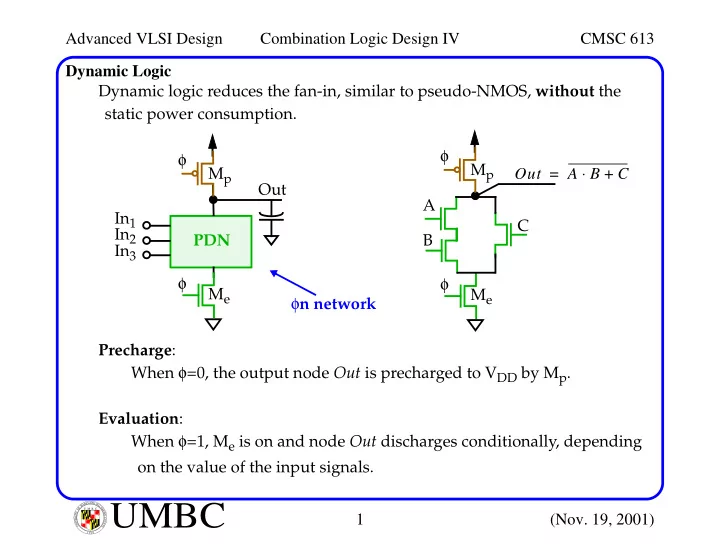
Advanced VLSI Design Combination Logic Design IV CMSC 613 Dynamic Logic Dynamic logic reduces the fan-in, similar to pseudo-NMOS, without the static power consumption. M p Out A B C M p = + Out A In 1 C In 2 B PDN In 3


slide-1
SLIDE 1

Advanced VLSI Design Combination Logic Design IV CMSC 613 1 (Nov. 19, 2001)

UMBC

U M B C U N I V E R S I T Y O F M A R Y L A N D B A L T I M O R E C O U N T Y 1 9 6 6

Dynamic Logic Dynamic logic reduces the fan-in, similar to pseudo-NMOS, without the static power consumption. Precharge: When φ=0, the output node Out is precharged to VDD by Mp. Evaluation: When φ=1, Me is on and node Out discharges conditionally, depending

  • n the value of the input signals.

PDN In1 In2 In3 Out φ φ Me Mp φn network φ φ Me Mp A B C Out A B ⋅ C + =

slide-2
SLIDE 2

Advanced VLSI Design Combination Logic Design IV CMSC 613 2 (Nov. 19, 2001)

UMBC

U M B C U N I V E R S I T Y O F M A R Y L A N D B A L T I M O R E C O U N T Y 1 9 6 6

Dynamic Logic If no path exists during evaluate, then Out remains high via CL (diffusion, wiring and gate capacitance). Note that once Out is discharged, it cannot be recharged. Therefore, the inputs can make at most one transition during evaluation. Properties:

  • The logic function is implemented in the NMOS pull-down network.
  • The # of transistors is N+2 instead of 2N
  • It is non-ratioed (noise margin does not depend on transistor ratios).
  • It only consumes dynamic power.
  • Faster switching due to reduced internal and downsteam capacitance.

Steady-state behavior: VOL and VOH are GND and VDD. Our standard definitions of noise margins and switching thresholds do not include time, which is required in this case.

slide-3
SLIDE 3

Advanced VLSI Design Combination Logic Design IV CMSC 613 3 (Nov. 19, 2001)

UMBC

U M B C U N I V E R S I T Y O F M A R Y L A N D B A L T I M O R E C O U N T Y 1 9 6 6

Dynamic Logic Steady-state behavior (cont): For example, noise margins depend on the length of the evaluate. If clk is too long, leakage affects the high output level significantly. Since the pull down network starts to conduct when the input signal exceeds VTn, it is reasonable to set VM, VIH, VIL = VTn. Therefore, NML is very low. Note that this is a conservative estimate since subthreshold leakage occurs for inputs below VTn. Also note that the high output level is sensitive to noise and coupling disturbances because of its high output impedance. The high value of NMH compensates for this increased sensitivity.

slide-4
SLIDE 4

Advanced VLSI Design Combination Logic Design IV CMSC 613 4 (Nov. 19, 2001)

UMBC

U M B C U N I V E R S I T Y O F M A R Y L A N D B A L T I M O R E C O U N T Y 1 9 6 6

Dynamic Logic Dynamic behavior: Also, after precharge, the output is high. Therefore, tpLH = 0! This is somewhat unfair since it ignores the precharge time. The designer is free to choose the size of the PMOS device, smaller is faster but increases load and tpHL. The tpHL is proportional to CL and current-sinking capabilities of PDN. Me slows down the gate a little. 0.0 2 4 6 Vout (V) 2.0 4.0 6.0 t (nsec) φ Capacitive coupling Precharge Evaluate

slide-5
SLIDE 5

Advanced VLSI Design Combination Logic Design IV CMSC 613 5 (Nov. 19, 2001)

UMBC

U M B C U N I V E R S I T Y O F M A R Y L A N D B A L T I M O R E C O U N T Y 1 9 6 6

Dynamic Logic There are three sources of noise:

  • Charge Leakage

Sets the minimum clock to 250Hz to 1kHz (testing difficulties)

  • Charge Sharing

t φ Precharge Evaluate t Via reversed-biased diffusion diodes and subthreshold leakage φ φ Me Mp A B=0 Out Mb Ma Ca Cb Cout ∆Vout VDD – Ca Ca CL +

     = ∆Vout VTn > If then Vout and Vx reach the same value. X Target is to keep ∆Vout VTp < since output may drive a static gate. Ca/CL < 0.2.

slide-6
SLIDE 6

Advanced VLSI Design Combination Logic Design IV CMSC 613 6 (Nov. 19, 2001)

UMBC

U M B C U N I V E R S I T Y O F M A R Y L A N D B A L T I M O R E C O U N T Y 1 9 6 6

Dynamic Logic One way to combat both of these: Pseudo-static: Mbl is a highly resistive (long and narrow) PMOS transistor. Alternatively, precharge internal nodes using a clock driven PMOS.

  • Clock Feedthrough

The clock is coupled to the storage node via Cgs and gate-overlap caps. May forward bias the junction and inject electrons into substrate. φ φ Me Mp A B Out Mb Ma Mbl bleeder Static bleeder φ φ Me Mp A B Out Mb Ma Mbl Precharge Internal nodes φ

slide-7
SLIDE 7

Advanced VLSI Design Combination Logic Design IV CMSC 613 7 (Nov. 19, 2001)

UMBC

U M B C U N I V E R S I T Y O F M A R Y L A N D B A L T I M O R E C O U N T Y 1 9 6 6

DOMINO Logic Cascading Dynamic gates Fix is to restrict the inputs to making only a 0->1 transition during eval. φ φ Me Mp In φ φ Me Mp Out1 Out2 φ Evaluate In Out1 Out2 ∆V t PDN In1 In2 In3 Out1 φ φ Me Mp PDN In4 φ φ Me Mp Out2 Mr Fanout also driven by static inverter. Level restorer.

slide-8
SLIDE 8

Advanced VLSI Design Combination Logic Design IV CMSC 613 8 (Nov. 19, 2001)

UMBC

U M B C U N I V E R S I T Y O F M A R Y L A N D B A L T I M O R E C O U N T Y 1 9 6 6

DOMINO Logic During evaluation, either the output of the first DOMINO stays at 0 (no delay!) or makes a 0->1 transition. The transition may ripple all the way down the chain. Properties:

  • Only non-inverting logic can be implemented.
  • Appropriate for complex, large fan-out circuits such as ALUs or control cir-

cuits.

  • Very high speeds can be achieved, tpHL = 0.

In the past, DOMINO was used in the design of a number of high speed ICs. The first 32-bit microprocessor (BellMAC 32) used it. Recently, pure DOMINO circuits are rare, mainly due to the non-inverting logic property.

slide-9
SLIDE 9

Advanced VLSI Design Combination Logic Design IV CMSC 613 9 (Nov. 19, 2001)

UMBC

U M B C U N I V E R S I T Y O F M A R Y L A N D B A L T I M O R E C O U N T Y 1 9 6 6

np-CMOS Logic PUN networks replace the static inverters. Note that the φp blocks are driven with the Clk_bar so that the precharge and evaluate periods coincide. np-CMOS logic style is 20% faster than DOMINO, despite the slower PMOS pull-up devices. The DEC alpha-processor (first at 250MHz) used this logic extensively. Disadv: NML = VTn and NMH = |VTp|. PDN In1 In2 In3 Out1 φ φ Me Mp PUN In4 φ φ Mp Me Out2 φp block φn block Also called ZIPPER logic Conditionally charged

slide-10
SLIDE 10

Advanced VLSI Design Combination Logic Design IV CMSC 613 10 (Nov. 19, 2001)

UMBC

U M B C U N I V E R S I T Y O F M A R Y L A N D B A L T I M O R E C O U N T Y 1 9 6 6

Power Consumption We’ve already discussed sources of power consumption in CMOS inverter. We now discuss the effects of switching activity, glitching and direct-path cur- rent. Note that the factor f0->1 complicates the analysis for complex gates. Factors affecting the switching activity include the statistics of the input sig- nals, the circuit style (dynamic/static), the function, and network topology. These are incorporated by: where f is the average event rate, and P0->1 is the probability an input transi- tion results in a 0->1 power-consuming event. Pdyn CLVDD

2

f 0->1 = Pdyn CLVDD

2

P0->1 f =

slide-11
SLIDE 11

Advanced VLSI Design Combination Logic Design IV CMSC 613 11 (Nov. 19, 2001)

UMBC

U M B C U N I V E R S I T Y O F M A R Y L A N D B A L T I M O R E C O U N T Y 1 9 6 6

Complex Static Gate Power Consumption Consider a 2-input NOR gate, assume the input signals have a uniform distri- bution of high and low values. e.g., the 4 input combinations, AB = 00, 01, 10, 11, are equally likely. Therefore, the probability the output is low or high is 3/4 and 1/4, respec- tively. The probability of an energy consuming transition is the probability that the

  • utput is initially low, 3/4, times the probability it will become high, 1/4.

P0->1 P0P1 1 P1 – ( )P1 3 4

  • 1

4

  • ×

3 16

  • =

= = = 3/4 X 1/4 = 3/16 3/16 1/4 X 1/4 = 1/16 3/4 X 3/4 = 9/16 1

slide-12
SLIDE 12

Advanced VLSI Design Combination Logic Design IV CMSC 613 12 (Nov. 19, 2001)

UMBC

U M B C U N I V E R S I T Y O F M A R Y L A N D B A L T I M O R E C O U N T Y 1 9 6 6

Complex Static Gate Power Consumption Note that the output probabilities are no longer uniform. This suggests that the input signals are not uniform, since gates are typically cascaded. The probability that the output is 1 (P1) is a function of the input distributions, PA and PB (the probabilities the inputs are 1). The transition probability is then: 3-D graph shown in text. Derive these expressions for AND, OR and XOR. P1 1 PA – ( ) 1 PB – ( ) = for the NOR gate. P0->1 1 P1 – ( )P1 1 1 PA – ( ) 1 PB – ( ) – [ ] 1 PA – ( ) 1 PB – ( ) [ ] = =

slide-13
SLIDE 13

Advanced VLSI Design Combination Logic Design IV CMSC 613 13 (Nov. 19, 2001)

UMBC

U M B C U N I V E R S I T Y O F M A R Y L A N D B A L T I M O R E C O U N T Y 1 9 6 6

Complex Static Gate Power Consumption For example: With no reconvergent fan-out, the probability that X undergoes a power con- suming transistion is 3/16. X = 1, 3 out of 4 times. Therefore, X has an uneven distribution yielding a transition probability on Z as: The orderly calculations from input to output is not possible for

  • Circuits with feedback (sequential circuits).
  • Circuits with reconvergent fanout.

X A B C Z No reconvergent fan-out Z 1 PXPC – ( )PXPC 1 3 4

  • 1

2

  • ×

–     3 4

  • 1

2

  • ×

    15 16

  • =

= =

slide-14
SLIDE 14

Advanced VLSI Design Combination Logic Design IV CMSC 613 14 (Nov. 19, 2001)

UMBC

U M B C U N I V E R S I T Y O F M A R Y L A N D B A L T I M O R E C O U N T Y 1 9 6 6

Complex Static Gate Power Consumption In the latter case, the input signals are not independent. The procedure above yeilds 15/64 for the transition probability. However, reduction yields Z = B, and the P0->1 transition probability on Z is (1/2 X 1/2) = 1/4. Conditional probabilities take signal inter-dependencies into account. For example, Z = 1 iff B and X = 1. This expresses the probability that B and X are 1 simultaneously. If a dependency exists, a conditional probability is required for expansion: X Z Reconvergent fan-out A B PZ P Z=1 ( ) P B=1 X=1 , ( ) = = PZ P X=1 B=1 ( ) P B=1 X=1 ( ) ⋅ P X=1 B=1 ( ) P B=1 ( ) ⋅ = =

slide-15
SLIDE 15

Advanced VLSI Design Combination Logic Design IV CMSC 613 15 (Nov. 19, 2001)

UMBC

U M B C U N I V E R S I T Y O F M A R Y L A N D B A L T I M O R E C O U N T Y 1 9 6 6

Dynamic Gate Power Consumption What about dynamic circuits? During precharge, the output node is charged to 1. Therefore, power is consumed every time the PDN is on (output is 0), inde- pendent of the preceding or following values! Power consumption is determined solely by signal value probabilities, and not by transition probabilities. These is always larger than the transition probability, since the latter is the product of two signal probabilities both of which is smaller than 1. For example, the 0-probability of a 2-input NOR is If the inputs are equally probably, there is a 75% chance of a 1->0. Note CL is smaller than a static gate but the clock load must be considered. P0 PA PB PAPB – + ( ) = PNOR 0.75CLVDD

2

f clk =

slide-16
SLIDE 16

Advanced VLSI Design Combination Logic Design IV CMSC 613 16 (Nov. 19, 2001)

UMBC

U M B C U N I V E R S I T Y O F M A R Y L A N D B A L T I M O R E C O U N T Y 1 9 6 6

Glitches in Static CMOS Circuits The finite propagation delay through gates in a network can cause spurious transitions called glitches, critical races or dynamic hazards. These are multiple transitions during a single clock cycle. Assume a unit delay and all inputs arrive at the same time. The second NOR evaluates twice, the first one with the previous value of

  • X. This consumes unnecessary power.

Redesign can eliminate glitches by matching delays along signal paths. A B C X Z ABC 101 000 Unit delay

slide-17
SLIDE 17

Advanced VLSI Design Combination Logic Design IV CMSC 613 17 (Nov. 19, 2001)

UMBC

U M B C U N I V E R S I T Y O F M A R Y L A N D B A L T I M O R E C O U N T Y 1 9 6 6

Short Circuit Currents in Static CMOS Circuits Crowbar currents occur when both NMOS and PMOS are on simultaneously. As is true for glitches, these do not occur in dynamic circuits. The power dissipated is a function of the on-time of the transistors and their

  • peration mode.

For large CL (left), VDS for the PMOS remains at 0 during entire input

  • transition. ISC is approximately 0 in this case.

For small CL (right), VDS is VDD and is maximal (saturation). Neither case is acceptable. Actually, matching rise/fall times is optimal. CL ISC ~= 0 CL ISC ~= Imax Downstream ISC ~= Imax Large load Small load

slide-18
SLIDE 18

Advanced VLSI Design Combination Logic Design IV CMSC 613 18 (Nov. 19, 2001)

UMBC

U M B C U N I V E R S I T Y O F M A R Y L A N D B A L T I M O R E C O U N T Y 1 9 6 6

Low Power Design Assuming short-circuit current, glitching and leakage can be kept in bounds, the dominant power consumption is dynamic power. Power can be reduced by manipulating VDD and Ceff, (CL * P0->1). Reducing VDD is a big win because of the quadratic dependence. Although PDP decreases for lower VDD, delay increases, as predicted by. Delay increases substantially for VDD close to 2*VT. Therefore, to conserve energy, we should operate at the slowest possible speed. Pdyn CLVDD

2

P0->1 f = tp CLVDD 2

   1 kn VDD VTn – ( )2

  • 1

kp VDD VTp – ( )2

  • +

slide-19
SLIDE 19

Advanced VLSI Design Combination Logic Design IV CMSC 613 19 (Nov. 19, 2001)

UMBC

U M B C U N I V E R S I T Y O F M A R Y L A N D B A L T I M O R E C O U N T Y 1 9 6 6

Low Power Design To maintain throughput (compensate for increased delays), one approach is to lower threshold voltages. As we’ve seen, lowering threshold voltage, increases subthreshold leakage. This raises the minimum clock frequency (dynamic circuits). This increases standby currents and reduces noise margins (static cir- cuits). Note that the concept of zero leakage is preconceived. For example, the following configurations yield the same performance in a 0.25 um CMOS process.

  • VDD = 3V, VT = 0.7V
  • VDD = 0.45V, VT = 0.1V

However, the power consumption is reduced in the latter by 45X! For dynamic circuits, the power savings is only about a factor of 8. Architectural (area for power) compensations are also possible.

slide-20
SLIDE 20

Advanced VLSI Design Combination Logic Design IV CMSC 613 20 (Nov. 19, 2001)

UMBC

U M B C U N I V E R S I T Y O F M A R Y L A N D B A L T I M O R E C O U N T Y 1 9 6 6

Low Power Design When power supply voltage is lower bound due of external constraints or performance, the only other means is to reduce Ceff. This is achieved by reducing both the physical cap. and switching activity. Lowering the physical cap. usually improves performance as well. For example, a CPL adder reportedly uses 30% less power (at 4V) com- pared with a static version. Since most cap. is due to transistor cap. (diffusion and gate), this suggests the use of minimum sized devices whenever possible. Larger is only justified for large fan-outs and wiring capacitances. Note this contradicts the standard cell philosophy which use larger tran- sistors in order to accommodate a wider ranges of loads. Reducing switching activity can be accomplished by point-to-point buses and re-ordering inputs to gates (see text for examples).

slide-21
SLIDE 21

Advanced VLSI Design Combination Logic Design IV CMSC 613 21 (Nov. 19, 2001)

UMBC

U M B C U N I V E R S I T Y O F M A R Y L A N D B A L T I M O R E C O U N T Y 1 9 6 6

Summary Choosing a logic style depends on Ease of design, Robustness, System clock- ing requirements, Fan-out, Functionality and Testing. Static is robust and easy to design (ameanable to design automation). Complementary complex gates are expensive in area and performance. Pseudo-NMOS is simple and fast but reduces noise margins and increases power consumption. Pass-transistor logic is good for certain classes of circuits (MUX/adders). Dynamic logic gives fast and small circuits but complicates the design pro- cess and restricts the minimum clock rate. For a 4-input NAND gate: Style Ratioed Static power # of trans. Area (um2) delay (ns) Complementary No No 8 533 0.61 Pseudo-NMOS Yes Yes 5 288 1.49 CPL No No 14 800 0.75 Dynamic (np) No No 6 212 0.37