UNCTAD Expert Meeting on the Impact of Access to Financial Services. - - PowerPoint PPT Presentation

unctad expert meeting on the impact
SMART_READER_LITE
LIVE PREVIEW

UNCTAD Expert Meeting on the Impact of Access to Financial Services. - - PowerPoint PPT Presentation

U N I T E D N A T I O N S C O N F E R E N C E O N T R A D E A N D D E V E L O P M E N T U N I T E D N A T I O N S C O N F E R E N C E O N T R A D E A N D D E V E L O P M E N T Expert Meeting on THE


slide-1
SLIDE 1

U N I T E D N A T I O N S C O N F E R E N C E O N T R A D E A N D D E V E L O P M E N T U N I T E D N A T I O N S C O N F E R E N C E O N T R A D E A N D D E V E L O P M E N T

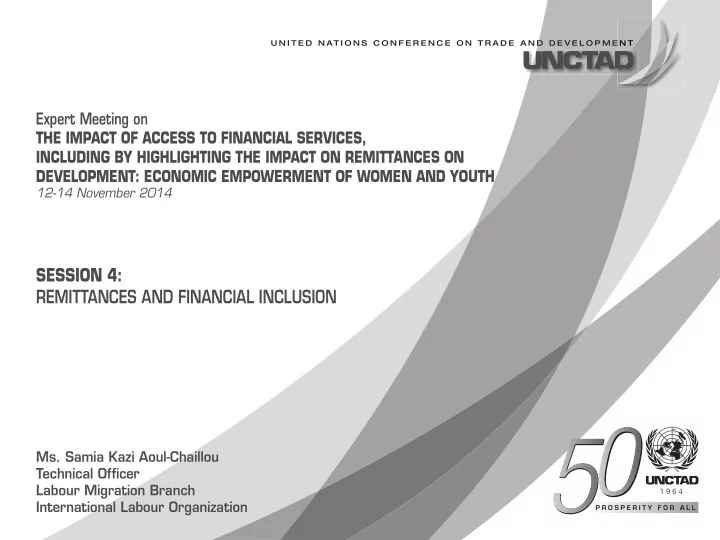
Expert Meeting on THE IMPACT OF ACCESS TO FINANCIAL SERVICES, INCLUDING BY HIGHLIGHTING THE IMPACT ON REMITTANCES ON DEVELOPMENT: ECONOMIC EMPOWERMENT OF WOMEN AND YOUTH

12-14 November 2014

SESSION 4: REMITTANCES AND FINANCIAL INCLUSION

  • Ms. Samia Kazi Aoul-Chaillou

Technical Offi cer Labour Migration Branch International Labour Organization

50

1 9 6 4

P R O S P E R I T Y F O R A L L

50

slide-2
SLIDE 2

UNCTAD Expert Meeting on the Impact

  • f Access to Financial Services.

Session 4: Remittances and financial inclusion Labour migration and remittances: ILO rights-based and migrant-centred approach to remittances

Samia Kazi Aoul Labour Migration Branch- MIGRANT International Labour Office

slide-3
SLIDE 3

Introduction

  • The ILO estimates: more than half of the 232 million international

migrants are economically active.

  • Remittances: a work related outcome, the expression of solidarity.
  • Remittance costs: efforts should continue to lower them down.
  • Social costs of migration for MWs and their families.
  • June 2014, the ILO DG’s report Setting an ILO Agenda for Fair

Migration: “There is a need to ensure that (…) remittances can be made securely and at minimal cost and to explore how they can be used to best effect to promote jobs and development”

slide-4
SLIDE 4

A rights-based and migrant centred approach to remittances

  • Remittances

▫ Private individual earnings ▫ Primarily used for food, education, improved housing and health care. ▫ Improve households’ living standards ▫ An insurance against shocks ▫ Impact on domestic production & job creation ▫ Financial inclusion, productive investments

  • 2 ILO Conventions C 97 & C 143 – fundamental principles:

Equality of treatment & non-discrimination.

  • C97 « right to transfer part of the earnings and savings of the

migrant»

  • Ensuring the protection of migrant workers is essential to

maximise the development benefits of migration for migrants themselves, their countries of origin and destination. Contribute to poverty alleviation

slide-5
SLIDE 5

Migration conditions & impact on remittances

Impact on the employment rate of migrants, their earnings & ability to transfer money to their families.. Segmented labour market Differentiated treatment Unsafe working conditions Discriminations (wage, social protection, working conditions) No recognition of qualifications and skills Migrant status

slide-6
SLIDE 6

How to optimize the benefits of labour migration on development?

Good governance of labour migration that relies on concerted, coherent, transparent and flexible migration policies based on international standards and social dialogue. Equality of treatment & Non-discrimination Access to Decent Work Adequacy S/D of labour (skills/job

matching)

Positive impact on Migrant workers (e.g. earnings, social protection, skills) Possible + impact on remittances & MWs’ contribution to communities/countries

  • f origin and

destination

slide-7
SLIDE 7

What role for governments?

The ILO Multilateral Framework on Labour Migration (2006)

  • Non-binding principles & guidelines for a rights-based approach to labour

migration: Highlights that “the contribution of labour migration to employment, economic growth, development and the alleviation of poverty should be recognized and maximized for the benefit of both origin and destination countries” (Principle 15)

  • Among the guidelines that may prove valuable in giving practical effect to the

above principle (15.5) providing incentives to promote the productive investment of remittances in the countries of origin; (15.6.) reducing the costs of remittance transfers, including by facilitating accessible financial services, reducing transaction fees, providing tax incentives and promoting greater competition between financial institutions;

  • Facilitate the use of formal transfer channels, efficient technologies and

partnerships.

slide-8
SLIDE 8

What role for governments?

  • Create a conducive environment for the development of a financial

market that allows competition and development of remittances linked products

  • Support financial education
  • Facilitate human capital transfer through temporary or permanent returns.
  • Negotiate bilateral agreements on social security and vocational training.
  • Facilitate procedures & rules of access to labour markets and reduce

recruitment costs.

  • Support the reintegration into the labour market and stimulate

entrepreneurship: training, financial assistance, recognition of qualifications, access to microcredit

slide-9
SLIDE 9

8

What role for social partners and diaspora associations?

  • Employers’ organizations: encourage entrepreneurship development, provide

financial orientation and access to financial payment facilities.

  • Workers’ organizations: provide financial orientation for migrant workers and

their families, advocate for more accessible financial infrastructure, and support the development of adequate financial schemes/services for migrant workers.

  • Diaspora associations provide information to their members, they strengthen

migrant workers and their families’ capacity to make informed/ rational choices about the use of remittances and remittances-linked services through financial education (ILO partnership with the FORIM)

slide-10
SLIDE 10

ILO action on financial inclusion for migrants and their families

9 Promoting Financial Inclusion for MWs and their families To enhance welfare of low- income households and support enterprises & job creation, asset building, risk mitigation Access to financial services (savings, credit, insurance, payment) Demand-side of financial services: Financial education Supply-side of financial services: Work with MFIs to support adequate and innovative financial services

slide-11
SLIDE 11
  • Financial education training tools developed to improve

knowledge and skills for responsible budgeting, including spending, saving, borrowing, and investing.

  • Financial education trainings carried out Benin, Burkina

Faso, Cambodia, Ethiopia, Indonesia, Kenya, Mali, Mauritania, Moldova, Morocco, Myanmar, Philippines, Senegal, Singapore, Malaysia, Thailand, France, Spain and Italy. (+/- 20,000 beneficiaries)

ILO action on Financial inclusion for migrants and their families

slide-12
SLIDE 12
  • Training provided to microfinance institutions through the

course on “Making Microfinance Work, Managing Product diversification”. In Albania, Moldova technical support was provided in developing national action plans to improve formalisation and investment of remittances.

  • Action research carried out on migrant remittances and

microfinance in various countries (Bangladesh, Mexico, Nepal, Senegal, South Africa).

  • The ILO has carried out feasibility studies on the possibility

to use a portion of migrant workers remittances to develop health micro insurance products in origin countries (Mali, Senegal, Comoros)

  • Seguros futuro: a cooperative insurance company in El
  • Salvador. The ILO Microinsurance Innovation Facility

supported Seguros futuro in the development of financial and insurance products adapted to the needs of remittance recipients families.

ILO action on Financial inclusion for migrants and their families

slide-13
SLIDE 13

Conclusion

  • Remittances have a positive impact on poverty alleviation and

development but can also have negative consequences.

  • Good governance of labour migration relying on rights-based migration

policies and promoting efficient labour markets should be at the heart of the discussions on remittances and their contribution to development.

  • Reducing the costs of migration goes beyond reducing remittances

costs.

  • No country or government can achieve this goal in isolation:

cooperation between countries of origin and destination, social dialogue and the involvement of multiple actors at local, national and international level are central to this process.

slide-14
SLIDE 14

Thank you for your attention !

Samia Kazi Aoul – Chaillou kaziaoul@ilo.org