Understanding and Treating Hoarding Disorder Sanjaya Saxena, M.D. - - PDF document

understanding and treating hoarding disorder
SMART_READER_LITE
LIVE PREVIEW

Understanding and Treating Hoarding Disorder Sanjaya Saxena, M.D. - - PDF document

Hoarding / Saving Behavior Understanding and Treating Hoarding Disorder Sanjaya Saxena, M.D. Director, UCSD Obsessive-Compulsive Disorders Program Professor, UCSD Department of Psychiatry UCSD School of Medicine La Jolla, CA Hoarding


slide-1
SLIDE 1

Understanding and Treating Hoarding Disorder

Sanjaya Saxena, M.D.

UCSD School of Medicine La Jolla, CA

Director, UCSD Obsessive-Compulsive Disorders Program Professor, UCSD Department of Psychiatry

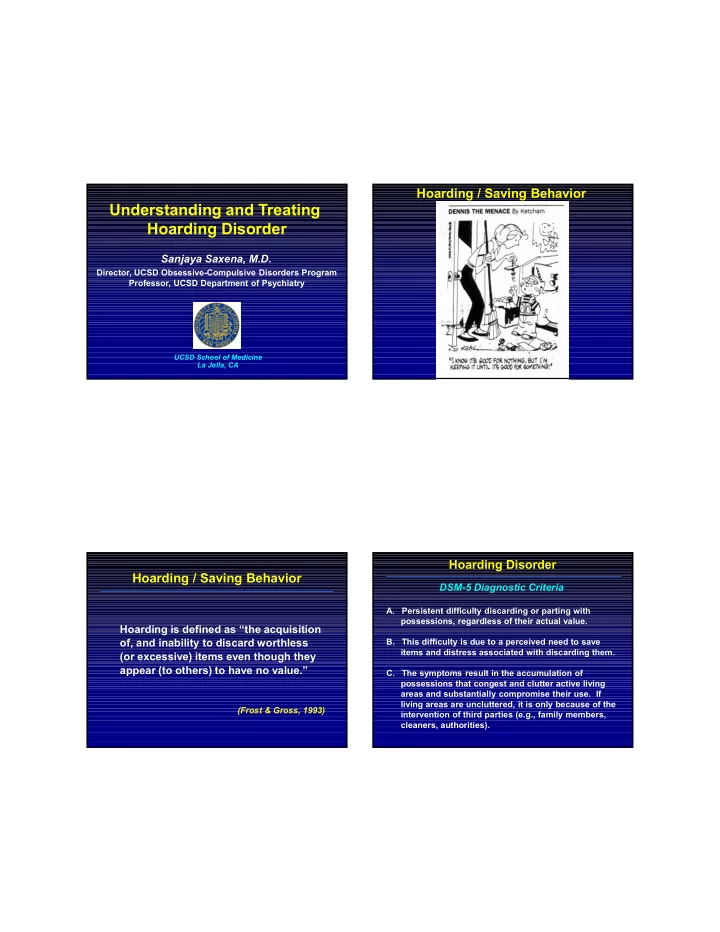
Hoarding / Saving Behavior

Hoarding is defined as “the acquisition

  • f, and inability to discard worthless

(or excessive) items even though they appear (to others) to have no value.”

Hoarding / Saving Behavior

(Frost & Gross, 1993)

Hoarding Disorder

A. Persistent difficulty discarding or parting with possessions, regardless of their actual value.

  • B. This difficulty is due to a perceived need to save

items and distress associated with discarding them.

  • C. The symptoms result in the accumulation of

possessions that congest and clutter active living areas and substantially compromise their use. If living areas are uncluttered, it is only because of the intervention of third parties (e.g., family members, cleaners, authorities).

DSM-5 Diagnostic Criteria

slide-2
SLIDE 2

Hoarding Disorder

  • D. The hoarding causes clinically significant distress or

impairment in social, occupational, or other important areas

  • f functioning (including maintaining a safe environment for

self and others).

  • E. The hoarding is not attributable to another medical condition

(e.g., brain injury, cerebrovascular disease, Prader-Willi Syndrome).

  • F. The hoarding is not better accounted for by the symptoms
  • f another mental disorder (e.g., hoarding due to obsessions

in Obsessive-Compulsive Disorder, decreased energy in Major Depressive Disorder, delusions in Schizophrenia or another Psychotic Disorder, cognitive deficits in Dementia, restricted interests in Autistic Spectrum Disorder).

DSM-5 Diagnostic Criteria

Hoarding Disorder

Specify if: With Excessive Acquisition: If symptoms are accompanied by excessive collecting or buying or stealing of items that are not needed or for which there is no available space. Indicate whether hoarding beliefs and behaviors are currently characterized by: Good or fair insight: The individual recognizes that hoarding-related beliefs and behaviors (pertaining to difficulty discarding items, clutter, or excessive acquisition) are problematic. Poor insight: The individual is mostly convinced that hoarding-related beliefs and behaviors (pertaining to difficulty discarding items, clutter, or excessive acquisition) are not problematic despite evidence to the contrary. Absent Insight (i.e., delusional beliefs about hoarding): The individual is completely convinced that hoarding-related beliefs and behaviors (pertaining to difficulty discarding items, clutter, or excessive acquisition) are not problematic despite evidence to the contrary.

DSM-5 Diagnostic Criteria

Compulsive Hoarding Compulsive Hoarding

slide-3
SLIDE 3
  • Population prevalence of clinically

significant compulsive hoarding: 3-5% = Estimated 7-11 million people in the U.S.

Hoarding Disorder

(Samuels et al, 2008; Mueller et al, 2009; Iervelino et al, 2009; Timpano et al, 2011; Nordsletten et al, 2013)

Prevalence Age at Onset

Mild Moderate Severe Any Symptom 13.4 24.3 33.6 Clutter 16.6 23.8 35.6 Acquiring 18.2 26.6 34.1 Difficulty Discarding 16.4 22.6 33.5 Recognition 30.0 36.7 41.8

Compulsive Hoarding

(Grisham et al, 2006) (Samuels et al, 2002; Lochner et al, 2005; Ayers et al, 2010)

Mean: 12-13 years old

Compulsive Hoarding

Newspapers Books Clothes Magazines Bills / Receipts / Statements Bags, Storage Containers Mail, Catalogs, Ads Notes and Lists Memorabilia Some Idiosyncratic Items

Most Commonly Hoarded items

(Frost & Gross, 1993; Winsberg et al, 1999)

Reasons Given for Hoarding / Saving Behavior

  • Perceived Need for the Items
  • Could use it, fix it, sell it
  • Might need it some day
  • It’s valuable, was expensive
  • Emotional Attachment to Possessions
  • Sentimental attachments
  • Memorabilia
  • Reminders of loved ones

Same Reasons for Patients with Hoarding Disorder as for Non-hoarding People

slide-4
SLIDE 4

Animal Hoarding

Hoarding of Cats

Animal Hoarding

Hoarding By Cats

Compulsive Hoarding

Cognitive-Behavioral Model

  • Information Processing Deficits
  • organization
  • categorization
  • memory
  • focusing attention
  • Excessive Emotional Attachment to Possessions
  • Distorted Beliefs about the Importance of

Possessions; Responsibilities

  • Poor Insight; Over-Valued Ideation.

(Frost & Hartl, 1996; Neziroglu et al, 2012)

  • Obsessional Concerns and Perceived Need to Save
  • Clutter
  • Excessive Acquisition
  • “Churning”
  • Procrastination
  • Disorganization - of Possessions, Time, Activities, Thoughts
  • Indecisiveness
  • Slowness / Lateness
  • Avoidance
  • Perfectionism
  • Circumstantial, over-inclusive language

Compulsive Hoarding

The Behavioral Syndrome

(Frost et al, 1996; Saxena et al, 2002)

slide-5
SLIDE 5

Point Disorder prevalence (n=217)

Major Depression 51% Dysthymia 5% Bipolar Disorder 1% ADHD 28% OCD (non-hoarding) 18% GAD 24% Social Phobia 24% PTSD 7% Panic Disorder 0% Specific Phobia 14% Eating Disorders 1% EtOH or Drug Abuse 2% Compulsive Buying 61% Kleptomania 10% Pathological Gambling 6% Trichotillomania 5% OCPD (without hoarding criterion) 18%

(Frost et al, 2011)

Hoarding Disorder

Comorbidity

Hoarding Disorder

  • Not all Clutter is due to Hoarding Disorder.
  • Compulsive Hoarding is a Neuropsychiatric Disorder.
  • Hoarding Disorder is NOT merely Laziness,

Obstinance, or “Chronic Disorganization”.

  • Hoarding Disorder can cause severe Functional

Impairment and Disability.

  • People with Hoarding Disorder Need Neuropsychiatric

Evaluation and Treatment, Not Just House-Cleaning!

Initial Points to Remember:

Useful Assessment Questions

  • Amount and type of clutter?
  • Health or safety hazards due to clutter?
  • Urges to save?
  • Beliefs & fears about loss of possessions?
  • Level of insight?
  • Procrastination, Avoidance?
  • Indecisiveness, Disorganization?
  • Level of functioning and impairment?
  • Level of support?

Assessment of Compulsive Hoarding

(Saxena & Maidment, 2004)

  • Medication
  • Cognitive-Behavioral Therapy (CBT)
  • Biblio-based Support Groups (using BIT)
  • Other Psychotherapies: ineffective
  • 12 Step Approaches: ineffective
  • House Cleaning by Others: ineffective

Treatment of Hoarding Disorder

slide-6
SLIDE 6

Treatment of Hoarding Disorder

Authors Sample size; Age Measures Treatment Method % Change in Symptom Severity

Saxena et al, 2007 n = 32 (25 completers) Mean age 49 SADS-L, YBOCS, HAM-D, HAM-A, GAF, UHSS Paroxetine: 42 ± 13 mg/day for 10-12 weeks Intent-to-Treat Analysis YBOCS: 24% HAM-D: 30% HAM-A: 25% GAF: 14% UHSS: 24% (31% in completers) Saxena & Sumner, 2014 n = 24 (23 completers) Mean age 53 MINI, UHSS, SI-R, YBOCS, HAM-D, HAM-A, GAF, CGI Venlafaxine XR: 204 +/- 72 mg/day for 12 weeks UHSS: 36% SI-R: 32% YBOCS: 39% HAM-D: 46% HAM-A: 44% GAF: 19% 70% Responded

Prospective Medication Treatment Studies

Treatment of Hoarding Disorder

Authors Sample size; Age Measures Treatment Method % Change in Symptom Severity

Grassi et al, 2016 n = 12 (11 completers) Mean age 46.5 UHSS, SI-R, ASRS, HAM-D, GAF, SDS Atomoxetine: 62.7 ± 12.8 mg/day for 12 weeks

  • Added onto
  • ngoing meds

UHSS: 41% SI-R: 40% ASRS: 19% HAM-D: 12% GAF: 29% SDS: 34% 6 were full responders; 3 were partial responders Rodriguez et al, 2013 n = 4 Mean age 42.8 SI-R, ADHDSS Methylphenidate- ER: 36-54 mg/day for 4 weeks

  • Added onto
  • ngoing meds

SI-R: 14% ADHDSS: 50% 2 partial responders

Prospective Medication Treatment Studies

  • 1. Eliminate health and fire hazards.
  • 2. Create living and work space.
  • 3. Extinguish fear of discarding unnecessary

possessions.

  • 4. Eliminate excessive buying / acquisition.
  • 5. Improve decision-making skills.
  • 6. Decrease procrastination and avoidance.
  • 7. Improve organizational and time management skills.
  • 8. Organize possessions for easier access.
  • 9. Prevent future excessive saving / acquisition.

Cognitive-Behavioral Therapy for Compulsive Hoarding

Goals

(Saxena & Maidment, 2004)

  • 1. Education; improve insight and motivation for treatment.
  • 2. Treatment contract for CBT
  • 3. Treatment Set-up: Select target area of clutter.

Assess items in the area; create hierarchy. Create realistic categories and storage system.

  • 4. ERP - Excavation: Patient must make decision to keep or discard each

item and permanently remove it from the pile. : Saved items must be stored appropriately. : Continue until area is clear, then move to next area.

  • 5. Plan and implement appropriate use of space.
  • 6. Preventing Incoming Clutter by Reducing Excessive Acquisition
  • 7. Cognitive Restructuring
  • 8. Organizing: Possessions, Time, Tasks, etc.
  • 9. Relapse Prevention

CBT for Compulsive Hoarding

Treatment Sequence

(Saxena & Maidment, 2004)
slide-7
SLIDE 7
  • Pharmacotherapy
  • Prior studies of OCD +/- Hoarding probably don’t apply.
  • Paroxetine appears to be moderately effective but hard to tolerate.
  • Venlafaxine appears to be quite effective for hoarding, depression,

and anxiety, faster than CBT.

  • Atomoxetine appears to be effective, faster than CBT.
  • Cognitive-Behavioral Therapy
  • mildly-moderately effective alone, needs modification
  • 20-30 sessions, ≥ 6months are required for efficacy.
  • Is significantly improved by adding Cognitive Rehabilitation
  • Biblio-based Support Groups: moderately effective, faster than CBT.
  • Intensive Multi-Modal Treatment
  • Intensive, frequent CBT plus aggressive medication treatment

appears to be effective, for severely ill patients, in only 6 weeks.

  • We must develop more effective treatments!

Treatment of Hoarding Disorder

Conclusions

How to Enhance CBT for Hoarding?

Many Hoarding Disorder patients have executive functioning deficits. Some have poor insight. So:

1. Use Cognitive Rehabilitation to teach skills that improve cognitive functioning and compensate for cognitive deficits:

  • Planning, preparation, organization, abstract reasoning,

cognitive flexibility, problem solving skills, working memory.

  • 2. Emphasize exposure & response prevention (discarding)
  • Maximize in-session practice and homework compliance
  • 3. De-emphasize cognitive restructuring strategies

4. Do intensive treatment – multiple hours/day, several days/week. 5. Use Motivational Interviewing & Enhancement: particularly for patients with poor insight or who refuse treatment.

Compulsive Hoarding

Etiology and Pathophysiology

  • Family / Genetic Studies
  • Hoarding Secondary to Brain Damage
  • Brain Imaging Studies

Hoarding Disorder

Family Studies

Compulsive hoarding runs in families.

  • 85% of hoarding patients reported having a family member

with hoarding behaviors, while only one-third had a family member with non-hoarding OCD. (Winsberg et al, 1999)

  • Hoarding was found in 12% of 1st degree relatives of

compulsive hoarding patients vs. 3% of 1st degree relatives of non-hoarding OCD patients. (Samuels et al, 2002)

  • Hoarding symptom factor is strongly familial in OCD

patients.

(Hasler et al, 2007; Iervolino et al, 2011)

slide-8
SLIDE 8

Twin Studies

Compulsive hoarding is highly heritable.

  • Heritability of Hoarding Disorder: 0.36 -0.51

(Iervolino et al, 2009; Monzani et al, 2013; Mathews et al, 2014)

  • BDD, OCD, Hoarding Disorder, Trichotillomania, and

Skin-picking share a common genetic liability factor. OCD, BDD, and HD also have disorder-specific genetic factors and nonshared environmental risk factors.

(Monzani et al, 2013)

Hoarding Disorder

Compulsive Hoarding Caused by Brain Damage

Case reports:

  • 51 y/o male with damage to right medial orbitofrontal cortex from

cerebral hemorrhage (ruptured ACA aneurysm) developed repetitive behavior of “borrowing” cars. (Cohen et al, 1999)

  • 46 y/o male with damage to left orbitofrontal cortex from cerebral

hemorrhage (ruptured ACA aneurysm) developed compulsive collecting of toy plastic bullets. (Hahm et al, 2001)

  • 40 y/o male developed classic compulsive hoarding behavior

two years after resection of olfactory meningioma, with loss of brain tissue in bilateral frontal poles, orbitofrontal cortex, and superior frontal cortex.

(Volle et al, 2002)

Neurobiology of Compulsive Hoarding

Compulsive Hoarding Caused by Brain Damage

Nine patients with compulsive hoarding behaviors beginning after brain damage, compared to 54 non-hoarding brain-damaged patients: All hoarding patients had damage to prefrontal cortex, mostly in medial and inferior areas. Greatest lesion overlap was in right medial prefrontal cortex, anterior cingulate cortex, orbitofrontal pole, and adjacent white

  • matter. (Anderson et al, 2005)

Neurobiology of Compulsive Hoarding

slide-9
SLIDE 9

Significant Negative Correlations Between Glucose Metabolism and Hoarding Severity in Patients with OCD (n=45)

Sagittal

Dorsal Anterior Cingulate Cortex

Cerebral Glucose Metabolism In Compulsive Hoarding

Sagittal 3.0 2.5 1.5 2.0 1.0 0.5 0.0 Z value L Transverse R (Saxena et al, 2004)

Anterior Cingulate Cortex Dysfunction in Hoarding Disorder

  • Hoarding patients had significantly lower normalized

cerebral glucose metabolism than controls throughout the anterior cingulate cortex (ACC), bilaterally.

  • right dorsal ACC (p = .007), left dorsal ACC (p = .04),
  • right ventral ACC (p = .05), left ventral ACC (p = .01)
  • No significant differences in posterior cingulate cortex (PCC).
  • UHSS scores were inversely correlated with normalized

glucose metabolism in the right dACC, right PCC, and bilateral putamen.

  • Hoarding patients did not show significant differences

from controls on any of the other OCD- or depression- related brain regions.

(Saxena, 2008)

FDG-PET Results

Anterior Cingulate Cortex Dysfunction In Hoarding Disorder

  • 1. Hoarding Disorder is associated with dysfunction

throughout the ACC.

  • 2. ACC dysfunction may mediate the core symptoms

and associated features of the compulsive hoarding syndrome.

  • Dysfunction of the dACC may mediate the decision-making

difficulties, attention problems, and other cognitive deficits seen in hoarding patients.

  • Dysfunction of the vACC, which mediates memory for

fear extinction, could underlie the persistence of

  • bsessional fears in hoarding patients.

Conclusions

slide-10
SLIDE 10

Understanding and Treating Hoarding Disorder

Summary

  • Hoarding Disorder is a common and serious condition.
  • Hoarding Disorder is a Neuropsychiatric Disorder.
  • It is not due to laziness or a character flaw.
  • It is associated with distinct brain abnormalities.
  • It will not improve without treatment.
  • Simply throwing away or organizing a hoarding patient’s

possessions will not solve his/her problems!

  • All people with significant hoarding behaviors need

neuropsychiatric evaluation.

  • Hoarding Disorder is Treatable.
  • Thorough assessment and treatment planning are required.
  • Specific medications and tailored CBT can be quite effective.

UC San Diego Obsessive-Compulsive Disorders Clinic: (858) 534-8730

UC San Diego Health System La Jolla, CA

UC San Diego OCD Research Program: (858) 246-1872