Understanding Medicare in the United States By Craig B. Garner, - - PowerPoint PPT Presentation

understanding medicare in the united states
SMART_READER_LITE
LIVE PREVIEW

Understanding Medicare in the United States By Craig B. Garner, - - PowerPoint PPT Presentation

Understanding Medicare in the United States By Craig B. Garner, Esq. 1 INTRODUCTION 2 BEFORE MEDICARE For much of its first two centuries in Americas history, the burden of caring for the sick and injured fell to neighbors, friends and


slide-1
SLIDE 1

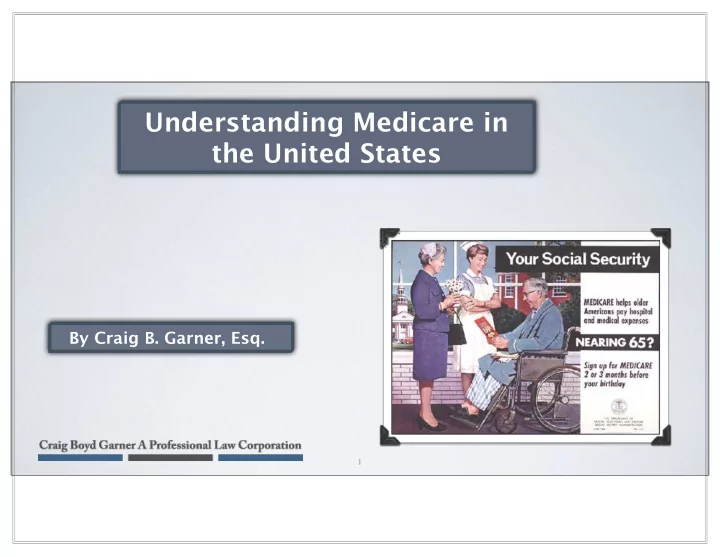
Understanding Medicare in the United States

By Craig B. Garner, Esq.

1
slide-2
SLIDE 2

INTRODUCTION

2

slide-3
SLIDE 3

BEFORE MEDICARE

For much of its first two centuries in America’s history, the burden of caring for the sick and injured fell to neighbors, friends and relatives, with additional support from individual communities and religious groups. Visits by an actual doctor were generally limited to the home and dictated by local

  • demographics. Almshouses and charity wards provided a certain degree of medical

service, as hospitals were few and far between. Those who had the opportunity to visit a hospital prior to the twentieth century more than likely did so after an accident or as the result of an unfortunate designation of insanity.

3

slide-4
SLIDE 4

MEDICINE IN THE NINETEENTH CENTURY

For Through the 1800s the delivery of care rendered by the few hospitals in cities like New York, Boston and Philadelphia far exceeded the treatment one would expect from a local almshouse or charity ward. The need to provide health care for an entire nation was strong. With fewer than 200 hospitals in 1873, that number grew to nearly 5,000 by the 1920s, including mental institutions.

The Medical Laboratory, University of Pennsylvania

4

slide-5
SLIDE 5

HOSPITAL AND COMMUNITY WORKING TOGETHER

In 1946 Congress sought to influence health care nationwide through the Hospital Survey and Construction Act (the Hill Burton Act) which disbursed approximately $3.7 billion to hospitals. The Hill Burton Act wanted to create 4.5 hospital beds per 1,000 people nationwide. Congress would eventually require participation in Medicare and Medicaid as a condition to receive monies under the Hill Burton Act.

Harold H. Burton Lister Hill

5

slide-6
SLIDE 6

MEDICARE

6

slide-7
SLIDE 7

By the 1960s, America’s health care system was at a crossroads. Though the earlier Social Security Act of 1935 had established a general welfare system for the elderly, it did not include health insurance. President Harry Truman had wanted to create a system of national health insurance during his tenure, but his efforts were continually stalled by the lobbying power of the American Medical Association (AMA). Ultimately, a compromise of sorts was reached by diluting Truman’s grand ambitions with an addition to the Social Security system created 30 years earlier. As President Johnson symbolically handed former President Truman the first Medicare card on July 30, 1965, America’s commitment to government-sponsored health care became permanent.

MEDICARE BEGINS

7

slide-8
SLIDE 8

Medicare sought to provide coverage to all persons 65 years of age or older who could satisfy certain legal residency requirements. Within a year’s time, nearly 19 million elderly Americans were enrolled in the program, with Medicaid providing similar access to heath care on a State level for qualifying low-income individuals.

8

slide-9
SLIDE 9

Part A provided health insurance coverage for qualified individuals requiring hospitalization. Part B initially offered a set of optional benefits addressing medically necessary services such as doctor services, outpatient care, and home health services, and soon included durable medical equipment, podiatric care, and outpatient physical therapy. In 1972 the Federal government extended Medicare eligibility to people under the age of 65 with certain long-term disabilities and others with chronic kidney disease. Medicaid eligibility for elderly, blind and disabled residents of an individual state became linked to a newly enacted Federal program.

THE FOUNDATION OF MEDICARE

9

slide-10
SLIDE 10

HEALTH MAINTENANCE ORGANIZATIONS

10

slide-11
SLIDE 11

In 1973, Congress passed the Health Maintenance Organization Act. The HMO Act

  • ffered government subsidies and loans to HMOs, helping these managed care entities

to attain much needed financial stability, in part so they could carry Medicare’s increasing burden. As a result, a new power was extended to HMO administrators that authorized their ability to challenge the medical judgment of licensed physicians. The HMO Act represents the first instance of business concerns gaining the upper hand

  • ver medical judgment in the health care system, and marked the first step toward the

discrepancy of power between the two that still exists today.

HMOS ENTER THE PICTURE . . .

11

slide-12
SLIDE 12

Thanks to the consistency of government subsidies, the HMO model expanded to become the preeminent template for American health providers. There were 168 HMOs in 1978, with 6 million enrolled. By 1990, there were 652 HMO plans, covering 34.7 million people. In 1996, the number of enrollees grew to 60 million. In 2010 there were an estimated 154 million people enrolled in managed care (109.7 million in preferred provider organizations, and 44.3 million in HMOs).

. . . AND EXPAND

12

slide-13
SLIDE 13

THE WAY OF THE DRG

13

slide-14
SLIDE 14

A NEW WAY TO PAY -- THE DRG

Prior to 1983, most patients remained in the hospital until the doctor decided it was time for them to leave, which resulted in an inconsistent range of hospital days for treating similar conditions. T

  • correct this issue, Medicare’s cost-based reimbursement policy was scrapped in favor of a

newly developed classification system designed to standardize patient care by devoting a set price to a given procedure. Called the diagnosis-related group (DRG), this prospective payment system did away with reimbursing providers for the actual cost of their services, creating instead a predetermined rate per illness based on a patient’s diagnosis. In doing so, the burden now fell on hospitals to provide the necessary care for a set procedure that kept within the payment cap if they wished to see a profit.

14

slide-15
SLIDE 15

THE DRG (continued)

This shift away from Medicare’s earlier “fee-for- services” policy was intended to curtail what many saw as the overuse of testing and treatments by doctors in a hospital setting who knew these patient expenses would be covered under Part A. By providing a set fee per diagnosis, proponents argued that providers would be motivated to become more efficient in their diagnosis and treatment

15

slide-16
SLIDE 16

THE DRG (continued)

Diagnosis-related units are assigned to almost every aspect of acute hospital care. T

  • day, the top ten most used DRGs include:

heart failure and shock pneumonia certain cerebrovascular diseases psychoses pulmonary disease joint, limb and lower extremity procedures angina certain digestive disorders, such as esophagitis and gastroenteritis gastrointestinal hemorrhage nutritional and certain metabolic disorders

16

slide-17
SLIDE 17

CONGRESS FLEXES ITS MUSCLES AND MEDICARE EXPANDS

17

slide-18
SLIDE 18

EMTALA

In 1986, Congress passed the Emergency Medical Treatment and Active Labor Act (EMTALA). Designed to counteract “patient dumping,” EMTALA requires every hospital that receives federal funding to treat any patient with an emergency condition. Federal law defines an “emergency medical condition” as “a medical condition manifesting itself by acute symptoms of sufficient severity (including severe pain) such that the absence of immediate medical attention could reasonably be expected to result in . . . placing the health of the individual . . . in serious jeopardy.”

18

slide-19
SLIDE 19

Medicare’s annual reimbursements add up to nearly 20% of medical expenditures in the U.S., so most hospitals have little choice but to participate. In 2008 the uncompensated medical care in the United States approached $57 billion, about $43 billion. Hospitals shoulder close to 60% of this uncompensated medical care, mostly due to the nature of the services they provide for patients with heightened levels of acuity. Are hospitals becoming an endangered institution?

EMTALA, continued

19

slide-20
SLIDE 20

PORTABILITY AND ACCOUNTABILITY

The Health Insurance Portability and Accountability Act of 1996 (HIPAA) sought to provide new Federal rules improving continuity or "portability" of coverage in the large group, small group, and individual health insurance markets, while reinforcing the need to protect the privacy of patient health records. Health providers were instructed to comply with HIPAA’s Privacy and Security Acts by 2003 or risk severe financial penalties.

20

slide-21
SLIDE 21

MEDICARE+CHOICE (MEDICARE ADVANTAGE)

Enacted in 1997, the bill included an array of new Medicare managed care and other private health plan choices for beneficiaries, all of which were offered through a coordinated

  • pen enrollment process.

The new regulations expanded education and information to help beneficiaries make informed choices. Created five new prospective payment systems (PPS) for Medicare services: (1) inpatient rehabilitation hospital or unit services, (2) skilled nursing facility (SNF) services, (3) home health services, (4) hospital outpatient department services, and (5) outpatient rehabilitation services.

21

slide-22
SLIDE 22

PART D

In 2003, the Medicare Prescription Drug, Improvement, and Modernization Act established a voluntary outpatient prescription drug benefit for Medicare beneficiaries. Known as “Part D,” this prescription drug coverage was made available to all Medicare beneficiaries as of January 1, 2006, through a variety of plans that had been pre- approved by the federal government

22

slide-23
SLIDE 23

BRINGING RX DRUG COVERAGE TO THE SENIORS OF AMERICA

“With the Medicare Act of 2003, our government is finally bringing prescription drug coverage to the seniors of America. With this law, we're giving older Americans better choices and more control over their health care, so they can receive the modern medical care they deserve. . . . Our nation has the best health care system in the world. And we want our seniors to share in the benefits of that system. Our nation has made a promise, a solemn promise to America's

  • seniors. We have pledged to help our citizens find affordable medical care in the later years of
  • life. Lyndon Johnson established that commitment by signing the Medicare Act of 1965. And

today, by reforming and modernizing this vital program, we are honoring the commitments of Medicare to all our seniors.”

23

slide-24
SLIDE 24

POLICING THE PROVIDERS

Also in 2003, the federal government initiated a three-year demonstration program using Recovery Audit Contractors (RACs) to detect and correct improper payments within Medicare. The program recovered more than $1.03 billion (96% of these payments were overpayments collected from providers (85% of which were collected from hospital providers) and the remaining 4% were underpayments). In 2005, the federal government launched the Medicaid Integrity Program (MIP), focusing on Medicaid payments. Medicaid Integrity Contractors (MICs) work with CMS to carry out this program.

24

slide-25
SLIDE 25

NEVER EVENTS

T

  • improve patient safety and rein in health care costs, in 2007 CMS announced that Medicare

and Medicaid would no longer cover “conditions that could reasonably have been prevented.” Medicare assembled a list of complications so egregious that they called them “never events,” meaning they should never occur in a hospital setting. “Never events” included complications stemming from operating on the wrong side of the body to leaving instruments in a patient after a procedure. According to CMS, patients developed 1.7 million infections in hospitals each year, causing or contributing to the death of 99,000 people a year — about 270 a day. Regardless of the health of a patient’s immune system at the time of admittance, hospitals suddenly found themselves responsible for any and all hospital acquired illnesses.

25

slide-26
SLIDE 26

MEDICARE IN THE MODERN AGE

26

slide-27
SLIDE 27

HEALTH CARE GOES HITECH

Under the Health Information T echnology for Economic and Clinical Health Act (HITECH). Seeking to protect patient privacy and tighten the rules of accountability for the sharing of a patient’s medical information. HITECH made most of the HIPAA requirements for patient health information directly applicable to business associates as well health care providers. Hospitals were required to develop a system for identifying breaches and notify covered entities following discovery of a breach. We should be mindful of the speed with which technology changes, as well as the dilution of privacy expectations progressing from generation to generation. HIPAA is a critical facet of America’s march toward paperless medicine, though at times it may appear to be more of an

  • bstacle.

27

slide-28
SLIDE 28

In 2010, CMS proposed the adoption of what was to constitute “meaningful use” of electronic health records (EHRs), while also implementing financial incentive programs through Medicare and Medicaid that would reward or penalize hospitals and physicians for their ability to institute certified EHRs within an established time frame. CMS proposed that hospitals adopt “meaningful use” in three stages of increasingly technological sophistication. Hospitals and physicians must meet the initial requirements and in the future enhance their EHR capability to receive incentive payments and avoid penalties beginning in 2015.

PAPERLESS MEDICINE

28

slide-29
SLIDE 29

REFORM, RESTRUCTURE, REVIEW

29

slide-30
SLIDE 30

Health Care Reform is a comprehensive plan embracing a multitude

  • f revisions to the structure of the American health care system.

Taking place over several years, it will include in part: The prohibition of health insurers from denying coverage or refusing claims based on pre-existing conditions The expansion of Medicaid eligibility, including families who did not previously qualify Providing incentives for businesses to provide health care benefits Increasing support for medical research. On March 23, 2010, President Obama signed the Patient Protection and Affordable Care Act into law (followed by the Health Care and Education Reconciliation Act).

HEALTH CARE REFORM

30

slide-31
SLIDE 31

THE FUTURE OF HOSPITAL REIMBURSEMENT

Under Health Care Reform, in the future CMS will start paying hospitals Medicare “bonuses” based upon overall performance, adherence to quality measures, and patient satisfaction. This hospital value-based purchasing program is another step toward shifting the reimbursement infrastructure from cost-based to performance-driven. Beginning in October 2012, hospitals can share bonus money from an $850 million fund based upon their performance scores. The following year, hospitals will face a 1% reduction overall on Medicare payments under this system. By 2015, hospitals with poor performance ratings may be excluded from the bonus pool and face additional cuts in reimbursement. “The incentives we're putting into place have created a whole new way to think about hospital care." Jonathan Blum, deputy administrator of CMS

31

slide-32
SLIDE 32

HOSPITAL PERFORMANCE MEASURES

Hospitals must closely track their performance on various measures

  • f quality, patient experience, and operations. This includes the

following examples: Readmission rates for cardiac cases Readmission rates for pneumonia patients Mortality rates for cardiac and pneumonia patients Average waiting time in the emergency department Patients who would recommend a hospital Patients who were happy with their levels of communication with doctors and nurses

32

slide-33
SLIDE 33

THE FUTURE OF MEDICARE FOR PHYSICIANS

In 2015, roughly 750,000 physicians in the Medicare program will be asked to revalidate their individual enrollment records during a massive anti-fraud effort mandated by PPACA. Medicare will also require a value-based purchasing modifier that adjusts physician fees based on quality and efficiency measures. Although not starting until 2015, CMS measure physician performance as early as 2013. 2015: CMS starts applying the modifier to specific physicians and groups. 2017: CMS starts applying the modifier to all physicians and groups.

33

slide-34
SLIDE 34

ACCOUNTABLE CARE ORGANIZATIONS

Medicare encourages the formation of Accountable Care Organizations (ACOs) to monitor the collective quality and efficiency of doctors and hospitals alike, while at the same time creating an entirely new set of standards for compensation.

34

slide-35
SLIDE 35

ACCOUNTABLE CARE ORGANIZATIONS (continued)

Assignment of patients: a preliminary prospective-assignment method with beneficiaries identified quarterly (there will still be a final reconciliation after each performance year based

  • n patients served by the ACO).

Quality: Measures: 33 quality measures in 4 domains. Application: The first round of applications due in early 2012. In the beginning, ACOs will also have some flexibility within each of the performance years, rather than the original uniform 3-year agreement based only on a calendar year. EHR: No longer a mandatory condition of participation, although it is retained as an important quality measure.

35

slide-36
SLIDE 36

ACCOUNTABLE CARE ORGANIZATIONS (continued)

The Office of the Inspector General clarified the implications of physician self referral laws and the federal anti- kickback statutes. The Federal Trade Commission clarified there will no longer require mandatory antitrust review, and there will be an antitrust “safety zone” for ACOs approved by CMS The Internal Revenue Service clarified the ways in which a charitable organization can participate. In addition to the October 2011 modifications surrounding formation, other federal agencies have clarified issues of concern in the revised regulations:

36

slide-37
SLIDE 37

MEDICARE AND PREVENTATIVE CARE

“The Affordable Care Act helps stop health problems before they start.”

  • -HHS Secretary Kathleen Sebelius

Under Health Care Reform, the future of Medicare is about: Pilot Programs Preventative Health Care Services Forward Thinking Research

37

slide-38
SLIDE 38

Last summer, new regulations recommended preventative services free for Medicare beneficiaries. Health Care Reform also created the Patient- Centered Outcomes Research Institute (PCORI) to produce groundbreaking, evidence based information. A report issued by the Prevention and Public Health Fund estimates that a $10 per person investment each year in community-based, preventative health programs could result in an annual savings of more than $15 billion over the next five years.

MEDICARE AND PREVENTATIVE CARE, continued

38