Unit 3 Crash Course GTAGTAGGT What would be the sequence of bases of - - PDF document

unit 3 crash course
SMART_READER_LITE
LIVE PREVIEW

Unit 3 Crash Course GTAGTAGGT What would be the sequence of bases of - - PDF document

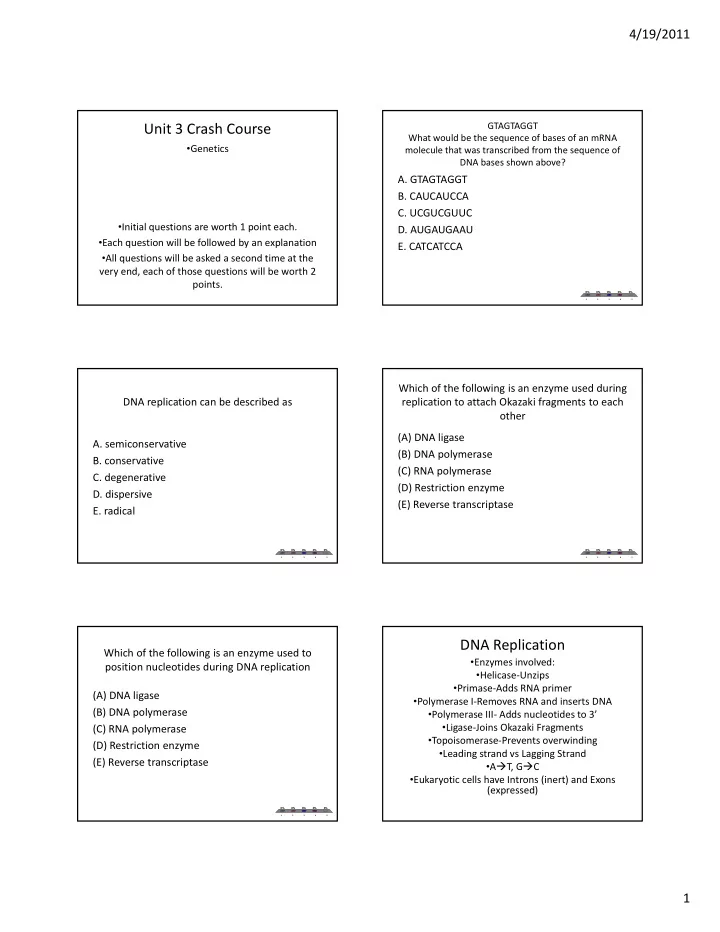
4/19/2011 Unit 3 Crash Course GTAGTAGGT What would be the sequence of bases of an mRNA Genetics molecule that was transcribed from the sequence of DNA bases shown above? A. GTAGTAGGT B. CAUCAUCCA C. UCGUCGUUC Initial questions are worth 1


slide-1
SLIDE 1

4/19/2011 1

Unit 3 Crash Course

  • Genetics
  • Initial questions are worth 1 point each.
  • Each question will be followed by an explanation
  • All questions will be asked a second time at the

very end, each of those questions will be worth 2 points.

GTAGTAGGT What would be the sequence of bases of an mRNA molecule that was transcribed from the sequence of DNA bases shown above?

  • A. GTAGTAGGT
  • B. CAUCAUCCA

1 2 3 4 5

0% 0% 0% 0% 0%

  • C. UCGUCGUUC
  • D. AUGAUGAAU
  • E. CATCATCCA

DNA replication can be described as

  • A. semiconservative
  • B. conservative

1 2 3 4 5

0% 0% 0% 0% 0%

  • C. degenerative
  • D. dispersive
  • E. radical

Which of the following is an enzyme used during replication to attach Okazaki fragments to each

  • ther

(A) DNA ligase (B) DNA polymerase

1 2 3 4 5

0% 0% 0% 0% 0%

(C) RNA polymerase (D) Restriction enzyme (E) Reverse transcriptase Which of the following is an enzyme used to position nucleotides during DNA replication (A) DNA ligase (B) DNA polymerase

1 2 3 4 5

0% 0% 0% 0% 0%

(C) RNA polymerase (D) Restriction enzyme (E) Reverse transcriptase

DNA Replication

  • Enzymes involved:
  • Helicase‐Unzips
  • Primase‐Adds RNA primer
  • Polymerase I‐Removes RNA and inserts DNA
  • Polymerase III‐ Adds nucleotides to 3’

k k

  • Ligase‐Joins Okazaki Fragments
  • Topoisomerase‐Prevents overwinding
  • Leading strand vs Lagging Strand
  • AT, GC
  • Eukaryotic cells have Introns (inert) and Exons

(expressed)

slide-2
SLIDE 2

4/19/2011 2

Which of the following terms refers to both the movement of a ribosome along a piece of mRNA and the movement of a piece

  • f one chromosome to another chromosome?

(A) Transduction (B) Transgenesis

1 2 3 4 5

0% 0% 0% 0% 0%

( ) g (C) Transformation (D) Translocation (E) Transplantation

The replacement of glutamic acid by valine at a specific position in the beta chains of hemoglobin leads to sickle cell

  • anemia. This change represents which of the following

mutational events?

  • A. DNA base pair substitution
  • B. DNA base pair deletion

1 2 3 4 5

0% 0% 0% 0% 0%

  • C. DNA base pair addition
  • D. Chromosomal deletion
  • E. Frame shift mutation

ABCDEF… ABDEF... A rearrangement in linear sequence of genes as shown in the diagram above is known as:

  • A. duplication
  • B. deletion

1 2 3 4 5

0% 0% 0% 0% 0%

  • C. inversion
  • D. polyploidy
  • E. translocation

DNA Mutations

  • Substitution‐One nucleotide is replace with

another, no frame shift

  • Deletion, Insertion‐Often result in frame shift
  • Transposition‐movement of whole segments
  • Transposons‐Jumping genes

The primary value of a specific type of backcross known as a test cross is to

  • A. determine whether a trait is really

hereditary B permit detection of recessive

1 2 3 4 5

0% 0% 0% 0% 0%

  • B. permit detection of recessive

genes

  • C. reveal cases of blending

inheritance

  • D. reveal remote ancestors
  • E. reveal sex‐linked inheritance

A diploid cell has three pairs of homologous chromosome designated J1/J2, K1/K2 and L1/L2. Which

  • f the following represents a probable chromosome

complement in a haploid cell formed by meiosis?

  • A. J1 and K1
  • B. J1 and J2

1 2 3 4 5

0% 0% 0% 0% 0%

  • C. J2, K1, and L2
  • D. J1, J1, K2, and K2
  • E. J1, J2, K1, K2, L1, and L2
slide-3
SLIDE 3

4/19/2011 3

A form of vitamin D‐resistant rickets, known as hypophosphatemia, is inherited as an X linked dominant trait. If a male with hypophosphatemia marries a normal female, which of the following predictions concerning their potential progeny would be true?

  • A. All of their sons would inherit the

disease. B All of their daughters would inherit

1 2 3 4 5

0% 0% 0% 0% 0%

  • B. All of their daughters would inherit

the disease.

  • C. About 50% of their sons would

inherit the disease.

  • D. About 50% of their daughters would

inherit the disease.

  • E. None of their daughters would inherit

the disease.

Mendelian Inheritance

  • Law of segregation‐homologous chromosomes

separate in meiosis

  • Law of independent assortment‐the way one

allele segregates has no change on others

  • Complete Dominance‐ one allele shows, other

does not

  • Incomplete Dominance‐dominant trait may be

less apparent (red+whitepink)

  • Co‐dominance‐Both traits are 100% expressed
  • Homozygous‐ AA or aa, Heterozygous‐ Aa
  • Epistasis is the control over one locus by another
  • Sex Linked Traits are found on the X chromosome

The relative location of four genes on a chromosome can be mapped from the following data on crossover frequencies. Which of the following represents the relative positions of these four genes on the chromosome?

  • A. ABCD
  • B. ADCB
  • C. CABD
  • D. CBAD
  • E. DBCA

1 2 3 4 5

0% 0% 0% 0% 0%

Which of the following can be diagnosed by examining a karyotype of an individual's white blood cells? (A) Sickle cell anemia (B) Alzheimer disease

1 2 3 4 5

0% 0% 0% 0% 0%

(C) Down syndrome (D) Cystic fibrosis (E) Duchenne muscular dystrophy

A spermatocyte produces the following four sperm cells. These cells are the result of nondisjunction during which of These cells are the result of nondisjunction during which of the following phases?

1 2 3 4 5

0% 0% 0% 0% 0%

(A) Interphase (G1 or G2) (B) Interphase (S) (C) Mitosis (D) Meiosis I (E) Meiosis II

Meiosis

  • 1 diploid becomes 4 unique haploid
  • Crossing over occurs in prophase 1
  • Genes are more likely to be inherited together

if they are close together (gene loci)

  • Nondisjunction can occur in anaphase 1 or

anaphase 2

  • Down syndrome‐trisomy 21
slide-4
SLIDE 4

4/19/2011 4

What is the probability that the genotype Aa will be produced by the parents Aa x Aa (A) 0 (B) 1/16

1 2 3 4 5

0% 0% 0% 0% 0%

(C) 1/4 (D) 1/2 (E) 3/4

In fruit flies, vermilion eyes are a sex‐linked recessive

  • characteristic. If a vermilion‐eyed female is crossed

with a wild‐type male, what proportion of the male

  • ffspring should have vermilion eyes?
  • A. 0%

B 25%

1 2 3 4 5

0% 0% 0% 0% 0%

  • B. 25%
  • C. 50%
  • D. 75%
  • E. 100%

What is the probability that the genotype ccdd will be produced by the parents CcDd x CcDd (A) 0 (B) 1/16

1 2 3 4 5

0% 0% 0% 0% 0%

(C) 1/4 (D) 1/2 (E) 3/4

Laws of Probability

  • Law of multiplication – probability of 2 events
  • ccurring is the product of each probability
  • Monohybrid cross‐Aa x Aa 1:AA 2:Aa 1:aa

probability: 75% dominant 25% recessive P tt f l i d t i i

  • Punnett squares are useful in determining

probability

A a A AA homozygous Aa heterozygous a Aa heterozygous aa homozygous

Analysis of DNA sequences from two individuals of the same species results in a greater estimate of genetic variability than docs analysis of amino acid sequences from the same individuals because

(A) different DNA sequences can code for the same amino acid (B) some amino acid variations cannot be d d b l h

1 2 3 4 5

0% 0% 0% 0% 0%

detected by protein electrophoresis (C) DNA sequencing is a more reliable technique than protein electrophoresis (D) proteins are more easily damaged than is DNA (E) DNA is more heat‐sensitive and therefore varies more

Protein Synthesis

  • Transcription factors‐ activate promotor
  • Transcription‐ DNA to mRNA
  • mRNA modification‐ Alternate splicing, G‐cap,

poly A tail

  • Translation‐ mRNA to amino acid sequence
  • tRNA matches codons to amino acids
  • rRNA makes up ribosomes
  • Post‐translational modifications:

phosphorylation and cleavage

slide-5
SLIDE 5

4/19/2011 5

Refer to the following pedigree that illustrates the inheritance of sickle cell

  • anemia. Shading indicates the presence
  • f sickle cell anemia.

What is the probability that the next child of parents A and B would have had sickle cell anemia? sickle cell anemia?

1 2 3 4 5

0% 0% 0% 0% 0%

  • A. 0%
  • B. 25%
  • C. 60%
  • D. 75%
  • E. 100%

Refer to the following pedigree that illustrates the inheritance of sickle cell

  • anemia. Shading indicates the presence
  • f sickle cell anemia.

The most reasonable explanation for the fact that the offspring of C and D do not have sickle cell anemia is that each received a

1 2 3 4 5

0% 0% 0% 0% 0%

  • A. sickle allele from the mother
  • B. normal allele from the father
  • C. sickle allele from each parent
  • D. normal allele from each parent
  • E. pair of normal alleles from the

father

Refer to the following pedigree that illustrates the inheritance of sickle cell

  • anemia. Shading indicates the presence of

sickle cell anemia. Which of the following statements is correct about the four offspring of C and D? A O l h f l i f h i kl

1 2 3 4 5

0% 0% 0% 0% 0%

  • A. Only the females are carriers of the sickle

cell trait.

  • B. Only the males are carriers of the sickle

cell trait.

  • C. Only the females are heterozygous for the

sickle cell trait.

  • D. All are homozygous for the sickle cell trait.
  • E. All are carriers of the sickle cell trait.

Pedigrees

  • Used to determine heritage
  • Shows sex‐linked traits, dominant vs. recessive
  • Females are circle, males are square

Review Quiz!

  • Answer values are doubled… lets

see how you do.

A form of vitamin D‐resistant rickets, known as hypophosphatemia, is inherited as an X linked dominant trait. If a male with hypophosphatemia marries a normal female, which of the following predictions concerning their potential progeny would be true?

  • A. All of their sons would inherit the

disease. B All of their daughters would inherit

1 2 3 4 5

0% 0% 0% 0% 0%

  • B. All of their daughters would inherit

the disease.

  • C. About 50% of their sons would

inherit the disease.

  • D. About 50% of their daughters would

inherit the disease.

  • E. None of their daughters would inherit

the disease.

slide-6
SLIDE 6

4/19/2011 6

Refer to the following pedigree that illustrates the inheritance of sickle cell

  • anemia. Shading indicates the presence
  • f sickle cell anemia.

The most reasonable explanation for the fact that the offspring of C and D do not have sickle cell anemia is that each received a

1 2 3 4 5

0% 0% 0% 0% 0%

  • A. sickle allele from the mother
  • B. normal allele from the father
  • C. sickle allele from each parent
  • D. normal allele from each parent
  • E. pair of normal alleles from the

father

Which of the following is an enzyme used during replication to attach Okazaki fragments to each

  • ther

(A) DNA ligase (B) DNA polymerase

1 2 3 4 5

0% 0% 0% 0% 0%

(C) RNA polymerase (D) Restriction enzyme (E) Reverse transcriptase Which of the following is an enzyme used to position nucleotides during DNA replication (A) DNA ligase (B) DNA polymerase

1 2 3 4 5

0% 0% 0% 0% 0%

(C) RNA polymerase (D) Restriction enzyme (E) Reverse transcriptase What is the probability that the genotype ccdd will be produced by the parents CcDd x CcDd (A) 0 (B) 1/16

1 2 3 4 5

0% 0% 0% 0% 0%

(C) 1/4 (D) 1/2 (E) 3/4

The replacement of glutamic acid by valine at a specific position in the beta chains of hemoglobin leads to sickle cell

  • anemia. This change represents which of the following

mutational events?

  • A. DNA base pair substitution
  • B. DNA base pair deletion

1 2 3 4 5

0% 0% 0% 0% 0%

  • C. DNA base pair addition
  • D. Chromosomal deletion
  • E. Frame shift mutation

Which of the following terms refers to both the movement of a ribosome along a piece of mRNA and the movement of a piece

  • f one chromosome to another chromosome?

(A) Transduction (B) Transgenesis

1 2 3 4 5

0% 0% 0% 0% 0%

( ) g (C) Transformation (D) Translocation (E) Transplantation

slide-7
SLIDE 7

4/19/2011 7

What is the probability that the genotype Aa will be produced by the parents Aa x Aa (A) 0 (B) 1/16

1 2 3 4 5

0% 0% 0% 0% 0%

(C) 1/4 (D) 1/2 (E) 3/4 The relative location of four genes on a chromosome can be mapped from the following data on crossover frequencies. Which of the following represents the relative positions of these four genes on the chromosome?

  • A. ABCD
  • B. ADCB
  • C. CABD
  • D. CBAD
  • E. DBCA

1 2 3 4 5

0% 0% 0% 0% 0%

A diploid cell has three pairs of homologous chromosome designated J1/J2, K1/K2 and L1/L2. Which

  • f the following represents a probable chromosome

complement in a haploid cell formed by meiosis?

  • A. J1 and K1
  • B. J1 and J2

1 2 3 4 5

0% 0% 0% 0% 0%

  • C. J2, K1, and L2
  • D. J1, J1, K2, and K2
  • E. J1, J2, K1, K2, L1, and L2

A spermatocyte produces the following four sperm cells. These cells are the result of nondisjunction during which of These cells are the result of nondisjunction during which of the following phases?

1 2 3 4 5

0% 0% 0% 0% 0%

(A) Interphase (G1 or G2) (B) Interphase (S) (C) Mitosis (D) Meiosis I (E) Meiosis II

DNA replication can be described as

  • A. semiconservative
  • B. conservative

1 2 3 4 5

0% 0% 0% 0% 0%

  • C. degenerative
  • D. dispersive
  • E. radical

Refer to the following pedigree that illustrates the inheritance of sickle cell

  • anemia. Shading indicates the presence
  • f sickle cell anemia.

What is the probability that the next child of parents A and B would have had sickle cell anemia? sickle cell anemia?

1 2 3 4 5

0% 0% 0% 0% 0%

  • A. 0%
  • B. 25%
  • C. 60%
  • D. 75%
  • E. 100%
slide-8
SLIDE 8

4/19/2011 8

Which of the following can be diagnosed by examining a karyotype of an individual's white blood cells? (A) Sickle cell anemia (B) Alzheimer disease

1 2 3 4 5

0% 0% 0% 0% 0%

(C) Down syndrome (D) Cystic fibrosis (E) Duchenne muscular dystrophy The primary value of a specific type of backcross known as a test cross is to

  • A. determine whether a trait is really

hereditary B permit detection of recessive

1 2 3 4 5

0% 0% 0% 0% 0%

  • B. permit detection of recessive

genes

  • C. reveal cases of blending

inheritance

  • D. reveal remote ancestors
  • E. reveal sex‐linked inheritance

Analysis of DNA sequences from two individuals of the same species results in a greater estimate of genetic variability than docs analysis of amino acid sequences from the same individuals because

(A) different DNA sequences can code for the same amino acid (B) some amino acid variations cannot be d d b l h

1 2 3 4 5

0% 0% 0% 0% 0%

detected by protein electrophoresis (C) DNA sequencing is a more reliable technique than protein electrophoresis (D) proteins are more easily damaged than is DNA (E) DNA is more heat‐sensitive and therefore varies more

ABCDEF… ABDEF... A rearrangement in linear sequence of genes as shown in the diagram above is known as:

  • A. duplication
  • B. deletion

1 2 3 4 5

0% 0% 0% 0% 0%

  • C. inversion
  • D. polyploidy
  • E. translocation

In fruit flies, vermilion eyes are a sex‐linked recessive

  • characteristic. If a vermilion‐eyed female is crossed

with a wild‐type male, what proportion of the male

  • ffspring should have vermilion eyes?
  • A. 0%

B 25%

1 2 3 4 5

0% 0% 0% 0% 0%

  • B. 25%
  • C. 50%
  • D. 75%
  • E. 100%

GTAGTAGGT What would be the sequence of bases of an mRNA molecule that was transcribed from the sequence of DNA bases shown above?

  • A. GTAGTAGGT
  • B. CAUCAUCCA

1 2 3 4 5

0% 0% 0% 0% 0%

  • C. UCGUCGUUC
  • D. AUGAUGAAU
  • E. CATCATCCA
slide-9
SLIDE 9

4/19/2011 9

Refer to the following pedigree that illustrates the inheritance of sickle cell

  • anemia. Shading indicates the presence of

sickle cell anemia. Which of the following statements is correct about the four offspring of C and D? A O l h f l i f h i kl

1 2 3 4 5

0% 0% 0% 0% 0%

  • A. Only the females are carriers of the sickle

cell trait.

  • B. Only the males are carriers of the sickle

cell trait.

  • C. Only the females are heterozygous for the

sickle cell trait.

  • D. All are homozygous for the sickle cell trait.
  • E. All are carriers of the sickle cell trait.