Unit2Day4-VandenBout Monday, September 30, 2013 1:30 PM Vanden - - PDF document

unit2day4 vandenbout
SMART_READER_LITE
LIVE PREVIEW

Unit2Day4-VandenBout Monday, September 30, 2013 1:30 PM Vanden - - PDF document

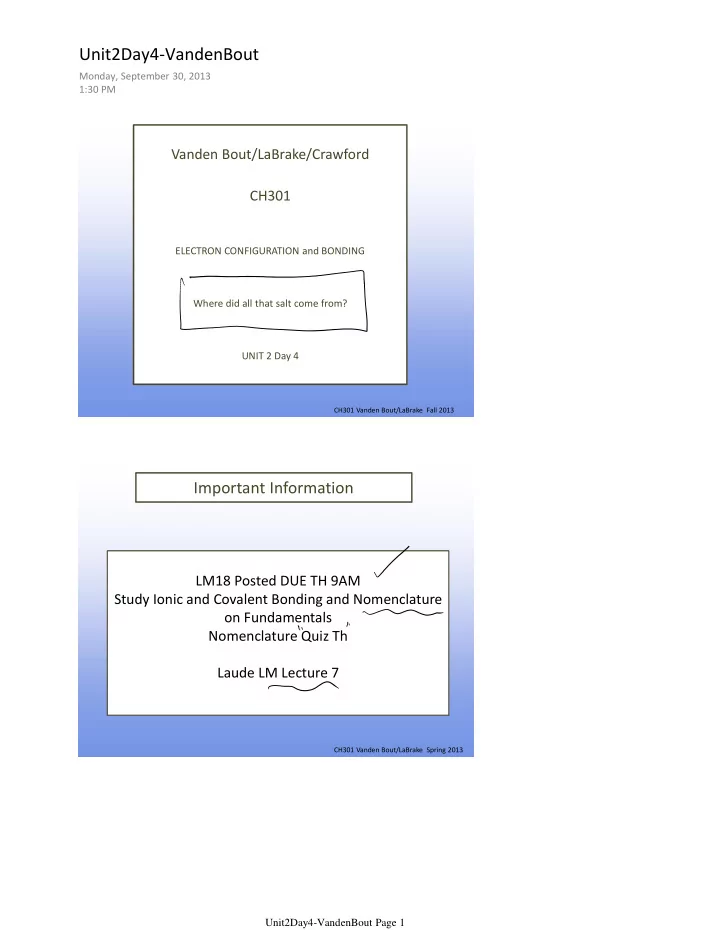
Unit2Day4-VandenBout Monday, September 30, 2013 1:30 PM Vanden Bout/LaBrake/Crawford CH301 ELECTRON CONFIGURATION and BONDING Where did all that salt come from? UNIT 2 Day 4 CH301 Vanden Bout/LaBrake Fall 2013 Important Information LM18


slide-1
SLIDE 1

CH301 Vanden Bout/LaBrake Fall 2013

Vanden Bout/LaBrake/Crawford CH301

ELECTRON CONFIGURATION and BONDING Where did all that salt come from? UNIT 2 Day 4

CH301 Vanden Bout/LaBrake Spring 2013

Important Information

LM18 Posted DUE TH 9AM Study Ionic and Covalent Bonding and Nomenclature

  • n Fundamentals

Nomenclature Quiz Th Laude LM Lecture 7

Unit2Day4-VandenBout

Monday, September 30, 2013 1:30 PM Unit2Day4-VandenBout Page 1

slide-2
SLIDE 2

CH301 Vanden Bout/LaBrake Fall 2013

What are we going to learn today?

−Electron Configuration and Bonding

  • Relate the valence shell electron configuration to

bonding

  • Understand the similarities and differences between

ionic and covalent bonding

  • Recognize and name compounds based on elemental

composition

CH301 Vanden Bout/LaBrake Fall 2013

QUIZ: CLICKER QUESTION 1

The trend on the periodic table is that atomic radii: a) Increases as you move from L to R across b) Decreases as you move from R to L across c) Increases as you move from T to B down d) Increases as you move from B to T up e) Both b and c

QUIZ: CLICKER QUESTION 2

Which of the following symbols does not match the elemental name? A.Fe - Iron B.As – Arsenic C.Co – Copper D.Sn – Tin E.V - Vanadium

Unit2Day4-VandenBout Page 2

slide-3
SLIDE 3

CH301 Vanden Bout/LaBrake Fall 2013

match the elemental name? A.Fe - Iron B.As – Arsenic C.Co – Copper D.Sn – Tin E.V - Vanadium

CH301 Vanden Bout/LaBrake Fall 2013

At the end of the last class period we saw a

  • demo. Two metals were tossed into water

and something happened.

a)The metals sank to the bottom of the bucket b)The metals floated in the bucket c)The metals spun around the surface of the water and then burst into flames d)This is not true, just a trick question for the 75 people who were absent Thursday

QUIZ: CLICKER QUESTION 3

Unit2Day4-VandenBout Page 3

slide-4
SLIDE 4

CH301 Vanden Bout/LaBrake Fall 2013

Where are the electrons in Ne? 1s22s22p6 very stable gas Z=10 Where are the electrons in Na? [Ne]3s1 not so stable metal Z=11 Where are the electrons in K? [Ar]4s1 more, not so stable metal Z=19

CH301 Vanden Bout/LaBrake Fall 2013

Shielding and Effective Nuclear Charge

Left to Right Zeff is increasing Top to Bottom Zeff is similar Top to Bottom. Electron in higher in Energy. Farther from the nucleus THIS CAN EXPLAIN A LOT ABOUT THE PERIODIC TABLE

Trend: Atomic Radii

Unit2Day4-VandenBout Page 4

slide-5
SLIDE 5

CH301 Vanden Bout/LaBrake Fall 2013

Atomic Radii

CH302 Vanden Bout/LaBrake Fall 2012 CH302 Vanden Bout/LaBrake Fall 2013

EXPLAIN SPIKE IN IONIZATION ENERGY!

Unit2Day4-VandenBout Page 5

slide-6
SLIDE 6

CH301 Vanden Bout/LaBrake Fall 2013

Based on this trend in ionization energies this element is

  • A. argon
  • B. carbon
  • C. magnesium
  • D. sulfur

CH301 Vanden Bout/LaBrake Fall 2013

SHOW SOME ELECTRON CONFIGURATIONS OF IONS

Unit2Day4-VandenBout Page 6

slide-7
SLIDE 7

CH302 Vanden Bout/LaBrake Fall 2012 CH301 Vanden Bout/LaBrake Fall 2013

POLL: CLICKER QUESTION 4

Where did this guy get all of that salt (NaCl)? a)It formed from Na+ and Cl- ions in the water b)He first pitch a few block of Na metal into a pool and then bubbled in Cl2 gas. c)He add the Cl2 gas to the water that already had Na+ ions. d)He added Na metal to the water that already had Cl- ions.

ELECTRON LEAVES.. WHERE DOES IT GO? Metals tend to give up electrons to nonmetals, in each case the valence is “satisfied” Sometimes is complicated… eg in the sodium in water demo Sometimes is more obvious… 2Na(s) + Cl2(g)  2NaCl(s)

Unit2Day4-VandenBout Page 7

slide-8
SLIDE 8

CH301 Vanden Bout/LaBrake Fall 2013

each case the valence is “satisfied” Sometimes is complicated… eg in the sodium in water demo Sometimes is more obvious… 2Na(s) + Cl2(g)  2NaCl(s) Sometimes they are already gone!

CH301 Vanden Bout/LaBrake Fall 2013

Formation of Ionic Compound – Downhill in Energy

CH301 Vanden Bout/LaBrake Fall 2013

Ionic Compound… downhill in energy…..

Unit2Day4-VandenBout Page 8

slide-9
SLIDE 9

CH301 Vanden Bout/LaBrake Fall 2013

Ionic Compounds… Not a discrete pair of ions…it is a whole collection

CH301 Vanden Bout/LaBrake Fall 2013

Coulomb’s Law Lattice energy depends on Coulomb’s Law and the crystal structure (the way the ions are packed together). Assuming the same crystal structure, which do you think would have the larger lattice energy: a)NaF b)NaBr?

POLL: CLICKER QUESTION 5

Ionic Radius

Unit2Day4-VandenBout Page 9

slide-10
SLIDE 10

CH301 Vanden Bout/LaBrake Fall 2013 CH301 Vanden Bout/LaBrake Fall 2013

Polyatomic Ions Calcium Carbonate Ca2+ CO3

2-

Know the names and formulas for all the common polyatomic

  • ions. See the Data & Tables

under “more” on the eBook

Unit2Day4-VandenBout Page 10

slide-11
SLIDE 11

CH301 Vanden Bout/LaBrake Fall 2013

Naming Ionic Compounds Choose the formula that corresponds to: sodium

  • xide

a)NaO b)NaO2 c)Na2O d)Na2O2

POLL: CLICKER QUESTION 6

CH301 Vanden Bout/LaBrake Fall 2013

Naming Ionic Compounds You need to be able to name common ionic compounds and with elemental ions and polyatomic ions. WEBSITE – FUNDAMENTALS – DO THE WORKSHEETS What about compounds that aren’t ionic.. Covalent? How are they formed? Are electrons lost???? No.. They are “shared”…… (two non-metals… two elements with similar electronegativities)

Unit2Day4-VandenBout Page 11

slide-12
SLIDE 12

CH301 Vanden Bout/LaBrake Fall 2013

’ No.. They are “shared”…… (two non-metals… two elements with similar electronegativities)

CH301 Vanden Bout/LaBrake Fall 2013

Covalent Compounds Characterize the bond…. Bond Length Bond Strength Electron Pair Shared Equally? YES – PURE COVALENT NO – POLAR COVALENT

SHOW THE SIMULATOR…..

CH301 Vanden Bout/LaBrake Fall 2013

Unit2Day4-VandenBout Page 12

slide-13
SLIDE 13

Electronegativity-electron pulling power of an atom when it is part of a molecule

  • When one atom is more electronegative than another in a bond, a

polar covalent bond is formed. Degree of polarity is dependent on difference in electronegativities.

CH301 Vanden Bout/LaBrake Fall 2013

Unit2Day4-VandenBout Page 13

slide-14
SLIDE 14

Ionic vs Covalent Bonds

  • All bonds can be viewed as hybrids

between purely ionic and purely covalent

  • When two identical atoms are bound, it

is purely covalent.

  • When two different atoms are bound,
  • ne may have a greater attraction for

electrons, and have a partial negative charge.

  • Polar covalent bond – degree is

measured as dipole moment

  • When one atom has a much stronger

attraction to the electrons than the

  • ther, an electron may be donated

yielding an ionic bond.

CH301 Vanden Bout/LaBrake Fall 2013

Covalent Compounds - Naming

Unit2Day4-VandenBout Page 14

slide-15
SLIDE 15

CH301 Vanden Bout/LaBrake Fall 2013

Covalent Compounds What is attached to what?

Valence electrons – Lewis symbols – Lewis Structure – Satisfy the Octet

H2 CH4

CH301 Vanden Bout/LaBrake Fall 2013

What have we learned?

NUCLEAR CHARGE FELT BY VALENCE ELECTRONS IS SHIELDED BY THE CORE ELECTRONS ATOMS BEHAVE IN CERTAIN PREDICTABLE WAYS WHICH CAN BE CORRELATED TO THE ELECTRON CONFIGURATIONS IONIC BONDS TEND TO FORM BETWEEN METALS AND NONMETALS COVALENT BONDS TEND TO FORM BETWEEN NONMETALS AND NONMETALS NAMING COMPOUNDS IS IMPORTANT AND NECESSARY Unit2Day4-VandenBout Page 15

slide-16
SLIDE 16

CH301 Vanden Bout/LaBrake Fall 2013

Learning Outcomes

Identify metals and non-metals and predict types of compounds (ionic/covalent) Between different elements Relate coulombs law and lattice energy Name basic binary ionic compounds including polyatomic ions Name basic covalent compounds containing two elements Explain the trends in electro-negativity on the periodic table Differentiate between pure covalent and polar covalent bonds

Unit2Day4-VandenBout Page 16