Unleashing knowledge with open access Jean-Claude Gudon COAR2018 - - PowerPoint PPT Presentation

unleashing knowledge with open access
SMART_READER_LITE
LIVE PREVIEW

Unleashing knowledge with open access Jean-Claude Gudon COAR2018 - - PowerPoint PPT Presentation

Unleashing knowledge with open access Jean-Claude Gudon COAR2018 Part 1 Before images and writing (i.e. documents): only one sociology existed Afterwards: three sociologies co-existed A Human-Human sociology A Human-documents


slide-1
SLIDE 1

1

Unleashing knowledge with open access

Jean-Claude Guédon COAR2018

Part 1

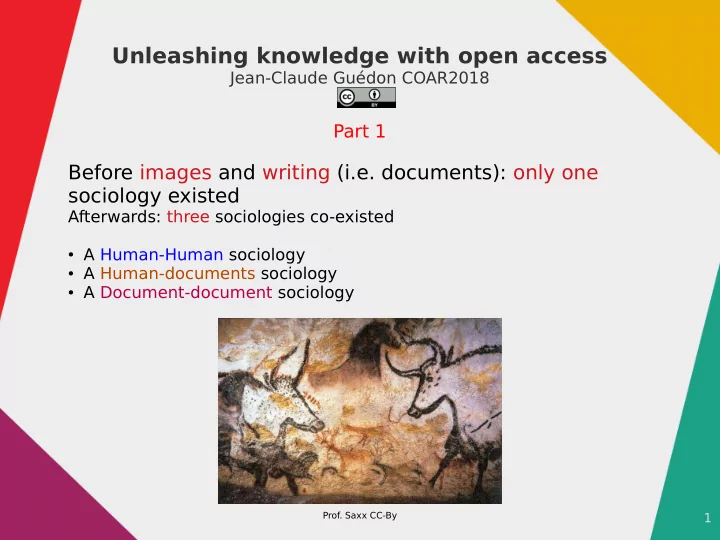
Before images and writing (i.e. documents): only one sociology existed

Afterwards: three sociologies co-existed

  • A Human-Human sociology
  • A Human-documents sociology
  • A Document-document sociology
  • Prof. Saxx CC-By
slide-2
SLIDE 2

2

Unleashing knowledge with open access

Jean-Claude Guédon COAR2018 Human-to-human sociology

Tiago Ribeiro CC-by 2.0

slide-3
SLIDE 3

3

Unleashing knowledge with open access

Jean-Claude Guédon COAR2018

Document-to-document sociology

Matl cc-by-sa “Natur und Kunst” (Goethe) poem quoted in Leiden (NL) Egor Kraft, “The URL Stone” CC-by-sa

slide-4
SLIDE 4

4

Unleashing knowledge with open access

Jean-Claude Guédon COAR2018

Human-document sociology

Public domain illustrations

slide-5
SLIDE 5

5

Unleashing knowledge with open access

Jean-Claude Guédon COAR2018 Obviously, the triple sociology is related to technology

  • Between human beings: writing, postal systems, print, telephones,

Public domain

  • Between humans and documents: tools, pens, printing press, brush, etc.

Delphine Ménard CC-by-SA 3.0

  • Between documents: libraries, shelves, footnotes, marginal notes,

bibliographies, links, etc.

Viisas Hiiri CC-By 4.0

slide-6
SLIDE 6

6

Unleashing knowledge with open access

Jean-Claude Guédon COAR2018

Yet, the triple sociology is not about technology!

slide-7
SLIDE 7

7

Unleashing knowledge with open access

Jean-Claude Guédon COAR2018

Part 2

The triple sociology, as applied to scholarly communication

1) How do researchers interact with each other? (competition, collaboration) 2) How do researchers/scholars interact with documents? (workflow) 3) How do scientific documents relate to each other (Links, citations, comments)

slide-8
SLIDE 8

8

Unleashing knowledge with open access

Jean-Claude Guédon COAR2018

In the digital world, the triple sociology evolves in new ways. Many words, old and new, emerge with new (and often fuzzy) meaning(s) They refer to even fuzzier entities

Examples:

Repositories Portals, Mega-journals, Platforms Journals Articles, Crystals-of-Knowledge Blogs, etc.

slide-9
SLIDE 9

9

Unleashing knowledge with open access

Jean-Claude Guédon COAR2018

In the digital context, let us ask: what is... an article? a Journal? a portal? a platform? And where does a repository fit in all of this?

slide-10
SLIDE 10

10

Unleashing knowledge with open access

Jean-Claude Guédon COAR2018

Words related to humans also change:

Authors reveal their “author functions” Publishers reveal their “publishing functions” And so do readers, users, reviewers, etc.

Furthermore, functions can be distributed among roles in different and unfamiliar ways

slide-11
SLIDE 11

11

Unleashing knowledge with open access

Jean-Claude Guédon COAR2018

For example: the “publisher” Ever since Henry Oldenburg, scholarly publishing means:

  • Registration = author and title
  • Certification = peer review
  • (Preservation = Library collections)
  • Dissemination = book, journal, trade
  • And, much more recently, Evaluation (= Impact factor)

The publisher is viewed as a monolith, but it is only a print construct!

slide-12
SLIDE 12

12

Unleashing knowledge with open access

Jean-Claude Guédon COAR2018

Nowadays: these functions can be spread across various actors:

  • Registration can be done by a university,

a research centre, etc.

  • Certification can be handled by peers,

independently of journals (e.g. F1000 Research)

  • Certification can become part of the

scientific record

slide-13
SLIDE 13

13

Unleashing knowledge with open access

Jean-Claude Guédon COAR2018

Furthermore:

  • Articles can correspond to “Crystals of knowledge”*,

and not “versions of record”;

  • Libraries can preserve digital files better than publishers
  • Dissemination is replaced by Internet access
  • Evaluation can be based on content, and not on the

prestige of journals

Thomas Wiben Jensen and J.-C. Guédon with Niels Stern, ed., « Crystals of Knowledge Production: An Intercontinental Conversation about Open Science and the Humanities, » Nordic Perspectives on Open Science, 2015(1). http://dx.doi.org/10.7557/11.3619 . http://nopos.eu/index.php/nopos/article/view/3619 .F
slide-14
SLIDE 14

14

Unleashing knowledge with open access

Jean-Claude Guédon COAR2018

In the digital world, publishing becomes releasing releasing

slide-15
SLIDE 15

15

Unleashing knowledge with open access

Jean-Claude Guédon COAR2018

Part 3

What about reputation, visibility, prestige, authority? Researchers are Janus-faced: Both information seekers and status seekers

Public domain

slide-16
SLIDE 16

16

Unleashing knowledge with open access

Jean-Claude Guédon COAR2018

OPEN ACCESS, (SO FAR) (AT BEST) ABOUT RESEARCHER STATUS HAS BEEN WEAK

slide-17
SLIDE 17

17

Unleashing knowledge with open access

Jean-Claude Guédon COAR2018

Lack of GOOD answers to status concerns explains the slow uptake of Open Access, particularly in repositories. Publisher-led OA, by contrast, is driven by the publishers’ monopolistic hold

  • n status (impact factor).
slide-18
SLIDE 18

18

Unleashing knowledge with open access

Jean-Claude Guédon COAR2018

Within the triple sociology, the crucial interaction is human-human. The interaction between researchers is managed through a form of competition underpinned by the commercial competition

  • f journals.
slide-19
SLIDE 19

19

Unleashing knowledge with open access

Jean-Claude Guédon COAR2018

Competition shapes technology, not the reverse! The impact factor is the (bad) currency

  • f this competition
slide-20
SLIDE 20

20

Unleashing knowledge with open access

Jean-Claude Guédon COAR2018

The impact factor structures competition from the individual researcher to whole countries. Rankings, rankings, rankings... Rankings, rankings, rankings...

slide-21
SLIDE 21

21

Unleashing knowledge with open access

Jean-Claude Guédon COAR2018

Part 4

Meanwhile, repositories...

slide-22
SLIDE 22

22

Unleashing knowledge with open access

Jean-Claude Guédon COAR2018

Are repositories more than silos? One common answer is: No! Thanks to OAI-PMH, OAI-PMH, OAI-PMH... But how many researchers do you know that, for example, use

OAISTERS?

slide-23
SLIDE 23

23

Unleashing knowledge with open access

Jean-Claude Guédon COAR2018

If you try...

slide-24
SLIDE 24

24

Unleashing knowledge with open access

Jean-Claude Guédon COAR2018

Yet, this is an article found in a Scielo journal

slide-25
SLIDE 25

25

Unleashing knowledge with open access

Jean-Claude Guédon COAR2018

Google Scholar does work better Part (but only part) of the solution, therefore, lies in optimizing the site for search engines (in particular Google Scholar)

On this see K. Arlitsch and P . S. O’Brien and the COAR Webinar fjrst presented on September 18th, 2017

slide-26
SLIDE 26

26

But the way forward is not purely technical! 1) The researcher as status-seeker must be satisfied; 2) Going beyond the present system requires going beyond commercialized, IF-driven, journals; 3) Yet, the term “journal” is deeply entrenched. 4) Therefore, the word “journals” must be kept, but it must be redefined. HOW?

Unleashing knowledge with open access

Jean-Claude Guédon COAR2018

slide-27
SLIDE 27

27

Unleashing knowledge with open access

Jean-Claude Guédon COAR2018

The best model for a scholarly journal is the traditional society journal 1) It is the voice of a scholarly community; 2) It seeks to reach other, similar communities elsewhere; 3) Its financial support is designed NOT TO INTERFERE with the scholarly communication system in any way; 4) It locates the “journal” close to the workflow of the researchers; 5) It places the “journal” under the exclusive control of scholarly communities; 6) Reputation is gradually built through scholar-to-scholar interactions that rely on time-based community experience; 7) Quality evaluation finds itself aligned with reputation within the starting community, and beyond; 8) Both competition and cooperation can now contribute to knowledge production

slide-28
SLIDE 28

28

Unleashing knowledge with open access

Jean-Claude Guédon COAR2018

Repositories need to recreate “journals”. How?

slide-29
SLIDE 29

29

Unleashing knowledge with open access

Jean-Claude Guédon COAR2018

It starts with networking,

  • f course...

but networking itself must

  • bey some principle
slide-30
SLIDE 30

30

Unleashing knowledge with open access

Jean-Claude Guédon COAR2018

Think

  • f an institutional depository as a

town, a town peopled with documents...

slide-31
SLIDE 31

31

Unleashing knowledge with open access

Jean-Claude Guédon COAR2018

A town, to live, thrive, and grow, needs to link to other towns and requires a Hinterland

slide-32
SLIDE 32

32

Unleashing knowledge with open access

Jean-Claude Guédon COAR2018

Real towns relate to each other According to two principles: physical proximity, economic complementarity Depository towns can relate to each other according to two principles as well: Disciplinary or speciality “proximity” Problem-solving complementarity

slide-33
SLIDE 33

33

Unleashing knowledge with open access

Jean-Claude Guédon COAR2018

Only when repositories relate to other repositories according to principles of intellectual proximity or problem-solving complementarity can they aspire to being a

platform

slide-34
SLIDE 34

34

Unleashing knowledge with open access

Jean-Claude Guédon COAR2018

Platforms, of course, can network with other platforms The fractal structure

  • f knowledge production

appears here

slide-35
SLIDE 35

35

Unleashing knowledge with open access

Jean-Claude Guédon COAR2018

Intellectual proximity lies closest to the traditional notion of journals; Intellectual complementarity corresponds best to the “mode 2” production of knowledge

slide-36
SLIDE 36

36

Unleashing knowledge with open access

Jean-Claude Guédon COAR2018

Organizing networking in this fashion allows to redefine evaluation and impact as a three-dimensional scheme: 1) Intellectual significance 2) Relevance to specific problem solving 3) Reach beyond traditional research actors (the Hinterland)

slide-37
SLIDE 37

37

Unleashing knowledge with open access

Jean-Claude Guédon COAR2018

Competition can be circumscribed to situations where it can be of use, rather than being a mindless principle of management

slide-38
SLIDE 38

38

Unleashing knowledge with open access

Jean-Claude Guédon COAR2018

“Intellectual proximity and complementarity” are also good ways to grow effective communities, and not just crowds

slide-39
SLIDE 39

39

Unleashing knowledge with open access

Jean-Claude Guédon COAR2018

Finally, it is clear that repositories have two key and strategic forms of positioning themselves:

slide-40
SLIDE 40

40

Unleashing knowledge with open access

Jean-Claude Guédon COAR2018

1) They are able to stay close to the workflow of researchers; 2) They can contribute to “universal” science without neglecting direct and present concerns

slide-41
SLIDE 41

41

Unleashing knowledge with open access

Jean-Claude Guédon COAR2018

Danke schön!