
SLIDE 1
Town of Nags Head
US Hwy. 64/264 Pedestrian Crossing at the “Little Bridge”
Alternatives Analysis
Public Meeting
Prepared by:
Department of Public Works
August 8, 2013
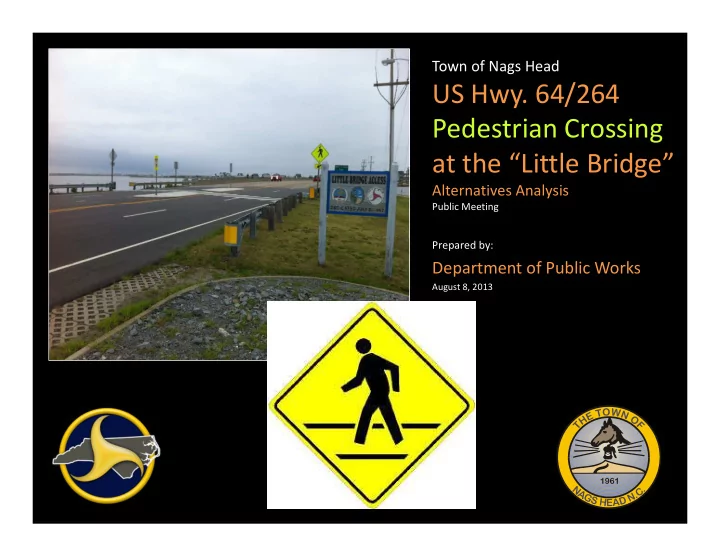
US Hwy. 64/264 Pedestrian Crossing at the Little Bridge - - PowerPoint PPT Presentation
Town of Nags Head US Hwy. 64/264 Pedestrian Crossing at the Little Bridge Alternatives Analysis Public Meeting Prepared by: Department of Public Works August 8, 2013 NC Pedestrian Laws Where traffic-control signals are not in
Town of Nags Head
US Hwy. 64/264 Pedestrian Crossing at the “Little Bridge”
Alternatives Analysis
Public Meeting
Prepared by:
Department of Public Works
August 8, 2013
NC Pedestrian Laws
are not in place or in operation the driver of a vehicle shall yield the right-of-way to a pedestrian crossing the roadway within any marked crosswalk or within any unmarked crosswalk at or near an intersection… (NCGS 20- 173a)
stopped at a crosswalk at an intersection to permit a pedestrian to cross, the driver
approaching from the rear shall not overtake and pass such stopped vehicle. (NCGS 20-173b)
Pedestrian Laws (Cont’d)
a roadway at an intersection or elsewhere distinctly indicated for pedestrian crossing by lines or other markings
Vehicle Code)
a highway improved, designed, or ordinarily used for vehicular travel, exclusive of the shoulder…. (NCGS 20-4.01(38))
Pedestrian Safety
A Shared Responsibility
PEDESTRIANS
pedestrian to ensure that it is safe to proceed across the roadway.
driver before entering a crosswalk.
Even though one vehicle has stopped, vehicles may pass in another lane or in an opposite direction.
lines of the crosswalk. Your full attention should be directed to
DRIVERS
is extremely difficult to defend & can lead to severe liability consequences.
vehicles stopped for pedestrians on your side of the roadway.
may challenge you to stop since they have the right-of-way in the
pedestrian within a marked crosswalk is a violation of state law.
BE ALERT! Use good judgment. Be aware of your surroundings.
Pedestrian Signage
allowed per crosswalk location;
centerline adjacent to the crosswalk, not in the crosswalk ;
should be placed on the island;
support shall comply with the breakaway requirements of the latest edition of AASHTO’s “Specification for Structural Supports for Highways Signs, Luminaries, and Traffic Signals.”
damage, and may be removed at night if the pedestrian activity at night is minimal.
Little Bridge Pedestrian Crossing
Pirates Cove Whalebone Junction Little Bridge Washington Baum Bridge
Fin n Feather Motel Lone Cedar Restaurant Little Bridge 860’ 475’
Little Bridge Access Parking Lot
Ex. Refuge Island AADT=17,000
The Predicament
Bridge” and the horizontal curve transition for the Washington Baum bridge create limited sight distance.
the presence of the pedestrian crossing.
crosswalk, one lane of traffic will stop while the other lane of traffic continues on.
with actual speeds averaging between 55-60 mph.
yield for pedestrians.
Evaluation Criteria
solution to least effective.
AASHTO, MUTCD, & FHWA Standards and regulations.
#1 Overpass/Underpass
Benefits
separation of pedestrians from vehicles
Barriers
west of current location
more direct route
vertical clearance
Photos courtesy of GatorBridge.
#2 Eliminate Access to North Side of Bridge
Benefits
Pedestrian/Vehicle conflicts
implement
Barriers
standing recreational access
there is a way”
#3 Traffic Signal Installation
Benefits
facilities
vehicle conflicts
Barriers
$100,000
crossings to satisfy MUTCD warrant
to take more direct route
#4 Pedestrian Warning Signal Installation
Benefits
visual cues for motorists
implement: $15K-$20k
Barriers
between 25%-40% effective
at the existing vehicle speeds
treatments such as yield bars
#5 Reduce Speed Limit
Benefits
distance for motorists
implement
pedestrian crashes
Barriers
have NOT concluded that speed limit is not significantly related to crash frequency
service - traffic flow
#6 Pavement Markings/Crosswalk Enhancements
Benefits
Clutter
implement: $3k to $20k
hazards ahead
Barriers
not suitable for higher speeds of traffic
hazard
with other measures
#7 Pedestrian/Driver Education
Benefits
Awareness & Behavior
motorists of changing conditions
Barriers
commitment for effectiveness
public
Added Streetlight Diagonal Hatch Markings Hi-Vis Delineators