
SLIDE 1
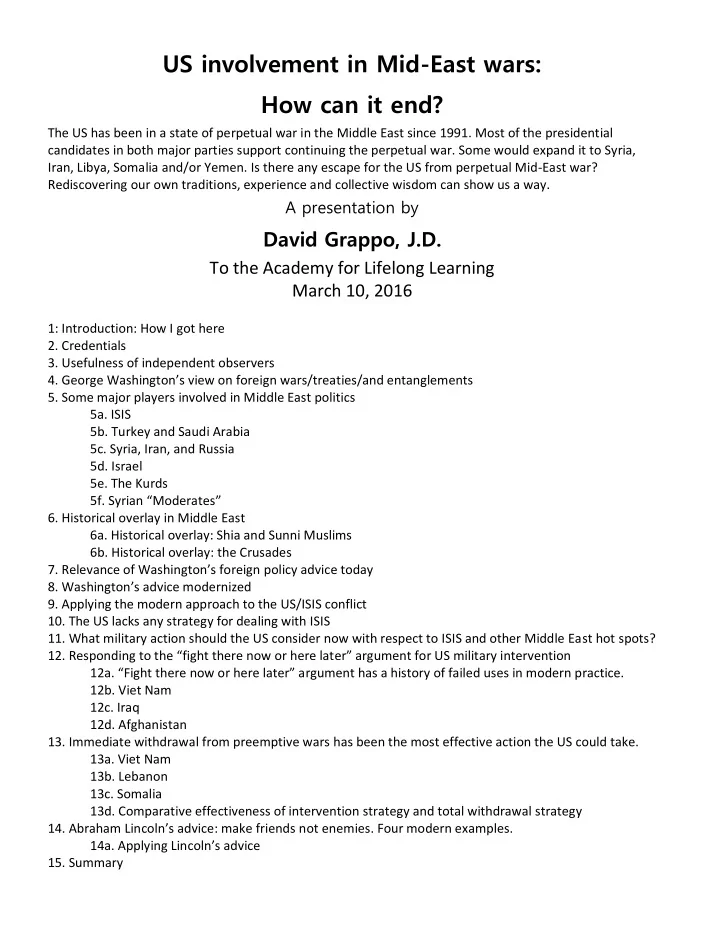
US involvement in Mid-East wars: How can it end?
The US has been in a state of perpetual war in the Middle East since 1991. Most of the presidential candidates in both major parties support continuing the perpetual war. Some would expand it to Syria, Iran, Libya, Somalia and/or Yemen. Is there any escape for the US from perpetual Mid-East war? Rediscovering our own traditions, experience and collective wisdom can show us a way.
A presentation by
David Grappo, J.D.
To the Academy for Lifelong Learning March 10, 2016
1: Introduction: How I got here
- 2. Credentials
- 3. Usefulness of independent observers
- 4. George Washington’s view on foreign wars/treaties/and entanglements
- 5. Some major players involved in Middle East politics
- 5a. ISIS
- 5b. Turkey and Saudi Arabia
- 5c. Syria, Iran, and Russia
- 5d. Israel
- 5e. The Kurds
- 5f. Syrian “Moderates”
- 6. Historical overlay in Middle East
- 6a. Historical overlay: Shia and Sunni Muslims
- 6b. Historical overlay: the Crusades
- 7. Relevance of Washington’s foreign policy advice today
- 8. Washington’s advice modernized
- 9. Applying the modern approach to the US/ISIS conflict
- 10. The US lacks any strategy for dealing with ISIS
- 11. What military action should the US consider now with respect to ISIS and other Middle East hot spots?
- 12. Responding to the “fight there now or here later” argument for US military intervention
- 12a. “Fight there now or here later” argument has a history of failed uses in modern practice.
- 12b. Viet Nam
- 12c. Iraq
- 12d. Afghanistan
- 13. Immediate withdrawal from preemptive wars has been the most effective action the US could take.
- 13a. Viet Nam
- 13b. Lebanon
- 13c. Somalia
- 13d. Comparative effectiveness of intervention strategy and total withdrawal strategy
- 14. Abraham Lincoln’s advice: make friends not enemies. Four modern examples.
- 14a. Applying Lincoln’s advice
- 15. Summary