Use caution in the elderly: Disclosures review of safe and - - PDF document

use caution in the elderly disclosures review of safe and
SMART_READER_LITE
LIVE PREVIEW

Use caution in the elderly: Disclosures review of safe and - - PDF document

1/21/2018 Use caution in the elderly: Disclosures review of safe and effective I have no disclosures or conflicts of interest medication use in older patients related to this presentation John T. Holmes, PharmD, BCPS Assistant Professor


slide-1
SLIDE 1

1/21/2018 1

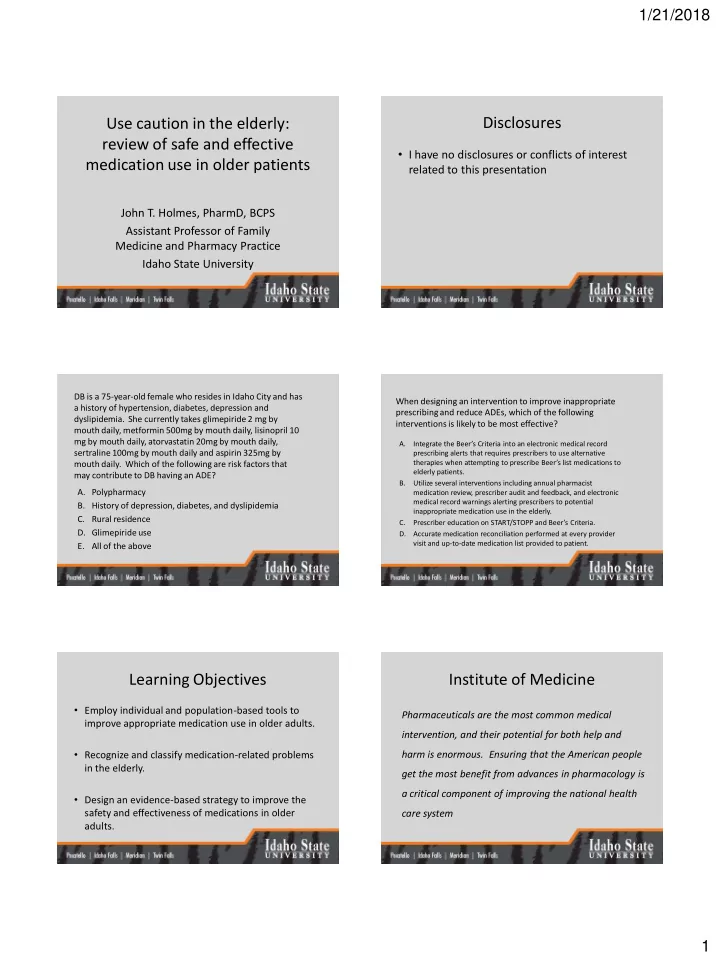
Use caution in the elderly: review of safe and effective medication use in older patients

John T. Holmes, PharmD, BCPS Assistant Professor of Family Medicine and Pharmacy Practice Idaho State University

Disclosures

  • I have no disclosures or conflicts of interest

related to this presentation

DB is a 75-year-old female who resides in Idaho City and has a history of hypertension, diabetes, depression and

  • dyslipidemia. She currently takes glimepiride 2 mg by

mouth daily, metformin 500mg by mouth daily, lisinopril 10 mg by mouth daily, atorvastatin 20mg by mouth daily, sertraline 100mg by mouth daily and aspirin 325mg by mouth daily. Which of the following are risk factors that may contribute to DB having an ADE?

  • A. Polypharmacy
  • B. History of depression, diabetes, and dyslipidemia
  • C. Rural residence
  • D. Glimepiride use
  • E. All of the above

When designing an intervention to improve inappropriate prescribing and reduce ADEs, which of the following interventions is likely to be most effective?

A. Integrate the Beer’s Criteria into an electronic medical record prescribing alerts that requires prescribers to use alternative therapies when attempting to prescribe Beer’s list medications to elderly patients. B. Utilize several interventions including annual pharmacist medication review, prescriber audit and feedback, and electronic medical record warnings alerting prescribers to potential inappropriate medication use in the elderly. C. Prescriber education on START/STOPP and Beer’s Criteria. D. Accurate medication reconciliation performed at every provider visit and up-to-date medication list provided to patient.

Learning Objectives

  • Employ individual and population-based tools to

improve appropriate medication use in older adults.

  • Recognize and classify medication-related problems

in the elderly.

  • Design an evidence-based strategy to improve the

safety and effectiveness of medications in older adults.

Institute of Medicine

Pharmaceuticals are the most common medical intervention, and their potential for both help and harm is enormous. Ensuring that the American people get the most benefit from advances in pharmacology is a critical component of improving the national health care system

slide-2
SLIDE 2

1/21/2018 2 The Problem

  • 84% of older adults take ≥1 prescription medication
  • About 35% of older adults take ≥5 prescription

medications

– 38% take over-the-counter medications – 64% take herbal medications

  • Estimated that 15% of older adults at risk for major

drug-drug interaction

Qato et al. JAMA Intern Med. 2016 Apr;176(4):473-82. Alhawassi et al. Clin Interv Ageing. 2014;9:2079-2086.

The Problem

  • Mean prevalence of ADRs in elderly is around 11%

– Range is 5.8% – 46.3%

  • Prevalence of ADRs leading to hospitalization is 10%
  • One in six hospital admissions for older people due

to an ADE

– In patients >75 years old, one in three admission due to ADE

Qato et al. JAMA Intern Med. 2016 Apr;176(4):473-82. Alhawassi et al. Clin Interv Ageing. 2014;9:2079-2086.

Definitions

  • Medication-Related Problems (MRP)

– Event or circumstance involving medication therapy that actually or potentially interferes with an optimum

  • utcome for a specific patient
  • Inappropriate Prescribing (IP)

– Use of medications that pose more risk than equally or more effective but lower-risk alternative therapy

Risk Factors for ADRs in Elderly

  • Medication-Related Factors

– Number of medications – Antihypertensive medications – Antithrombotic/Anticoagulant medications – Antibacterials – NSAIDs – Antidiabetic medications – Psycholeptics – Drug-Drug Interactions

Alhawassi et al. Clin Interv Ageing. 2014;9:2079-2086.

Risk Factors for ADRs in Elderly

  • Disease-Related factors

– Multimorbidity – Cardiovascular disease – Diabetes – Cancer – Depression – Impaired renal function – Dementia – Dyslipidemia – Elevated WBC – Liver disease

Alhawassi et al. Clin Interv Ageing. 2014;9:2079-2086.

Risk Factors for ADRs in Elderly

  • Patient-Related Factors

– Greater Age – Female – Rural residential location – Socioeconomic status

  • Other Factors

– History of Falls – Limitations in activities of daily living

Alhawassi et al. Clin Interv Ageing. 2014;9:2079-2086.

slide-3
SLIDE 3

1/21/2018 3 Reasons for ADEs in Elderly

  • Pharmacokinetic/Pharmacodynamic Changes

– Changes in volume of distribution of several medications

  • Reduction in lean muscle mass and water content
  • Increase in proportion of total body fat

– Reduced serum albumin – Reduced liver mass and perfusion – Reduced glomerular filtration rate – Altered pharmacodynamic responses

Lavan et al. Ther Adv Drug Saf. 2016 Feb;7(1):11-22

Reasons for ADEs in Elderly

  • Polypharmacy

– Higher prevalence of chronic disease and comorbidity – Strongly predictive of ADRs

  • 2 concurrent medications  13% risk of ADR
  • 4 concurrent medications  38% risk of ADR
  • 7 concurrent medications  82% risk of ADR

– Prescribing cascade

  • Antipsychotic  metabolic disease  medications for diabetes,

hypertension, dyslipidemia, obesity, etc.

  • Thiazide diuretic  gout  medication for gout

Hajjar et al. Am J Geriatr Pharmacother. 2007;5: 345–51. Goldberg et al. Am J Emerg Med 1996;14:447-450.

Inappropriate Prescribing

  • 50% of older adults take one or more medications

that are not necessary

  • IP occurs in:

– 12-40% of nursing home residents – 14-23% of community-dwelling older people (Gallagher et

  • al. 2007)
  • Increase risk ADEs, hospitalization, and death
  • Greater healthcare costs
  • 50% of ADRs in older adults due to inappropriate

prescribing (Lindley et al. 1992)

Categories of Inappropriate Prescribing

  • The use of a drug:

– That has wrong indication – That has no indication – That has a high risk for Adverse Drug Events (ADEs) – At higher frequency/dose than recommended – That is unnecessarily expensive – For longer or shorter duration than clinically indicated

  • Failure to prescribe appropriate drug therapy for

irrational or ageist reasons (e.g. warfarin)

  • Use of multiple medication with documented drug-

drug interactions or drug-disease interactions

Measuring Inappropriate Prescribing

  • Measuring prescribing quality usually focused on
  • ne of the following (rarely all):

– Avoidance of inappropriate medications – Appropriate use of indicated medications – Monitoring side effects and/or drug levels – Avoidance of drug-drug interaction – Involvement of patients and their values

  • Interventions to improve prescribing have mixed results

for health outcomes (i.e. mortality) and costs

Spinewine et al. Lancet. 2007;370(9582):173 Alldred et al. Cochrane Database Syst Rev. 2016;2:CD009095 Institute of Medicine. Preventing Medication Errors. Washington, DC: National Academies Press; 2007

slide-4
SLIDE 4

1/21/2018 4 Predicting ADRs

  • GerontoNet ADR Risk Score

Variable Points

≥4 Comorbid Conditions 1 Heart Failure 1 Liver Disease 1 Number of Drugs ≤ 5 5 – 7 1 ≥ 8 4 Previous ADR 2 Renal Failure 1

Onder et al., Arch Intern Med. 2010 July;170(13):1142-1148

Drug Utilization Review Tools

  • Explicit (criterion-based)

– Developed using expert opinion, consensus, published reviews – Drug or disease-oriented – Applied with little or no clinical judgment – May not take into account all factors that define high quality indicators for each patient – Do not address comorbidity or patient preference – Examples

  • Beer’s Criteria
  • Screening Tool of Older Persons Prescriptions (STOPP)
  • Screening Tool to Alert doctors to the Right Treatment (START)

Spinewine et al. Lancet. 2007;370(9582):173

Drug Utilization Review Tools

  • Implicit (judgment-based)

– Employ patient-specific information and evidence – Focus on patient rather than drugs or disease – Account for patient preferences and are most sensitive – Time-consuming – Depends on user’s knowledge and attitudes – Low reliability – Example:

  • Medication Appropriateness Index (MAI)

Spinewine et al. Lancet. 2007;370(9582):173

Which of the following do you have experience using?

  • A. START/STOPP
  • B. Beer’s Criteria
  • C. Medication Appropriate Index (MAI)
  • D. Both START/STOP and Beer’s Criteria
  • E. START/STOPP, Beer’s Criteria, and MAI
  • F. None of these

START / STOPP

  • Screening Tool to Alert doctors to Right Treatment

(START)

– 34 START Criteria

  • Screening Tool of Older Persons’ potentially

inappropriate Prescriptions (STOPP)

– 81 STOPP Criteria – Overlaps with Beer’s Criteria

  • Developed in 2008; last updated in 2014
  • Includes brief explanation about why the prescribing

practice is potentially inappropriate

STOPP Examples

  • Indication of Medication

– Any drug prescribed without an evidence-based clinical indication – Any drug prescribed beyond recommended duration – Any duplicate drug class prescription (optimization of monotherapy)

  • Cardiovascular

– Digoxin for heart failure with normal systolic ventricular function – Loop diuretic as first-line treatment for hypertension

slide-5
SLIDE 5

1/21/2018 5 STOPP Examples

  • Cardiovascular

– Thiazide diuretic with current significant hypokalemia, hyponatremia, hypercalcaemia, or history of gout – ACE inhibitors or Angiotensin Receptor Blockers in patients with hyperkalaemia. – Aldosterone antagonists (e.g. spironolactone, eplerenone) with concurrent potassium-conserving drugs (e.g. ACEI’s, ARB’s, amiloride, triamterene) without monitoring of serum potassium

  • Antiplatelet/Anticoagulant

– Long-term aspirin at doses greater than 160 mg/day – NSAID in combination with anticoagulant – NSAID with concurrent antiplatelet agent without PPI prophylaxis

STOPP Examples

  • CNS/Psychotropic Drugs

– TCA as first-line antidepressant treatment – SSRIs with current or recent significant hyponatremia – Anticholinergics in patients with delirium or dementia – First generation antihistamines

  • Renal

– Metformin if eGFR < 30 ml/min/1.73m2 – Direct thrombin inhibitors if eGFR < 30 ml/min/1.73m2

  • Gastrointestinal

– PPI for PUD or erosive peptic esophagitis at full therapeutic dose > 8 weeks

STOPP Examples

  • Respiratory

– Systemic corticosteroids instead of inhaled corticosteroids for maintenance therapy in moderate-severe COPD – Non-selective beta-blocker with a history of asthma requiring treatment

  • Musculoskeletal

– Oral bisphosphonates in patients with current or recent history of upper GI disease – NSAID with severe HTN or HF – Long-term use of NSAID for symptom relief of

  • steoarthritis pain where acetaminophen has not been

tried

  • Urogenital

– Selective alpha-a selective alpha blockers in those with symptomatic orthostatic hypotension

STOPP Examples

  • Endocrine

– Sulfonylurea with a long duration of action – TZD in HF

  • Drugs that increase risk of fall

– BZD, neuroleptics, hypnotic Z-drugs, vasodilators with postural hypotension

  • Analgesic

– Use of regular opioids without concomitant laxative – Use of oral or transdermal strong opioids as first line therapy for mild pain

START Examples

  • Cardiovascular

– Anticoagulant in presence of chronic atrial fibrillation – Antiplatelet therapy with a documented history of coronary, cerebral or peripheral vascular disease – Appropriate beta-blocker with stable systolic HF

  • Respiratory

– Regular inhaled B2 agonist or antimuscarinic bronchodilator for mild-moderate asthma or COPD

  • Gastrointestinal

– PPI with severe GERD or peptic stricture requiring dilation

START Examples

  • CNS

– Non-TCA antidepressant drug in presence of persistent major depressive symptoms – SSRI for persistent severe anxiety that interferes with independent functioning – Dopamine agonist for RLS once iron deficiency and several renal failure excluded

  • Musculoskeletal

– Vitamin D supplement in older people who are housebound or experiencing falls or with osteopenia – Bisphosphonate/vitamin D/calcium in patients taking long-term systemic corticosteroids

slide-6
SLIDE 6

1/21/2018 6 START Examples

  • Endocrine System

– ACE Inhibitor or ARB in diabetes with evidence of renal disease (proteinuria or microalbuminuria) with or without serum biochemical renal impairment

  • Urogenital

– Alpha-1 blocker with symptomatic prostatism, where prostatectomy is not considered necessary

  • Analgesics

– High-potency opioids in moderate-severe pain, where acetaminophen, NSAIDs or low-potency opioids are not appropriate to the pain severity or have been ineffective

  • Vaccines

– Influenza – Pneumococcal

Effectiveness of START/STOPP

  • Reduced potentially inappropriate medication rates
  • Reduces falls
  • Reduced delirium episodes
  • Reduced hospital length-of-stay
  • Reduced primary and emergency care utilization
  • Reduced medication costs
  • No improvements in quality of life or mortality

Hill-Taylor et al., J Clin Pharm Ther. 2016 Apr;41(2):158-69.

Beer’s Criteria

  • Developed by Dr. Mark Beers in 1991
  • Most commonly used criteria to assist in

preventing ADEs in older adults

  • Intended for use in outpatient and inpatient

settings

Beer’s Criteria

  • Most recent update in 2015 (5th iteration)

– 34 medications or classes that are potentially inappropriate for older adults and should be avoided – 14 medications that are potentially inappropriate and should be used with caution

  • Access lists and “How to Use” document for free

at geriatricscareonline.org

Beer’s Criteria Examples Beer’s Criteria Examples

slide-7
SLIDE 7

1/21/2018 7 Beer’s Criteria Examples Beer’s Criteria Examples Beer’s Criteria Examples

Medication Review Process

  • Step 1: Identify aims and objects of drug therapy
  • Step 2: Identify essential drug therapy
  • Step 3: Does the patient take unnecessary drug

therapy?

  • Step 4: Are therapeutic objectives being achieved?
  • Step 5: Does the patient have ADE/ADR or is at risk
  • f ADE/ADRs?
  • Step 6: Is drug therapy cost effective?
  • Step 7: Is the patient willing and able to take drug

therapy as intended?

Polypharmacy Guidance. NHS Scotland. 2015. http://www.sehd.scot.nhs.uk/publications/DC20150415polypharmacy.pdf http://www.polypharmacy.scot.nhs.uk/ http://www.polypharmacy.scot.nhs.uk/

slide-8
SLIDE 8

1/21/2018 8

http://www.polypharmacy.scot.nhs.uk/

Tool to Improve Medication in the Elderly via Review

Lee SS et al. Am J Pharm Educ. 2009 May 27;73(3):52. Lee SS et al. Am J Pharm Educ. 2009 May 27;73(3):52. Lee SS et al. Am J Pharm Educ. 2009 May 27;73(3):52.

What other tools or processes have you used to comprehensively review a medication profile of an

  • lder adult?

Effectiveness of Interventions

  • Interventions are organizational
  • Most are complex, multifaceted pharmaceutical care-

based interventions

  • Various assessment criteria used
  • Pharmaceutical care provided by pharmacists
  • Variable timing of intervention delivery
  • Conflicting effects on reduction of MRPs and

hospitalization

  • No difference in health related quality of life
  • Impact on clinical outcomes unclear

Cooper et al., BMJ Open 2015;5e009235 Ryan et al., Cochrane Database Syst Rev 2014;4:CD007768

slide-9
SLIDE 9

1/21/2018 9

Medication Monitoring

  • Discussion of medication monitoring accounts

for <5% of chapters on pharmacology and prescribing in widely used text

– Predominate focus is on serum drug levels to titrate medication

  • Focus predominately on time of prescribing

– <25% of ADEs in ambulatory care are clearly preventable at the time of prescribing

  • ADEs often occur due to known side effects

– Opioids, hypoglycemics, anticoagulants

– ADEs due to errors of monitoring > ADEs due to

Medication Monitoring Medication Monitoring Considerations to Reduce ADEs

  • Be watchful for medications started at a younger

age that have never been adjusted

  • Medications required in the short-term setting are
  • ften not needed in the long term (e.g. loop

diuretic)

  • Avoid adding medications to treat adverse effect of

another

– Prescribing Cascades

  • Assess for and recognize atypical ADE

presentations

  • Appropriate and timely medication reconciliation
  • Identification and documentation of diagnoses,

medication and previous ADRs

Pretorius et al. Am Fam Physician. 2013 Mar;87(5):331-336

Considerations to Reduce ADEs

  • Deprescribe
  • Use agents with a wide therapeutic window
  • Review medication lists regularly and reconcile

with problem list

  • Set an end date and use objective criteria to

determine success or failure of empiric trial (e.g. agents for pain, behavior cognition)

  • Start low and go slow
  • Monitor medication use
  • Avoid starting 2 new medications in the same

patient at the same time

  • Use standardized methods to review patient

medications

Pretorius et al. Am Fam Physician. 2013 Mar;87(5):331-336

Considerations to Reduce ADEs

  • Ask patients about self-medication with OTCs

and herbal products

  • Consider potential for patient related error

– Administration, autonomous modification of med schedule, etc

  • Make patients aware of potential drug

confusions

– Sound-alike, look-alike, and combination medications

  • Consider therapeutic aim

– Duration versus quality of life

Pretorius et al. Am Fam Physician. 2013 Mar;87(5):331-336

slide-10
SLIDE 10

1/21/2018 10 Approaches to Minimize Inappropriate Prescribing

  • Promote use of evidence-based therapies
  • Minimize use of medications for which there is

no clinical need, questionable evidence, or duplication

  • Avoid medications with poor benefit to risk

ratio

  • Do not make drug-therapy recommendations

according to inflexible, rigid guidelines

  • Avoid treating side effects with another drug
  • Use multiple tools

Approaches to Minimize Inappropriate Prescribing

  • Prescriber education

– Audit and feedback, reports and prescriber detailing

  • Computerized Support

– Provider level – decision-making support – Pharmacist level – medication alerts/warnings

  • Pharmacist-Based Interventions

– Medication reviews – Use of explicit criteria and provider follow- up/education

  • Interdisciplinary Teams

Kaur et al. Drugs Aging. 2009;26:1013

  • Ten Things Clinicians and Patients Should

Question

http://www.choosingwisely.org/societies/american-geriatrics-society/

Choosing Wisely

  • Don’t use antipsychotics as the first choice to treat

behavioral and psychological symptoms of dementia

  • Avoid using medications other than metformin to

achieve hemoglobin A1c <7.5% in most older adults

– Moderate control is generally better

  • Don’t use benzodiazepines or other sedative-hypnotics in
  • lder adults as first choice for insomnia, agitation or

delirium

  • Don’t use antimicrobials to treat bacteriuria in older

adults unless specific urinary tract symptoms are present

http://www.choosingwisely.org/societies/american-geriatrics-society/

Choosing Wisely

  • Don’t use antimicrobials to treat bacteriuria in older adults

unless specific urinary tract symptoms are present

  • Don’t prescribe cholinesterase inhibitors for dementia

without periodic assessment for perceived cognitive benefits and adverse gastrointestinal effects

  • Avoid using prescription appetite stimulants or high-calorie

supplements for treatment of anorexia or cachexia in older adults

  • Don’t prescribe a medication without conducting a drug

regimen review – Annual review of medications is an indicator for quality prescribing in vulnerable elderly

http://www.choosingwisely.org/societies/american-geriatrics-society/

Questions????