Use of Symmetries in Additivity How Utility u Depends . . . - - PowerPoint PPT Presentation

use of symmetries in
SMART_READER_LITE
LIVE PREVIEW

Use of Symmetries in Additivity How Utility u Depends . . . - - PowerPoint PPT Presentation

How Do People Make . . . Symmetries Play a . . . Scaling Shift Use of Symmetries in Additivity How Utility u Depends . . . Economics Probabilistic Choice Vladik Kreinovich 1 , Olga Kosheleva 1 , Decision Making . . . Nguyen Ngoc Thach 2 ,


slide-1
SLIDE 1

How Do People Make . . . Symmetries Play a . . . Scaling Shift Additivity How Utility u Depends . . . Probabilistic Choice Decision Making . . . Taking Future Effects . . . Home Page Title Page ◭◭ ◮◮ ◭ ◮ Page 1 of 19 Go Back Full Screen Close Quit

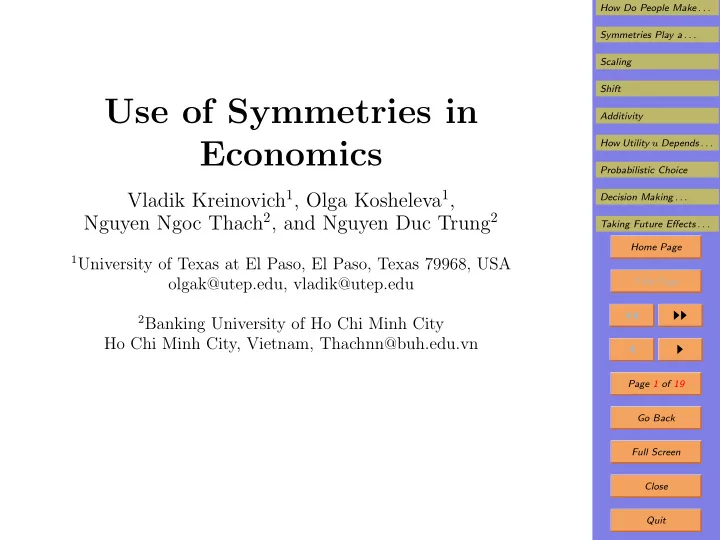
Use of Symmetries in Economics

Vladik Kreinovich1, Olga Kosheleva1, Nguyen Ngoc Thach2, and Nguyen Duc Trung2

1University of Texas at El Paso, El Paso, Texas 79968, USA

  • lgak@utep.edu, vladik@utep.edu

2Banking University of Ho Chi Minh City

Ho Chi Minh City, Vietnam, Thachnn@buh.edu.vn

slide-2
SLIDE 2

How Do People Make . . . Symmetries Play a . . . Scaling Shift Additivity How Utility u Depends . . . Probabilistic Choice Decision Making . . . Taking Future Effects . . . Home Page Title Page ◭◭ ◮◮ ◭ ◮ Page 2 of 19 Go Back Full Screen Close Quit

1. A Brief Overview

  • Many semi-heuristic econometric formulas can be de-

rived from the natural symmetry requirements.

  • The list of such formulas includes many famous formu-

las provided by Nobel-prize winners, such as: – Hurwicz optimism-pessimism criterion for decision making under uncertainty, – McFadden’s formula for probabilistic decision mak- ing, – Nash’s formula for bargaining solution.

  • It also includes Cobb-Douglas formula for production,

gravity model for trade, etc.

slide-3
SLIDE 3

How Do People Make . . . Symmetries Play a . . . Scaling Shift Additivity How Utility u Depends . . . Probabilistic Choice Decision Making . . . Taking Future Effects . . . Home Page Title Page ◭◭ ◮◮ ◭ ◮ Page 3 of 19 Go Back Full Screen Close Quit

2. How Do People Make Predictions?

  • How do people make predictions?

How did people know that the Sun will rise in the morning?

  • Because in the past, the sun was always rising.
  • In all these cases, to make a prediction, we look at

similar situations in the past.

  • We then make predictions based on what happened in

such situations.

  • Some predictions are more complicated than that –

they are based on using physical laws.

  • But how do we know that a law – e.g., Ohm’s law – is

valid?

  • Because in several previous similar situations, this for-

mula was true.

slide-4
SLIDE 4

How Do People Make . . . Symmetries Play a . . . Scaling Shift Additivity How Utility u Depends . . . Probabilistic Choice Decision Making . . . Taking Future Effects . . . Home Page Title Page ◭◭ ◮◮ ◭ ◮ Page 4 of 19 Go Back Full Screen Close Quit

3. How to Describe This Idea in Precise Terms?

  • We can shift or rotate the lab, Ohm’s law will not

change.

  • In general, we have some phenomenon p depending on

the situation s.

  • We replace the original situation s by the changed sit-

uation T(s).

  • Invariance means that the phenomenon remains the

same after the change: p(T(s)) = p(s).

  • A particular case of an invariance is when we have, e.g.,

a spherically symmetric object.

  • If we rotate this object, it will remain the same – this

is exactly what symmetry means in geometry.

  • Because of this example, physicists call each invariance

symmetry.

slide-5
SLIDE 5

How Do People Make . . . Symmetries Play a . . . Scaling Shift Additivity How Utility u Depends . . . Probabilistic Choice Decision Making . . . Taking Future Effects . . . Home Page Title Page ◭◭ ◮◮ ◭ ◮ Page 5 of 19 Go Back Full Screen Close Quit

4. Symmetries Play a Fundamental Role in Physics

  • In the past, physical theories – e.g., Newton’s mechan-

ics – were formulated in terms of diff. eq.

  • Nowadays theories are usually formulated in terms of

their symmetries, and equations can be derived.

  • Traditional physical equations can also be derived from

their symmetries.

  • Predictions in economics are also based on similarity.
  • So, let us see if we can derive economic equations from

the corresponding symmetries.

slide-6
SLIDE 6

How Do People Make . . . Symmetries Play a . . . Scaling Shift Additivity How Utility u Depends . . . Probabilistic Choice Decision Making . . . Taking Future Effects . . . Home Page Title Page ◭◭ ◮◮ ◭ ◮ Page 6 of 19 Go Back Full Screen Close Quit

5. Scaling

  • Physical equations – like Ohm’s law V = I · R – deal

with numerical values of different physical quantities.

  • These numerical values depend on the measuring unit.
  • If we replace the original measuring unit with a λ times

smaller one, then x → x′ = λ · x.

  • Fundamental equations y = f(x) should not change if

we change the measuring unit (e.g., dollars or pesos).

  • We can’t require f(λ · x) = f(x), then f(x) = const.
  • We can require that for each λ, there is a C(λ) s.t. if

y = f(x), then y′ = f(x′), where y′ = C(λ) · y.

  • For continuous f(x), this implies f(x) = A · xc.
  • The requirement y = f(x1, . . . , xn) ⇒ y′ = f(x′

1, . . . , x′ n),

where x′

i = λi · xi and y′ = C(λ1, . . .) · y, implies

f = A · xc1

1 · . . . · xcn n .

slide-7
SLIDE 7

How Do People Make . . . Symmetries Play a . . . Scaling Shift Additivity How Utility u Depends . . . Probabilistic Choice Decision Making . . . Taking Future Effects . . . Home Page Title Page ◭◭ ◮◮ ◭ ◮ Page 7 of 19 Go Back Full Screen Close Quit

6. Shift

  • For some quantities (e.g., time or temperature), the

numerical value also depends on the starting point.

  • If we replace the original starting point measuring unit

with an earlier one, we get x′ = x + x0.

  • Fundamental equations y = f(x) should not change if

we change the starting point.

  • Example: salary itself? salary + social benefits?
  • It’s reasonable to require that for each x0, there is a

C(x0) s.t. y = f(x) ⇒ y′ = f(x′), with y′ def = C(λ) · y.

  • For continuous f(x), this implies f(x) = A · exp(c · x).
slide-8
SLIDE 8

How Do People Make . . . Symmetries Play a . . . Scaling Shift Additivity How Utility u Depends . . . Probabilistic Choice Decision Making . . . Taking Future Effects . . . Home Page Title Page ◭◭ ◮◮ ◭ ◮ Page 8 of 19 Go Back Full Screen Close Quit

7. Additivity

  • How trade y depends on the GDP x: y = f(x)?
  • We can apply f(x) to the whole country’s GDP, or to

regions whose GDPs are x′ and x′′: x = x′ + x′′.

  • The result should be the same:

f(x′ + x′′) = f(x′) + f(x′′).

  • For continuous f(x), this implies f(x) = c · x.
  • In multi-D case, we have f(x′

1 + x′′ 1, . . . , x′ n + x′′ n) =

f(x′

1, . . . , x′ n) + f(x′′ 1, . . . , x′′ n).

  • This implies that f(x1, . . . , xn) = c1 · x1 + . . . + cn · xn.
slide-9
SLIDE 9

How Do People Make . . . Symmetries Play a . . . Scaling Shift Additivity How Utility u Depends . . . Probabilistic Choice Decision Making . . . Taking Future Effects . . . Home Page Title Page ◭◭ ◮◮ ◭ ◮ Page 9 of 19 Go Back Full Screen Close Quit

8. How Can We Describe Human Preferences?

  • We select a very good alternative A+ and a very bad

alternative A−.

  • For each p ∈ [0, 1], L(p) is a lottery in which we get

A+ with probability p, else A−.

  • For each realistic alternative A, it is better than L(0) =

A− and worse than L(1) = A+: L(0) < A < L(1).

  • Of course, if L(p) < A and p′ < p, then L(p′) < A.

Similarly, if A < L(p) and p < p′, then A < L(p′).

  • Thus, one can show that there exists a threshold value

u(A) = sup{p : L(p) < A} (called utility) such that: – for p < u(A), we have L(p) < A, and – for p > u(A), we have A < L(p).

  • The alternative A is equivalent to the lottery L(u(A)),

in the sense that L(u−ε) < A < L(u+ε) for all ε > 0.

slide-10
SLIDE 10

How Do People Make . . . Symmetries Play a . . . Scaling Shift Additivity How Utility u Depends . . . Probabilistic Choice Decision Making . . . Taking Future Effects . . . Home Page Title Page ◭◭ ◮◮ ◭ ◮ Page 10 of 19 Go Back Full Screen Close Quit

9. What If We Select Different A+ and A−?

  • Let us consider the case when A′

− < A− < A+ < A′ +.

  • Then, A ∼ L(u(A)), i.e., A+ with prob. u(A) else A−.
  • A+ ∼ L′(u′(A+)), i.e., A′

+ with prob. u′(A+) else A′ −.

  • A− ∼ L′(u′(A−)), i.e., A′

+ with prob. u′(A−) else A′ −.

  • Thus, A is equivalent to a 2-step lottery in which we

get A′

+ with probability

u′(A) = u(A) · u′(A+) + (1 − u(A)) · u′(A−).

  • Otherwise, we get A′

−.

  • Thus, changing a pair follows the same formulas as

when we change the starting point and the meas. unit.

  • Laws should not depend on the choice of a pair.
  • So, we get scale- and shift-invariance.
slide-11
SLIDE 11

How Do People Make . . . Symmetries Play a . . . Scaling Shift Additivity How Utility u Depends . . . Probabilistic Choice Decision Making . . . Taking Future Effects . . . Home Page Title Page ◭◭ ◮◮ ◭ ◮ Page 11 of 19 Go Back Full Screen Close Quit

10. How Utility u Depends on Money m

  • For money, there is a natural starting point correspond-

ing to 0 amount: no savings and no debts.

  • Let us select a utility function for which this 0-money

situation corresponds to 0 utility.

  • Once the starting point is thus fixed, the only remain-

ing utility transformation is scaling u → k · u.

  • The numerical amount of money depends on the choice
  • f the monetary unit.
  • It is reasonable to require that the formula u(m) does

not change if we simply change the monetary unit.

  • This scale-invariance leads to the power law u = A·mc.
  • This is exactly what was experimentally observed, with

c ≈ 0.5.

slide-12
SLIDE 12

How Do People Make . . . Symmetries Play a . . . Scaling Shift Additivity How Utility u Depends . . . Probabilistic Choice Decision Making . . . Taking Future Effects . . . Home Page Title Page ◭◭ ◮◮ ◭ ◮ Page 12 of 19 Go Back Full Screen Close Quit

11. Probabilistic Choice

  • If we repeatedly offer the same choice to a person,

he/she may make different choices in diff. iterations.

  • The probability p(a) of selecting an alternative grows

with utility: p(a) ∼ f(u(a)).

  • The condition p(a) = 1 implies p(a) = f(u(a))/C,

where C =

a

f(u(a)).

  • Utility is defined modulo shift.
  • If we require that the probabilities do not change with

shift, we get f(u + u0) = C(u0) · f(u).

  • Thus, f(u) = A · exp(c · u).
  • This is exactly the formula for which D. McFadden

received his Nobel Prize in 2011.

  • If we require scale-invariance, we get f(u) = A · uc –

which was also observed.

slide-13
SLIDE 13

How Do People Make . . . Symmetries Play a . . . Scaling Shift Additivity How Utility u Depends . . . Probabilistic Choice Decision Making . . . Taking Future Effects . . . Home Page Title Page ◭◭ ◮◮ ◭ ◮ Page 13 of 19 Go Back Full Screen Close Quit

12. Decision Making under Interval Uncertainty

  • In practice, we often only know the bounds u(a) and

u(a) on the utility u(a) of each alternative a.

  • To make a decision under this uncertainty, we need to

find an equivalent utility u0(u, u).

  • It’s reasonable to require invariance: u0(u, u) = u ⇒

u0(u+∆u, u+∆u) = u+∆u and u0(k ·u, k ·u) = k ·u.

  • For αH

def

= u0(0, 1) this implies u0(0, u−u) = (u−u)·αH and u0(u, u) = u + (u − u) · αH.

  • This is exactly the formula for which Leo Hurwicz re-

ceived his Nobel prize.

  • Thus, Hurwicz’s formula can be derived from natural

symmetries.

slide-14
SLIDE 14

How Do People Make . . . Symmetries Play a . . . Scaling Shift Additivity How Utility u Depends . . . Probabilistic Choice Decision Making . . . Taking Future Effects . . . Home Page Title Page ◭◭ ◮◮ ◭ ◮ Page 14 of 19 Go Back Full Screen Close Quit

13. Taking Future Effects into Account

  • An option of getting $1 at time t is less valuable than

getting $1 right away.

  • What is the price D(t) that a person should pay now

for the option of getting $1 at moment t?

  • For any t and t0, the value D(t + t0) can be estimated

as follows: – $1 at moment t + t0 is worth D(t) at moment t0; – each dollar at moment t0 is worth D(t0) now; – so we get D(t0) · D(t).

  • It is reasonable to require that this estimate also leads

to D(t + t0): D(t + t0) = D(t0) · D(t).

  • This is a particular case of shift-invariance, so D(t) =

exp(c · t).

  • This is exactly the usual formula for discounting.
slide-15
SLIDE 15

How Do People Make . . . Symmetries Play a . . . Scaling Shift Additivity How Utility u Depends . . . Probabilistic Choice Decision Making . . . Taking Future Effects . . . Home Page Title Page ◭◭ ◮◮ ◭ ◮ Page 15 of 19 Go Back Full Screen Close Quit

14. Group Decision Making: Nash’s Idea

  • The group may be unable to come to an agreement.
  • The resulting situation is known as the status quo.
  • We can shift each individual utility so that for the sta-

tus quo solution, the utility of each participant is 0.

  • The only remaining symmetries are ui → u′

i = ki · ui.

  • We want to combine n utilities u1, . . . , un into a single

utility value u = f(u1, . . . , un).

  • Scale-invariance ⇒ f(u1, . . . , xn) = A · uc1

1 · . . . · ucn n .

  • It is also reasonable to require that the decision should

not change if we simply rename the participants.

  • Thus, ci = const, and f(u1, . . . , un) = A · (u1 · . . . · un)c.
  • Maximizing f ⇔ maximizing u1 · . . . · un (Nash’s idea).
slide-16
SLIDE 16

How Do People Make . . . Symmetries Play a . . . Scaling Shift Additivity How Utility u Depends . . . Probabilistic Choice Decision Making . . . Taking Future Effects . . . Home Page Title Page ◭◭ ◮◮ ◭ ◮ Page 16 of 19 Go Back Full Screen Close Quit

15. Cobb-Douglas Production Function

  • We know the country’s overall capital K and overall

labor input L.

  • We want to estimate the country’s production Y :

Y ≈ f(K, L).

  • Scale-invariance implies that Y = A · Kα · Lβ, for some

α and β.

  • This is exactly the well-known Cobb-Douglas produc-

tion function.

  • Thus, the Cobb-Douglas formula can also be derived

from natural symmetries.

slide-17
SLIDE 17

How Do People Make . . . Symmetries Play a . . . Scaling Shift Additivity How Utility u Depends . . . Probabilistic Choice Decision Making . . . Taking Future Effects . . . Home Page Title Page ◭◭ ◮◮ ◭ ◮ Page 17 of 19 Go Back Full Screen Close Quit

16. Gravity Model for Trade

  • We want to estimate the trade volume tij between

countries i, j based on GDPs gi, gj, and distance rij: tij ≈ f(gi, gj, rij).

  • Additivity ⇒ f is linear in gi and gj: tij = gi·gj·H(rij).
  • The formulas should not change if we simply change

the unit for distance.

  • This scale-invariance implies that H(r) = A · rc.
  • This is exactly the well-known gravity model.
  • The usual gravity model only takes into account the

GDPs gi and gj of the two countries.

  • If we take into account populations pi, pj, we get:

tij = Ggg · gi · gj + Ggp · gi · pj + Gpg · pi · gj + Gpp · pi · pj rc

ij

.

slide-18
SLIDE 18

How Do People Make . . . Symmetries Play a . . . Scaling Shift Additivity How Utility u Depends . . . Probabilistic Choice Decision Making . . . Taking Future Effects . . . Home Page Title Page ◭◭ ◮◮ ◭ ◮ Page 18 of 19 Go Back Full Screen Close Quit

17. Linear ARMAX-GARCH Models

  • We know the previous values Xt−1, Xt−2, . . . , of an

economic quantity X.

  • We also know the values dt, dt−1, . . . , of an external

quantity d that affects X.

  • We want to predict Xt: Xt ≈ f(Xt−1, Xt−2, . . . , dt, dt−1, . . .).
  • For additive X and d (e.g., GDP X and investment d),

additivity implies linearity: Xt ≈

p

  • i=1

ϕi · Xt−i +

b

  • i=1

ηi · dt−i.

  • In a nutshell, this is exactly the AutoRegressive-Moving-

Average model with eXogenous inputs (ARMAX).

  • Thus, this model can indeed be justified by the corre-

sponding symmetries.

slide-19
SLIDE 19

How Do People Make . . . Symmetries Play a . . . Scaling Shift Additivity How Utility u Depends . . . Probabilistic Choice Decision Making . . . Taking Future Effects . . . Home Page Title Page ◭◭ ◮◮ ◭ ◮ Page 19 of 19 Go Back Full Screen Close Quit

18. Acknowledgments This work was partially supported by the US National Sci- ence Foundation via grant HRD-1242122 (Cyber-ShARE).