
SLIDE 1
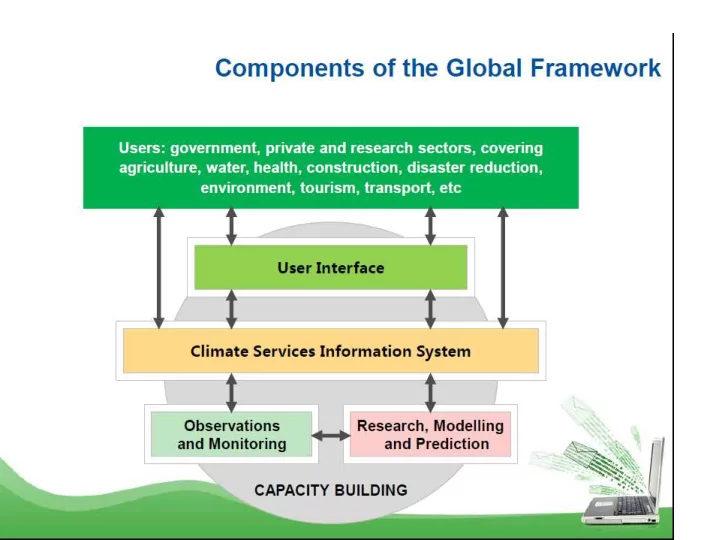
User Interface Platform and its linkages with CSIS Dr Roger Stone - - - PowerPoint PPT Presentation
User Interface Platform and its linkages with CSIS Dr Roger Stone - 14:30 Discussion on how to serve efficiently the users; likely different suggestions with respect of different users Members categories Roger C. STONE (Lead) -
Aim of TTUI The Task Team on User Interface will:
economic benefits of using climate information, products and services,
climate risk management, and adaptation strategies and planning, to include user- friendly terminology,
variations and change and on the use of climate information in climate risk management and adaptation by specific sectors, and publish these in the form of an
Services for Improved Humanitarian Planning and Response, develop an implementation plan to facilitate the provision of meteorological, Hydrological and Climate Services to the international humanitarian agencies from National Meteorological and Hydrological Services (NMHSs), RSMCs, Global and Regional Climate Centres (RCCs),
three years from the date of formation of the Task Team) and that the team can be dissolved.
Members
Roger C. STONE (Lead) - AUSTRALIA (RAV) Abdullah CEYLAN – TURKEY (RAVI) Valentina KHAN – RUSSIAN FEDERATION (RAVI) Shuhei MAEDA - JAPAN (RAII) Samwel Omwoyo MARIGI – KENYA (RAI)
Deliverables: A guideline for users on integrating climate predictions and information into climate risk management, and adaptation strategies and planning, to include a user-friendly terminology; · A collection of existing case studies relevant to quantifying the social and economic benefits of using climate information, products and services; · Information on the susceptibility of various sectors to climate variations and change and the use of climate information in climate risk management and adaptation by specific sectors, in the form of an online catalogue.
Part of the Commission for Climatology’s Open Panel of CCI Experts OPACE IV – Climate Information for Adaptation and Risk Management
The WMO TT-UI will likely recommended the following guidelines to assist WMO and National Meteorological and Hydrological Services (NMHS) to succeed in the overall aim of improving users’ benefits from the advances being made in climate science and research and in use of integrating systems of value to users core needs. 1.Apply the overall recommended systematic approach agreed to by TTUI as a guideline for users in integrating climate predictions into climate risk management. 2.There is a core need by developers of seasonal climate and climate change forecast models and systems to work much more closely with the likely developers of tactical and strategic management systems in selected industries (eg agriculture, hydrology, energy, insurance, etc) . 3.There is an urgent need to provide more modelled or actual case studies of detailed quantified economic benefits of the value of seasonal climate and climate change forecasts for specific industries in order to demonstrate to industry/users, scientists, and policy makers where critical opportunities and value would or does exist in the application of climate science outputs. 4.There is a need to establish more systems modelling research and
approaches can be developed that will effectively integrate climate forecast modelling systems with comprehensive industry decision systems. 5.There is a need to increase interaction with user groups in addition to agriculture where it appears the greatest amount of user interaction in regards to climate forecasts has so far taken place.
Members
Roger C. STONE (Lead) - AUSTRALIA (RAV) Abdullah CEYLAN – TURKEY (RAVI) Valentina KHAN – RUSSIAN FEDERATION (RAVI) Shuhei MAEDA - JAPAN (RAII) Samwel Omwoyo MARIGI – KENYA (RAI)
Overall, TTUI recommended a systematic approach that was agreed to at the Meeting of the Commission for Climatology (CCl) Task Team
for users in integrating climate predictions into climate risk management:
its management: it is essential to understand the system dynamics and
could influence desired systems behaviour or performance – what are those decisions that are important?;
understand where in the target system climate risk is an issue;
to the forecasts. If forecasts are now available, what possible options are there at relevant decision-points? How might decisions (eg in agriculture, water resources, health) be changed in response to forecasts? What nature of forecast would be most useful? and - what lead-time is required for management responses?
Meeting of the Commission for Climatology (CCl) Task Team on User Interface (TT-UI) Geneva, Switzerland, 29-31 March, 2011
Part of the Commission for Climatology’s Open Panel of CCI Experts OPACE IV – Climate Information for Adaptation and Risk Management
The WMO TT-UI will likely recommended the following guidelines to assist WMO and National Meteorological and Hydrological Services (NMHS) to succeed in the overall aim of improving users’ benefits from the advances being made in climate science and research and in use of integrating systems of value to users core needs. 1.Apply the overall recommended systematic approach agreed to by TTUI as a guideline for users in integrating climate predictions into climate risk management. 2.There is a core need by developers of seasonal climate and climate change forecast models and systems to work much more closely with the likely developers of tactical and strategic management systems in selected industries (eg agriculture, hydrology, energy, insurance, etc) . 3.There is an urgent need to provide more modelled or actual case studies of detailed quantified economic benefits of the value of seasonal climate and climate change forecasts for specific industries in order to demonstrate to industry/users, scientists, and policy makers where critical opportunities and value would or does exist in the application of climate science outputs. 4.There is a need to establish more systems modelling research and
approaches can be developed that will effectively integrate climate forecast modelling systems with comprehensive industry decision systems. 5.There is a need to increase interaction with user groups in addition to agriculture where it appears the greatest amount of user interaction in regards to climate forecasts has so far taken place.
Members
Roger C. STONE (Lead) - AUSTRALIA (RAV) Abdullah CEYLAN – TURKEY (RAVI) Valentina KHAN – RUSSIAN FEDERATION (RAVI) Shuhei MAEDA - JAPAN (RAII) Samwel Omwoyo MARIGI – KENYA (RAI)
and clear communication of the likely outcomes (e.g. economic or environmental), and associated risks of changing a management practice (eg in agriculture, water resources, etc) are key to achieving adoption of the technology.
industry managers/decision-makers generates valuable insights and learning throughout the entire process: i.e. identifying relevant questions/problems and devising suitable technologies and tools.
NMHS/university/etc: rather than just accepting a given climate forecast, consider what specific improvements would be of greatest value in the target
and for climate research of value for particular sectors. “Climate information doesn’t have to be perfect to be useful; it just needs to support a decision”. (Approach concepts, especially after Hammer, 2000; also refer to Hammer et al., 2001; Stone and Meinke, 2005, 2007; Rodriguez, 2010; Stone, 2012).
Meeting of the Commission for Climatology (CCl) Task Team on User Interface (TT-UI) Geneva, Switzerland, 29-31 March ,2011
(Stone and Plant 2014).
What are the decisions? Linking climate information to stakeholder decisions – complex issues of scale – Targeting seasonal forecasts (example from sugar industry) Farm Harvest, Transport, Mill Catchment Marketing Policy
for wet weather disruption – season start and finish
schedule Land & Water Resource Management Environmental Management
allocation
and policy associated with exceptional Events
Crop size Forecast Early Season Supply Supply Patterns
The Cane Plant Sugarcane Production Harvest & Transport Raw Sugar Milling Marketing & Shipping
water resources
farm operations
for wet weather disruption
arrangements
finish times
cane supply
based on likely crop size
shipments based on supply pattern during harvest season
Y .L. Everingham, R.C. Muchow, R.C. Stone, N.G. Inman-Bamber, A. Singels, C.N. Bezuidenhout (2002)
Producer Production Transport Processing Retail, Marketing & Shipping
stocking rates
availability in peak demand periods
supply: daily, monthly, six monthly planning.
issues.
lambs getting sold small/lightweight) “Going into dry is fantastic – heaps of stock, plant at capacity and decreasing prices
months after season break, lack of supply: key issues regarding long term viability emerge”
ssessing market signals, forward contracts
consistency and consumer retention based on nutrition, integrity, value, enjoyment.
Part of the Commission for Climatology’s Open Panel of CCI Experts OPACE IV – Climate Information for Adaptation and Risk Management Crop production decisions. For many regions of the United States of America:
species or cultivar selection, fertility management, area to be planted, pest management, intensity and timing of grazing and purchase, sale, or movement of animals (Steiner et al., 2004).
input supply, markets, transportation, storage, or community health services can also be guided by climate forecasts.
some specific seasons. However, to move forward, continued improvement and evaluation of forecasts skill are
extreme events should also be a focus for further work.
methods to communicate probabilistic outcomes are needed.
decision-making on-farm and using seasonal climate forecasts within the context of overall risk analysis and management of an agricultural system.
Part of the Commission for Climatology’s Open Panel of CCI Experts OPACE IV – Climate Information for Adaptation and Risk Management
users operate and use information - users, including farmers, usually operate in an environment of considerable uncertainty, reacting to and coping with multiple stressors whose impacts are not always clear or predictable.
climate outlook forums) for the dissemination and uptake of climate information. Climate information, used in isolation, (e.g. in ‘stand-alone’ climate outlook forums) and undertaken in a traditional, linear fashion, where information is moved from the forecast producer to user, is divorced from the broader, complex social context in which such information is embedded.
with climate variability and food security. Alternative modes of interaction (e.g. using existing platforms to ‘piggyback’ information or seeking appropriate ‘boundary organisations’) should be found to sustainably manage climate risks (adapted from Vogel and O’Brien, 2006).
dissemination: instead, greater attention needs to be given to the infrastructural and institutional advances necessary to facilitate the use of forecast information within a range of contexts, e.g. rural livelihood strategies if better examples of successful case studies are to be developed and discovered (Vogel and O’Brien, 2006). .
Part of the Commission for Climatology’s Open Panel of CCI Experts OPACE IV – Climate Information for Adaptation and Risk Management
An example of the current institutional and information delivery process in (southern) Africa (part A) but with a suggested improved overall dissemination and institutional process and systems also provided (part B).
A dedicated centre? (Meinke and Stone, 2005). The need for an interdisciplinary, integrated, systems science approach? the need to really understand the specific needs and decision-points
systems; assess value of climate forecasts; look at user value chains?…
directly from a generally publicly issued seasonal forecast to a real decision is too great to be done (well) intuitively.
information to be much more relevant to the decision in question than the general piece of information contained in the forecast. There are numerous possibilities and interactions and the insights gained from analysis
because it is typically grown in relatively arid regions of the world, and like sugar, some of the largest wheat producing regions in the world are in areas in which consistent weather patterns associated with the El Niño- Southern Oscillation (ENSO) have been identified. A model has simulated 25 years of world wheat trade with results placed in present value terms. The results (Hill et al) show wheat producers in Australia, Canada and the USA can expect to gain 15.7%, 5.3%, and 5.1%.in profit through use of ENSO-based forecast systems.
value for agriculture’ but they ‘go further to show that the value of these types of forecasts can roughly be doubled by releasing more refined forecasts and educating agricultural producers to use them’.
forecast information increases total value to certain US agricultural enterprises for 10 US regions by $399 million dollars per annum. However use of more refined forecasts (eg the ‘five phase SOI’ information) raises the total value
total value to the US economy from just this approach in use of seasonal climate forecasts to be worth, on average, approximately $2,095m pa….)
Part of the Commission for Climatology’s Open Panel of CCI Experts OPACE IV – Climate Information for Adaptation and Risk Management APSIM
“Collect and assess existing case studies relevant to quantifying the social and economic benefits of using climate information, products and services”.
simply utilised directly into management applications, especially in agriculture and water resources and application for Ghana is provided (Adiku and Stone).
between rainfall or temperature and key ENSO indicators - before a full forecasting system is eventually utilised (Stone et al, Nature, 1996) offers considerable scope for using a first step seasonal climate forecasting system
is continuously measured and results are available even throughout the growing season. Hence, benefits to day-to-day decision making on water management is believed to be enhanced (authors).
the Agricultural Production Systems Simulator (APSIM) model, from four locations in southeast Australia. Important variations in shift and dispersion in spring rainfall and simulated wheat yields were observed across the studied locations.
each year, using both SOI and SST phase-based systems. These results were identified in relation to the potential benefit of making tactical top-dress management applications of nitrogen fertilisers during early August.
Part of the Commission for Climatology’s Open Panel of CCI Experts OPACE IV – Climate Information for Adaptation and Risk Management
productivity forecasting system has been demonstrated by Challinor et al for groundnut production in India.
identified, typical of that used in seasonal weather forecasting, that can form the basis of crop modelling work for an example of groundnut production in India. Output from such a system will have value for use in trading and export/import decision-making.
‘average La Niña event’ can easily cost this industry in excess of $175 million AUD for an industry that generates about $2 billion, annually. (2010 La Niña cost this industry ~$500m). Ultimately most blame for the loss can be placed on a ‘wet end’ to the sugar harvest season and the inability to forecast and plan for it with a sufficient lead time.
‘forecasting systems’ to be worth approximately $10m per annum, on average, just for
(Australia, Argentina, Canada) they clearly demonstrate that while shifts in forecast probability distributions from the ‘all years’ long-term climatology may not always be great, modest shifts in forecast probability distributions can provide sufficient shift to modify critical decisions, especially in agricultural industries.
Part of the Commission for Climatology’s Open Panel of CCI Experts OPACE IV – Climate Information for Adaptation and Risk Management.
always important, especially to provide indication of the range of management decisions that could or already have been changed as a result of application of seasonal climate forecasting to management
making concerns reliability of outcomes. It is known seasonal (or weather) forecasts are not necessarily precise and the decision-maker faces a ‘sample of one’ from a possible distribution of outcomes.
value of use of seasonal forecasts. In one example, they demonstrate that adjusting management in response to a forecast, by using simulation models to assess the value of changing planting row spacing, based on seasonal forecasts, will pay-off in the long run with an average ~$28/ha (AUD) average improvement in profit per annum and with profit increasing by about 11% overall – (many cotton farms in Australia are over 10,000ha).
forecast and suggest that in discussing management responses to forecasts with users that it is imperative to highlight the point that there are no ‘rights’ and ‘wrongs’ with this type of technology — just shifts in probability distributions. There are studies that note the credibility crises that have arisen in some countries when this approach has not been taken!
(agricultural) scientists and practitioners with the science of climate prediction. They note that professions involved in decision making must take a proactive role in the development of climate forecasts if the design and use of climate predictions are to reach their full potential.
Part of the Commission for Climatology’s Open Panel of CCI Experts OPACE IV – Climate Information for Adaptation and Risk Management
Assessment on a Seasonal-to-decadal timescale’), recently funded by the European commission under the 7th framework program, intends to improve the ability to maximise the societal benefit of these new technologies of seasonal to decadal timescale forecasts. The project works in close relation with a number of European stakeholders with the aim of wishing to develop a few fully working prototypes of climate services addressing the need of specific users.
few examples of the actual use of this type of predictions to decision-making processes across Europe. The project points out that in other parts of the world the use of seasonal forecasts is more advanced, although its use has been questioned at times due to issues surrounding its credibility, saliency, and legitimacy (see work by Cash and Buizer). .A key comprehensive workshop from the EUPORIAS Project, involving user applications of seasonal forecasts, identifies that, in Europe, the users of seasonal to decadal climate forecasts and information are mainly related to the energy, insurance and transport sectors.
climatology to those using this information in operational/dynamical models to support decision-making”. This study points out that annual and decadal climate information is much less used across European sectors/countries.
“revolved around issues of skill and predictability; capacity, relevance, and usability; accessibility and communication; and changing existing practices” (EUPORIAS project milestone, 2013).
Part of the Commission for Climatology’s Open Panel of CCI Experts OPACE IV – Climate Information for Adaptation and Risk Management
Health aspects – Malaria. Excellent examples of use of forecasting systems in improving management of health issues are available in Thomson et al (2006).
based, seasonal-timescale, multi-model ensemble predictions of climate”, and applying leading global coupled ocean– atmosphere climate models developed in Europe are demonstrated.
are well established, importantly adding up to four months lead time over malaria warnings issued with observed precipitation and having a comparably high level of probabilistic prediction skill.
makers can now use this information for improved resource allocation - the ability of a malaria early-warning system to improve resource allocation and assist in the reduction of malaria morbidity and mortality depend on decision-makers’ capacity to make effective use of new information within their own control paradigm.
epidemic malaria control activities currently promoted by the WHO-AFRO Southern Africa Inter-Country Malaria Team (SAMC) in Zimbabwe and undertaken by the National Malaria Control Unit in Botswana.
Part of the Commission for Climatology’s Open Panel of CCI Experts OPACE IV – Climate Information for Adaptation and Risk Management
Success of climate forums. In southern Africa, Vogel and O’Brien (2006) point to the 1997–1998 rainfall season in the region as a good case study that illustrates the success of climate forums and climate forecast information but which also highlights some of the missed opportunities
They note that by using various GCMs and statistical model outputs, and by incorporating recent advances in seasonal-to-interannual climate variability research, it was possible to predict the 1997– 1998 El Niño event. This marked the first year that seasonal climate forecasts were widely disseminated in southern Africa. However, unlike the ENSO event of 1982–1983, which was not predicted and had large economic consequences, the onset and related potential impacts of the 1997–1998 event was anticipated by the forecasts. They note that the 1997–1998 El Niño event, coupled with growing concerns about potential climatic change associated with global warming, contributed to the heightened awareness and desire to better manage climate fluctuations. In southern Africa, SARCOF was established in an effort to promote the dissemination of consistent and clear consensus forecasts to the user community, and to minimize the confusion that arises when conflicting forecasts from various sources are heard. Seasonal climate forecasts used in the SARCOF forum provide probabilistic estimates of total rainfall relative to a 30 year period.
Part of the Commission for Climatology’s Open Panel of CCI Experts OPACE IV – Climate Information for Adaptation and Risk Management
Additional noteworthy European examples:
climate research funding encompassing various modules research for climate services development. JPI Climate modules (From Bessembinder and Zölch, 2013). The EUPORIAS project points out that the “JPI Climate Module 2” focuses on research for climate services development in order to ensure: quality assurance of climate services provided, effectiveness of service provided, and standards. This module encompasses two ‘fast-track activities’ (FTA): “FTA 2.1. aims to improve the transfer of data, information and knowledge about climate and climate change to society within Europe”. “Better dissemination requires proper knowledge
understanding what is available; understanding users’ needs; and provision of an improved interface - to achieve this, a number of activities are being pursued including: preparation of an inventory of user requirements (what do users need to know; user perceptions of risk); collection of guidance documents; analysis of existing uses; and recommendations for future research. FTA 2.2 focuses on mapping climate services providers within Europe. A number of definitions can be used to identify specific roles within climate services including: “Climate service” - User driven development and provision of knowledge for understanding climate, climate change and its impacts, as well as guidance in its use to researchers and decision makers in policy and business (extracted from EUPORIAS Report D12.2 Courtesy Prof. Suraje Dessai.)
Roger C Stone, University of Southern Queensland, Australia. World Meteorological Organisation, Commission for Agricultural Meteorology.
Queensland state output – focussing on specific regions – and linking to targeted requirements – pasture growth forecasts include antecedent soil moisture conditions and pasture growth modelling.
Useful to apply seasonal climate forecasting systems that can also be integrated with crop, pasture, and hydrological models.
Commonwealth Bureau
– good standard output
Operational climate services we utilise – examples (also provides examples of the value of varying spatial representation)
to become CLIMATE ARM
carbon)
Agricultural Production Systems Simulator (APSIM) simulates
Sow date & SOI Phase
15-Sep Negative 15-Oct Negative 15-Nov Negative 15-Dec Negative 15-Jan Negative
Yield (kg/ha)
6000 5500 5000 4500 4000 3500 3000 2500 2000 1500
‘WhopperCropper’ (now CROPARM)- Farm-level decisions (‘when do I plant my crop’?)
sorghum yields associated with varying climate regimes (example for a ‘consistently negative SOI phase’) – varying management decisions (sowing dates) : example for Miles, Australia. Effect of sowing date on sorghum yield at Miles South QLD with a ‘consistently negative’ SOI phase for September/October (Other parameters - 150mm PAWC, 2/3 full at sowing, 6pl/m2, medium maturity’)
Courtesy D Cobon – 4 month lead time forecasts
Example of an integrated climate/ crop model forecast system – Australian wheat crop forecast for 2014 (OzW heat Model Potgieter, 2009; integrated with climate model of Stone et al, 1996) – issued September, 2014; first available May 2014
Are user decision-support systems always useful?…..
Assisting decision processes for stakeholders? – developing decision-support systems that link climate information, agricultural models and user decisions – make sure they actually add value …
estimation of future stocking rates.
pasture budgeting monitoring.
total grazing pressure.
drought preparation.
Reporting- (3540) Non-reporting- (5039)
127 Agro- AWS 548 AWS Type of Observatory Installe d Propo sed AWS 675 400 ARG 1350 2000 DWR 16 42 Doppler Weather Radar 16 DWRs are installed Products are * Rain intensity * Cumulative rain * Cloud motion winds * Vertical profiles of Temperature, humidity etc. (Res: 0.5x0.5 km) Assimilation of DWR data with AWS
India's advanced weather satellite INSAT-3D launched in the early hours
Guiana, and has successfully been placed in Geosynchronous orbit. It carries four payloads
(SAS & R) INSAT-3D INDIA’s Advanced
Actual Mean Maximum Temperature Mean Mac Temperature anomaly Actual Mean Minimum Temperature Relative Humidity Cloud amount Wind Speed Mean Min. Temperature anomaly
Sowing Suitability of crops
Surface soil moisture estimation by passive microwave sensor Surface Soil Moisture from SMOS
Soil Moisture estimation at Block level in Koriya District of Chattisgarh
NDVI at Block level in Koriya District of Chattisgarh