Using an Age-Friendly Lens to Respond to and Recover from COVID-19 - - PowerPoint PPT Presentation

using an age friendly lens to respond to and recover from
SMART_READER_LITE
LIVE PREVIEW

Using an Age-Friendly Lens to Respond to and Recover from COVID-19 - - PowerPoint PPT Presentation

Using an Age-Friendly Lens to Respond to and Recover from COVID-19 Danielle Arigoni, AARP Director of Livable Communities August 27, 2020 Questions to answer today What do we mean by an age-friendly approach and what does it


slide-1
SLIDE 1

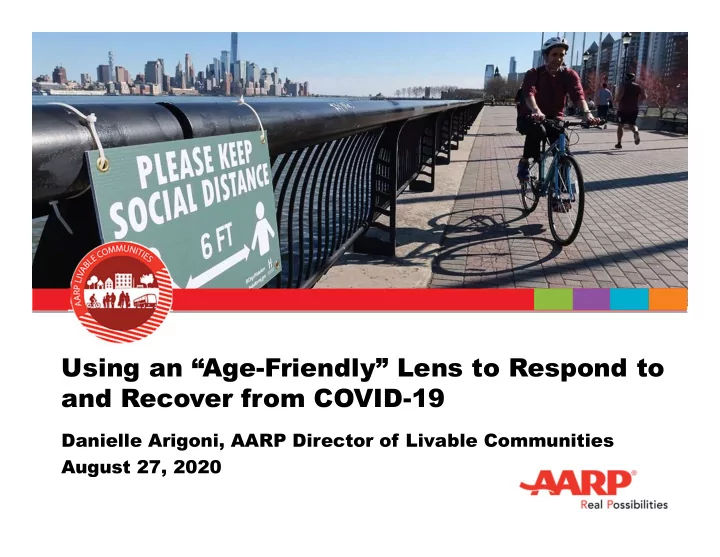
Using an “Age-Friendly” Lens to Respond to and Recover from COVID-19

Danielle Arigoni, AARP Director of Livable Communities August 27, 2020

slide-2
SLIDE 2

 What do we mean by an “age-friendly approach” and what does it have to do with smart growth?  How has COVID-19 impacted older adults? What does that tell us about what communities need to consider as they respond to and recovery from COVID-19 in order to be great places for all?  What resources do AARP Livable Communities and National Main Street Center offer to support communities?  What can we do to best position communities for a successful recovery that creates more great places for all?

Questions to answer today

slide-3
SLIDE 3

3

March 13, 2018

slide-4
SLIDE 4
slide-5
SLIDE 5

Over half of all HH are 1- or 2-persons, but more than 85% of housing stock is 2, 3, 4 or more bedrooms. The share of 65+ renters who are rent-burdened increased from 43% in 2001 to 50% in 2015. Less than 1% of US homes are built with universal design in mind. Older adults outlive their ability to drive between 7-10 years. Older adults represent disproportionate share of pedestrian fatalities in 35 states. Isolation and loneliness present health risks equivalent to smoking 15 cigarettes a day. Isolation is associated with a 50% percent increased risk of dementia. Older adults represent more than 20% of population, but only 4% of park users. Parks serving people of color are half the size and 5x as crowded, which increases temps and leads to disproportionate share of heat- related deaths among older adults.

slide-6
SLIDE 6

We support communities and local leaders to think differently about their housing, transportation and public spaces to create great places for all people of all ages.

AARP Livable Communities Approach

aka our “Age-Friendly” Approach

slide-7
SLIDE 7

(l-r) Oregon, Lexington, KY’ Seaside, CA; Eugene, OR; Durham, NC Main home ADU

Housing

slide-8
SLIDE 8

(l-r) Los Angeles, CA; Bethel, VT; Montgomery, AL; Columbus, OH

Transportation

slide-9
SLIDE 9

(clockwise from top left) Brownsville,

TX; Omaha, NE; New Orleans, LA; San Diego, CA; Manning, IA

Public Spaces and Parks

slide-10
SLIDE 10

We support communities and local leaders to think differently about their housing, transportation and public spaces to create great places for all people of all ages.

AARP Livable Communities Approach

aka our “Age-Friendly” Approach

State offices leading the charge

  • n state/local

advocacy Grants to catalyze change and build momentum Programs and tech assistance to support local leaders Tools and publications to empower residents and advocates

slide-11
SLIDE 11

Programs and tech assistance to support local leaders Grants to catalyze change and build momentum Tools and publications to empower residents and advocates

Training and technical assistance programs

slide-12
SLIDE 12

Training and technical assistance programs

Programs and tech assistance to support local leaders Grants to catalyze change and build momentum Tools and publications to empower residents and advocates

Registration now open: aarp.org/Transportation2020

slide-13
SLIDE 13

Grants for projects in communities

Programs and tech assistance to support local leaders Grants to catalyze change and build momentum Tools and publications to empower residents and advocates

2020: $2.4 million in grants awarded to 184 communities (to date >$6 million in 4 years) Search for your community at https://livablemap.aarp.org/

slide-14
SLIDE 14

Tools: LivIndex, map and newsletter

Programs and tech assistance to support local leaders Grants to catalyze change and build momentum Tools and publications to empower residents and advocates

Livability Index

https://livabilityindex.aarp.org/

Free weekly e-newsletter Text LIVABLE to 50757 Searchable map

https://livablemap.aarp.org

slide-15
SLIDE 15

Free publications

Programs and tech assistance to support local leaders Grants to catalyze change and build momentum Tools and publications to empower residents and advocates

Free practitioner-oriented publications in print and via download on:

  • Rural livability (incl. broadband, econ dev)
  • Housing (home modification, ADUs, diversity)
  • Transportation (including walk audit)
  • Placemaking and parks (including park audit)
  • Community engagement
slide-16
SLIDE 16

Free publications

Programs and tech assistance to support local leaders Grants to catalyze change and build momentum Tools and publications to empower residents and advocates

…including publications to help inform local residents on their built environment, and empower them to become agents of change

slide-17
SLIDE 17

Co-branded content with partners

Programs and tech assistance to support local leaders Grants to catalyze change and build momentum Tools and publications to empower residents and advocates

Our newest tool:

Commercial District Design: COVID-19 Response and Management

slide-18
SLIDE 18

Programs and tech assistance to support local leaders Grants to catalyze change and build momentum Tools and publications to empower residents and advocates

AARP Network of Age-Friendly States and Communities

Search for your community at https://livablemap.aarp.org/ Nearly 500 communities + 6 states Five-year cycle Over 100 million US residents live in an age- friendly community

slide-19
SLIDE 19

Impact of COVID-19 on Older Adults

CDC: 80% of all COVID-19 related deaths people 65 or older

  • Many in congregate living facilities
  • Disproportionately high among people of color, and those with

underlying health conditions Other impacts:

  • Lack of access to healthy food, medicine
  • Prolonged isolation from family and friends
  • Limited opportunities for social engagement, volunteering
  • Inability to access housing alternatives
  • Layoffs and lack of employment
  • Delays in accessing needed health care
  • Decline in transportation options avail to non-drivers
  • Decreased support/relief for caregivers
  • Unequal access to online resources for those lacking high-speed

internet or smartphones

slide-20
SLIDE 20
  • Lack of housing alternatives
  • Prolonged isolation from family

and friends

  • Layoffs and lack of employment
  • Lack of access to healthy food,

medicine

  • Limited opportunities for social

engagement, volunteering

  • Delays in accessing needed

health care

  • Decline in transportation
  • ptions avail to non-drivers
  • Decreased support/relief

for caregivers

  • Access to info and online

resources dependent upon high-speed internet or smartphones

Directly related to “age-friendly” domains

slide-21
SLIDE 21

Learning from Age-Friendly Leaders

Major areas of focus: Ensuring access to information Ensuring access to food Keeping older adults engaged in civic/social life

First person narratives on aarp.org/livable AARP/NLC Older Adult Response Initiative

slide-22
SLIDE 22
slide-23
SLIDE 23

Urban Suburban (with a mix of offices, apartments, and shops Suburban (mostly residential) Small town Rural Other

0% 5% 10% 15% 20% 25% 30%

2020 NAFSC Member Survey on COVID-19:

What type of community are you?

30% 37% 25%

slide-24
SLIDE 24

51 44 29 31 22 14 8 6 6 6 4 10 20 30 40 50 60

2020 NAFSC Member Survey on COVID-19:

Who serves as the lead organization(s) to coordinate your age-friendly work?

slide-25
SLIDE 25

2020 NAFSC Member Survey on COVID-19:

To what extent to do you feel that your community has been impacted by COVID-19? Great Extent 58% Moderate Extent 24% Some Extent 8% Small Extent 6% Too Soon to Tell 4%

slide-26
SLIDE 26

2020 NAFSC Member Survey on COVID-19:

Have your age-friendly efforts/commitments helped your community to be better prepared to respond to COVID-19? Yes 54% No 14% Not Sure 32%

slide-27
SLIDE 27

6% 7% 14% 26% 46%

0% 5% 10% 15% 20% 25% 30% 35% 40% 45% 50%

Other Recruiting and deploying volunteers Prior efforts to understand residents needs through surveys (or other means) Prior efforts to improve communication with residents Partnerships with diverse organizations

2020 NAFSC Member Survey on COVID-19:

What element of your age-friendly work has been most helpful in your response to COVID-19?

slide-28
SLIDE 28

0% 20% 40% 60% 80% 100% 120%

Expanding access to work and volunteer opportunities Ensuring access to adequate housing Addressing disparities and systemic inequities Addressing safety of congregate senior living facilities Addressing housing supports and services Ensuring access to transportation and mobility Supporting local businesses and local economic activity Preparing for emergencies and/or disasters Addressing mental health Ensuring access to healthcare, including telemedicine Ensuring access to food and/or medicine Keeping older adults engaged in social/civic activities Ensuring access to information

What are the most urgent areas for your community in COVID-19 response and recovery? Response Recovery

Part of action plan pre-COVID? 65% 85% 90% 57% 88% 70% 23% 68% 53% 47% 77% 47% 42%

slide-29
SLIDE 29

2020 NAFSC Member Survey on COVID-19:

Do you think that your community’s experience with COVID-19 will change your age-friendly approach?

Yes 65% No 6% Not Sure 29%

slide-30
SLIDE 30
  • “For many communities, identifying the most

isolated residents is always challenging. However, this pandemic has forced many to seek out assistance and support who would not have in the past.”

  • “Now after COVID, coupled with being the epicenter
  • f the nation’s response to the murder of George

Floyd … it has never been more clear that the action plan needs to adjust dramatically and ensure that a lens of equity is throughout the plan.”

  • “COVID-19 has changed everything. There is no

possible way it will not change our approach… It has underscored the need to address inequities, … made us more conscious of the need to see congregate settings as "community" settings, … and made us realize the need for a voice to be dedicated to combatting ageism.”

  • “Need to improve communication systems so we

can reach all town residents with critical information.”

  • “Greater sensitivity to issues of equity, mental

health, and food.”

  • “Our priorities will shift to include access to

information, digital literacy and social isolation.”

  • “The self-isolation recommendation has shown a

tremendous need for connection to recreation and nature for ALL people. This means connection to trails, and parks and open spaces. Also, access to the internet/technology has been a large barrier to many aging that has been highlighted during this time.”

  • “We have been largely reactive and now we need to

take a more proactive approach. By doing that we can avoid potential pitfalls. We are lacking in community based partnerships. Businesses and

  • rganizations exist in silos. It is time to change

that.”

  • “Walkability, aging in place, and good

communication infrastructure now take higher priorities than before.”

2020 NAFSC Member Survey on COVID-19:

Age-friendly members describe how

slide-31
SLIDE 31

AARP Livable Communities Approach

Learn more at:

State offices leading the charge

  • n state/local

advocacy Grants to catalyze change and build momentum Programs and tech assistance to support local leaders Tools and publications to empower residents and advocates

aarp.org/livable

Livablemap.aarp.org Livabilityindex.aarp.org Aarp.org/CommunityChallenge aarp.org/states