USING DATA FOR EQUITY AND SOCIAL JUSTICE: A CASE STUDY ON K-12 - - PowerPoint PPT Presentation

using data for equity and social justice a case study on
SMART_READER_LITE
LIVE PREVIEW

USING DATA FOR EQUITY AND SOCIAL JUSTICE: A CASE STUDY ON K-12 - - PowerPoint PPT Presentation

USING DATA FOR EQUITY AND SOCIAL JUSTICE: A CASE STUDY ON K-12 FILIPINO ACHIEVEMENT GAPS AND OPPORTUNITIES IN HAWAII PUBLIC SCHOOLS Hawaii DXP Data Summit 2017 Patricia Halagao, Ph.D. Associate Professor University of Hawaii at Mnoa


slide-1
SLIDE 1

USING DATA FOR EQUITY AND SOCIAL JUSTICE: A CASE STUDY ON K-12 FILIPINO ACHIEVEMENT GAPS AND OPPORTUNITIES IN HAWAIʻI PUBLIC SCHOOLS

Patricia Halagao, Ph.D. Associate Professor University of Hawaiʻi at Mānoa May 12, 2017
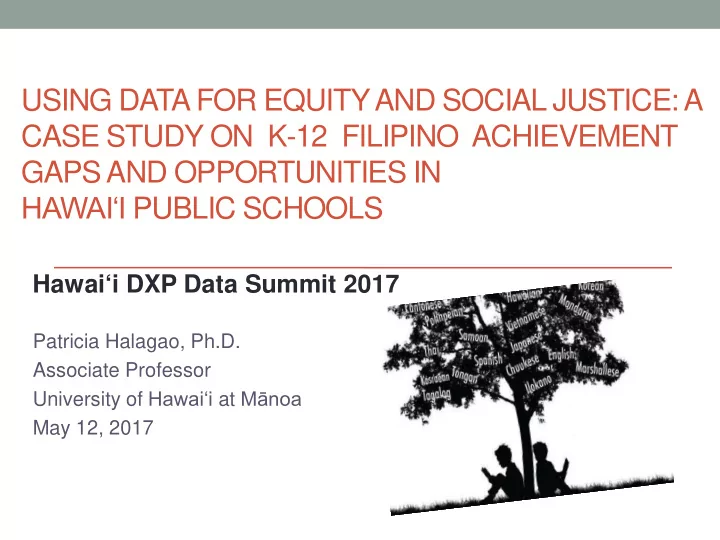
Hawai‘i DXP Data Summit 2017

slide-2
SLIDE 2

Who are you? Who am I?

slide-3
SLIDE 3
slide-4
SLIDE 4

Overview

  • Purpose
  • Data collection
  • Data analysis
  • Implications
slide-5
SLIDE 5

Purpose

  • Presents the first large scale and current examination of

Hawaii DOE data on Filipinos

  • Provides a baseline to understand the status of K-12

Filipino American education

  • Analyzes data to identify target areas of challenges and

successes

  • Analyzes data to improve instruction and Filipino student

academic achievement

  • Provides recommendations for curricular and systemic

reform

slide-6
SLIDE 6

PURPOSE: TO USE DATA TO IMPROVE FILIPINO STUDENT ACHIEVEMENT

“The need for data – instead of intuition, tradition, and convenience – to guide administrative and educational decisions has become increasingly important”

  • Learning Points Associates
slide-7
SLIDE 7

Data Collection

  • Data Source: HawaiʻiDepartment of Education, 2013-2016
  • David Moyer, Data Fellow, DOE Office of Strategic

Reform

  • Hawaiʻi P-20 Partnerships for Education’s Hawaiʻi Data

eXchange Partnership

  • Collaboration
  • Reflection
slide-8
SLIDE 8

Types of Data

  • Demographic Data (population, concentration)
  • Academic Achievement Data (Standardized tests,

proficiency rates in Language arts & math, Graduation rates, College Enrollment, Complex)

  • Quantitative Intersectionality (achievement data X

ethnicity, class, gender, language)

slide-9
SLIDE 9

Data Analysis

  • Focus questions
  • Analyze Data patterns
  • Generate Hypothesis
  • Check Hypothesis
slide-10
SLIDE 10

DEMOGRAPHIC DATA

Who are our students? What trends do we see in our student population? Where are students concentrated?

slide-11
SLIDE 11

HI Department of Education

  • 9th largest schools district and only statewide educational

system in the country

  • King Kamehameha III established Hawaii’s public school

system in 1840 making it one of the oldest school districts West of the Mississippi

  • Comprised of 255 schools and 33 charter schools
  • Serves 185,000 students, employs 13,000 teachers
  • Act 51
slide-12
SLIDE 12

Ethnicity

  • Surprises?
  • Where are different ethnic groups concentrated?
  • Are our schools ethnically segregated?
slide-13
SLIDE 13
slide-14
SLIDE 14
slide-15
SLIDE 15

Demographic Data Patterns

  • Filipinos have consistently made up the second largest

ethnic group in DOE (22%).

  • Filipino student enrollment concentrated on Oahu,

primarily Central and Leeward areas

  • Filipinos make up the majority student enrollment in the 3
  • ut of the 5 largest high schools (Campbell 35%, Waipahu

45%, Farrington 50%),3 out of 5 middle schools (Waipahu 28%, Kalakaua 52%, Maui Waena 35%), 2 out of 5 elementary schools (August Ahrens 54%, Ewa El. 26%) in Hawaii

slide-16
SLIDE 16

ACHIEVEMENT DATA

What is the achievement according to race/ethnicity? In terms of proficiency of standardized assessments? What are the achievement trends?

slide-17
SLIDE 17
slide-18
SLIDE 18
slide-19
SLIDE 19
slide-20
SLIDE 20

Student Achievement

  • What is the academic proficiency rate by ethnicity?
slide-21
SLIDE 21

Asian, 0.69 Filipino, 0.49 Micronesian, 0.18 Native Hawaiian, 0.34 Samoan, 0.29 White, 0.62 Statewide, 0.48

0.1 0.2 0.3 0.4 0.5 0.6 0.7 0.8 0.9 1 SY 2010-11 SY 2011-12 SY 2012-13 SY 2013-14 ฀ SY 2014-15* SBA

School Year (SY)

State Assessment Results, Percent Proficient in English Language Arts/Reading

slide-22
SLIDE 22

Asian, 0.64 Filipino, 0.43 Micronesian, 0.12 Native Hawaiian, 0.27 Samoan, 0.24 White, 0.53 Statewide, 0.41

0.1 0.2 0.3 0.4 0.5 0.6 0.7 0.8 0.9 1 SY 2010-11 SY 2011-12 SY 2012-13 SY 2013-14 ฀ SY 2014-15* SBA

School Year (SY)

State Assessment Results, Percent Proficient in Mathematics

slide-23
SLIDE 23

Achievement Data Patterns

  • Lumping achievement data obscures differences
  • Among the 4 largest ethnic groups and those who have

been in Hawaii the longest (Native Hawaiians, Japanese, Chinese and White), Filipinos rank third in reading and math proficiency.

  • Filipinos are second to bottom compared to the Native

Hawaiians.

  • there doesn't seem to be a group that has missed out on

recent test score gains--although existing gaps have largely stayed the same.

  • Filipino show gains in Math

Hawaii Public Schools Proficiency Rates and Student Growth Scores: 2007 - 2014

Five largest racial/ ethnic groups shown. Width of the line indicates number of students tested. READING MATHEMATICS

0% 20% 40% 60% 80% Pro

Native Hawaiian Filipino Japanese White Multiple Multiple Native Hawaiian Filipino White Japanese

Proficiency Rates READING MATHEMATICS

2007 2008 2009 2010 2011 2012 2013 2014 2007 2008 2009 2010 2011 2012 2013 2014

40 45 50 55 60 Me

White Filipino Japanese Native Hawaiian Filipino Multiple Native Hawaiian Japanese White

Median Student Growth Percentiles

slide-24
SLIDE 24

Student Achievement

  • What is the graduation rate by ethnicity?
  • What is college enrollment by ethnicity?
  • What is chronic absenteeism statistics by ethnicity?
slide-25
SLIDE 25

0.91 0.89 0.82 0.76 0.79 0.79 0.63 0.9 0.89 0.82 0.81 0.8 0.78 0.57 0% 10% 20% 30% 40% 50% 60% 70% 80% 90% 100% ฀ Asian ฀ Filipino ฀ Statewide ฀ Samoan ฀ White ฀ Native Hawaiian ฀ Micronesian Graduated Class

On-Time Graduation Rate

2013 2014

slide-26
SLIDE 26

Native Hawaiian Flipino White Japanese Multiple 40 50 60 70 80 90 Class of 2009 Class of 2010 Class of 2011

Hawaii Public Schools College Enrollment Rates within 16 months of Graduation

slide-27
SLIDE 27

Asian, 0.78 Filipino, 0.58 Micronesian, 0.23 Native Hawaiian, 0.43 Samoan, 0.36 White, 0.57 Statewide, 0.55

0.1 0.2 0.3 0.4 0.5 0.6 0.7 0.8 0.9 1 2011 2012 2013 2014 2015

Graduated Class

First Fall College Enrollment Rate Enrolled Anywhere in Nation

slide-28
SLIDE 28
slide-29
SLIDE 29

Achievement Data Patterns

  • When disaggregated from the Asian category, Filipinos

perform 20% below their Asian peers.

  • Among the 4 largest ethnic groups and those who have

been in Hawaii the longest (Native Hawaiians, Japanese, Chinese and White), Filipinos rank third as a group in reading and math proficiency.

  • Filipinos are performing at the state-average in reading

and math proficiency.

  • All ethnic groups show gain in proficiency in reading and

math although existing gaps have largely stayed the same.

  • Filipinos show gains in college attendance 2009-2015
slide-30
SLIDE 30

INTERSECTIONALITY

What is achievement according to ethnicity & gender? What is achievement according to ethnicity & socioeconomic? What is achievement according to place (complex)? What is achievement according to ethnicity & ELL? Intersectionality is the theory of how different forms of oppression and discrimination interact

(Crenshaw, 1989)

slide-31
SLIDE 31

Ethnicity & Gender

  • What is academic achievement according to ethnicity and

gender?

  • What explains this disparity?
slide-32
SLIDE 32
slide-33
SLIDE 33

Ethnicity & Class

  • What is academic achievement according to ethnicity and

class?

  • What explains this achievement and opportunity gap?
slide-34
SLIDE 34
slide-35
SLIDE 35

Intersectionality Patterns

  • When broken down according to gender and socio

economic class, their proficiency rate by gender shows Filipino girls outscoring boys, reflecting a trend in all ethnic groups

  • Proficiency by ethnicity and economic disadvantage

shows not economically disadvantaged outscoring economically disadvantaged

slide-36
SLIDE 36

Ethnicity & Complex

  • What is academic achievement according to

place/complexes?

  • What explains this achievement and opportunity gap?
slide-37
SLIDE 37
slide-38
SLIDE 38

1 2 3 4 4 3 1 2 3 3 4 1 1 2 2

slide-39
SLIDE 39
slide-40
SLIDE 40
slide-41
SLIDE 41
slide-42
SLIDE 42

Ethnicity, Complex & Achievement Patterns

  • Filipinos faring better in schools with less Filipinos
  • Filipinos doing better in school with higher socioeconomic

populations (Mililani, Kailua, Kaiser, Waiakea)

  • Filipinos doing better in schools where culture-based

education is a focus (Keaau, Pahoa)

  • What’s going on in Waialua?
  • Watch out for Kauai.
slide-43
SLIDE 43

Language & Achievement

  • How many EL students do we have?
  • What are the most spoken home languages?
  • Where are the home languages concentrated?
  • How does language affect academic achievement?
  • What is the achievement pattern for Filipino EL students?
slide-44
SLIDE 44
slide-45
SLIDE 45

Total: 13027

slide-46
SLIDE 46

3950/ 13027 Filipino languages makes up 30% of languages spoken in DOE

3753/13027 Micronesian languages make up 29%

slide-47
SLIDE 47
slide-48
SLIDE 48

Language & Ethnicity Patterns

  • EL students make up 10-13.5% of the student population
  • ver past 5 years
  • Concentration of certain languages in specific areas
  • Filipino EL students are represented most on Oahu,

followed by Maui, Kauai

  • Filipino languages make up 30% of the languages spoken

in the DOE

  • Ilokano (21%) is the top language used in schools with

Tagalog ranking as the fourth most spoken language (8%) in the schools.

slide-49
SLIDE 49
slide-50
SLIDE 50
slide-51
SLIDE 51
slide-52
SLIDE 52

Language, Ethnicity & Achievement

  • According to Strive HI, EL students proficiency rate

declined 2015 to 2016 by 10 % in ELA and Math.

  • There is an academic disparity between Filipino EL and

Filipino non-ELs

slide-53
SLIDE 53

Analyzing Data Pattern

  • Based on all the data we have studied and the patterns

we have observed, what is the sum of problems that have emerged from the data?

slide-54
SLIDE 54

Issues

  • Filipino American students are an “invisible majority” in

schools

  • Lumping achievement data obscures differences
  • Filipinos are neither doing “bad or good”
  • Subgroup diversity (gender, socio economics, language)
  • Steady gains in college, but disproportionate attending

community college

  • Academic achievement gaps have remained steady and

enduring over time

  • Filipino level of academic achievement ranking reflects

and perpetuates social hierarchy in Hawai`i society

slide-55
SLIDE 55

Questions

  • Why are our students performing the way they are?
  • What in our systems and practices is causing our

students to have these issues and what can we do?

slide-56
SLIDE 56

Discussion

  • Raise Critical Awareness
  • Achievement vs. Opportunity Gap
  • Act on our Strengths
slide-57
SLIDE 57

Raise Critical Awareness

  • Lack of awareness of seriousness of problem
  • Data lumped together
  • Race compounded with gender, class and language
  • Structural issues of racism and discrimination (Okamura,

2008)

slide-58
SLIDE 58

Achievement vs. Opportunity Gaps

  • Achievement gap looks at outputs vs. opportunity gaps

look at inputs (funding, resources, opportunities)

  • Lack of targeted professional development
  • Lack of culturally relevant curriculum and pedagogy
  • Absence of Language education policy (ELL/Bilingual)

and equitable practice

  • Filipino teacher role models
slide-59
SLIDE 59

Act on our Strengths

  • “the solutions are not found in the problems, but rather

focus on change through our strengths” Kamehameha lead evaluator (2015)

  • EL vs. multilingualism
slide-60
SLIDE 60

Implications & Recommendations

  • Evaluation and targeted qualitative research
  • Culturally and linguistic responsive/ sustaining pedagogy

and policies

  • Diverse assessment
  • Community Empowerment
slide-61
SLIDE 61

Evaluation & Research

  • Develop robust data collection, research and evaluation

plan ✔ USDOE AAPI Data Disaggregation Initiative

  • Dissaggregate Filipinos from Asian Category

✔ The federal ESSA law requires school districts to report student data according to subgroups such as major racial/ethnic groups, English Learners, economically disadvantaged, children with disabilities, and homeless. ✔ Proposed ESSA plan disaggregates Filipinos from Asian Category

slide-62
SLIDE 62

Evaluation & Research

  • Track students and conduct school-level data analysis for

institutional racism (i.e. tracking, honors courses, college- going rates, careers)

  • Qualitative research studies, Limitation: Need for multiple

forms of data (i.e. perceptual data, school process data, well-being) ✔ Educational Perspectives themed issue on Filipinos and Education

slide-63
SLIDE 63

Culturally Responsive Teaching

  • Uses the cultural backgrounds
  • f students to teach them more

effectively.

  • When academic knowledge and

skills are situated within their lived experiences, they are more personally meaningful, interesting, and are learned more easily and thoroughly (Gay, 2000).

  • Academic achievement

improves when they are taught through their own cultural and experiential filters.

  • s
slide-64
SLIDE 64

Colonial Mentality

  • Colonial racial hierarchy
  • Historical legacy of

colonialism (David & Okazaki, 2006)

  • Plantation Mentality
  • This attitude results in

cultural inferiority, inability to articulate ethnic identity, and lack of ethnic pride (Strobel, 2001).

slide-65
SLIDE 65

Data driven decisions

  • High representation demands attention
  • Target language resources toward local community
  • Concentrate Filipino professional development and

resources in areas of high Filipino concentration ✔ Filipino American Education Institute (2010)

  • Promote culturally relevant and critical curriculum
  • Address ethnic, gender and social economic equities

✔ DOE/BOE Strategic Plan (2017-2020) and Governors Blueprint

slide-66
SLIDE 66

PASSION

slide-67
SLIDE 67

MULTILINGUALISM FOR EQUITABLE EDUCATION (BOE Policy 105.14) Multilingual/ EL, Immigrant & ASL Learners

Students & Families

HAWAIIAN EDUCATION (BOE Policy 105.7) KA PAPHANA KAIAPUNI (BOE Policy 105.8) Hawaiian/Indigenous All Learners FAMILY & COMMUNITY ENGAGEMENT/ PARTNERSHIP (BOE Policy 101.14) “Embracing the diverse cultures,

languages, strengths and needs of all families”

SEAL OF BILITERACY (BOE Policy 105.15) Heritage/ World Language Learners

Culturally Responsive Policies

slide-68
SLIDE 68

Community Empowerment

  • Educate educators, administrators, legislators, policy

makers ✔ UH COE Tinalak Filipino Education Advisory Council ✔ Filipino Courier ✔ Educational Perspectives

  • Empower Filipinos to advocate for themselves

✔ BOE Testimony

slide-69
SLIDE 69

Q&A

  • For more information, contact: phalagao@hawaii.edu