Using Telemedicine to Keep Care Closer to Home in Oregon A Critical - - PowerPoint PPT Presentation

using telemedicine to keep care closer to home in oregon
SMART_READER_LITE
LIVE PREVIEW

Using Telemedicine to Keep Care Closer to Home in Oregon A Critical - - PowerPoint PPT Presentation

Using Telemedicine to Keep Care Closer to Home in Oregon A Critical Access Hospital Case Study NRTRC 10.03.2018 Grande Ronde Hospital Mission We will ensure access to high-quality , cost-effective healthcare in a safe and customer-friendly


slide-1
SLIDE 1

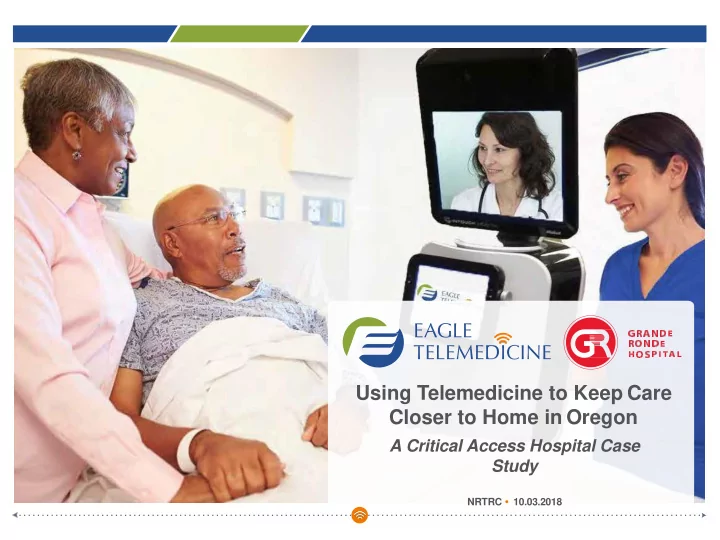
Using Telemedicine to Keep Care Closer to Home in Oregon

A Critical Access Hospital Case Study

NRTRC • 10.03.2018
slide-2
SLIDE 2

We will ensure access to high-quality, cost-effective healthcare in a safe and customer-friendly environment for all those in need of our services

2

Grande Ronde Hospital Mission

slide-3
SLIDE 3

3

Grande Ronde Hospital is a private, not-for-profit, critical access hospital (CAH).

Grande Ronde Hospital At a Glance

Employees 762 Service Lines 20 Employed Providers 76 Ambulatory Clinics 14 Telemedicine Providers 95 RHC/Medical Homes 5 Gross Revenue $162M Service Area Population 51K Ambulatory/Outpatient Revenue $130M = 80% Service Area Square Miles 10,596

Organization Facts & Figures

slide-4
SLIDE 4

4

Remote Presence Health System

Consulting Services

Adult Hospitalist Services

Eagle Hospitalist Physicians

Adult Intensivists

Advanced ICU Care

Congestive Heart Failure Teaching

Idaho Heart Care

Neonatology

  • St. Alphonsus

PICU

OHSU

Rheumatology

  • St. Alphonsus, Baker City,

OR

Telestroke

  • St. Alphonsus

Other Services

Cardiology Grand Rounds

  • St. Alphonsus

Distance Education

  • St. Alphonsus

Emergency Department Grand Rounds

Idaho Emergency Physicians

Televisit & NICU Telebaby

  • St. Alphonsus

Foreign Language Interpretation

Passport to Languages

Televisit

Legacy Health System, Portland, OR

Televisit

Providence Telemedicine Network, Portland, OR

Televisit

Salem Hospital, Salem, OR

Outpatient Services/Clinics

Cardiology Outreach Clinic

Idaho Heart Care

Medical Oncology

  • Dr. M Bronstein, LA

Grande, OR; SAMG; St. Alphonsus

Teleradiology

Statrad

Genetic Counseling

  • St. Alphonsus

Outpatient Neurology

OHSU

Parkinson’s Movement Disorders Clinic

Oregon Health & Science University (OHSU)

Telepharmacy

  • St. Alphonsus

Outpatient Endocrinology

Walla Walla, WA Clinic

Left Ventricular Assist Device Clinic

OHSU

Cardiology Acute Myocardial Infarction Support Emergency Specialist Program

Idaho Emergency Physicians

slide-5
SLIDE 5

5

ICU Tele-intensivist Experience

10 Years: CY2008-CY2018

  • 138 ICU Patient Transfers Were Avoided
  • $4,934,041 Estimated Transfer Cost Savings
  • 138 ICU Patients Admitted Instead of Transferred
  • 1,030 Additional ICU & MedSurg Days
  • Significant Impact on Medicare Cost to Charge Ratio
  • 64.6% Medicare ~
slide-6
SLIDE 6

6

Tele-oncology

  • The circumference of the earth at the equator is:

24,901 miles

  • Every 18 months our Tele-oncology program

saves patients one trip around the earth.

25,434 miles

In just the first nine days of April:

19 patients received chemotherapy 5,384 travel miles saved, 87 hours of travel time saved, and $3,042 in travel expenses saved!

slide-7
SLIDE 7

7

Virtual Visits

GRH ReadyCare

Insurers Covering Virtual Visits

  • United HealthCare
  • Providence
  • Aetna
slide-8
SLIDE 8

8

Remote Home Monitoring

  • Patients with CHF and diabetes chronic conditions
  • They connect daily via remote monitoring
  • Remote services are delivered via tablet device
  • Vitals are collected and stored in the cloud ~

 CHF/Coronary Artery Disease/Atrial Fibrillation  Ortho (Hip/Knee)  COPD  Diabetes  Asthma  Hypertension  Post-Transplant/Surgical  Home Dialysis  Hyperlipidemia  Pneumonia  Depression and Behavioral Health  Comorbidities  Adults/Pediatrics

Potential Monitored Conditions

slide-9
SLIDE 9

Our Future Plans for Telehealth

9

Expand in-home monitoring program beyond congestive heart failure and diabetes Expand teleneurology for deep brain stimulation monitoring and device adjustment Develop

  • utbound

ambulatory services: clinics, workplace, home Work with AHA to resolve Medicare reimbursement issues

slide-10
SLIDE 10

10

Tele-hospitalist Program

Services

  • Night coverage
  • Cross-cover call
  • Onsite coverage relief

Physician Locations

 Tega Cay, South Carolina  Lawrence, Kansas  Warner Robbins, Georgia  Bet Shemesh, Israel  Paris, France

385 Night Calls in August 2017

slide-11
SLIDE 11

PHYSICIAN'S PERSPECTIVE

“Telemedicine is most effective when applied where physician resources are scarce and patient care is time sensitive. And it is providing hope to rural hospitals in an era when closure is a very real possibility unless new models of care are deployed.”

  • Dr. McCormick
slide-12
SLIDE 12
  • How to evaluate their critical-access facilities

to determine the types of telemedicine programs that are truly needed

  • Steps for implementing telenocturnist care

using remote physicians and on-site night- charge nurses

  • How to develop tele-cross coverage between

nighttime rounding and ED admissions during surges

  • Best practices for establishing collaborative

care between remote physicians and NP/PAs OVERVIE W

Using Telemedicine to Keep Care Closer to Home

slide-13
SLIDE 13

Telenocturnists eliminate toxicity innight coverage, a problem most critical access hospitals face.

  • The traditional approach to night coverage is using day hospitalists to

take night calls. However, this often leads to burnout, physician attrition, and makes nurses hesitant to call.

  • The other alternative is hiring a full-time nocturnist. Recruiting and

retaining a nocturnist is difficult, not to mention expensive. With salary and benefits, a full-time nocturnist can cost in excess of $600,000.

THE SOLUTION

TELENOCTURNIST PROGRAMS FOR CAHs

THE CHALLENGE

Three Models for Success:

  • Telenocturnists: Patients receive real-time diagnoses and treatment at

night from expert telenocturnists who are “beamed in” to the hospitalvia videoconferencing technology

  • Tele-Cross Coverage: Take the burden of floor calls off yournocturnist

team with face-to-face consults via videoconferencing technology.

  • NP/PA Backup: Telenocturnists participate in rounds via livevideo-

conferencing, and are available 24/7 as a part of your clinical team.

slide-14
SLIDE 14

IMPLEMENTATION

Implementing a TelenocturnistProgram

  • Test (and retest) technology
  • Orientation sessions for staff
  • Mock run
  • Hands on deck for Go-Live
  • Regular communication
  • Weekly communication leading up to Go-Live
  • Continuous dialogue during Go-Live
  • Weekly communication through the first month
  • Tweak processes
slide-15
SLIDE 15

SURGE PROTECTION

How to develop tele-cross coverage between night ime rounding and ED admissions during surges N I G H T S

Reduce Burnout, Increase Performance: In the nighttime care domain, telemedicine provides balance, easing the load for existing staff and ensuring that your standard of quality extends around the clock. It’s a seamless solution to the physician shortage that Eagle Telemedicine innovated, and one that is reducing toxicity of night coverage for ourhospital partners today. Surge Protection: Hospitalist overload and ED bottlenecks can happen at any time, but with Eagle, your hospital can access expert telehospitalists whenever you need assistance with patient admits.

slide-16
SLIDE 16
slide-17
SLIDE 17

Thank you for your interest!

  • Dr. "Mac" McCormick

President & , Eagle Telemedicine

678.441.8507 DIRECT 404.281.1603 MOBILE

www.eagletelemedicine.com

Doug Romer

Executive Director Patient Care Services, Grande Ronde Hospital

541.963.1460 DIRECT