Using the Moon to Determine the Magnitude of the Inner Solar System - - PowerPoint PPT Presentation

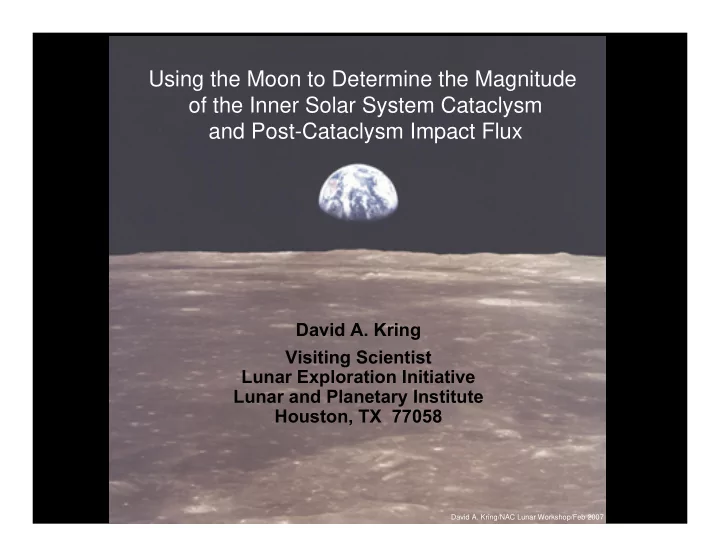
using the moon to determine the magnitude of the inner
SMART_READER_LITE
LIVE PREVIEW

Using the Moon to Determine the Magnitude of the Inner Solar System - - PowerPoint PPT Presentation

Using the Moon to Determine the Magnitude of the Inner Solar System Cataclysm and Post-Cataclysm Impact Flux David A. Kring Visiting Scientist Lunar Exploration Initiative Lunar and Planetary Institute Houston, TX 77058 David A. Kring/NAC


slide-1
SLIDE 1

Using the Moon to Determine the Magnitude

  • f the Inner Solar System Cataclysm

and Post-Cataclysm Impact Flux

David A. Kring Visiting Scientist Lunar Exploration Initiative Lunar and Planetary Institute Houston, TX 77058

David A. Kring/NAC Lunar Workshop/Feb 2007

slide-2
SLIDE 2

Using the Moon to Determine the Magnitude

  • f the Inner Solar System Cataclysm

and Post-Cataclysm Impact Flux

Why is this important?

David A. Kring/NAC Lunar Workshop/Feb 2007

slide-3
SLIDE 3

Using the Moon to Determine the Magnitude

  • f the Inner Solar System Cataclysm

and Post-Cataclysm Impact Flux

Why is this important?

  • These events resurfaced the Moon, generating the

landscape that we will be exploring

David A. Kring/NAC Lunar Workshop/Feb 2007

slide-4
SLIDE 4

Using the Moon to Determine the Magnitude

  • f the Inner Solar System Cataclysm

and Post-Cataclysm Impact Flux

Why is this important?

  • These events resurfaced the Moon, generating the

landscape that we will be exploring

  • Similar events resurfaced the Earth during a critical

time when life was first evolving

David A. Kring/NAC Lunar Workshop/Feb 2007

slide-5
SLIDE 5

Using the Moon to Determine the Magnitude

  • f the Inner Solar System Cataclysm

and Post-Cataclysm Impact Flux

Why is this important?

  • These events resurfaced the Moon, generating the

landscape that we will be exploring

  • Similar events resurfaced the Earth during a critical

time when life was first evolving

  • The processes affected all inner solar system

planets and will affect the lunar-calibrated crater ages assigned to their surfaces

David A. Kring/NAC Lunar Workshop/Feb 2007

slide-6
SLIDE 6

Using the Moon to Determine the Magnitude

  • f the Inner Solar System Cataclysm

and Post-Cataclysm Impact Flux

Why is this important?

  • These events resurfaced the Moon, generating the

landscape that we will be exploring

  • Similar events resurfaced the Earth during a critical

time when life was first evolving

  • The processes affected all inner solar system

planets and will affect the lunar-calibrated crater ages assigned to their surfaces

  • A study of these processes on the Moon will have

a dramatic affect on our understanding of how the

  • uter solar system formed

David A. Kring/NAC Lunar Workshop/Feb 2007

slide-7
SLIDE 7

Science Priorities for the Lunar Exploration Initiative

The Apollo Legacy –

The radiometric ages of rocks from the lunar highlands indicated the lunar crust had been thermally metamorphosed ~3.9 – 4.0 Ga. A large number of impact melts were also generated at the same time. This effect was seen in the Ar-Ar system (Turner et al., 1973) and the U-Pb system (Tera et al., 1974). It was also preserved in the more easily reset Rb-Sr system. (Data summary, left, from Bogard, 1995.) A severe period of bombardment was inferred:

The lunar cataclysm hypothesis.

David A. Kring/NAC Lunar Workshop/Feb 2007

slide-8
SLIDE 8

David A. Kring/NAC Lunar Workshop/Feb 2007

slide-9
SLIDE 9

Impact-generated Hydrothermal Systems provided: Crucibles for Pre-biotic Chemistry Habitat for Early Evolution of Life Long Lifetimes Active for 10,000 to several million years Impact-Origin of Life Hypothesis

Science Priorities for the Lunar Exploration Initiative

How often were these systems produced on early Earth? Preliminary Apollo-era data suggest 20,000 to 40,000 times

David A. Kring/NAC Lunar Workshop/Feb 2007

slide-10
SLIDE 10

Ar-Ar analyses of impact melts in lunar meteorites are consistent with a cataclysmic bombardment ~3.9 – 4.0 Ga e.g., Cohen, Swindle, & Kring (2000, 2005)

David A. Kring/NAC Lunar Workshop/Feb 2007

slide-11
SLIDE 11

Ar-Ar analyses of impact melts from asteroids suggest the cataclysmic bombardment affected the entire inner Solar System e.g., Bogard (1995), Kring & Cohen (2002) Ar-Ar analyses of impact melts in lunar meteorites are consistent with a cataclysmic bombardment ~3.9 – 4.0 Ga e.g., Cohen, Swindle, & Kring (2000, 2005)

David A. Kring/NAC Lunar Workshop/Feb 2007

slide-12
SLIDE 12

Siderophile elements in Apollo impact melts suggest the impacting objects came from the Asteroid Belt e.g., Kring & Cohen (2002), Norman et al. (2006) Ar-Ar analyses of impact melts in lunar meteorites are consistent with a cataclysmic bombardment ~3.9 – 4.0 Ga e.g., Cohen, Swindle, & Kring (2000, 2005) Ar-Ar analyses of impact melts from asteroids suggest the cataclysmic bombardment affected the entire inner Solar System e.g., Bogard (1995), Kring & Cohen (2002)

David A. Kring/NAC Lunar Workshop/Feb 2007
slide-13
SLIDE 13

Ar-Ar analyses of impact melts in lunar meteorites are consistent with a cataclysmic bombardment ~3.9 – 4.0 Ga e.g., Cohen, Swindle, & Kring (2000, 2005) Siderophile elements in Apollo impact melts suggest the impacting objects came from the Asteroid Belt e.g., Kring & Cohen (2002), Norman et al. (2006) The size distribution of craters on the Moon also suggests the impacting objects came from the Asteroid Belt e.g., Strom et al. (2005) Ar-Ar analyses of impact melts from asteroids suggest the cataclysmic bombardment affected the entire inner Solar System e.g., Bogard (1995), Kring & Cohen (2002)

David A. Kring/NAC Lunar Workshop/Feb 2007

slide-14
SLIDE 14

We need more lunar samples to determine the magnitude and duration of the bombardment. Yet, we are still operating in a data poor environment…….

David A. Kring/NAC Lunar Workshop/Feb 2007

slide-15
SLIDE 15

How was the composition of the atmosphere altered? How did impacts affect the origin of life & microbial evolution? How did impacts affect complex life (e.g., at K/T boundary)? What are the future impact hazards? What types of biogenic elements were delivered?

David A. Kring/NAC Lunar Workshop/Feb 2007

slide-16
SLIDE 16

Nectarian and Early Imbrian Impact Basins

Impact Basin Diameter (km) Age (Ga) Orientale 930 3.82 – 3.85 ? Schrodinger 320 Imbrium 1,200 3.85 ± 0.01 Bailly 300 Sikorsky-Rittenhouse 310 Hertzprung 570 3.89 ± 0.009 Serenitatis 740 3.895 ± 0.017 Crisium 1,060 3.89 ? Humorum 820 Humboldtianum 700 Medeleev 330 Korolev 440 Moscovienese 445 Mendel-Rydberg 630 Nectaris 860 3.89 – 3.91 ?

For comparison, Chicxulub’s diameter is ~180 km >1700 craters and basins 20 to >1000 km in diameter were produced

Nectarian Basins Early Imbriam Basins

David A. Kring/NAC Lunar Workshop/Feb 2007

implying ~70 to 90 million year bombardment

slide-17
SLIDE 17

Pre-Nectarian Basins

Impact Basin Diameter (km) Age (Ga)

Apollo 505 Grimaldi 430 Freundlick-Sharonov 600 Birkhoff 330 Planck 325 Schiller-Zucchius 325 Amundsen-Ganswindt 355 Lorentz 360 Smythii 840 Coulomb-Sarton 530 Keeler-Heaviside 780 Poincare 340 Ingenii 560 Lomonosov-Fleming 620 Nubium 690 Mutus-Vlacq 690 Tranquillitatis 800 Australe 880 Fecunditatis 990 Al-Khwarizmi/King 590 Pingre-Hausen 300 Werner-Airy 500 Balmer-Kapteyn 550 Flamsteed-Billy 570 Marginis 580 Insularum 600 Grissom-White 600 Tsiolkovskiy-Stark 700 South Pole-Aitken 2500 Procellarum 3200

?

David A. Kring/NAC Lunar Workshop/Feb 2007

slide-18
SLIDE 18

Pre-Nectarian Basins

Impact Basin Diameter (km) Age (Ga)

Apollo 505 Grimaldi 430 Freundlick-Sharonov 600 Birkhoff 330 Planck 325 Schiller-Zucchius 325 Amundsen-Ganswindt 355 Lorentz 360 Smythii 840 Coulomb-Sarton 530 Keeler-Heaviside 780 Poincare 340 Ingenii 560 Lomonosov-Fleming 620 Nubium 690 Mutus-Vlacq 690 Tranquillitatis 800 Australe 880 Fecunditatis 990 Al-Khwarizmi/King 590 Pingre-Hausen 300 Werner-Airy 500 Balmer-Kapteyn 550 Flamsteed-Billy 570 Marginis 580 Insularum 600 Grissom-White 600 Tsiolkovskiy-Stark 700 South Pole-Aitken 2500 Procellarum 3200

Highest Priority

David A. Kring/NAC Lunar Workshop/Feb 2007

slide-19
SLIDE 19

Pre-Nectarian Basins

Impact Basin Diameter (km) Age (Ga)

Apollo 505 Grimaldi 430 Freundlick-Sharonov 600 Birkhoff 330 Planck 325 Schiller-Zucchius 325 Amundsen-Ganswindt 355 Lorentz 360 Smythii 840 Coulomb-Sarton 530 Keeler-Heaviside 780 Poincare 340 Ingenii 560 Lomonosov-Fleming 620 Nubium 690 Mutus-Vlacq 690 Tranquillitatis 800 Australe 880 Fecunditatis 990 Al-Khwarizmi/King 590 Pingre-Hausen 300 Werner-Airy 500 Balmer-Kapteyn 550 Flamsteed-Billy 570 Marginis 580 Insularum 600 Grissom-White 600 Tsiolkovskiy-Stark 700 South Pole-Aitken 2500 Procellarum 3200

?

1 2 3

David A. Kring/NAC Lunar Workshop/Feb 2007

slide-20
SLIDE 20

Representative Eratosthenian Craters

Impact Crater Diameter (km) Age (Ga)

Lambert 30 Reiner 30 Archytas 32 Timocharis 34 Stearns 37 Manilius 39 Herschel 41 Rothmann 42 Plinius 43 Reinhold 43 Agrippa 44 Hainzel A 53 Maunder 55 Eratosthenes 58 Bullialdus 61 Hercules 69 Werner 70 Fabricius 78 Aristoteles 87 Theophilus 100 (rayed) Pythagoras 130 Langrenus 132 (rayed) Hausen 167 (largest young crater)

?

David A. Kring/NAC Lunar Workshop/Feb 2007

slide-21
SLIDE 21

How do we determine the impact flux? We collect impact melt breccias.

slide-22
SLIDE 22

Kring/Space Sciences 2006 Lunar Exploration Initiative

Impact Melt Breccias

Terrestrial Analogues + Apollo Examples

David A. Kring/NAC Lunar Workshop/Feb 2007

slide-23
SLIDE 23

Kring/Space Sciences 2006 Lunar Exploration Initiative

Copernicus Crater

Lunar Observer II

David A. Kring/NAC Lunar Workshop/Feb 2007

slide-24
SLIDE 24

Kring/Space Sciences 2006 Lunar Exploration Initiative

Sampling Lunar Impact Melt

  • Impact melts can be collected within lunar craters
  • Alternatively, they can be collected from debris

ejected from crater (next slides)

Lunar Observer V

David A. Kring/NAC Lunar Workshop/Feb 2007

slide-25
SLIDE 25

Kring/Space Sciences 2006 Lunar Exploration Initiative

Copernicus Crater

Complex Crater Diffuse Central Peak ~95 km diameter

David A. Kring/NAC Lunar Workshop/Feb 2007

slide-26
SLIDE 26

How do we collect these samples within the exploration initiative?

slide-27
SLIDE 27

Kring/Space Sciences Lunar Exploration Initiative

General Dynamics Foster-Miller Capability to land anywhere on the lunar surface

  • Lunar Reconnaissance Lander Series

Science & Exploration Strategy

slide-28
SLIDE 28

Thank you.

slide-29
SLIDE 29

Representative Copernican Craters

Impact Crater Diameter (km) Age (Ga) Kepler 32 Petavius B 33 Godin 35 Autolycus 39 (ray at A15 site?) 1.29 Aristarchus 40 Olbers A 43 Crookes 49 Anaxagoras 51 Aristillus 55 (ray at A15 site?) 1.29 Taruntius 56 Eudoxus 67 King 77 Copernicus 93 (ray at A12 site) 0.8-0.9 Tycho 85 (landslide at A17 site?) 0.1

The age of only a single large impact event, Tycho, is known during the Phanerozoic of Earth, which is the period of complex life on our planet. One cannot determine an impact rate with only a single data point. Were there pulses of activity at, say, 800 and 500 Ma?

David A. Kring/NAC Lunar Workshop/Feb 2007