Using the Tree Of Life Approach With A Couple Going Through Cancer - PowerPoint PPT Presentation
Using the Tree Of Life Approach With A Couple Going Through Cancer Karin Jansen Agenda Background Tree of life summary Helping process and cancer experience map Case discussion Reflection Background SA Education and
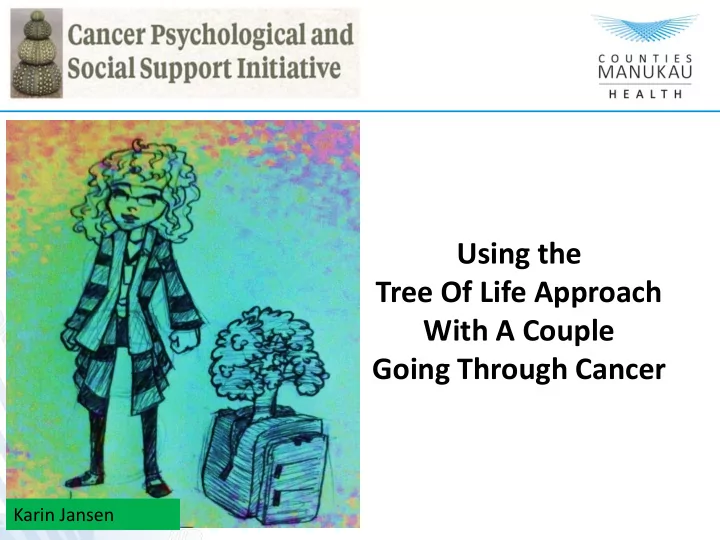
Using the Tree Of Life Approach With A Couple Going Through Cancer Karin Jansen
Agenda • Background • Tree of life summary • Helping process and cancer experience map • Case discussion • Reflection
Background • SA Education and experience • NZ experience • SW practice approach • History: Narrative therapy • Motivation: Tree of Life in NZ and in context of cancer
Te Whare Tapa Wha Mason Durie
Tree of Life development and metaphor • Development of approach • Metaphor • Roots: Where come from, family history, favourite place • Ground: Present life, daily activities • Trunk: skills, talents, abilities, strengths • Branches: Hopes, dreams, wishes • Leaves: Important people (alive, passed on) • Fruits: Gifts received • Storms and animals • Letter
Cancer Experience Map
Helping Process • Distress • Referral • Psycho social assessment • Discuss Summary (Te whare tapa wha) • Goal setting/work method • Implementation • Evaluation
Te Whare Tapa Wha Summary Te taha Wairua Te taha Whanau Strengths: Faith, Hopes and dreams for future, Humour, Strengths: Supportive spouse, active engagement to Realistic. pursue financial support for unfunded treatment. Support from extended family, Cancer Society and Heart Needs: Connect with community of faith Spouse find Foundation. No social safety concerns. “dark humour” challenging Communication about life/death challenging Needs: Spouse distress impact on patient distress. Patient and son attachment Social integration limited due to Action: How to connect with community of faith, How immunity challenges to have challenging conversations, Advanced Care Planning Action: Counselling; Family Start / attachment options to bond more with his son; Hospice involvement Te taha Tinana Te taha Hinengaro Strengths: Good self-management of health, physically Strengths: Positive mindset and attitude, motivated, independent. Home environment suitable, WINZ, CSC. patient open in communication Selfcare - Play Station/mindfulness exercises. Skilled Needs: Patient distress affected by spouse's ability to animation artist. Safety – medical alarm cope. Realist of diagnosis and communication Needs: Palliative diagnosis, low energy, fatigue, challenging sleeplessness, heart arrhythmias Action: Suggest Tree of Life approach to assist with Action: Art as coping mechanism with Tree of Life connection and communication
To my my bel elov oved ed wife e S There e is so s so much to tell l you about out us an s and d our trees s of life. . How w I se see your r tree is s like e a my mythological hological creature ure called led a nymph, h, nymphs phs are known own to live e in trees s and d protect tect them as th s the tree itself self also so protects tects and d provides vides a h home me in return. rn. So going ing back k to my tree. . A t tree that t twist st and d turns ns that t has s been n broken oken and d sc scared, d, with h a mighty ty trunk nk and d st strong ong roots ots it st stands ds lost st in the center er of a field d that t has s bee een n ra ravaged aged and d tortured rtured by battles tles, , lea eaving ving only y the e tools ols of war r behi ehind. nd. And d here e is s were we st stand d a t tree that t has s experienced ienced so some e of the worst st in life e being ng nour urished ished, , protec tecte ted d and d loved ved by you a beautiful tiful nymph ph that t grows ws her tree with h our love ve. Where re we are now nurtur turing ing our own n offspring fspring, , building lding a f future ure toge gether ther and d replenishing enishing the land d around und us to s to give e only y the best. st. It truly y amazes es me that t so someone one with h a t tree like ke mine has s so someone eone who can st still ll se see past st all that's t's wrong ng. Forever ver hoping ping to be the home e to your r heart t and d our love ve M
Evaluation • Every session: Self- assessment, SRS, ORS • Exit: RBA principles: - What changed • Recommendations: - Systemic involvement - Utilization in context of NZ culture and Cancer
Reflection on outcome About the couple About cancer • Discovery of each other • Using the tool removes again cancer as the centre of everything • Opportunity to identify and express emotions • Other truths amplified and changed perspectives • Unfinished business – catharsis • Difficult conversations such as impact of cancer on • Connection with each other couple and the individual narrative, new narrative explored • Motivation, energy and impact on mood
Reflection on outcome About the approach About social work in health • Non-threatening way to • Justification of time address traumatic aspects with out re-traumatizing • Perceptions of social work in physical health: • More sessions with themes: counselling vs practical therapeutic engagement support and discharge and powerful impact planning • Opportunity for patterns of • Distress: emotional and interaction to change social impact on patient – is • Active engagement impact one more important than on energy, mind-set and the other? emotions • Link: Spirituality and Te Whare Tapa Wha
Innovation • The face of social work is changing, and social work can continue to change by: • Social workers aligning with our professional identity as a profession that contribute to the social and emotional well- being of people, • Sharing the amazing work that we do, • Justifying social work with a solid foundation based on research, experience and the needs of our clients/patients.
Thank you • Acknowledgement to patient and spouse for giving their permission to share their story.
References • Best, E. 1977. The Forest Lore of the Maori. EC Keating: Wellington. • Denborough, D. 2008. Collective Narrative Practice. Dulwich Centre Publications: Adelaide. • Hall LK, Kunz BF, Davis EV, Dawson RI, Powers RS. The Cancer Experience Map: An Approach to Including the Patient Voice in Supportive Care Solutions . J Med Internet Res 2015;17(5):e132. DOI: 10.2196/jmir.3652 PMID: 26022846 PMCID: 4468569 • Kelley, P. 2009. Narrative Therapy. Social Worker’s Desk Reference. Oxford: New York. • Ministry of Health website. Maori Health Models. www.health.govt.nz/our-work/populations/maori • Ministry of Social Development website. Information about RBA and its use in New Zealand. (https://www.familyservices.govt.nz/about -funding/results-based-accountability/rba-basics- guidelines.html) • Ncube-Mlilo, N and Denborough, D. 2007. Tree of Life. Psychological Wellbeing Series. Repssi: Johannesburg. (www.pacificdisaster.net/pdnadmin/data/original/REPSSI_2007_Tree_life.pdf) • Winslade, J. Storying professional identity. The International Journal of Narrative Therapy and Community Work, 2002(4) • Yalom, I.D. 2001.The gift of therapy: Reflections on being a therapist. Piatkus, London.
Recommend
More recommend
Explore More Topics
Stay informed with curated content and fresh updates.