Using Uncertain Knowledge Agents dont have complete knowledge about - - PowerPoint PPT Presentation

using uncertain knowledge
SMART_READER_LITE
LIVE PREVIEW

Using Uncertain Knowledge Agents dont have complete knowledge about - - PowerPoint PPT Presentation

Using Uncertain Knowledge Agents dont have complete knowledge about the world. Agents need to make decisions based on their uncertainty. It isnt enough to assume what the world is like. Example: wearing a seat belt. An agent


slide-1
SLIDE 1

Using Uncertain Knowledge

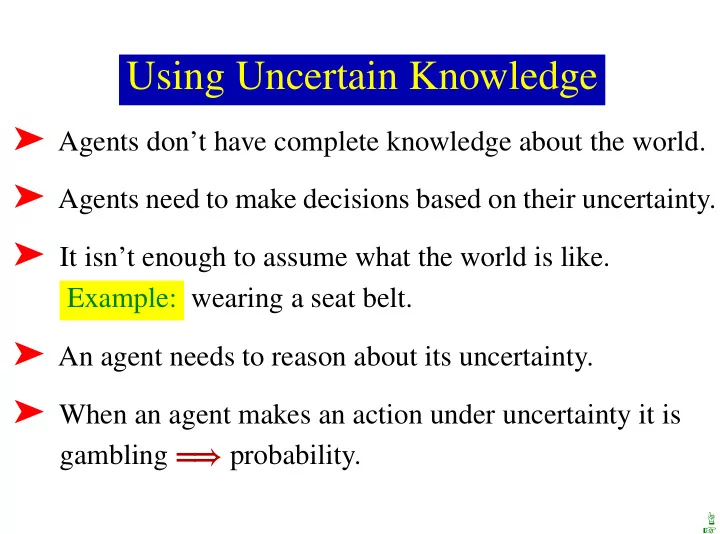
➤ Agents don’t have complete knowledge about the world. ➤ Agents need to make decisions based on their uncertainty. ➤ It isn’t enough to assume what the world is like.

Example: wearing a seat belt.

➤ An agent needs to reason about its uncertainty. ➤ When an agent makes an action under uncertainty it is

gambling ⇒ probability.

☞ ☞

slide-2
SLIDE 2

Probability

➤ Probability is an agent’s measure of belief in some

proposition — subjective probability.

➤ Example: Your probability of a bird flying is your

measure of belief in the flying ability of an individual based only on the knowledge that the individual is a bird.

➣ Other agents may have different probabilities, as they

may have had different experiences with birds or different knowledge about this particular bird.

➣ An agent’s belief in a bird’s flying ability is affected

by what the agent knows about that bird.

☞ ☞ ☞

slide-3
SLIDE 3

Numerical Measures of Belief

➤ Belief in proposition, f , can be measured in terms of a

number between 0 and 1 — this is the probability of f .

➣ The probability f is 0 means that f is believed to be

definitely false.

➣ The probability f is 1 means that f is believed to be

definitely true.

➤ Using 0 and 1 is purely a convention. ➤ f has a probability between 0 and 1, doesn’t mean f is

true to some degree, but means you are ignorant of its truth value. Probability is a measure of your ignorance.

☞ ☞ ☞

slide-4
SLIDE 4

Random Variables

➤ A random variable is a term in a language that can take

  • ne of a number of different values.

➤ The domain of a variable X, written dom(X), is the set

  • f values X can take.

➤ A tuple of random variables X1, . . . , Xn is a complex

random variable with domain dom(X1) × · · · × dom(Xn). Often the tuple is written as X1, . . . , Xn.

➤ Assignment X = x means variable X has value x. ➤ A proposition is a Boolean formula made from

assignments of values to variables.

☞ ☞ ☞

slide-5
SLIDE 5

Possible World Semantics

➤ A possible world specifies an assignment of one value

to each random variable.

➤ w |

= X = x means variable X is assigned value x in world w.

➤ Logical connectives have their standard meaning:

w | = α ∧ β if w | = α and w | = β w | = α ∨ β if w | = α or w | = β w | = ¬α if w | = α

➤ Let be the set of all possible worlds.

☞ ☞ ☞

slide-6
SLIDE 6

Semantics of Probability: finite case

For a finite number of possible worlds:

➤ Define a nonnegative measure µ(w) to each set of worlds

w so that the measures of the possible worlds sum to 1. The measure specifies how much you think the world w is like the real world.

➤ The probability of proposition f is defined by:

P(f ) =

  • w|

=f

µ(ω).

☞ ☞ ☞

slide-7
SLIDE 7

Axioms of Probability: finite case

Four axioms define what follows from a set of probabilities: Axiom 1 P(f ) = P(g) if f ↔ g is a tautology. That is, logically equivalent formulae have the same probability. Axiom 2 0 ≤ P(f ) for any formula f . Axiom 3 P(τ) = 1 if τ is a tautology. Axiom 4 P(f ∨ g) = P(f ) + P(g) if ¬(f ∧ g) is a tautology. These axioms are sound and complete with respect to the semantics.

☞ ☞ ☞

slide-8
SLIDE 8

Semantics of Probability: general case

In the general case we have a measure on sets of possible worlds, satisfying:

➤ µ(S) ≥ 0 for all S ⊆ ➤ µ() = 1 ➤ µ(S1 ∪ S2) = µ(S1) + µ(S2) if S1 ∩ S2 = {}.

Or sometimes σ-additivity: µ(

  • i

Si) =

  • i

µ(Si) if Si ∩ Sj = {} Then P(α) = µ({w|w | = α}).

☞ ☞ ☞

slide-9
SLIDE 9

Probability Distributions

➤ A probability distribution on a random variable X is a

function dom(X) → [0, 1] such that x → P(X = x). This is written as P(X).

➤ This also includes the case where we have tuples of

  • variables. E.g., P(X, Y, Z) means P(X, Y, Z).

➤ When dom(X) is infinite sometimes we need a

probability density function...

☞ ☞ ☞

slide-10
SLIDE 10

Conditioning

➤ Probabilistic conditioning specifies how to revise beliefs

based on new information.

➤ You build a probabilistic model taking all background

information into account. This gives the prior probability.

➤ All other information must be conditioned on. ➤ If evidence e is the all of the information obtained

subsequently, the conditional probability P(h|e) of h given e is the posterior probability of h.

☞ ☞ ☞

slide-11
SLIDE 11

Semantics of Conditional Probability

Evidence e rules out possible worlds incompatible with e. Evidence e induces a new measure, µe, over possible worlds µe(ω) =   

1 P(e) × µ(ω)

if ω | = e if ω | = e The conditional probability of formula h given evidence e is P(h|e) =

  • ω|

=h

µe(w) = P(h ∧ e) P(e)

☞ ☞ ☞

slide-12
SLIDE 12

Properties of Conditional Probabilities

➤ Chain rule:

P(f1 ∧ f2 ∧ . . . ∧ fn) = P(f1) × P(f2|f1) × P(f3|f1 ∧ f2) × · · · × P(fn|f1 ∧ · · · ∧ fn−1) =

n

  • i=1

P(fi|f1 ∧ · · · ∧ fi−1)

☞ ☞ ☞

slide-13
SLIDE 13

Bayes’ theorem

The chain rule and commutativity of conjunction (h ∧ e is equivalent to e ∧ h) gives us: P(h ∧ e) = P(h|e) × P(e) = P(e|h) × P(h). If P(e) = 0, you can divide the right hand sides by P(e): P(h|e) = P(e|h) × P(h) P(e) . This is Bayes’ theorem.

☞ ☞

slide-14
SLIDE 14

Why is Bayes’ theorem interesting?

➤ Often you have causal knowledge:

P(symptom | disease) P(light is off | status of switches and switch positions) P(alarm | fire) P(image looks like | a tree is in front of a car)

➤ and want to do evidential reasoning:

P(disease | symptom) P(status of switches | light is off and switch positions) P(fire | alarm). P(a tree is in front of a car | image looks like )

☞ ☞