
Confounding: A Big Idea V1 August 1, 2016 www.StatLit.org/pdf/2016-Schield-ASA-Slides.pdf Page 1
2015 StatChat2V1 1
Milo Schield, Augsburg College
Member: International Statistical Institute US Rep: International Statistical Literacy Project Director, W. M. Keck Statistical Literacy Project
- VP. National Numeracy Network
Editor: www.StatLit.org
August 1, 2016
www.StatLit.org/pdf/2016-Schield-ASA-Slides.pdf
Confounding: A Big Idea
V1
2015 StatChat22
Core Concepts in Intro Stats McKenzie (2004): Survey of Educators Goodall@RSS (2007) Big Ideas in Statistics Garfield & Ben Zvi (2008): Big Ideas of Statistics Gould-Miller-Peck (2012). Five Big Ideas Blitzstein@Harvard (2013): 10 Big Ideas Stat110 Stigler (2016): Seven pillars of statistical wisdom
2 V1
2015 StatChat23
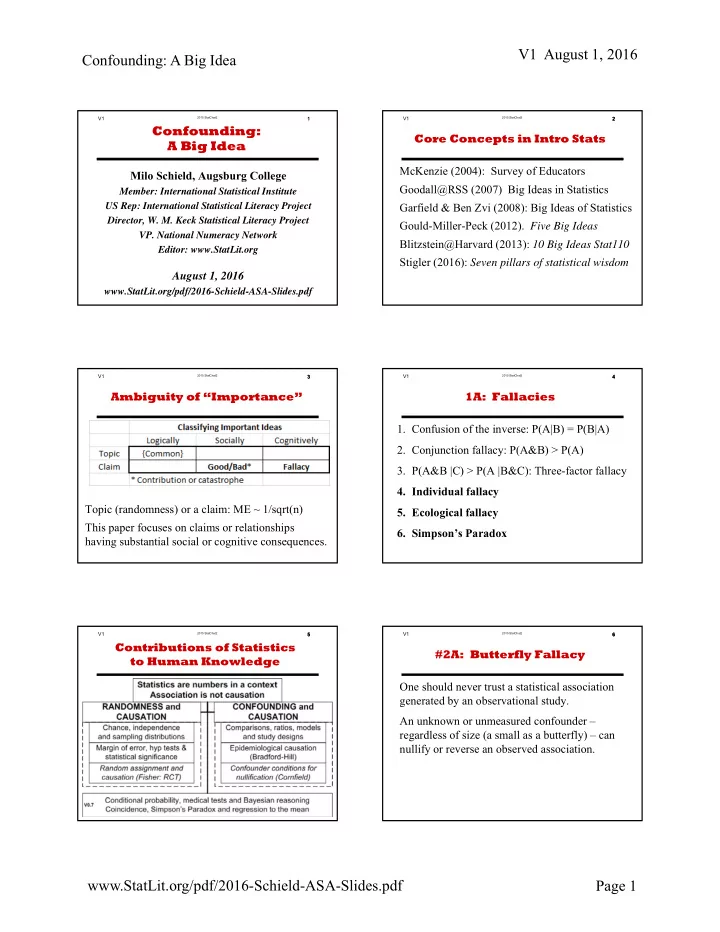
Ambiguity of “Importance” Topic (randomness) or a claim: ME ~ 1/sqrt(n) This paper focuses on claims or relationships having substantial social or cognitive consequences.
3 V1
2015 StatChat24
1A: Fallacies
- 1. Confusion of the inverse: P(A|B) = P(B|A)
- 2. Conjunction fallacy: P(A&B) > P(A)
- 3. P(A&B |C) > P(A |B&C): Three-factor fallacy
- 4. Individual fallacy
- 5. Ecological fallacy
- 6. Simpson’s Paradox
4 V1
2015 StatChat25
Contributions of Statistics to Human Knowledge .
5 V1
2015 StatChat26
#2A: Butterfly Fallacy One should never trust a statistical association generated by an observational study. An unknown or unmeasured confounder – regardless of size (a small as a butterfly) – can nullify or reverse an observed association.
6