Variational principle (Ch. 7) Only Sec. 7.1 Theorem: For an - PowerPoint PPT Presentation
EE201/MSE207 Lecture 16 Variational principle (Ch. 7) Only Sec. 7.1 Theorem: For an arbitrary | , the ground state energy satisfies inequality = Proof is simple. Let us expand =
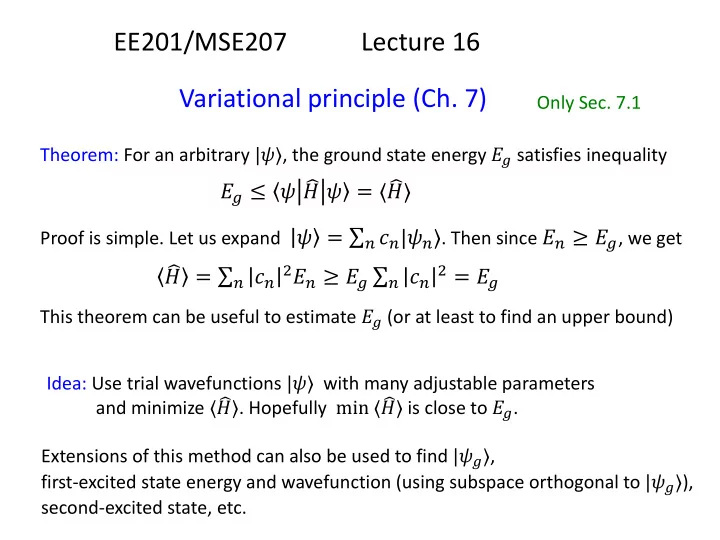
EE201/MSE207 Lecture 16 Variational principle (Ch. 7) Only Sec. 7.1 Theorem: For an arbitrary |πβͺ , the ground state energy πΉ π satisfies inequality πΉ π β€ π πΌ π = β© πΌβͺ Proof is simple. Let us expand π = π π π |π π βͺ . Then since πΉ π β₯ πΉ π , we get πΌ = π π π 2 πΉ π β₯ πΉ π π π π 2 = πΉ π This theorem can be useful to estimate πΉ π (or at least to find an upper bound) Idea: Use trial wavefunctions |πβͺ with many adjustable parameters and minimize β© πΌβͺ . Hopefully min β© πΌβͺ is close to πΉ π . Extensions of this method can also be used to find |π π βͺ , first-excited state energy and wavefunction (using subspace orthogonal to |π π βͺ ), second-excited state, etc.
EE201/MSE207 Lecture 16 Band structure (back to Ch. 5) Band structure for electrons is a consequence of a periodic potential in a lattice (due to periodic arrangement of atoms). For simplicity let us consider 1D case π π¦ + π = π(π¦) (periodic with lattice constant π ) Blochβs theorem: If π π¦ + π = π(π) , then for an eigenstate of energy π(π¦ + π) = π ππΏπ π π¦ (almost periodic, β quasimomentum β βπΏ ) Therefore π π¦ = π ππΏπ¦ π(π¦) , π π¦ + π = π(π¦) with periodic π(π¦) Proof Introduce displacement operator πΈ , so that πΈπ(π¦) = π(π¦ + π) . It commutes with Hamiltonian, πΈ, πΌ = 0 , therefore common eigenfunctions. π π¦ + π = π π π¦ If π β 1 , then π would increase or decrease exponentially Therefore π = 1 , can denote π = π ππΏπ .
Periodic boundary condition for Blochβs theorem π(π¦ + π) = π ππΏπ π π¦ β π π¦ + π = π π Usually people use periodic boundary condition in using Blochβs theorem π π¦ + ππ = π(π¦) for π β 1 atoms in a (1D) sample Why? Because it does not matter, but makes calculations simpler πΏ = 2ππ ππ , π = 0, Β±1, Β±2, β¦ Then This gives π different values of πΏ (the same π ππΏπ if Ξπ = π ): π states in a band for π atoms Since π is very large, πΏ is almost continuous.
Simple example: βDirac combβ π βatomsβ Dirac comb: π π π¦ = π½ π=1 π(π¦ β ππ) (wrapped around) β β 2 π 2 π π¦ + π π¦ π π¦ = πΉ π π¦ ππ¦ 2 2π 0 < π¦ < π β π π¦ = π΅ sin(ππ¦) + πΆ cos ππ¦ , π = 2ππΉ/β From Blochβs theorem we know that at βπ < π¦ < 0 , π π¦ = π βππΏπ [π΅ sin π(π¦ + π) + πΆ cos π(π¦ + π) ] πΆ = π βππΏπ [π΅ sin ππ + πΆ cos(ππ)] π 0 + 0 = π 0 β 0 β π β² 0 + 0 β π β² 0 β 0 = ( 2ππ½ β 2 ) π(0) β ππ΅ β π βππΏπ [ππ΅ cos ππ β ππΆ sin(ππ) ] = ( 2ππ½ β 2 ) πΆ From these two equations we find (eliminating π΅ and πΆ ) cos πΏπ = cos ππ + ππ½π sin(ππ) β 2 ππ
Dirac comb (cont.) π π π¦ = π½ π=1 π(π¦ β ππ) cos πΏπ = cos ππ + ππ½π sin(ππ) β 2 ππ π states πΏπ = 2ππ π gap π states gap gap gap gap 2 nd band 1 st band 3 rd band π states ππ½π = 10 β 2 π states ππ (β πΉ) π states per band ( Γ 2 spin) Gaps become smaller, eventually continuum
Bands Gaps become smaller, eventually continuum If one electron per atom ( π = 1 ), then half a band is filled (good conductor) If π = 2 , then one band is filled completely (insulator or semiconductor; cannot slightly excite electrons) If π = 3 , then 1.5 bands are filled (good conductor) If π = 4 , then again insulator or semiconductor Etc. Metals usually have π = 1 π states per band ( Γ 2 spin)
Bands (cont.) β πΉ cos πΏπ = . . . βπΏ is quasimomentum (behaves as momentum) βπ/π π/π 2π/π (Brillouin zone) Periodic: 2π/π πΉ = β 2 π 2 For a free particle 2π Define effective mass π eff via ΞπΉ = β 2 πΏ 2 ΞπΉ = β 2 (ΞπΏ) 2 or even 2π eff 2π eff ππΏ 2 = β 2 π 2 πΉ (similar to bands in semiconductors) or even π eff
Quasimomentum βπΏ behaves as momentum Let us add small force πΊ (e.g., due to electric field acting on electron, πΊ = βπβ° ). Then Ξπ = βπΊπ¦ and therefore πΉ β πΉ β πΊπ¦ (for the same πΏ ). From Blochβs theorem we know π π¦ = π ππΏπ¦ π πΏ (π¦) β π ππΏπ¦ on the large scale Adding time dependence, we get (on the large scale) Ξ¨ π¦, π’ β π ππΏπ¦ π βπ πΉβπΊπ¦ π’ = π π πΏ+ πΊπ’ β π¦ π βππΉπ’/β β πΏ β πΏ + πΊ π(βπΏ) β π’ β = πΊ It means ππ’ We see that βπΏ behaves as momentum (so named quasimomentum) (for validity of this approach we need very small πΊ ) Actually, significant oversimplification in this approach; this rather a hint. π’ β² β) ππ’ β² π’ πΉ(πΏ+πΊ πΊπ’ β)π¦ π β π β π π(πΏ+ π πΏ+πΊ π’ β (π¦) More rigorously, 0 is an approximate solution of SE (straightforward to check). Also, makes sense for energy change: πΊπ€ ππ = β ππΏ β ππΏ = ππΉ ππΉ ππ’ . ππ’
End of material included into the final exam Following lectures are important, but not needed for the exam
Recommend
More recommend
Explore More Topics
Stay informed with curated content and fresh updates.